How Does Fine Dust Affect the Skin Barrier and Collagen?
By Dr. Kim8 min read

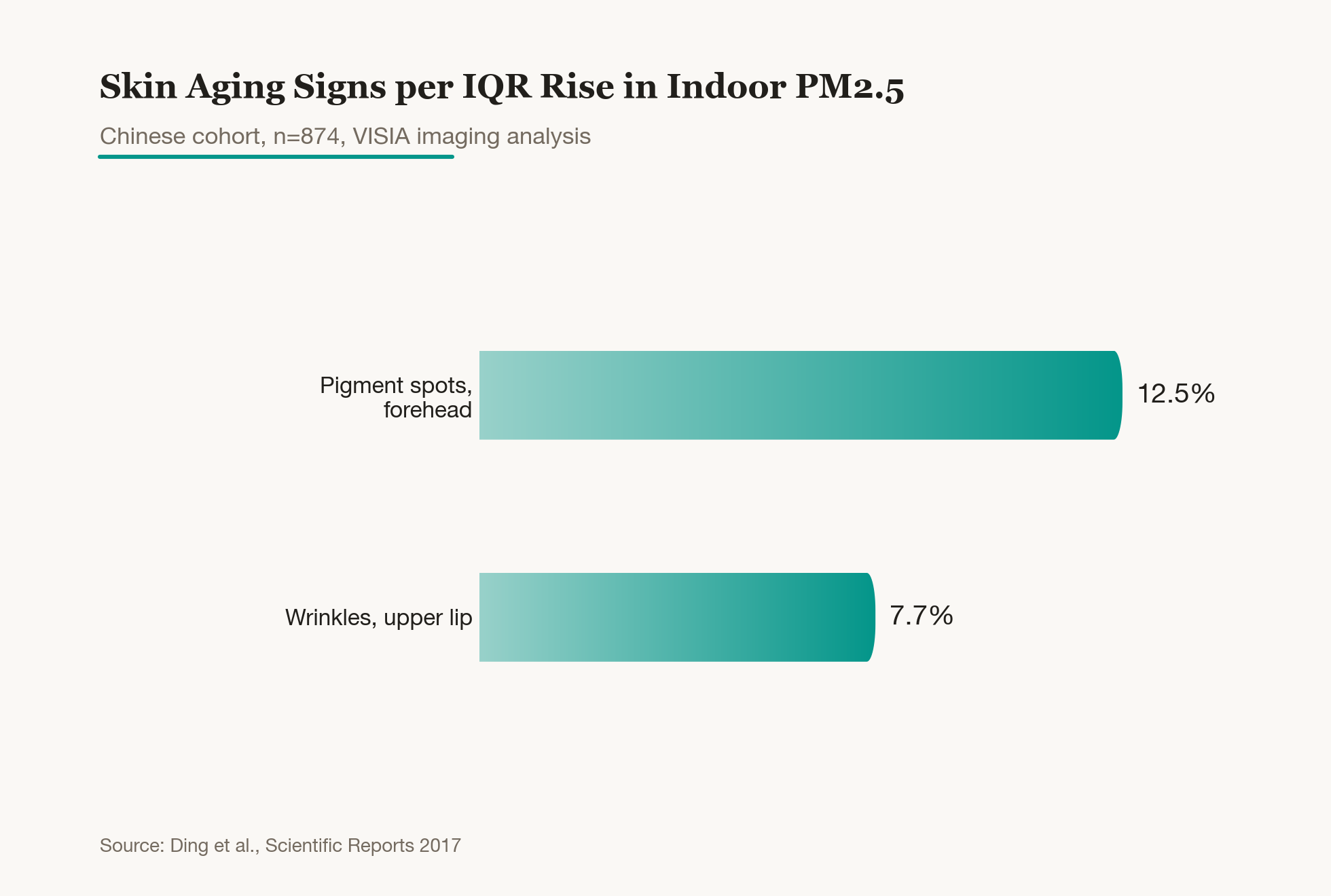
On heavy pollution days, a lot of people notice their makeup breaking up faster and their skin stinging for no clear reason. That is not just in your head. Fine dust particles are only a few dozenths the width of a human hair, so small that they do not just sit on the surface, they work their way into pores and the tiny gaps between skin cells. Once inside, they ramp up free radicals and trigger inflammation that reaches all the way to the skin barrier and collagen. Here is how fine dust actually gets in, why it sets off this chain reaction, and what actually helps.
What is in fine dust?
Fine dust is not one single substance, it is a cluster of many different pollutants stuck together. Soot particles, heavy metals, and sulfates from air pollution all clump into one particle, which means there is rarely just one irritating ingredient touching your skin at a time. It behaves less like ordinary dust and more like a tiny bundle of chemical stressors.
Skin is the body's largest organ in direct, continuous contact with outside air. Your lungs only meet the air when you breathe, but skin is exposed around the clock. Fine dust has not gotten the same attention as a skin issue that it has as a lung issue mainly because the damage builds slowly. A day or two of exposure barely shows, but with repeated exposure, the skin barrier and collagen wear down bit by bit.
Particle size matters a lot here. Larger particles get filtered out at the surface of the stratum corneum, but the ultrafine ones can squeeze through the narrow spaces between skin cells. Being small is essentially what gives them the ability to penetrate.
How does fine dust enter the skin?
Pores are not the only way in. Hair follicles, the small tube-shaped openings where hair grows, are a major entry point too. Because a follicle dips inward below the skin's surface like a narrow shaft, fine particles can use it as a shortcut straight to deeper layers, bypassing the stratum corneum altogether.
Once particles reach the area near keratinocytes, they get picked up by specific receptors on the cell surface. The aryl hydrocarbon receptor, or AhR, is the best known example, think of it as an antenna sitting on the cell that senses outside chemicals. Its normal job is to detect foreign substances entering the body and flip on a response, and components in fine dust happen to trigger that same antenna.
The real problem starts once that antenna switches on. The signal drives up free radicals inside the cell and releases inflammatory compounds at the same time. In other words, fine dust itself is not directly scraping at your skin, it is the cell's own defensive reaction to a perceived threat that ends up putting the skin under strain.
How fine dust reduces collagen
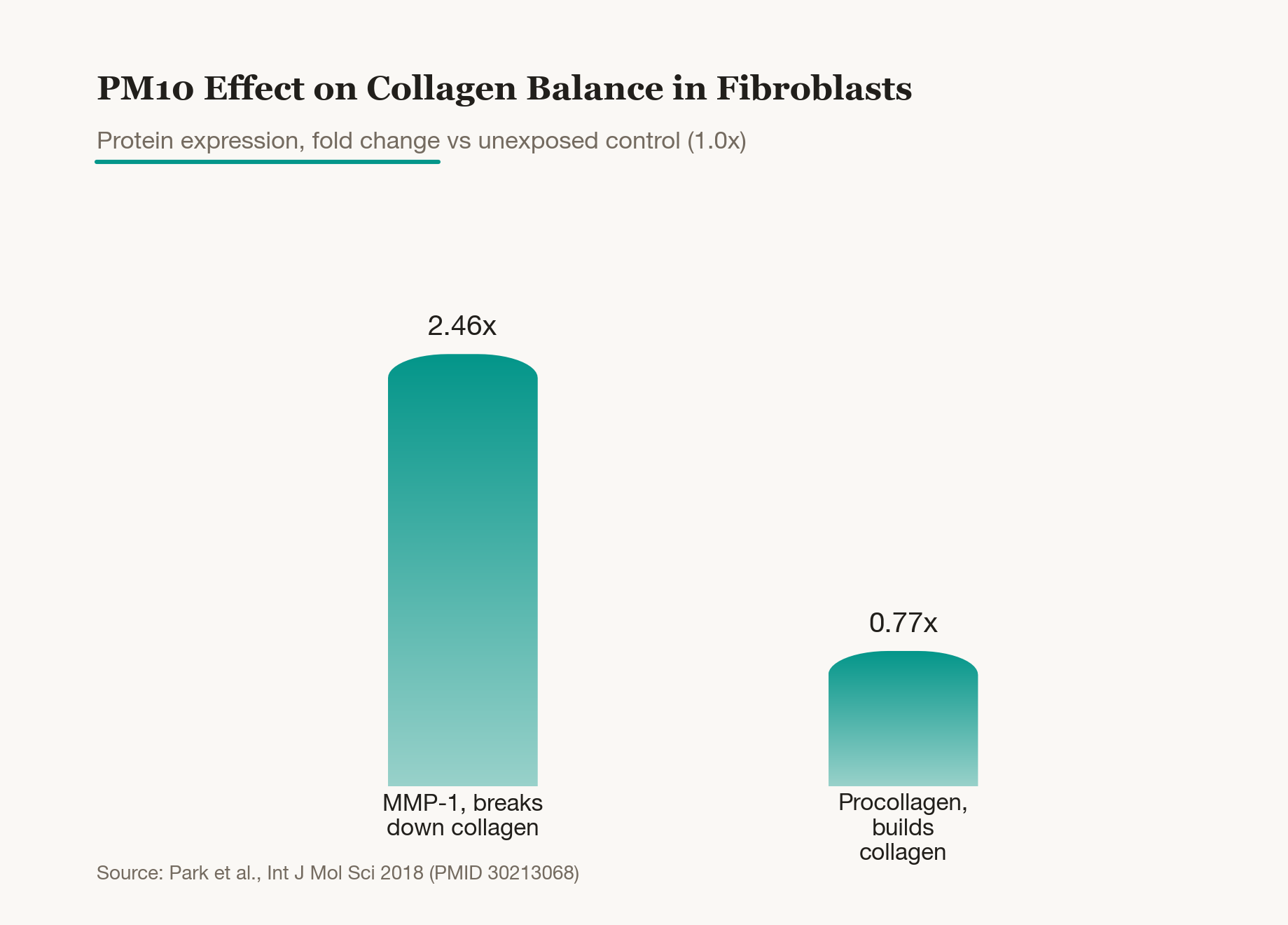
The antenna reaction described above does not stop there. Research on skin fibroblasts, the dermal cells that produce collagen, has shown that exposure to fine dust clearly raises expression of MMP (matrix metalloproteinase), the enzyme family that breaks down collagen, while expression of the collagen genes COL1A1 and COL1A2 drops at the same time.
So two things happen together, collagen production slows down while breakdown speeds up. It is similar to lightening one side of a scale while adding weight to the other. The net result tips toward less total collagen.
Free radicals are the key player throughout this process. Think of a free radical as something that causes a kind of rust-like damage inside cells, and the surge of free radicals from fine dust exposure interferes with fibroblasts' normal ability to synthesize collagen. That is why fine dust is often mentioned alongside UV as a driver of premature skin aging, though the pace differs from person to person depending on how much and how long they are exposed.
What changes when the skin barrier thins?
The skin barrier is often compared to a brick wall. Keratinocytes are the bricks, and lipids like ceramide act as the mortar filling the gaps between them. That structure needs to stay tight to hold moisture in and keep outside irritants out.
Studies have observed that key barrier proteins drop in skin exposed to fine dust. With less mortar holding things together, the gaps between the bricks widen. Through those gaps, moisture escapes more easily and outside irritants get in more easily too.
That is why frequent exposure to fine dust can leave skin feeling tight, looking flushed, and stinging for no obvious reason more often than usual. With a thinner barrier, skin reacts more strongly to triggers that would normally cause no problem at all. New keratinocytes typically take a few weeks to form and settle into place, so rebuilding a tighter barrier takes that much time plus consistent care.
Can fine dust cause acne and redness?
Fine dust also acts as a physical clog. When it mixes with sebum and dead skin cells and narrows the opening of a pore, that creates an environment where acne-causing bacteria thrive. As waste builds up inside that narrowed passage, the conditions for inflammatory acne fall right into place.
At the same time, the free radical response described earlier also increases release of inflammatory signaling molecules within the skin. Some research points to fine dust activating the inflammasome, a cellular structure that works like an alarm system amplifying inflammation. Once that alarm goes off, nearby inflammatory responses tend to cascade and grow.
For that reason, breakouts and blemishes tend to increase during heavy pollution periods, and people who already run redder or deal with rosacea tend to notice symptoms standing out more. When a thinner barrier meets an active inflammatory response, blood vessels dilate more easily and redness becomes more visible.
How often should you double cleanse?
Much of what makes up fine dust is oil soluble, meaning it mixes readily with fat rather than water. Rinsing with water alone often is not enough to fully remove these oil soluble pollutants, and they can linger in the gaps of the stratum corneum. That is why double cleansing, starting with an oil cleanser or cleansing balm, is so often recommended. It works on the principle that oil dissolves oil, pulling pollutants into the oil layer and washing them away together.
That said, cleansing too often or too aggressively creates a different problem. Scrubbing with a strong cleanser several times a day can strip away the same ceramide mortar that holds the barrier together. You need a balance that clears pollutants while keeping the barrier intact.
In practice, one round of double cleansing after coming home is usually enough, and following it right away with a moisturizer to replenish the barrier is just as important. Cleansing and replenishing work as a pair, and the benefit really only shows up when both steps happen together.
Skin care habits for high fine dust days
Protecting skin from fine dust works better as a set of overlapping habits rather than relying on any single product, since each habit addresses a different part of the problem.
- Double cleanse after coming home: This is the first step for removing oil soluble pollutants through the mechanism described above. The longer you put it off, the longer those particles sit in the stratum corneum.
- Add antioxidants: Ingredients like vitamin C and niacinamide are known to help neutralize the free radicals that fine dust generates. This approach targets the actual source of the damage.
- Use a ceramide moisturizer: This replenishes the mortar of the barrier from the outside. Think of it as a buffer while the barrier works on repairing itself.
- Wear sunscreen: Fine dust and UV both raise free radicals through separate pathways, so combined exposure can compound the damage. Reducing both stressors at once is the more efficient move.
- Ease up on exfoliation: Adding physical friction to an already thinned barrier can slow recovery rather than speed it up. When the barrier is sensitive, replenishing takes priority over adding more stimulation.
Keeping up with these habits consistently helps the skin barrier tighten back up and eases the oxidative stress that has been eating away at collagen. You cannot get rid of fine dust itself, but you can meaningfully reduce the toll it takes on your skin through consistent care.
References
Korean Dermatological Association, American Academy of Dermatology (AAD), and Ministry of Food and Drug Safety (MFDS).
Was this helpful?
About this article
Written by a practising aesthetic physician and intended for general education — not a substitute for individual medical advice.
Read next

Blue Light Pigmentation and Collagen Damage: Causes and Care
Blue light is the wavelength emitted by phone and computer screens, and because it's longer than UV rays, it reaches deeper into the skin, all the way to the dermis. Here's how this light generates free radicals inside skin cells and stimulates pigment cells, leading to dark spots and collagen breakdown, along with practical ways to cut back on screen exposure and protect your skin.
By Dr. Lee

AHA and BHA Differences: Choosing by Skin Type and Comparing Effects
AHA and BHA are both acids that clear away dead skin cells, but where they actually work depends on one simple thing, whether they dissolve in water or in oil. AHA breaks down the bonds holding surface buildup together, while BHA rides through oil to reach the sebum sitting deep inside your pores. Here is how each one works, and which fits which skin type.
By Dr. Kim
Maskne Causes and Care: Why Does It Cluster on the Chin and Cheeks?
A lot of people notice more breakouts along the jaw and cheeks the longer they wear a mask. Friction, high humidity, and clogged pores team up to weaken the skin barrier and give inflammation an easy foothold. Here is a look at why this happens and how to manage it, built around the underlying mechanisms.
By Dr. Kim