Blue Light Pigmentation and Collagen Damage: Causes and Care
By Dr. Lee7 min read

These days, most of us spend hours staring at phone and computer screens, and the term blue light has become familiar. It was first known for causing eye strain, but a growing body of research now points to effects on the skin as well. Unlike UV rays, blue light doesn't burn the skin, but its longer wavelength means it actually travels deeper into the skin. Here's a closer look at what happens once it gets there, and why it can lead to pigmentation and loss of elasticity.
Can blue light pass through window glass?
Blue light refers to the portion of visible light with wavelengths between 400 and 490 nanometers. It occurs naturally in sunlight, but these days we spend far more time exposed to the artificial blue light coming from phones, computers, tablets, and LED screens.
If you spend most of your day in front of a screen, wearing sunscreen and staying indoors doesn't shield you from blue light the way it does from UV rays. UVB in particular doesn't pass through ordinary glass very well, but UVA and blue light go straight through it. That's why exposure keeps building up near a window, inside a car, and even on cloudy days.
Why does blue light reach the dermis?
As a general rule, the shorter a light wave, the more it gets absorbed at the skin's surface, and the longer it is, the deeper it travels. UVB (280 to 320 nanometers) has a short wavelength, so most of it is absorbed in the epidermis, the outermost layer. UVA (320 to 400 nanometers) is longer and passes through the epidermis into the dermis, which is why it's considered a main driver of photoaging, things like wrinkles and sagging. Blue light has an even longer wavelength than UVA, so it also travels past the epidermis and reaches the dermis. That matters because the dermis is where collagen and elastin live, and any light strong enough to reach that layer has real potential to cause damage.
Think of it like visitors to a house. UVB is the guest who turns back at the front door, while UVA and blue light are the ones who walk straight through to the living room. The farther in they get, the more directly they can affect the cells and proteins waiting there.
Oxidative stress inside the dermis
Once blue light reaches the dermis, it sets off a reaction inside the mitochondria, the tiny structures inside cells that generate energy. Cells contain a compound called flavin, and when flavin absorbs blue light, it generates free radicals, unstable oxygen molecules that damage cells.
Free radicals work much like the process behind rust. Just as metal slowly corrodes when it meets oxygen in the air, skin cells slowly break down when they meet free radicals, with the cell membrane, DNA, and proteins all taking small hits. Once this damage builds up, cells stop functioning properly, and inflammation and aging can speed up as a result.
Fibroblasts, the cells responsible for producing collagen, are especially affected by this process. Research shows that fibroblasts exposed to free radicals produce collagen more slowly and lose some of their ability to multiply. It's essentially the factory that weaves collagen running out of steam, and over time that toll becomes a visible change.
How does pigmentation form?
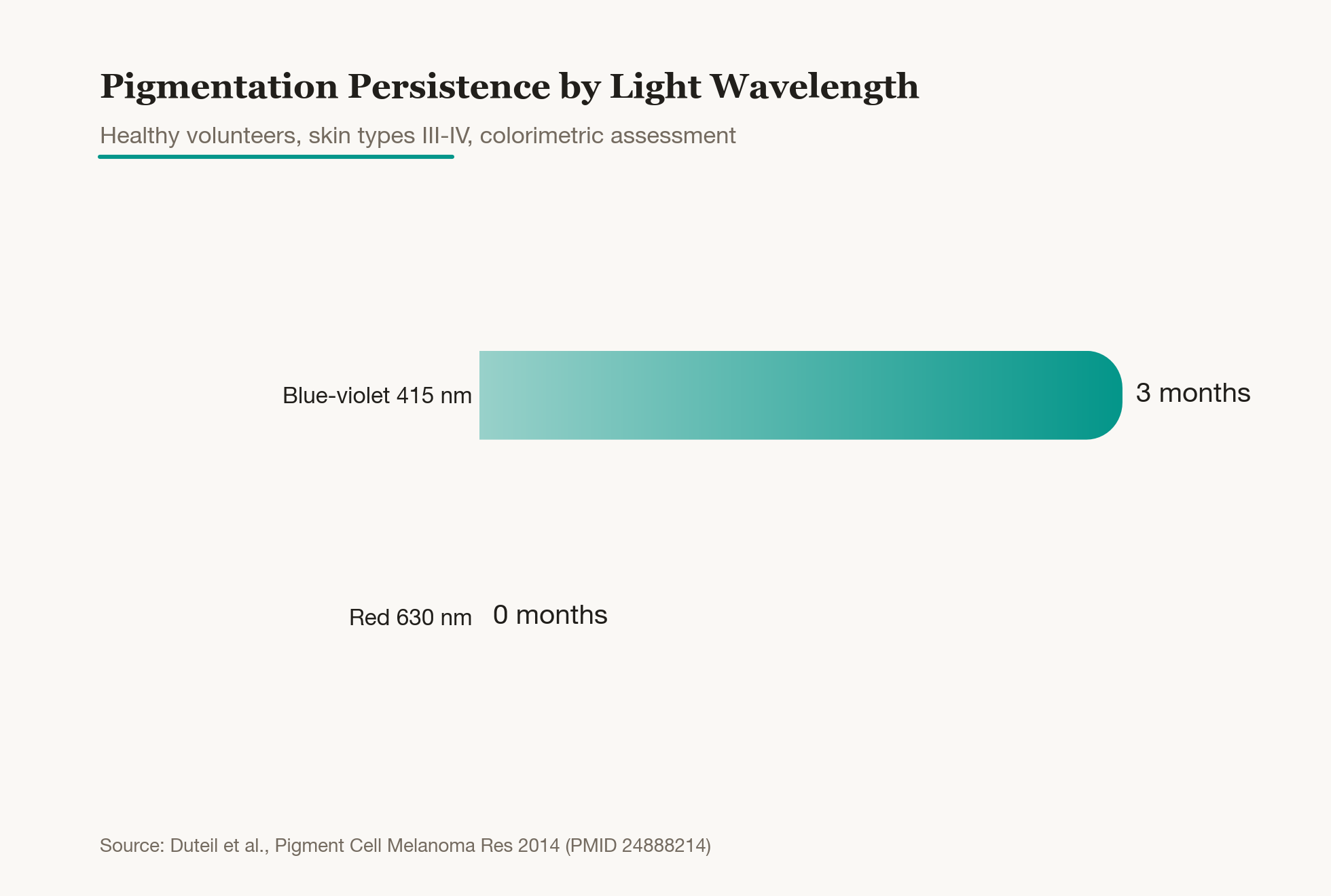
A protein called opsin 3, or OPN3, is known to play a role in how blue light triggers pigmentation. OPN3 originally detects light in the retina of the eye, but interestingly, it's also present in melanocytes, the pigment-producing cells in the skin.
When blue light stimulates OPN3, melanocytes ramp up melanin production beyond their usual output. Because this happens through a different pathway than UV-induced pigmentation, sunscreen alone isn't enough to fully block it. This response also tends to be more pronounced in people with darker skin tones.
In practice, the visible change often shows up as brown spots or an overall dullness rather than a single well-defined mark. Since it tends to spread subtly across the whole face rather than concentrate in one spot, it can take a while before you actually notice it.
Collagen breakdown and loss of elasticity
As oxidative stress accumulates, the body ramps up production of MMPs, matrix metalloproteinases, enzymes that break down old or damaged collagen. Normally, MMPs clear out worn-out collagen to make room for new collagen to move in. But when free radicals build up, this cutting process goes into overdrive, and more collagen ends up broken down than gets replaced.
The result is a gradual decline in the collagen and elastin that support the skin, which can mean less elasticity and more fine lines over time. The direction is similar to UV-driven photoaging, but the difference is that this damage accumulates little by little, every single day spent in front of a screen.
Picture a building whose support columns are wearing thin bit by bit. It won't collapse overnight, but if the material making up those columns keeps eroding day after day, the whole structure eventually starts to sag and sway. Collagen works the same way. Each day's change is tiny on its own, but stacked up over several years, the skin's underlying support structure ends up genuinely different.
Does looking at screens at night affect sleep too?
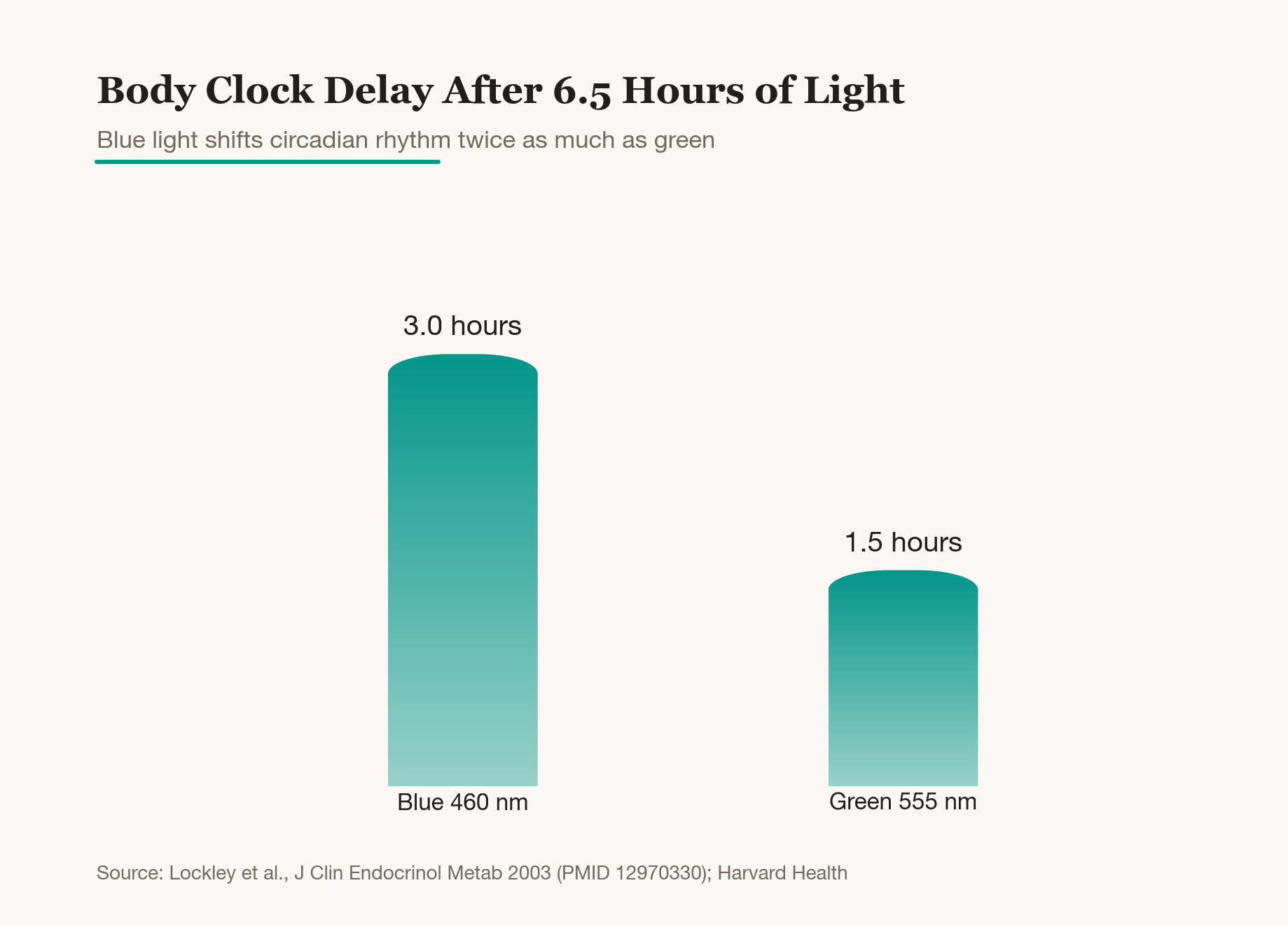
Blue light doesn't just affect the skin, it also affects the body's internal clock. Extended exposure to blue light suppresses the release of melatonin, the hormone that helps induce sleep. Normally, the body ramps up melatonin production once the sun sets and it gets dark, signaling that it's time to wind down. But when bright blue light keeps hitting your eyes, your body gets tricked into thinking it's still daytime.
When sleep becomes shorter and shallower, skin repair suffers too. Cell recovery and collagen synthesis both ramp up while you sleep, so when sleep quality drops, that repair process slows down right along with it. In the end, the habit of scrolling late into the night puts a double burden on both your skin and your sleep.
How to reduce blue light exposure
Reducing exposure itself is the first and simplest thing you can do. The following approaches are known to help.
- Use night mode and adjust screen brightness: Turning on night mode (the blue light reduction setting) on your phone and computer reduces the proportion of blue light wavelengths coming from the screen. It works by actually shifting the light's wavelength makeup, which cuts down your overall exposure.
- Keep some distance from the screen: Holding your screen a bit farther from your eyes and face weakens the intensity of light reaching your skin, since light intensity drops off sharply with distance.
- Choose a sunscreen with iron oxide: A standard sunscreen blocks UV rays but lets most blue light pass straight through. Formulas containing iron oxide also block part of the visible light spectrum, which makes them a useful choice on days with heavy screen use.
- Add antioxidants to your routine: Antioxidant ingredients like niacinamide and vitamin C help neutralize the free radicals blue light generates. Think of it as building a defense line that intercepts the oxidative reaction before it can spread.
- Cut back on screens before bed: Reducing screen use for one to two hours before sleep is recommended to help protect your body clock. It gives melatonin release the time it needs to get back on track.
Changing every habit at once is a lot to ask, but sticking with even a few of these consistently can noticeably cut down your cumulative exposure over time.
References
Korean Dermatological Association, American Academy of Dermatology (AAD), and Ministry of Food and Drug Safety (MFDS).
Was this helpful?
About this article
Written by a practising aesthetic physician and intended for general education — not a substitute for individual medical advice.
Read next

How Does Fine Dust Affect the Skin Barrier and Collagen?
Fine dust particles are so small they slip past the pores and into the gaps of your stratum corneum, unsettling the skin barrier from the inside. Along the way, free radicals surge and enzymes that break down collagen switch on, leaving skin more reactive and less firm. Here is how fine dust actually affects skin, and what genuinely helps.
By Dr. Kim
FCR Peeling Effects: Is It Okay for Sensitive Skin?
FCR peeling is a physical peel that works by massaging tiny needle-shaped crystals from coral into the skin to clear away dead skin and sebum together. Because it stimulates the skin differently than acid-based chemical peels, it tends to be more comfortable to try even on sensitive or acne-prone skin. Here's how it works and how to care for your skin afterward.
By Dr. Kim

Alex Toning: Effects, How It Works, Side Effects and Aftercare
Alex toning uses a 755nm alexandrite laser that is selectively absorbed by melanin to fade dark spots and pigmentation. Here is how the wavelength concentrates heat only in pigment cells, and why treatments are split into multiple low-energy sessions.
By Dr. Kim