Keloid Scar Causes and Treatment, Including Recurrence and Management
By Dr. Lee8 min read
Getting your ears pierced or having surgery almost always leaves some kind of mark. Most of the time that mark fades with the months. But every so often, it doesn't fade at all, and instead swells up bigger than the original wound ever was. A scar that keeps spreading past the edges of the injury like that is called a keloid.
Why doesn't a keloid settle down quietly the way other scars do? The answer comes down to a balance inside the skin, the balance between making collagen and clearing it away, breaking down. Let's walk through why that balance tips, what path it follows once it does, and how injections and laser treatment try to nudge it back.
How does a normal wound heal?
When skin gets injured, the body rushes to make a protein called collagen to fill the gap. Think of collagen as the scaffolding that holds skin up, so the body is essentially rebuilding a support beam right where the wound is.
The trick is that this construction project needs to stop exactly when the job is done. In a normal healing wound, the cells that produce collagen and the enzymes that trim away the excess work in tandem, much like a crew hauling in materials while another crew hauls out the leftovers. That balance is why a scar stops growing at some point and gradually softens and flattens.
A cut on your finger is a good example. For the first 2 to 3 weeks the wound sits red and slightly raised, but by 3 to 6 months the color fades and the surface settles down to roughly the height of the surrounding skin. That's the signal that the collagen build-out stopped on schedule and got cleaned up properly. A keloid is a scar where that final step never arrives.
Why do keloids keep growing?
In skin that's prone to keloids, this balance breaks down. The cells that produce collagen keep getting the signal to keep working and end up churning out far more than they need to, while MMP, the enzyme that acts like scissors trimming away used-up collagen, can't keep pace.
It's as if the scissors have gone dull while the crew hauling in materials just keeps growing, so collagen piles up much faster than it gets cleared. The result is a mound of collagen fibers that are thick, densely packed, and tangled in every direction, rising up above the surface of the skin.
A normal scar's collagen looks like neatly woven thread, with a consistent grain. A keloid's collagen looks more like a ball of yarn that's been knotted into a mess. That's part of why keloids feel hard to the touch and why the tightness or itching tends to linger for so long. This tangled structure doesn't tend to unravel on its own, which is exactly what makes keloids so stubborn to treat.
Difference between keloids and hypertrophic scars
Raised, thickened scars also show up as hypertrophic scars, which is why the two get mixed up so often. The key difference is whether the scar stays inside the boundary of the original wound.
A hypertrophic scar thickens, but it stays within the borders of the original injury, and it often flattens out on its own over time. A keloid, on the other hand, spreads past the edge of the wound and into healthy skin, continuing to grow. Like a vine that creeps past the flower bed and out onto the lawn, it commonly ends up noticeably larger than the original wound, and it's common for it to still show no sign of shrinking even years later.
The timing is different too. A hypertrophic scar tends to swell up within 4 to 8 weeks of the injury, while a keloid often doesn't start creeping outward until 3 to 12 months after the wound has fully closed. That's why plenty of people initially assume it's just an ordinary scar, only to end up at the clinic later once they notice it's steadily gotten bigger.
Who is prone to keloids, and where?
Not everyone develops a keloid from the same kind of wound. Reports suggest keloids show up more often in people with darker skin tones and in people with a family history of keloids, which points to genetic differences in how collagen gets produced and cleared.
Location matters as well. Keloids tend to form especially readily in spots under a lot of tension, such as the center of the chest, the shoulders, and the earlobes. The constant pulling force on the skin acts as an extra signal that keeps stimulating the collagen-producing cells. In areas where the skin is thin and barely under tension, like the eyelids, keloids are rare.
Age plays a role too. Reports point to keloids being especially common between the teens and the 30s, a stretch of life when collagen-producing cells are at their most active. This is also the period when the body's healing response runs at full strength after any injury, so the signal to build collagen ends up switched on that much more forcefully.
How do steroid injections work?
The most widely used treatment for keloids is injecting a steroid directly into the scar. It works through two main pathways.
First, it dials down the activity of the cells that are getting the signal to make collagen, cutting the sheer volume of new collagen being produced. Second, it revs the MMP enzyme, the same scissor-like enzyme mentioned earlier, back up so it can trim collagen more effectively again. It's the equivalent of shrinking the crew hauling in materials while growing the crew clearing them out, so the balance that had tipped gradually finds its footing again. That's why it usually takes 3 to 6 rounds of injections, spaced 4 to 6 weeks apart, before the scar visibly flattens.
How vascular laser treatment works
Vascular laser is often paired with keloid treatment as well. Keloid tissue tends to grow an unusually dense network of small blood vessels that feed the mass, and these vessels double as the delivery route for the signaling molecules that keep telling the tissue to make more collagen.
The laser targets these vessels selectively, narrowing or closing them off. It's similar to narrowing a river, less water flowing through means less cargo getting carried along with it. With less blood flow reaching the area, the stimulation reaching the collagen-producing cells drops too, and the scar's redness and thickness gradually fade.
For that reason, laser is more often used together with steroid injections than on its own. While the injection quiets the collagen-producing cells directly, the laser cuts back the blood vessels feeding those cells their signal, so the two treatments end up blocking different pathways at the same time.
Why does it grow back after treatment?
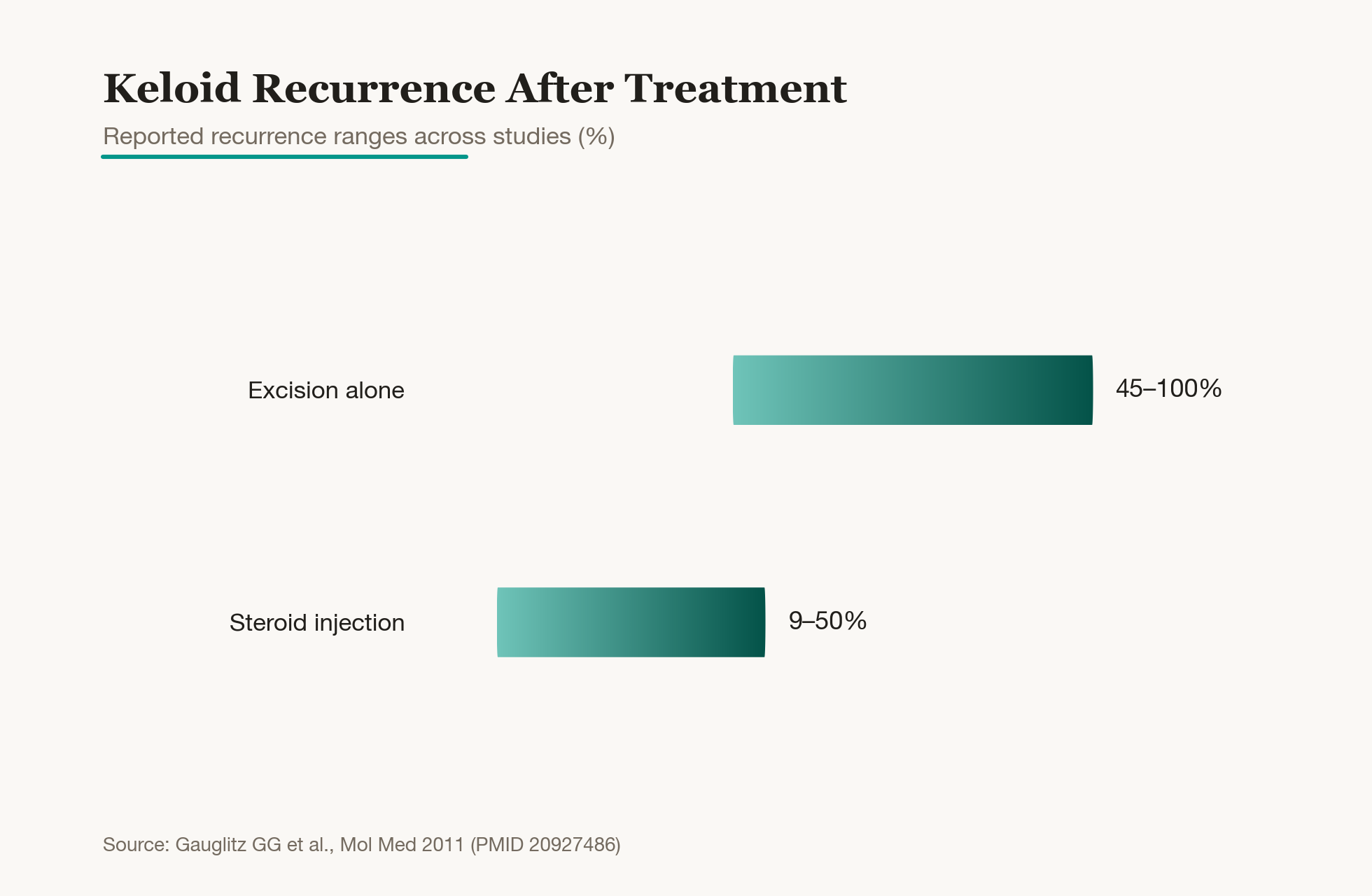
Keloids are known for a high recurrence rate even after treatment. Reports show that recurrence is especially common when surgery is used to simply cut the mass away and nothing else.
There are two reasons for this. One is that the cells responsible for the original keloid don't tend to change their behavior. If cells with a habit of overproducing collagen are still sitting in the surrounding tissue, the same process can play out again as the new wound heals. The other is that surgery itself creates a fresh wound. That new wound generates its own tension on the skin, and that tension acts as another signal stimulating the collagen-producing cells all over again. That's why surgery on its own is rarely recommended, and it's usually paired with injections or radiation therapy afterward to lower the odds of recurrence.
Scar care and follow-up
Once you understand the mechanics behind all of this, it's much easier to see why the clinic recommends the aftercare routines it does.
- Silicone sheets or gels work by controlling moisture and pressure on the surface of the scar, which helps reduce the signals that stimulate collagen-producing cells.
- Compression bandages or earlobe compression devices lower the tension on the scar physically, cutting back the stimulus that drives collagen production in the first place.
- Regular follow-up from 6 months out to as long as 5 years after treatment exists because of the recurrence mechanism described above, so any early sign of the scar starting to grow back can be caught quickly.
A keloid isn't the result of any single cause. It's what happens when genetic tendencies, skin tension, and the balance between making and clearing collagen all get tangled together. That's why treatment rarely relies on just one method, and a combination of injections, laser, and compression care tailored to the situation is the widely recommended approach.
References
Korean Dermatological Association, Ministry of Food and Drug Safety (MFDS), American Academy of Dermatology (AAD), and U.S. Food and Drug Administration (FDA).
Was this helpful?
About this article
Written by a practising aesthetic physician and intended for general education — not a substitute for individual medical advice.
Read next

Exosome Treatment Effects: How Are They Different From Stem Cells?
Exosomes are tiny signal packets that cells release into their surroundings, delivering only the messages a stem cell creates rather than the stem cell itself to the skin. Here is a plain look at how exosomes carry regeneration and calming signals, why clinics so often pair them with laser treatments, and how much evidence has actually built up so far.
By Dr. Kim
Burn Scar Laser Treatment: Can Red, Hard Scars Improve Too?
Burn scars stay red and thickened because the collagen that fills the wound never gets properly trimmed back. Here's how fractional and vascular lasers each work on that texture and redness, plus when to start treatment and how many sessions it typically takes.
By Dr. Kim
Cafe-au-Lait Spots Returning After Laser: Causes, Number of Sessions and Expectations
A café au lait spot forms because the pigment-making cells in that one patch of skin are locally overactive. Laser treatment breaks up the pigment that has already built up, but it doesn't switch off those cells, which is why the color so often returns. Here's the biology behind it, why results differ so much from person to person, and what a realistic treatment timeline actually looks like.
By Dr. Kim