Sculptra and Juvelook Volume: Differences and Duration Compared
By Dr. Kim8 min read

When the cheeks start to hollow and the folds around the mouth begin to sag, most people start looking into collagen-stimulating injectables. The two that come up most often side by side are Sculptra and Juvelook Volume. Both work by prompting your skin to build new collagen, gradually filling in volume and firmness over time, so the overall picture is similar.
But once you sit down for a consultation, the different ingredients and names can get confusing. Sculptra is PLLA, while Juvelook Volume is PDLLA with HA added. It sounds like a one-letter difference, but the particle shape, whether each delivers an immediate effect, and the amount of clinical evidence behind each are actually quite different. Here is a point-by-point look, based only on verified research, at how each one stimulates collagen, when results show up and how long they last, and how much evidence backs each one up.
Is there an effect right on treatment day?
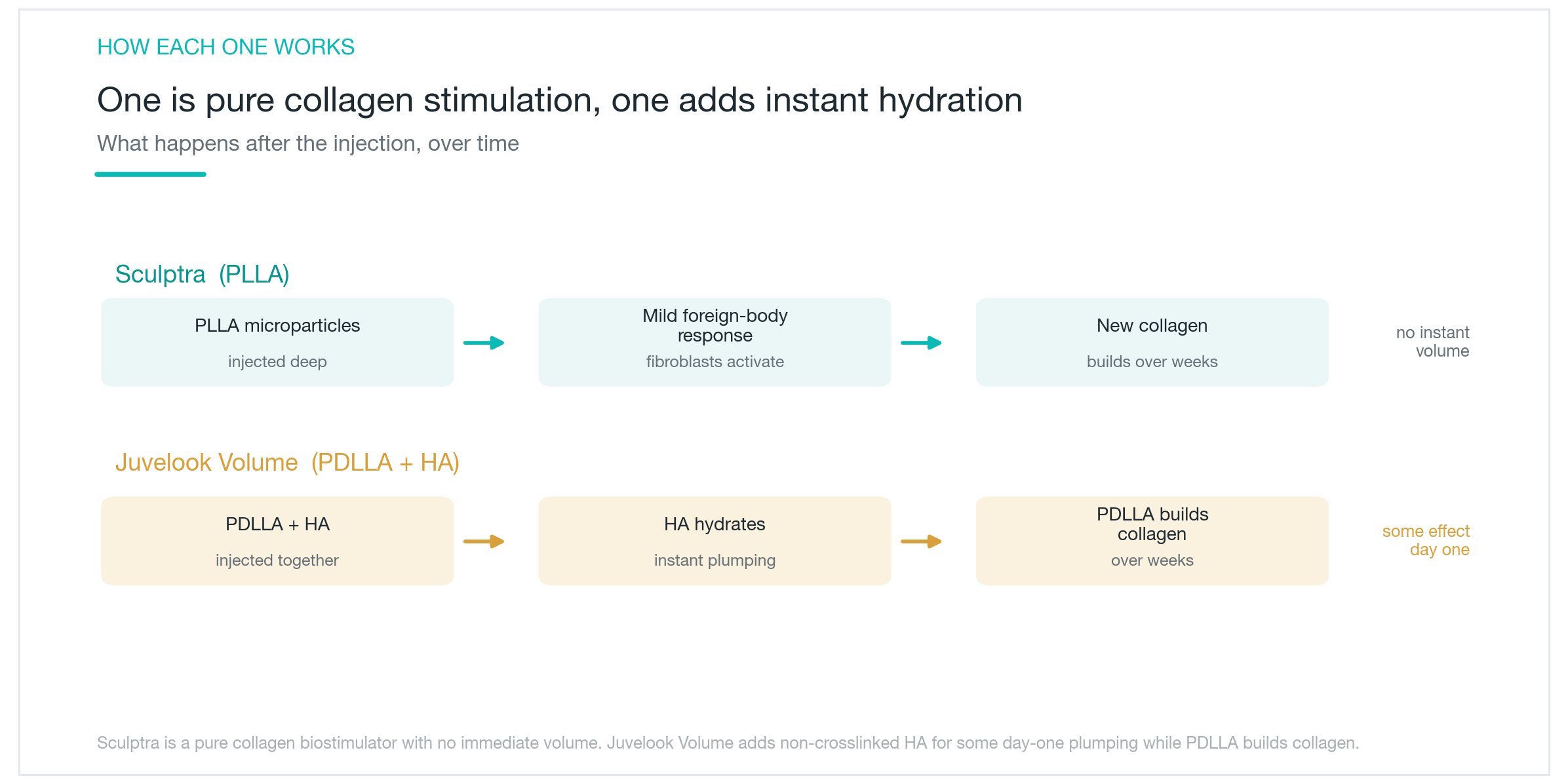
The big difference is whether there is an immediate effect. Sculptra's main ingredient, PLLA (poly-L-lactic acid), is a pure collagen stimulator. Once it is placed deep in the skin, the body gradually reacts to it, which stimulates fibroblasts and builds new collagen over several weeks. On the day of the injection there is no added volume; instead, it fills in slowly as time passes.
Juvelook Volume is a hybrid of PDLLA (poly-D,L-lactic acid) microspheres with non-crosslinked HA added. PDLLA stimulates collagen just like Sculptra's PLLA, but the HA that comes with it holds onto water right after the injection, giving a degree of immediate plumping. This HA is not crosslinked, though, so it is absorbed within a few weeks, and after that the collagen built by the PDLLA takes over.
In short, Sculptra relies on collagen alone, while Juvelook Volume adds one more element: early hydration. Whether you want a small change on the day of treatment or a purely collagen-driven build shapes the first impression you get.
Differences in particle shape and size
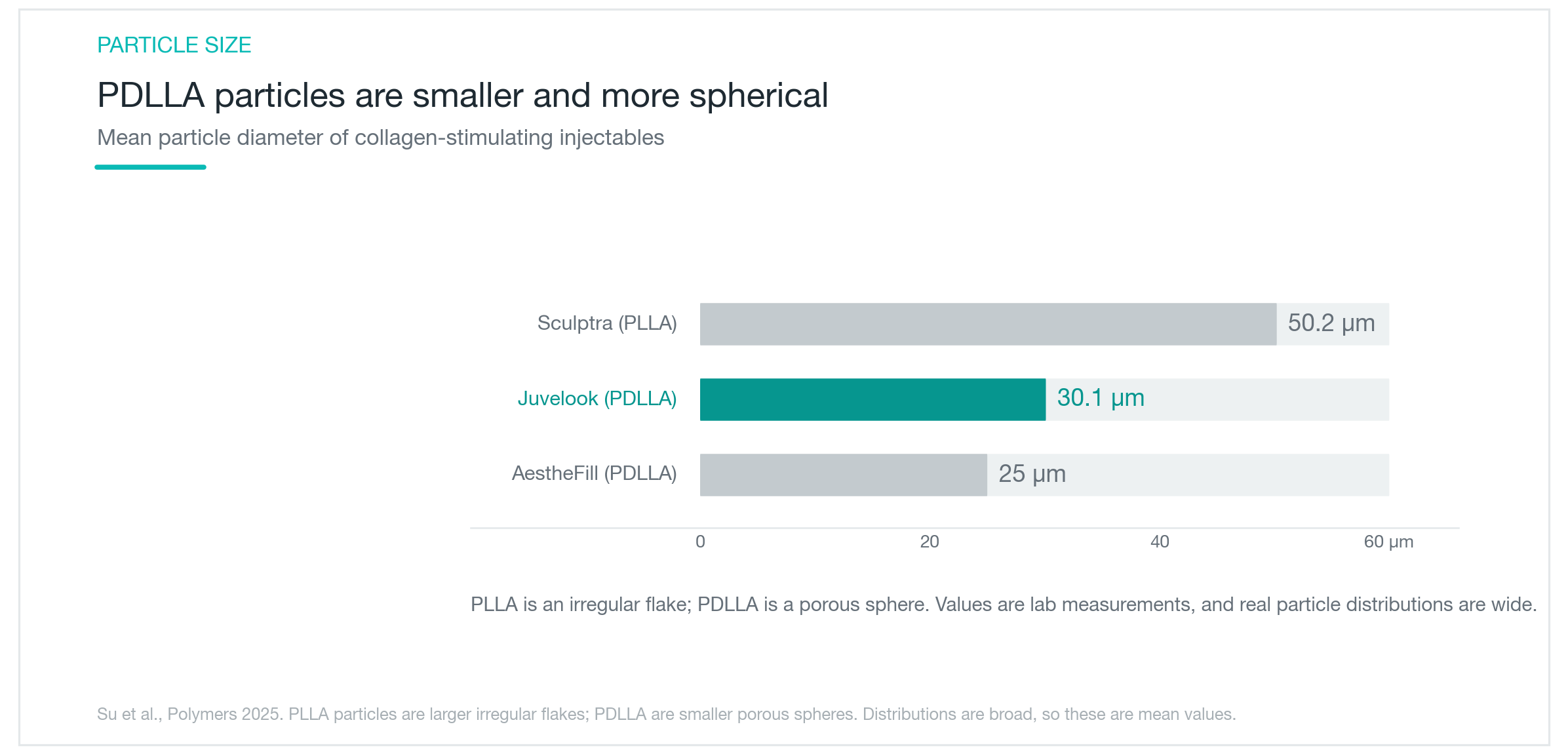
The two products differ right down to the shape of the polymer. Sculptra's PLLA has a single L-form structure, and under an electron microscope it looks less like smooth beads and more like irregular micro-flakes. That is why studies measuring it report a wide distribution in particle shape and size. Juvelook's PDLLA has a structure that mixes D-form and L-form, forming round microspheres with many pores on the surface. They also tend to be smaller, so they spread evenly through tissue more easily.
In studies that measured particle size directly, PLLA came in at an average of about 50µm and PDLLA at about 30µm. Keep in mind these are averages, and the actual particles are spread across a much wider range. Smaller, rounder particles are known to be favorable for smoother injection and lower early nodule risk, but that does not mean the final result is better.
The composition differs too. Sculptra is a freeze-dried powder, so it needs a reconstitution step, dissolved in sterile water before treatment, and it contains no immediate hydrating ingredient like HA. Juvelook Volume comes with non-crosslinked HA already in the PDLLA, so it arrives ready to use with no separate reconstitution. That is where the difference in prep time and early feel comes from.
Where do the collagen increase numbers come from?
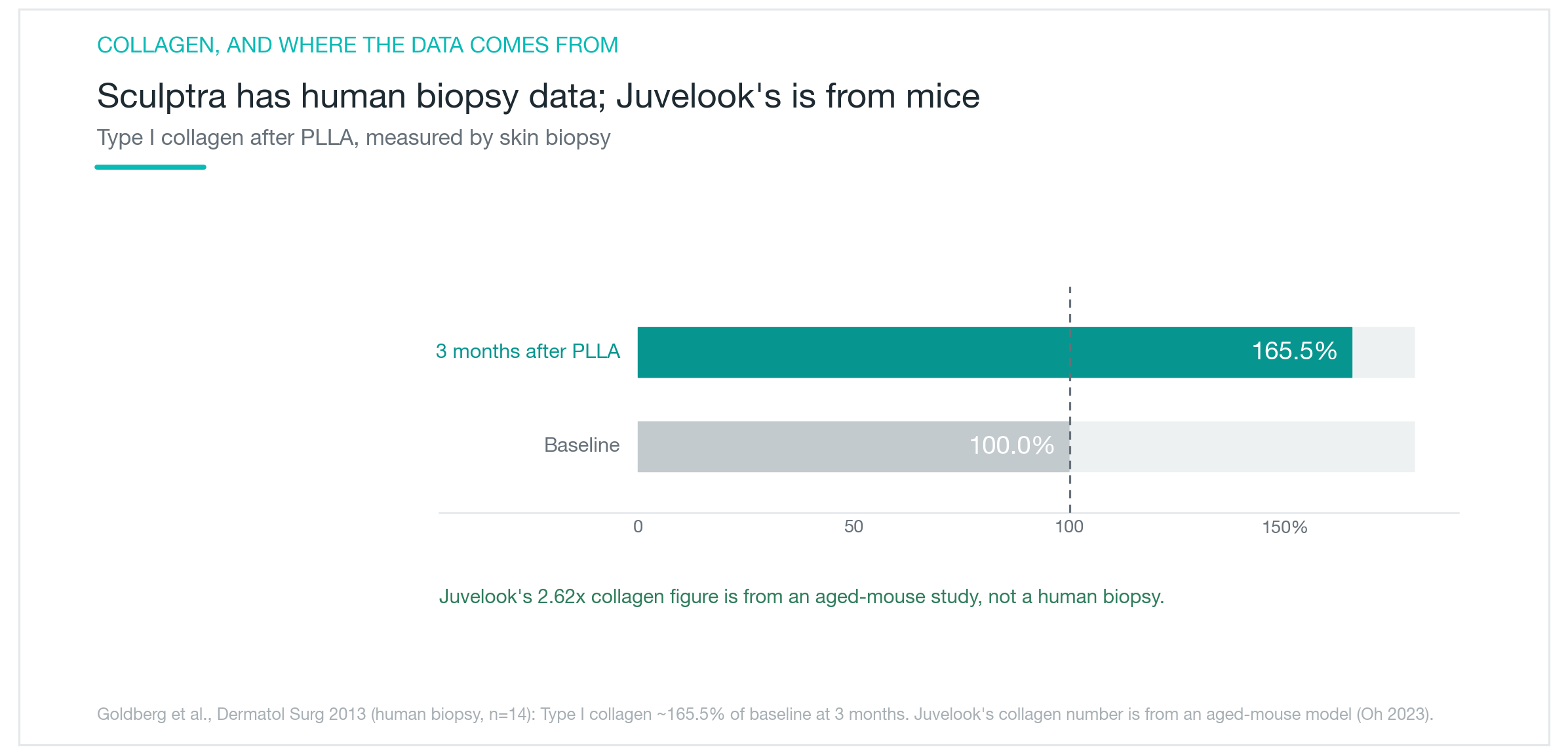
Sculptra has human skin biopsy data. In one study (n=14), type I collagen rose to about 165.5% of baseline three months after the PLLA injection. Because this was confirmed by taking actual skin samples and examining them under a microscope, the principle that new collagen forms has been directly observed in people. Over more than 20 years of use, data like this has continued to accumulate.
The collagen figure most often cited for Juvelook comes from an aging-mouse experiment. After PDLLA was applied, collagen density increased about 2.62-fold compared with the control group. The direction is the same as Sculptra, but this is animal preclinical data. It does not mean the same multiple will appear in human skin, so it is worth setting expectations a little differently.
Both numbers point in the same direction: collagen increases. But one is a human biopsy and one is an animal experiment, so the weight of the evidence is different. This does not mean Juvelook's principle is weak; knowing that human data is still building up simply makes the results easier to put in context.
For context, across collagen stimulators as a category, human data keeps coming out. The PLLA family has a randomized study showing improvement in nasolabial folds that held up against HA fillers, and PDLLA is also seeing small human studies published gradually. It is fair to understand that, for now, the human data on the Sculptra side is more established, while Juvelook's is just starting to build up.
Amount of clinical evidence and approval status
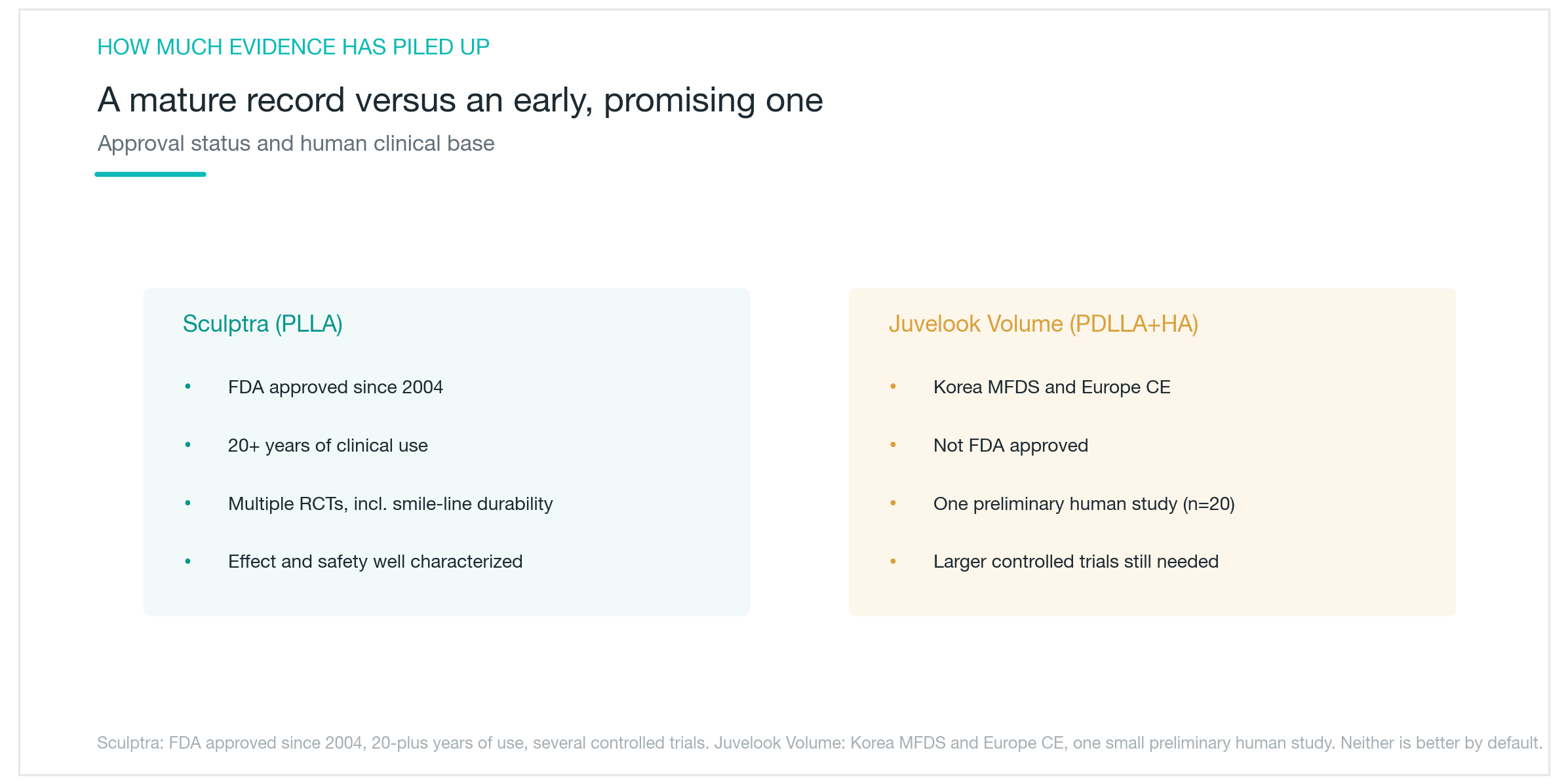
This is where the two products differ most. Sculptra received US FDA approval in 2004, and over more than 20 years of use it has built up several controlled trials. It was first approved to treat facial fat loss in HIV patients, then expanded to cosmetic indications. There is even a randomized trial looking at whether nasolabial fold improvement holds up over time, so the big picture of its efficacy and safety is relatively well documented.
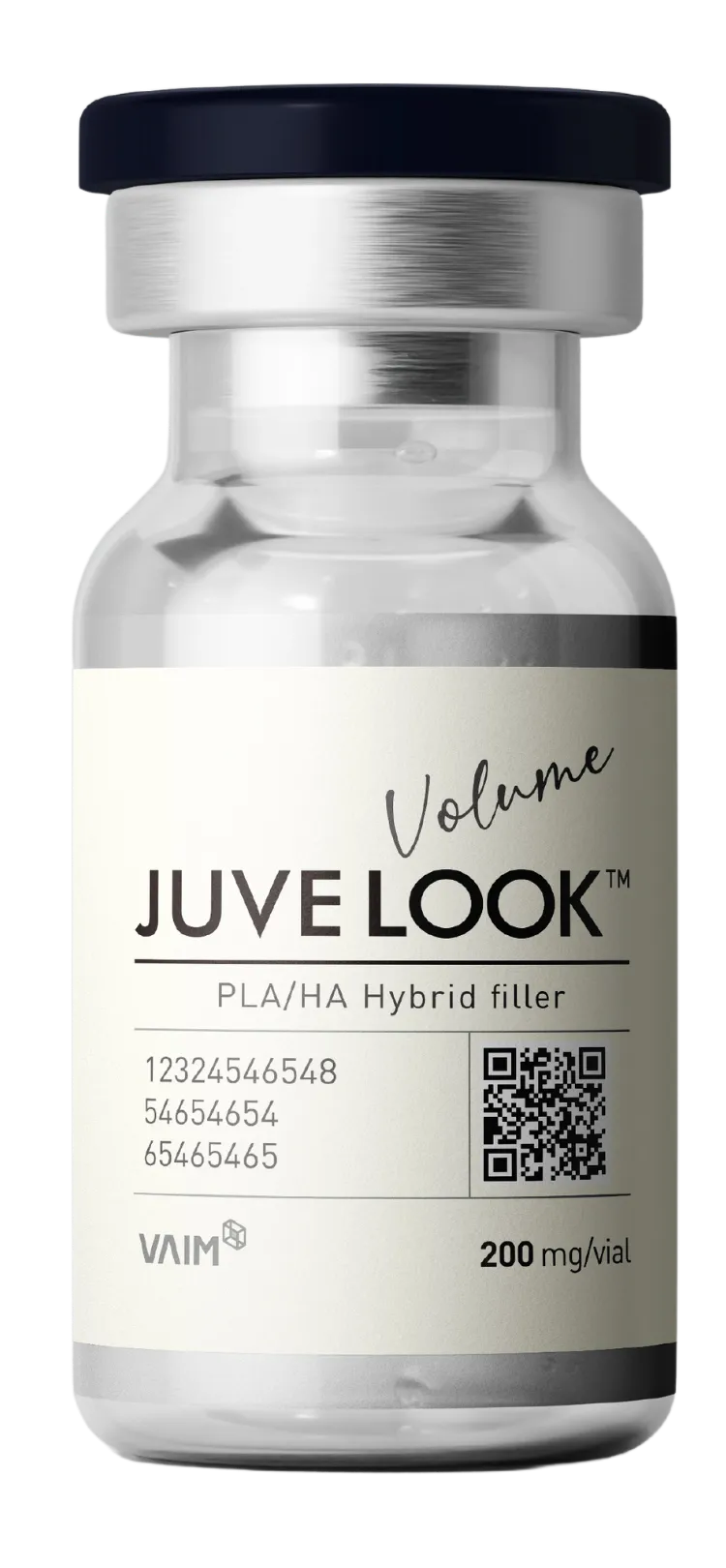
Juvelook Volume has Korean MFDS and European CE certification. It has not yet received US FDA approval. The core of its human data is a single pilot study of 20 people, in which meaningful improvement was seen in elasticity, firmness, and hydration. That said, the authors themselves noted it was a small pilot study and wrote that larger controlled trials are needed.
More evidence does not automatically mean better. If you value verified data, Sculptra brings peace of mind, and if you are drawn to a new hybrid approach with the added benefit of early hydration, Juvelook Volume is a reasonable option too. How much confirmation you want at this point is really the basis for your decision.
When do results show and how long do they last?
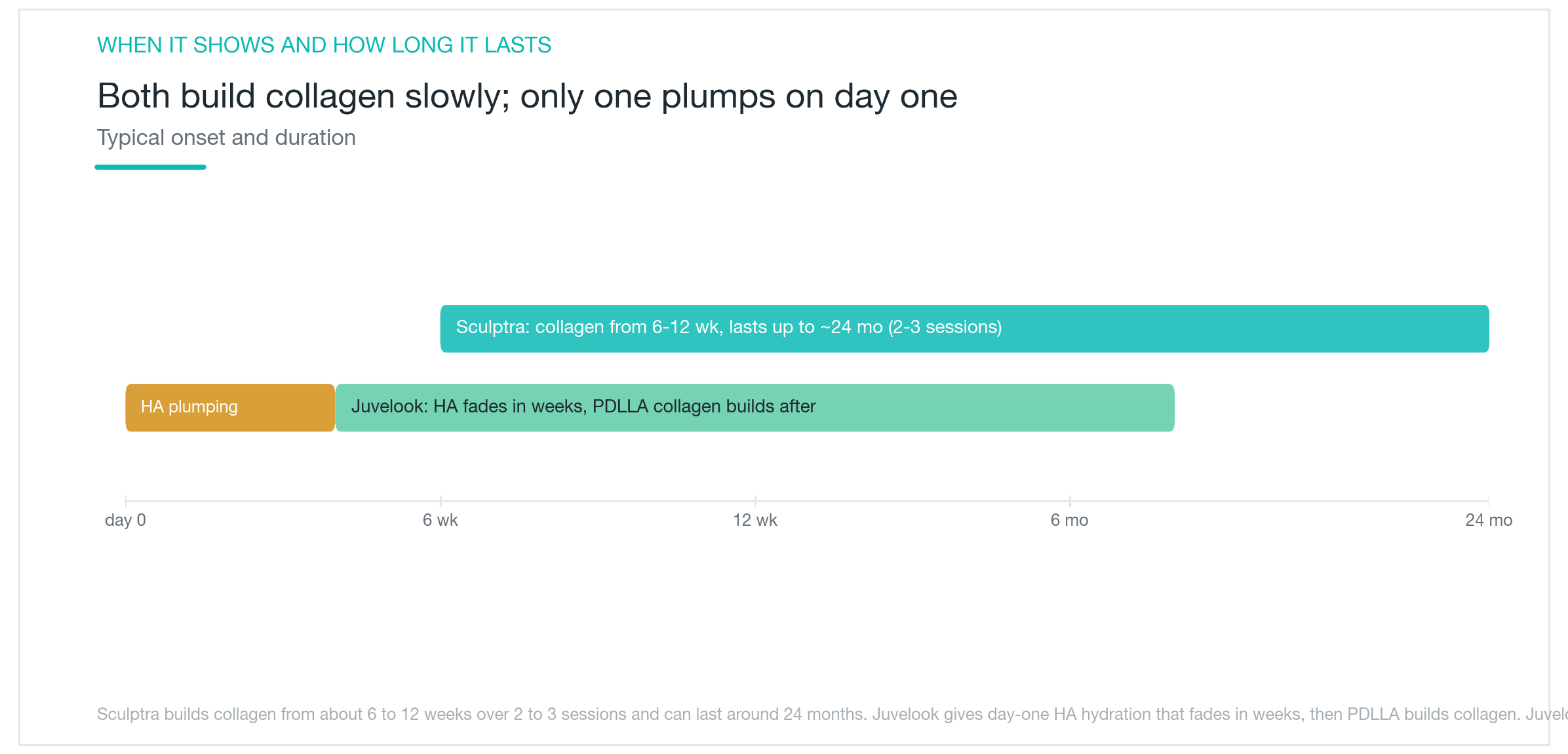
Sculptra is a gradual treatment. Because new collagen takes time to build, changes usually become visible over 6 to 12 weeks. It is given in 2 to 3 sessions spaced 4 to 6 weeks apart, and the finished volume is reported to last up to about 24 months. In exchange for no same-day effect, it fills in naturally and lasts a long time.
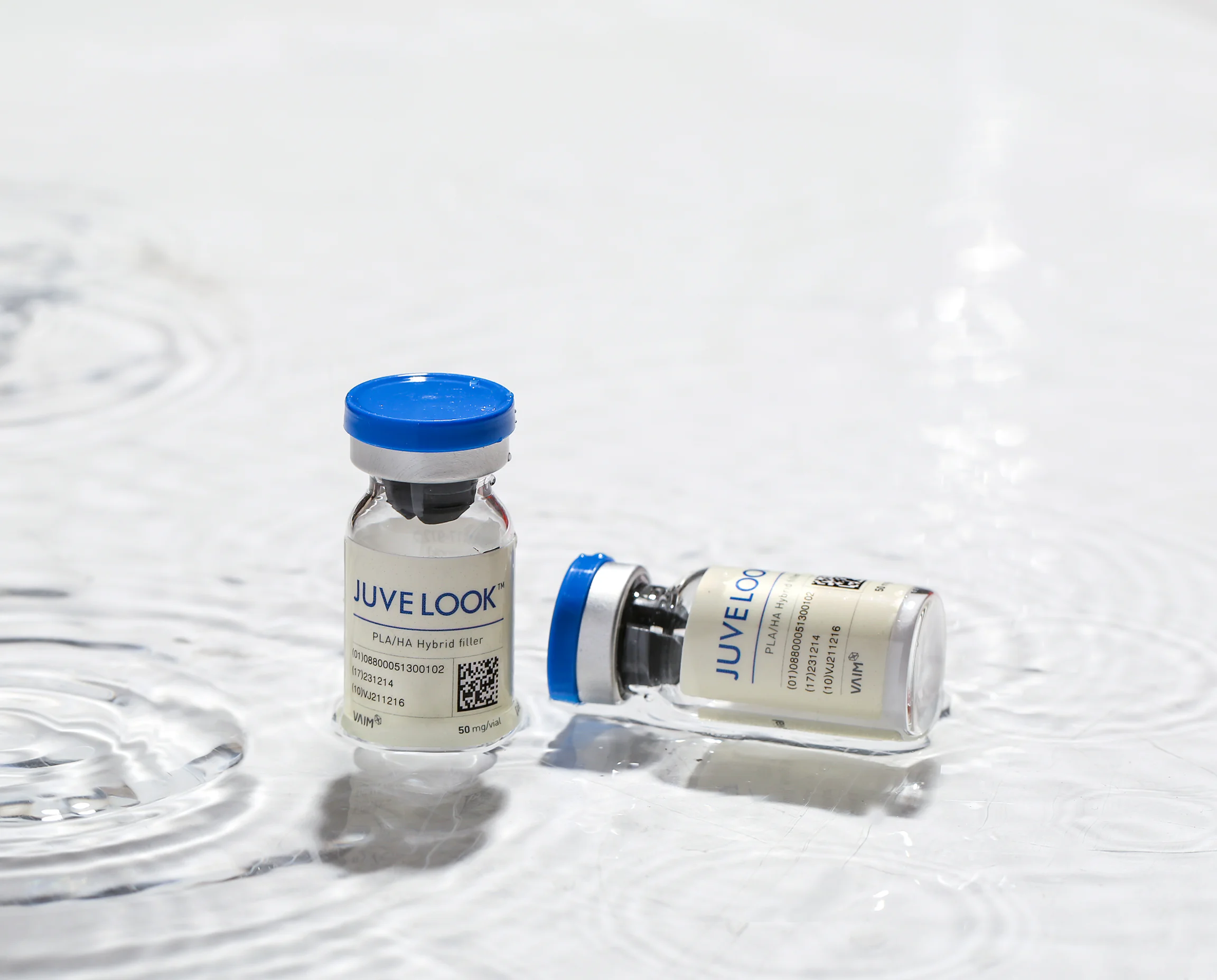
Juvelook Volume follows a slightly different timeline early on. Thanks to the HA it comes with, you feel a degree of hydration and plumping on the day of the injection, but that part is absorbed within a few weeks. After that, the collagen built by the PDLLA settles in. That said, human data on how long Juvelook Volume lasts is still accumulating, so it is a bit early to name a clear number of months the way we can with Sculptra.
Both products share the fact that collagen takes time to build. If you want to feel even a small change early on, Juvelook Volume's HA fits the bill, and if a verified duration matters more to you, Sculptra is the better match. Either way, this is a treatment you complete gradually over several sessions rather than in one go, so it is better to watch how things unfold over a few months than to judge in a hurry.
So which one is right for me?
It is hard to say that one is flat-out better. The general direction of how they work is the same, but they differ in whether there's an immediate effect, in particle characteristics, and in the amount of accumulated evidence, so the right choice comes down to what you value most.
If verified evidence and a long track record matter most to you, Sculptra is the practical pick. FDA approval, human biopsy data, and more than 20 years of clinical use have all stacked up, so it is easy to predict its effect and longevity. In exchange, you have to accept that there is no same-day change and that it fills in over several months.
If you are drawn to a new hybrid approach and the benefit of early hydration, Juvelook Volume is worth considering. The small same-day change the HA provides is a plus, and there is the convenience of using it without a separate reconstitution step. Just know going in that its human trials are still at the pilot stage, so aspects like longevity are in a wait-and-see phase while more data accumulates.
There are still not many trials putting the two products head to head. There is one small study of 33 people in which nasolabial fold improvement was statistically similar between the two. There is no large comparison yet that clearly settles which one is better, so for now it feels natural to choose based on each one's strengths and level of evidence. Collagen-stimulating injectables all share the risks of any injection procedure, including vascular complications, so above all it is important to have it done by a medical provider who knows the anatomy well.
Was this helpful?
About this article
Written by a practising aesthetic physician and intended for general education — not a substitute for individual medical advice.
Read next
Juvelook and Sculptra Differences: When Effects Appear and Lump Side Effects Compared
Juvelook is a collagen-stimulating filler that combines PDLLA with HA, while Sculptra is made purely of PLLA. Here is a verified breakdown of how they differ in immediate volume, collagen-stimulating mechanism, duration, and evidence level.
By Dr. Lee

Recessed Chin Filler and Implant: Differences, Duration and Recovery Compared
Filler and implants both correct a recessed chin, but they build volume through different mechanisms, last for different lengths of time, and differ in whether the result can be reversed. Here is how each one works, what recovery looks like, and how to decide which fits you.
By Dr. Kim

Trapezius Botox Effect and Duration, Including Side Effects and Who It Suits
Trapezius Botox, known as Bobby Botox, relaxes the muscle at the top of the shoulders to make the neck look longer and the shoulder line smoother. Here is an easy, research backed look at how it slims the shoulders, how long results last, whether shoulder weakness or other side effects show up, and who makes the best candidate.
By Dr. Kim