Juvelook and Sculptra Differences: When Effects Appear and Lump Side Effects Compared
By Dr. Lee8 min read
When cheeks hollow out or nasolabial folds deepen, many people look for a treatment that fills the area while also restoring skin firmness. Juvelook and Sculptra are two of the most commonly compared options. Neither is a simple filler that just fills space; both are collagen-stimulating fillers that prompt the skin to build its own new collagen. Still, they differ in ingredients, whether volume shows up right after injection, how the effect builds over time, and how strong the supporting evidence is. Juvelook is a Korean-made product that combines PDLLA with HA, while Sculptra is made purely of PLLA. Here is a breakdown of how the two differ and what to consider when choosing between them, based on verified data.
| Category | Juvelook | Sculptra |
|---|---|---|
| Main ingredient | PDLLA combined with HA | PLLA |
| Immediate volume | Yes, fades in about 2 weeks | Essentially none, settles within days |
| Duration | About 12–18 months | About 24 months |
| Evidence level | Mostly small studies | Large body of evidence |
How do the ingredients of Juvelook and Sculptra differ?
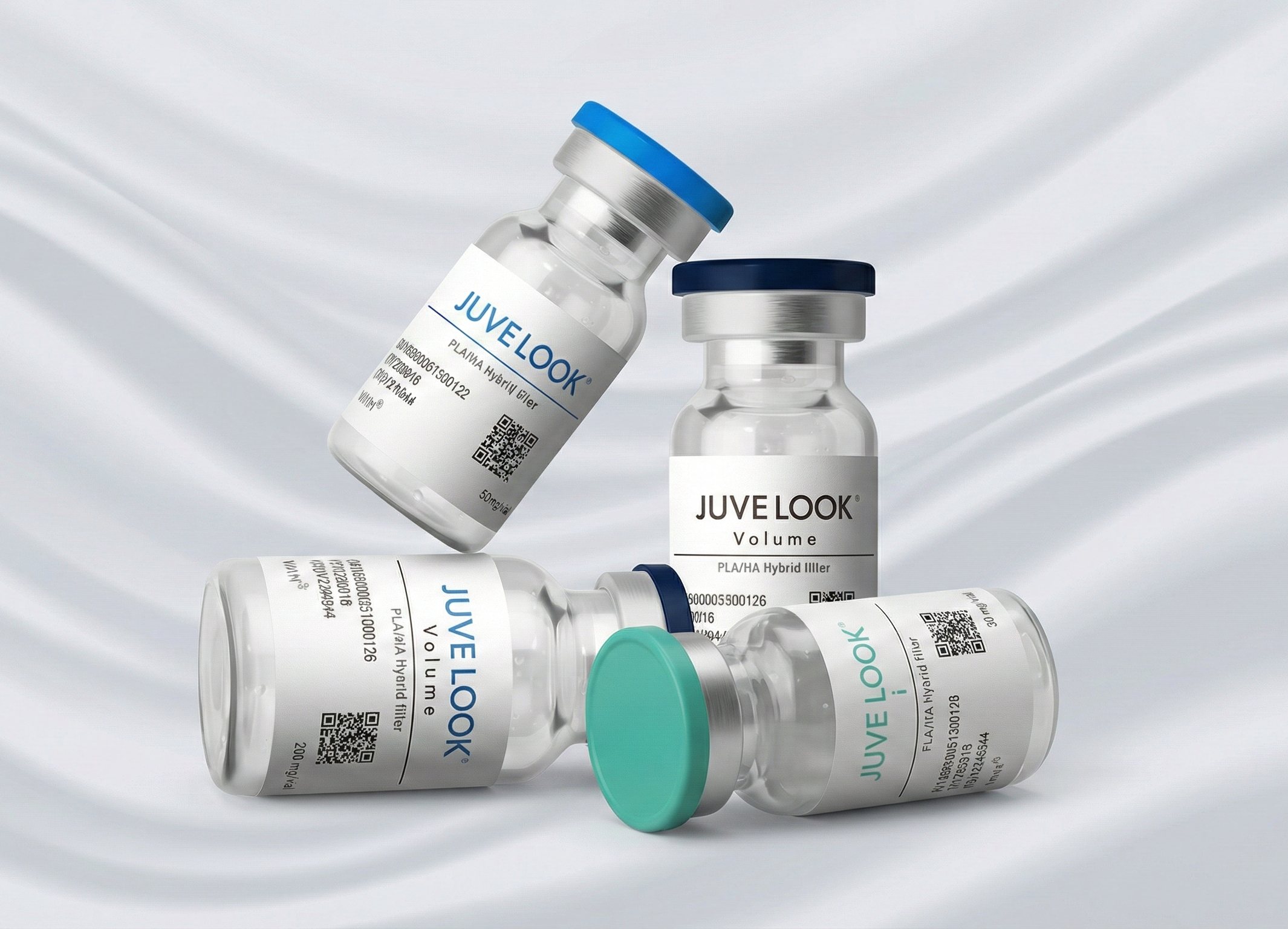
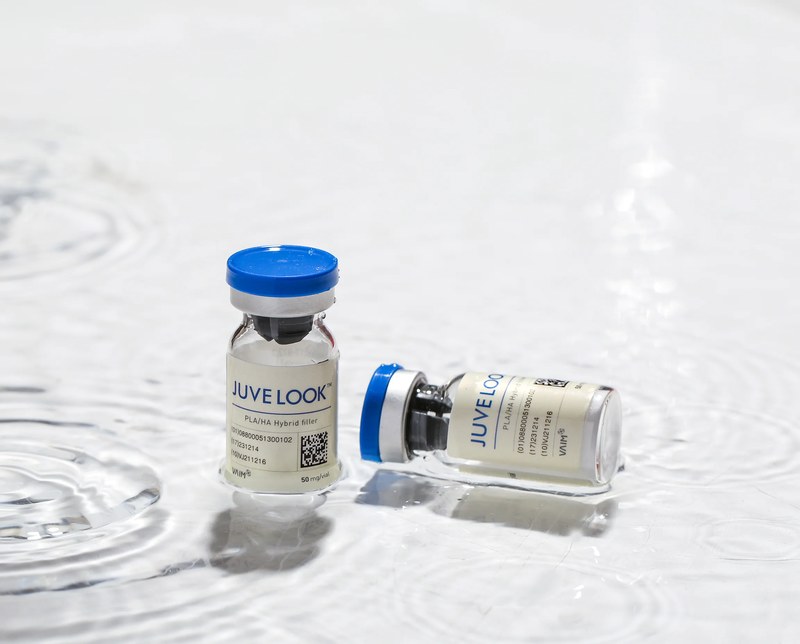
Juvelook is a Korean filler made by mixing microspheres of PDLLA with non-crosslinked HA. The microspheres are porous, full of tiny holes, which lets them add volume even in small amounts. Juvelook Volume, made specifically for volumizing, comes in a larger dose. It is manufactured by VAIM Global, based in Seoul.
Sculptra is made purely of PLLA. It comes as a freeze-dried powder, so it needs to be reconstituted with 5–8 mL of sterile water and diluted generously before use. Recent research has found that reconstituting it with 8 mL for a more diluted, ready-to-use mix is just as safe and produces results similar to the standard dilution. Unlike Juvelook, its particles are irregular, plate-shaped. It is made by Galderma.
| Category | Juvelook | Sculptra |
|---|---|---|
| Composition | PDLLA combined with HA | PLLA with CMC and mannitol |
| Preparation | Reconstituted and used right away | Reconstituted with 5–8 mL sterile water, diluted generously |
| Particle shape | Porous spheres | Irregular, plate-shaped |
| Contains HA | Yes | No |
Their regulatory status also differs. Juvelook is approved by Korea's MFDS as a tissue-restoring material and carries European CE certification, but it does not yet have FDA approval in the United States. Sculptra received FDA approval for cosmetic use in 2009, so it has a broader base of evidence and clinical history behind it. Both products are made of biodegradable material, so they gradually break down over time as newly formed collagen takes their place.

How particle properties change the way volume appears
Both products are biostimulators that trigger new collagen formation rather than fillers that simply occupy space. Macrophages gather around the injected microparticles, and as fibroblasts activate, type 1 collagen builds up around them. Meanwhile, the material itself slowly breaks down into lactic acid and is metabolized by the body, leaving no residue behind. Up to this point, the two products work in a similar way.
The difference lies in the particles themselves. Sculptra's PLLA is semi-crystalline, so it is firm, and its particles hold their position separately without clumping together. Juvelook's PDLLA is amorphous, so it deforms more easily, and its particles tend to clump into aggregates. This structural difference also affects how volume builds up over time.
| Property | Juvelook | Sculptra |
|---|---|---|
| Crystallinity | Amorphous, deforms easily | Semi-crystalline, firm |
| Particle behavior | Clumps into aggregates | Stays separated |
That said, there is still no head-to-head data comparing these mechanisms directly on human faces. Most of the comparisons available so far come from lab and animal studies, so they are not a solid basis for predicting real-world treatment results.
When will you feel the volume?
This is where the most noticeable difference shows up. Sculptra can leave a slightly swollen feeling right after injection, but that comes from the diluting fluid and settles within a few days. The real volume builds gradually as collagen forms over several months. So this is more of a treatment where you wait for changes over months rather than expecting results on day one. As mentioned earlier, it is reconstituted with sterile water, diluted generously, then injected in a fanning pattern into the deep dermis or subcutaneous fat layer.
Juvelook, on the other hand, shows volume from the day of injection. The HA and the reconstitution fluid fill the area immediately. However, this initial volume decreases after about 2 weeks as the water is absorbed. After that, the remaining PDLLA microspheres act as a scaffold for collagen formation, so volume does not drop sharply but instead continues at a similar level.
| Category | Juvelook | Sculptra |
|---|---|---|
| Volume on treatment day | Yes, lasts about 2 weeks | Temporary, settles within days |
| Volume afterward | Maintained by collagen | Gradually increases over months |
| Injection depth | Shallow layer | Deep dermis and subcutaneous |
Injection depth and technique also differ. Juvelook is often injected into a shallow layer, similar to a skin booster, while Sculptra is injected deeper to add volume across broader areas like the cheeks. Which product suits you better depends on whether you want a plump feeling right away or a result that builds gradually over months.
Which one has stronger evidence?
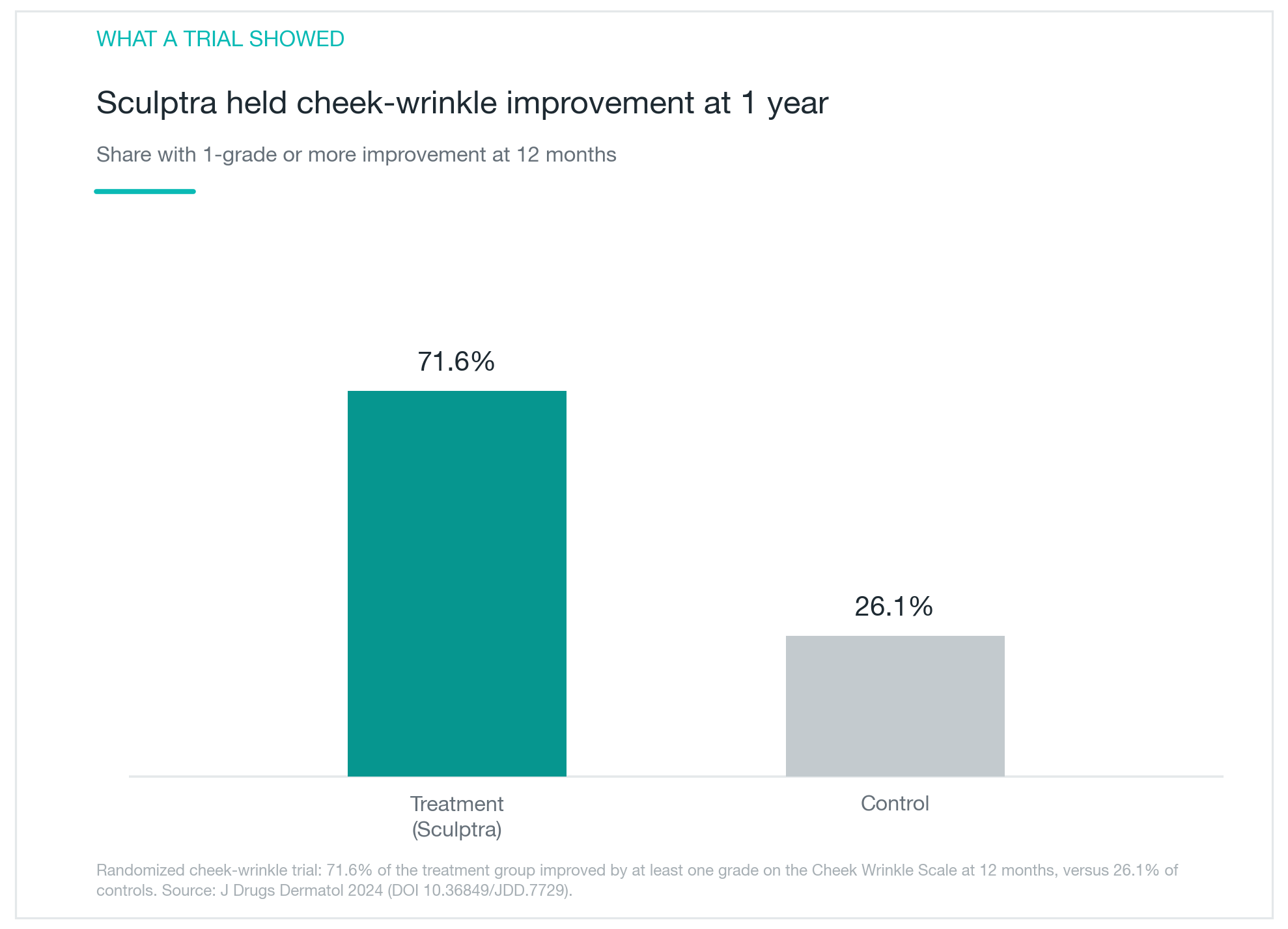
Sculptra has a fairly broad base of evidence. In a randomized controlled trial on cheek wrinkles, 71.6% of the treatment group improved by at least one wrinkle grade at 12 months, compared to 26.1% in the control group. Satisfaction with skin radiance, firmness, sagging, and natural appearance was also high, at over 84%. In a study comparing dilution volumes for nasolabial folds, more than 75% responded by week 24.
Juvelook's evidence base is still thinner. In a preliminary study of 20 patients treated on the face, skin elasticity, firmness, and hydration improved meaningfully, though the researchers themselves noted that larger comparative studies are needed. In a 15-patient study combining it with microneedling, pore scores dropped by about half at 12 weeks.
To be candid, there is still no randomized study comparing Juvelook and Sculptra head-to-head on human faces. Sculptra has several large studies behind it, while Juvelook is at the stage of accumulating small studies and case reports. In short, Sculptra has solid clinical support, and Juvelook is still building its evidence base. It helps to keep this difference in mind when choosing between them.
How many lumps should you expect?
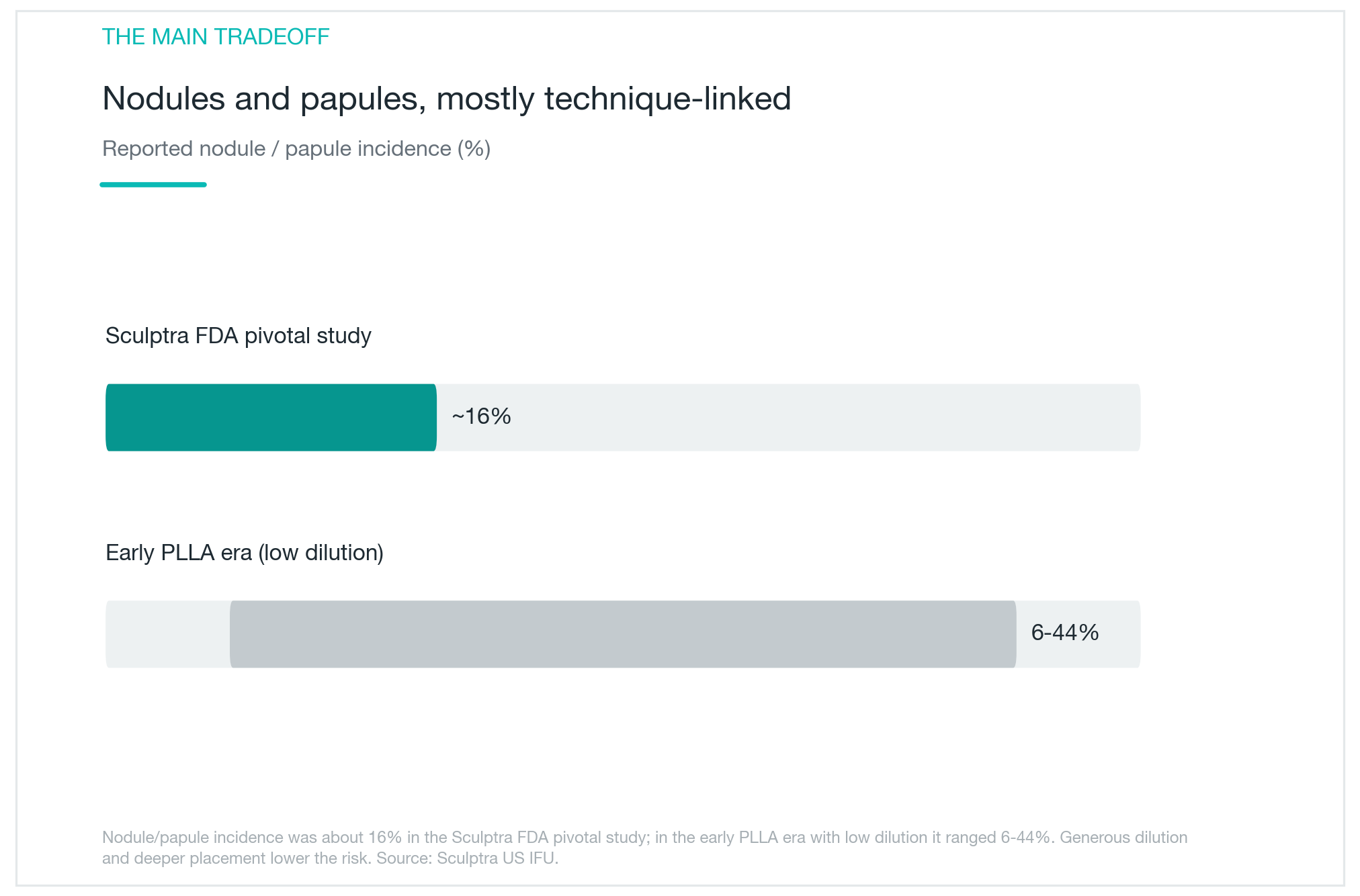
The side effect people worry about most with collagen-stimulating fillers is nodules, small palpable bumps under the skin. In Sculptra's FDA approval study, about 16%, or roughly 1 in 6 people, developed palpable nodules or papules. Most were small, symptom-free, and not very noticeable. However, nodules tend to appear late, often showing up months after the treatment.
This figure should be considered separately from the earlier era of PLLA, when less dilution was used. Back then, reported nodule rates ranged widely, from 6% to 44%. Later research confirmed that using more dilution lowers the nodule rate. With generous dilution and injection at the right depth, it is possible to keep the effect while lowering the risk of nodules.
Juvelook has shown a relatively low nodule risk in small studies. This is explained by PDLLA breaking down gradually from the inside out, causing less of a sharp change in acidity. Still, the risk is not zero, and there are reported cases of firm nodules forming after treatment under the eyes.
With both products, results depend heavily on the injector's skill. How well the product is reconstituted, the dilution volume, the injection depth, and how evenly it is spread all determine whether nodules are prevented and results look natural. Choosing an experienced injector with strong anatomical knowledge is the foundation for a safe outcome.
Criteria for choosing a product
Breaking down the evidence level shows a clear gap. Sculptra has several randomized controlled trials and a long track record of use, while Juvelook's evidence is centered on a single 20-patient preliminary study and small case reports. The commonly cited 12 to 18 month duration for Juvelook is, for now, mostly based on manufacturer and clinic explanations rather than a figure confirmed by large-scale clinical trials. It is worth keeping this difference in evidence weight in mind when making your choice.
| If you... | Consider |
|---|---|
| Want to feel volume from the day of treatment | Juvelook |
| Value a long track record of clinical evidence | Sculptra |
| Want volume across a broader area like the cheeks | Sculptra |
| Are mainly focused on skin texture and firmness | Juvelook |
That doesn't mean Juvelook falls short. Because it combines immediate volume with HA, it lets you feel a change from day one, and it is expanding its footing as a Korean option that also targets skin texture and firmness through shallow, skin-booster style injection. Sculptra's strength lies in its long-validated evidence for volume and lifting. Whichever you choose, results with both products depend heavily on the injector's skill, so the most important step is a thorough consultation with an experienced provider to determine the right area and amount for you.
Was this helpful?
About this article
Written by a practising aesthetic physician and intended for general education — not a substitute for individual medical advice.
Read next

Sculptra and Juvelook Volume: Differences and Duration Compared
Sculptra and Juvelook Volume both get filed under collagen-stimulating injectables, but they differ in ingredient and mechanism, particle shape, and how much evidence has stacked up. Here is a calm, research-based look at when results appear, how long they last, and what to weigh when choosing.
By Dr. Kim

Ellanse Filler and HA Filler: Duration and Effects Compared
Ellanse is a filler that combines PCL microspheres with CMC gel to deliver instant volume and ongoing collagen production. Here is what the evidence says about how it works, how long it lasts, and its side effects.
By Dr. Lee
Juvelook and Sculptra: PDLLA Ingredient Differences and Effects Compared
A clinical breakdown of Juvelook's PDLLA and hyaluronic acid combination, how it delivers immediate hydration alongside gradual collagen induction, how it compares to Sculptra, what the evidence supports, who it suits, and what side effects to expect.
By Dr. Kim