Ellanse Filler and HA Filler: Duration and Effects Compared
By Dr. Lee9 min read

When cheeks start to lose fullness or nasolabial folds become more noticeable, many people look for a treatment that keeps the area filled for a long time. Ellanse comes up often in that search. Right after injection, the gel component fills the area immediately, and over time new collagen forms within the skin to carry the effect forward. Unlike other collagen-stimulating treatments, it delivers a visible change from day one while still lasting more than a year. One thing worth knowing before treatment is that it cannot be dissolved with hyaluronidase. Here is a rundown, backed by evidence, of how Ellanse works, how well its effects and duration hold up, and how it differs from other fillers.
What is Ellanse filler made from?
Ellanse is a filler made by mixing microspheres of PCL (polycaprolactone) with CMC gel. Microspheres make up about 30% of the total formula, and the remaining 70% is CMC gel. Each microsphere is tiny, measuring 25–50µm.
The product is made by Sinclair, a UK company. Rather than simply filling space the way hyaluronic acid (HA) fillers do, it belongs to the category of biostimulators (collagen-stimulating fillers) that prompt the skin to produce its own new collagen. It is not permanent, though, and gradually breaks down in the body over time.
There is one important point to keep in mind. Hyaluronidase is the enzyme that dissolves HA fillers, but it has no effect on PCL. That means once Ellanse is injected, there is no way to reverse it immediately if you change your mind. It has approval from Korea's Ministry of Food and Drug Safety, but it has not yet received FDA approval in the United States.
It is mainly used in areas that need volume, such as the cheeks, temples, nasolabial folds, and jawline. Because it is a gel, it is injected into the deep dermis or subcutaneous fat layer with a syringe, using either a needle or a cannula depending on the area. While the ingredients differ from HA fillers, the procedure itself is similar in that it can be done right after a consultation at the clinic.
In what order does the gel leave and collagen fill in?
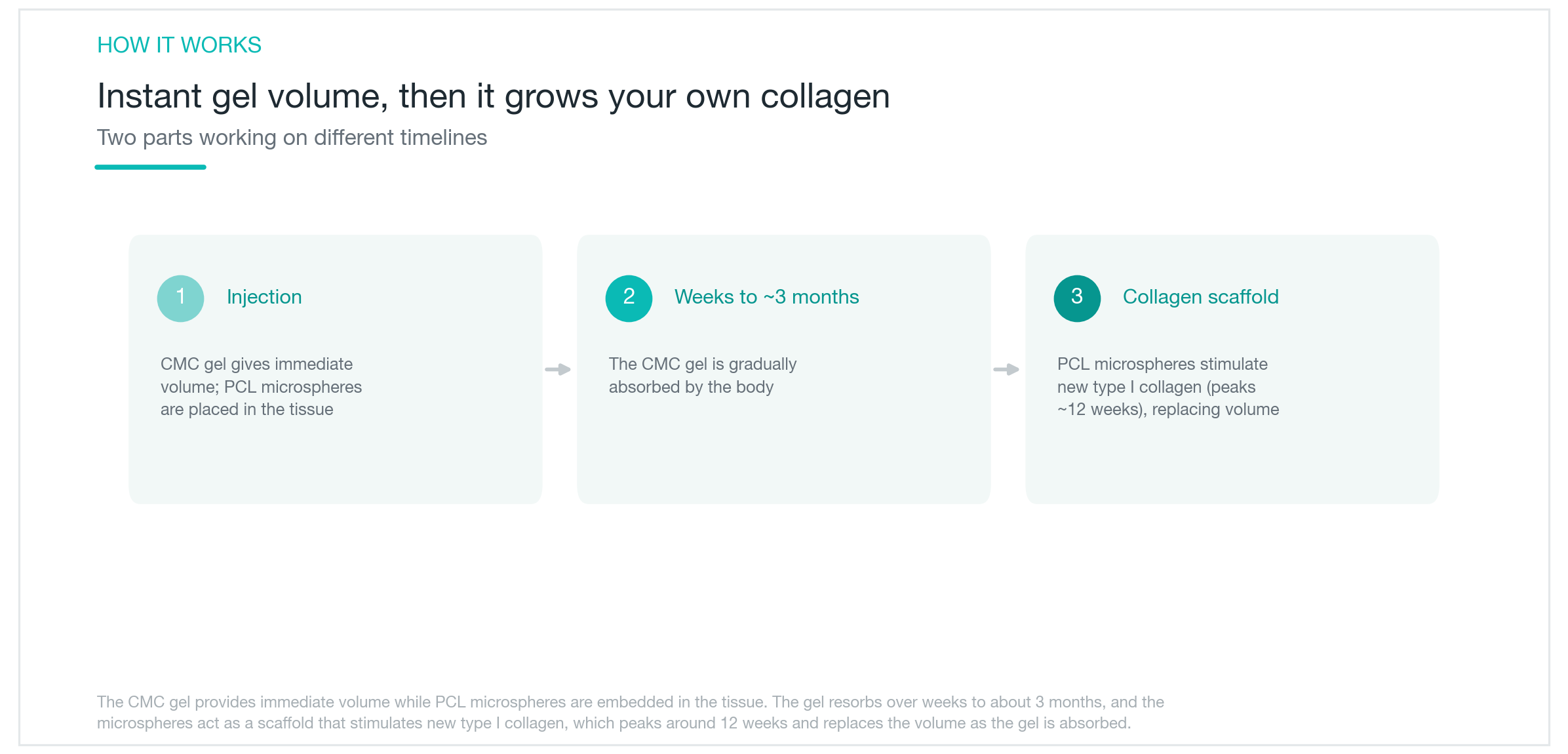
Ellanse works in two stages. Right after injection, the CMC gel immediately fills the area, giving instant volume. That is why the change is visible from the day of treatment.
Over the following weeks to three months, the CMC gel is gradually absorbed and disappears. During this period, the remaining PCL microspheres act as a scaffold, stimulating fibroblasts in the skin. As a result, new type 1 collagen begins to form.
Collagen production keeps increasing over time and appears to peak around 12 weeks (3 months). One study biopsied tissue six months after treatment and confirmed a real increase in type 1 collagen. Because new collagen takes over as the gel fades, the effect does not drop off sharply even during the period when the initial volume is receding.
Because of this sequence, how Ellanse feels on the day of treatment differs a bit from how it feels months later. At first, the volume created by the gel can give a somewhat plump look, and over the following months, as the gel fades and collagen settles in, the face tends to take on a more natural, refined look. This suits people who prefer a gradual, natural-looking change over an instantly finished result.

How many years does Ellanse last?
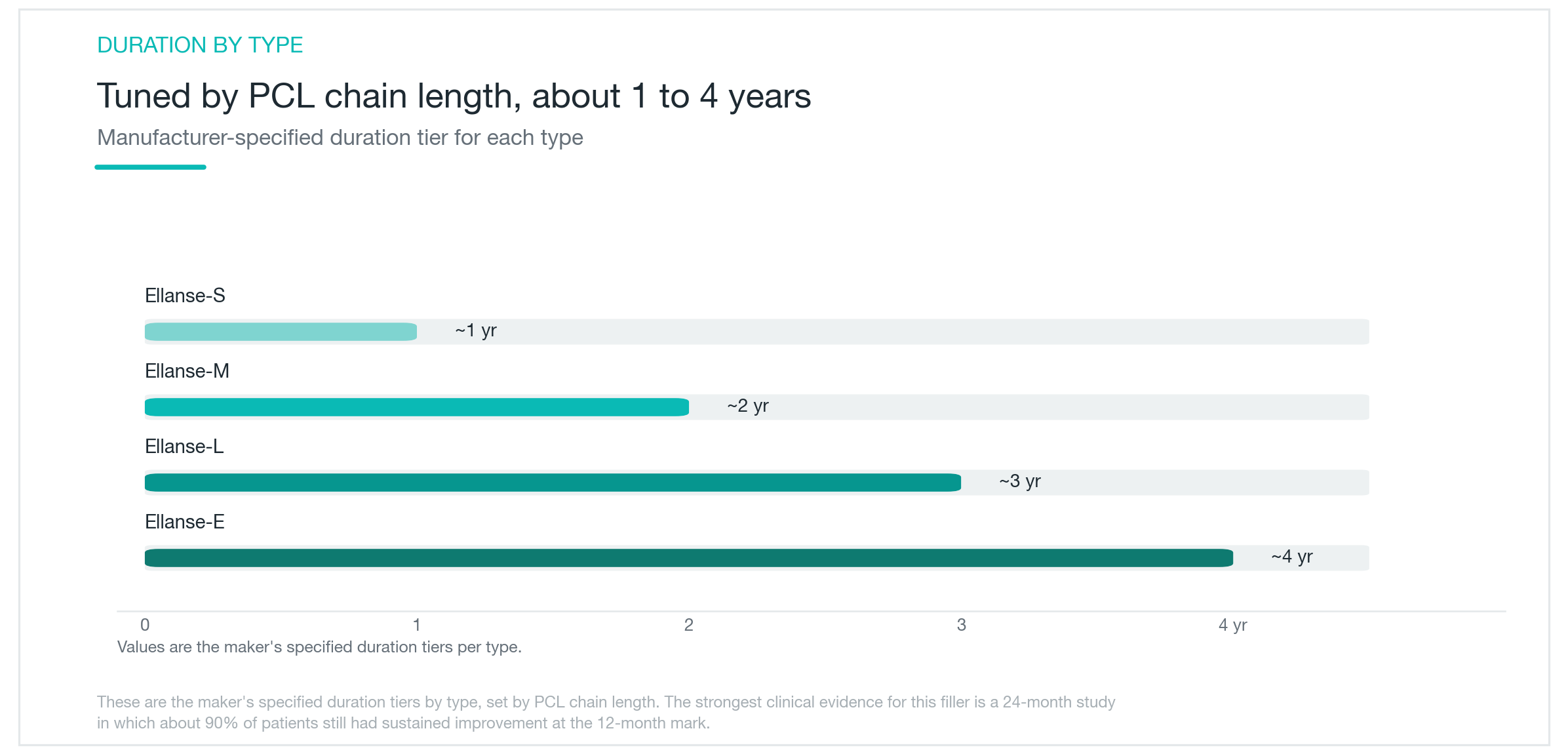
Ellanse comes in four types, S, M, L, and E, with duration varying based on the chain length used to make the microspheres. According to the manufacturer's specifications, the S type lasts about 1 year, M about 2 years, L about 3 years, and E up to about 4 years.
It is worth distinguishing, though, that this 1 to 4 year range comes from the manufacturer's specifications. The evidence actually confirmed in clinical trials comes from studies with shorter observation periods. In a 24-month randomized comparative study involving 40 people, the effect was still maintained at 90% and 91.4% at the 12-month mark.
In the same study, satisfaction at the 24-month mark was 72.4% and 81.7%. It is best to understand the manufacturer's 1 to 4 year range as a theoretical maximum depending on type, while the range with actual clinical evidence extends to about 2 years. Even so, that is a long duration compared with other fillers.
Choosing a type depends on both the treatment area and how long you want the effect to last. In areas with a lot of movement where a natural look matters, like the cheeks, doctors tend to choose a relatively shorter-acting type, while areas where longer-lasting results are wanted, like the jawline or beside the nose, tend to call for a longer type. Regardless of type, the full effect does not appear all at once but settles in gradually over several months.
Results of a nasolabial fold comparison study
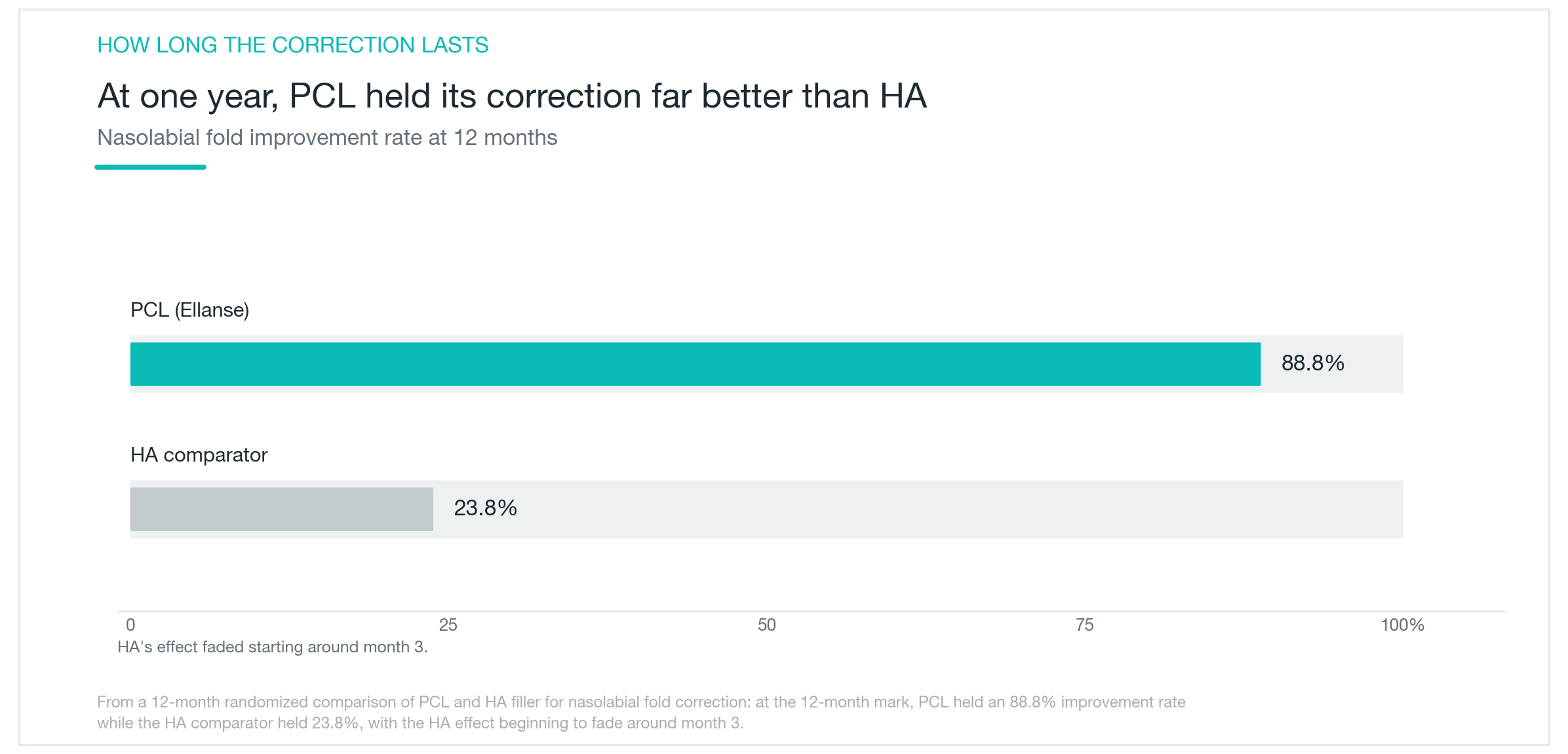
Among the studies confirming Ellanse's effect, one focused on nasolabial folds. Eighty people were split into two groups, one receiving Ellanse and the other an HA filler, and both were followed for 12 months.
At the 12-month mark, the wrinkle improvement rate was 88.8% for the Ellanse group versus 23.8% for the HA group, a statistically significant difference. The HA group's effect began gradually fading around the 3-month mark, while the Ellanse group's improvement is thought to have lasted longer because collagen production kept going.
Another study found that the M type of Ellanse held up just as well as the comparison product. A small case series of 9 people reported volume increases of 50–150% after 2 years, though with so few participants, it is hard to treat that as a representative average. Evidence that the mechanism of collagen stimulation translates into real improvement has been building up piece by piece this way.
The WSRS used in the nasolabial fold study is a grading scale that rates wrinkle depth to compare before and after treatment. Since both groups started out with similar wrinkle severity before treatment, the difference seen at 12 months can be attributed to a real difference in how long each product lasts. HA fills volume quickly at first but is gradually absorbed over time, while Ellanse's improvement lasted longer as collagen kept forming.
What are the side effects of a filler that can't be reversed?
If an HA filler does not look right or causes a problem, it can be reversed the same day with a hyaluronidase injection. That option does not exist with Ellanse. Once it is injected, it stays in place until the body breaks it down on its own.
That is why correcting an issue like slight misplacement, a nodule, or a vascular problem is much more difficult. It is especially important to be treated by a practitioner with strong anatomical knowledge and plenty of experience, and to carefully decide on the treatment area and amount beforehand.
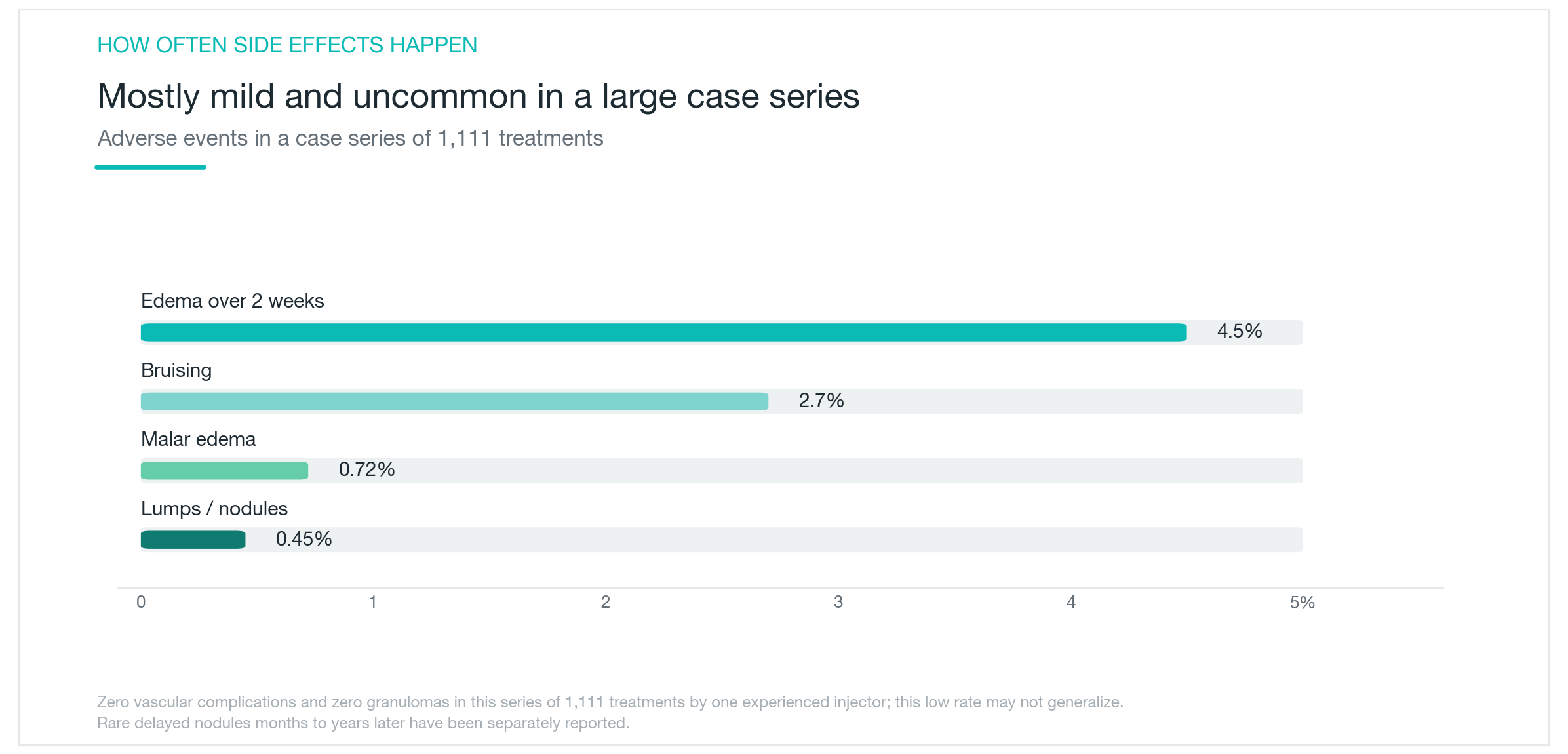
In data from a single experienced practitioner who treated 1111 cases, swelling lasting more than 2 weeks occurred in 4.5%, and bruising in 2.7%. Cheek edema appeared in 0.72% and temporary nodules in 0.45%, with no vascular problems, granulomas, or infections. Since this reflects the results of one experienced practitioner, though, it is hard to assume the nodule rate is always this low. There have also been rare reports of nodules or foreign body reactions appearing much later, such as 9 months or even 3 years after treatment, so regular follow-up checks after the procedure are a good idea.
Thoroughly assessing the facial vascular anatomy during consultation and avoiding injecting too much volume at once both matter for a safe outcome. Given that this filler cannot be reversed, it is reassuring to take time during the consultation to get a full explanation rather than deciding on the area and amount in a hurry.
How does it differ from other fillers?
Among collagen-stimulating fillers, Ellanse, Sculptra, and Radiesse each have their own distinct character. Here is a comparison.
| Category | Ellanse (PCL) | Sculptra (PLLA) | Radiesse (CaHA) | HA filler |
|---|---|---|---|---|
| Instant volume | Yes | No | Yes | Yes |
| Mechanism | PCL microspheres stimulate new collagen | PLLA stimulates new collagen only | Instant volume plus collagen stimulation | Fills volume, no stimulation |
| Duration | 1–4 years | About 24 months | 12–18 months | 6–18 months |
| Reversible | No | No | No | Yes |
Radiesse is made of CaHA, and like Ellanse, it gives instant volume right after injection while also stimulating collagen production, though its duration of 12–18 months is shorter than Ellanse's. Sculptra is made of PLLA and has no instant volume effect, so there is little visible change right after injection, with collagen gradually building up over the following weeks. It suits treatments aimed at long-term results rather than an immediate change.

HA fillers focus on filling space rather than stimulating collagen, so they typically last 6–18 months, but they come with the safeguard of being reversible at any time with hyaluronidase. If you want visible change from day one along with long-lasting results, Ellanse or Radiesse is a good fit. If you prefer a natural, gradual fill, Sculptra is the better choice. And if you want to keep the option of changing your mind, a reversible HA filler is the safer choice. Ellanse's strengths are its instant volume, long duration, and adjustable types, but its most defining feature is that it cannot be reversed, so it is worth fully understanding that before choosing it.
Was this helpful?
About this article
Written by a practising aesthetic physician and intended for general education — not a substitute for individual medical advice.
Read next
Ellanse PCL Filler Duration: Why Each Type Lasts a Different Length of Time
Ellanse works in two stages: its gel fills volume instantly while the PCL microspheres inside it slowly recruit your own collagen. Here's a plain-language breakdown of how that works and why each type lasts a different amount of time.
By Dr. Kim
Radiesse Filler: Results, How Long It Lasts, and Collagen Production
Radiesse is a filler whose calcium microspheres fill volume instantly while also triggering new collagen production. Here is a mechanism-focused look at why the particles create volume, how that leads to collagen stimulation, why diluted Radiesse is used as a skin booster, and how long results actually last.
By Dr. Lee

Parotid Botox and Masseter Botox: Differences and Effect Compared
Parotid gland Botox injects botulinum toxin into the parotid salivary gland to shrink its volume and slim the jawline. It targets a different tissue and location than masseter Botox, which works on muscle. Here is what the evidence says about dosing, how long it lasts, and side effects like dry mouth.
By Dr. Kim