Ellanse PCL Filler Duration: Why Each Type Lasts a Different Length of Time
By Dr. Kim8 min read
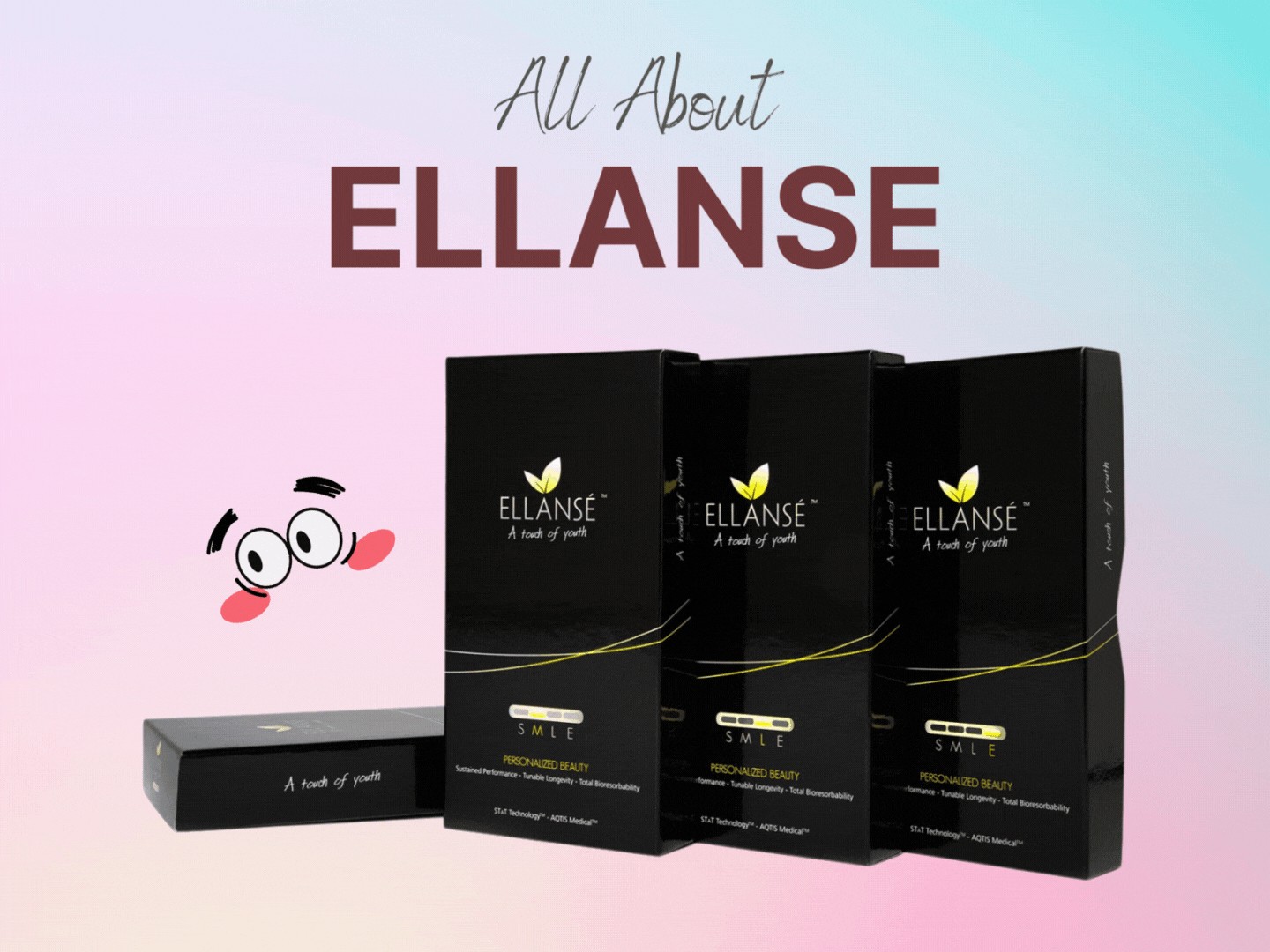
When people hear "filler," they usually picture hyaluronic acid (HA) fillers first. You get volume the moment it's injected, and the body gradually absorbs it over time. Ellanse works a little differently. It does fill volume right away, just like HA, but it also has a second act: tiny particles suspended inside it spend the next 12 weeks recruiting your own collagen.
That's why you often hear Ellanse described as delivering "instant results and long-term results at the same time." Once you understand why that's actually possible, and what's happening inside the skin as time passes, it also makes sense why its longevity differs from other fillers.
What is Ellanse filler made of?
Ellanse isn't made of a single ingredient. It's built from two components. One is a gel that's biocompatible and slowly dissolves in water over time. The other is a set of microscopic particles evenly suspended inside that gel: PCL (polycaprolactone) microspheres.
Think of the gel as the carrier fluid moving the particles into place, and the PCL microspheres as tiny seeds floating in that fluid. At the moment of injection, the gel and the "seeds" go in together and create volume. As time passes, the gel gradually clears out while the particles stay behind and get to work growing new tissue right where they landed. The fact that these two ingredients play different roles at different points in time is the key to understanding how Ellanse works.
A simple way to picture it: imagine watering a flower bed and scattering seeds at the same time. The water sinks into the soil and disappears within a few days, but the seeds stay in the ground and slowly take root. Ellanse works much the same way. The gel gets absorbed first and clears the way, while the PCL particles remain in place for the long haul, continuing to build new tissue.
Why does it add volume right away?
The gel portion of Ellanse is made of carboxymethylcellulose (CMC). The name sounds technical, but what it does is straightforward. CMC absorbs water and swells, so the moment it's injected, it acts like a cushion that fills out the space. Picture a dry sponge dropped into water, swelling up almost instantly. That water-absorbing property is what lets it create volume on the spot, with no chemical reaction required.
This is why you see visible volume right after treatment, similar to how HA fillers smooth things out immediately after injection. The difference is that Ellanse's gel gradually gets absorbed by the body over time, much like water soaking away. It typically clears over roughly 6 to 8 weeks. If the gel were doing all the work, volume should keep shrinking as it disappears, but in practice, results tend to hold up far better than that. The reason lies in the PCL microspheres, which is what the next section covers.
How does PCL stimulate collagen?
PCL is a synthetic polymer that's also commonly used in surgical sutures and other medical materials, known for breaking down in the body slowly and safely. Inside Ellanse, it takes the form of tiny round particles, invisible to the naked eye, spread evenly throughout the gel.
Once these particles settle into the skin, the body recognizes them not as its own tissue but as a foreign material. Whenever something foreign enters the body, a natural response kicks in to wall it off and surround it with new tissue. In that process, fibroblasts, the cells responsible for producing collagen, gather around each particle. Collagen can be thought of as the structural protein that props up your skin, like scaffolding. As fibroblasts start weaving that scaffolding, a thin collagen shell forms around each individual particle.
In other words, the PCL particle itself doesn't add bulk. It acts as a trigger that prompts your own body to manufacture collagen. It's similar to how planting a seed causes roots to grow on the spot.
It resembles what happens when a small splinter gets lodged under the skin and new tissue grows around it to wall it off. It's also comparable to how, after a wound is stitched, the suture material slowly dissolves while sturdy tissue forms around it, which is part of why PCL particles can be used safely inside the body.
What makes this response notable is that it doesn't stop at a single particle. It happens evenly across the entire area where the particles are dispersed. Because the particles are mixed uniformly throughout the gel rather than clumped in one spot, the resulting collagen is said to spread out just as evenly, leading to a more natural-looking volume.
How many weeks until collagen settles in?
This process doesn't wrap up overnight. Encasing a single particle in collagen takes about 4 to 6 weeks, and building up sufficient collagen across the entire treated area typically takes around 12 weeks.
The pace at which the body produces new collagen is fixed, and rushing it doesn't speed things up. It's the same logic as a wound: new skin doesn't appear in a day, it heals gradually over 1 to 2 weeks.
During this period, two things are happening inside the skin at once. The gel that was initially injected is slowly clearing out, while newly formed collagen fills in behind it. It's a bit like a relay handoff. Early on, the gel carries the volume, and as time goes on, the collagen your body has built takes over that role. That's why the volume right after treatment and the volume at 12 weeks aren't really the same thing at all. One is injected gel, and the other is genuine tissue your body made on its own.
Why does duration differ between types?
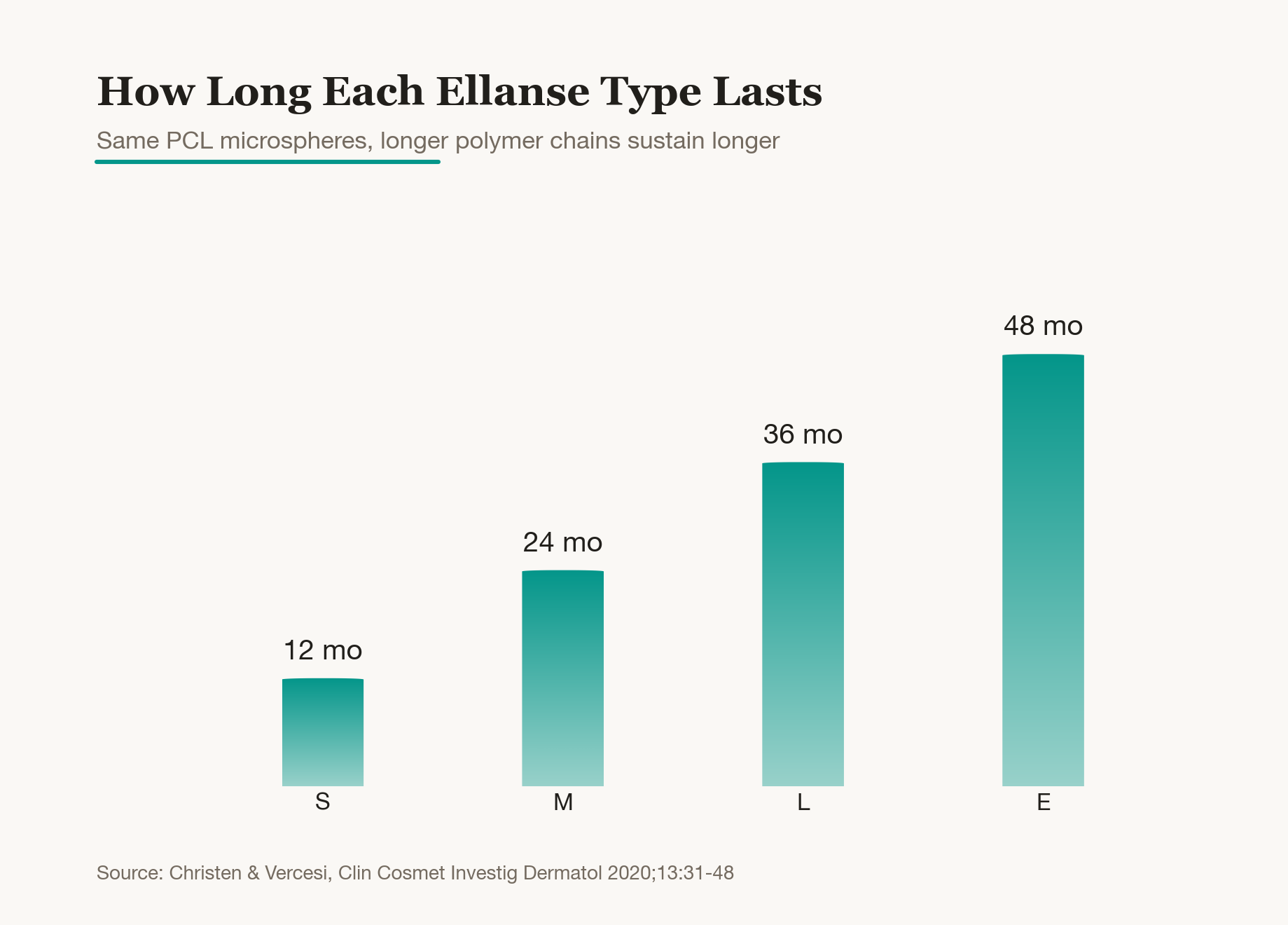
Ellanse isn't a single product. It comes in several types, S, M, L, and E, and each one is said to last a different length of time. If they all work on the same principle, why does the duration change? The answer isn't particle size or gel viscosity. It comes down to the length of the polymer chains that make up the PCL, in other words, its molecular weight.
- Regardless of type, the PCL particles are the same size, 25 to 50 micrometers, and the CMC gel concentration is matched too. So attributing the difference in longevity to particle size or gel viscosity isn't accurate.
- The real difference lies in how long the polymer chains that make up the PCL are. Longer chains with a higher molecular weight take the body longer to break down through hydrolysis, while shorter chains with a lower molecular weight break down comparatively faster. It's like rope: a thick, long strand takes much longer to unravel than a thin, short one.
- Since slower breakdown stretches out the window during which collagen is being stimulated, types built with longer PCL chains tend to last longer overall.
- Areas with thin skin and dense blood vessels, like around the eyes, generally aren't treated with Ellanse in the first place. The particles can be felt or become visible under such thin skin, and because vessels there need to be treated with extra caution, other fillers or procedures tend to be considered first.
These differences are exactly why the choice of type depends on the treatment area and how long you want the results to last. Whether an area calls for something firm and long-lasting, or something lighter and shorter-lived, is what guides a provider's choice between types.
Aftercare and precautions
Collagen formation isn't an instant reaction that finishes with a single visit, it's a biological process that unfolds gradually over about 12 weeks. That means judging the final result based only on the swelling or volume changes seen in the first 2 to 5 days is premature.
Pressing hard on the treated area or massaging it isn't recommended, since it can push the gel and particles in unintended directions. If the area is pressed repeatedly before the gel has settled, the particles can shift out of place and clump together, creating an uneven, lumpy texture. That's why leaving the area alone for the first 1 to 2 weeks after treatment helps everything settle evenly. Since how well collagen forms can also be influenced by individual healing capacity and lifestyle habits, it's natural to give the process enough time and check back with your provider if anything seems off.
Some mild swelling or bruising around the injection sites in the first 2 to 5 days is considered a normal response to introducing the gel and particles, and it typically settles on its own. Once the results have run their course, many people return for another session to repeat the process and maintain the effect.
References
Korean Dermatological Association, Ministry of Food and Drug Safety (MFDS), American Academy of Dermatology (AAD), and U.S. Food and Drug Administration (FDA).
Was this helpful?
About this article
Written by a practising aesthetic physician and intended for general education — not a substitute for individual medical advice.
Read next

Ellanse Filler and HA Filler: Duration and Effects Compared
Ellanse is a filler that combines PCL microspheres with CMC gel to deliver instant volume and ongoing collagen production. Here is what the evidence says about how it works, how long it lasts, and its side effects.
By Dr. Lee
Radiesse Filler: Results, How Long It Lasts, and Collagen Production
Radiesse is a filler whose calcium microspheres fill volume instantly while also triggering new collagen production. Here is a mechanism-focused look at why the particles create volume, how that leads to collagen stimulation, why diluted Radiesse is used as a skin booster, and how long results actually last.
By Dr. Lee
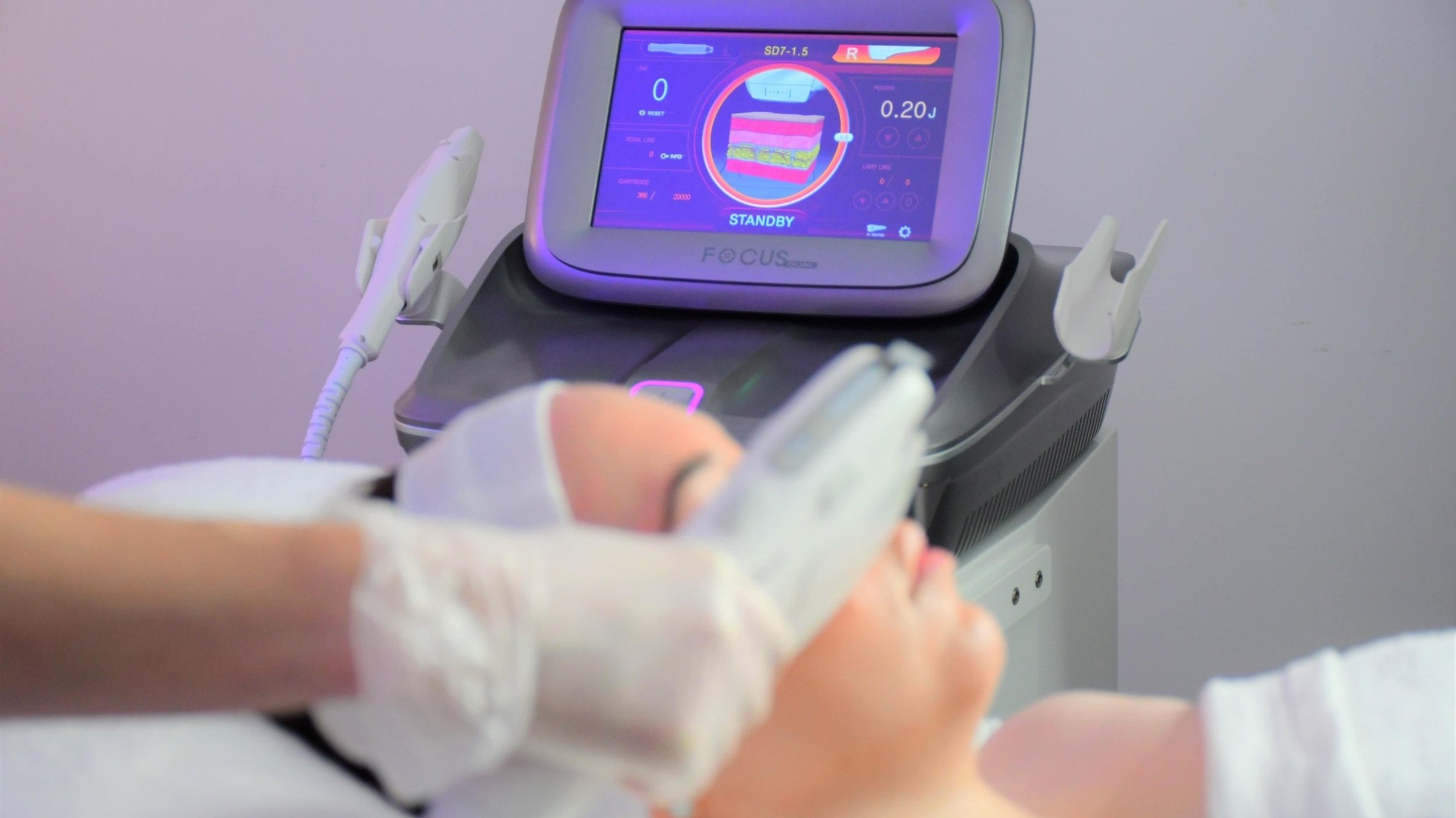
HIFU Lifting Effects and How It Works, Including Sessions and Duration
Here's why HIFU lifting targets a deeper layer called the SMAS rather than the surface of your skin, starting with how focused ultrasound converges at a single point. We break down the two stages: the immediate tightness you feel right after treatment, and the collagen that builds gradually over 4 weeks to 6 months.
By Dr. Lee