Juvelook and Sculptra: PDLLA Ingredient Differences and Effects Compared
By Dr. Kim8 min read
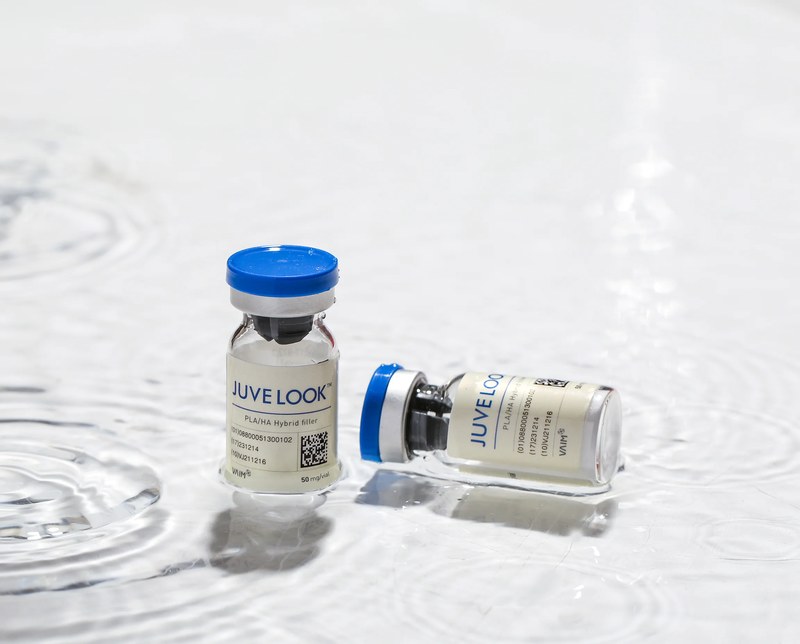
The question I get more than almost any other: "What's the difference between Juvelook and Sculptra?" Both stimulate collagen, and patients have that part right. But all collagen biostimulators share an inconvenient truth: they're slow. You have the treatment, and then you wait. Weeks pass before anything is visible, which is genuinely frustrating. Juvelook was designed around that frustration. It pairs PDLLA (poly-D,L-lactic acid) with hyaluronic acid: immediate hydration upfront, sustained collagen induction in the background. The PDLLA component branches off the same polylactic acid family tree as Sculptra's PLLA, a biodegradable microparticle that triggers your own collagen rather than filling volume from outside. It's a relatively new product, which means marketing enthusiasm has outpaced long-term data in some corners. What follows covers what's actually known: the mechanism, how it differs from Sculptra in ways that matter clinically, where the human evidence stands, and who this treatment genuinely suits.
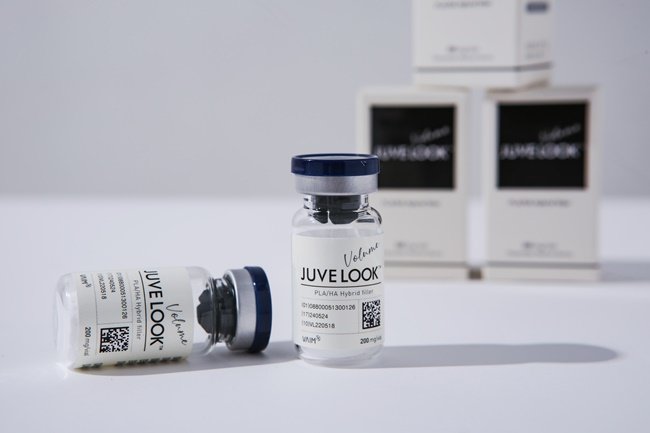
An injection that contains PDLLA and hyaluronic acid together
Juvelook is a hybrid: two active ingredients doing two different jobs. The hyaluronic acid component delivers immediate volume and hydration; patients notice something the same day. The PDLLA is the slower player: biodegradable microparticles distributed through the dermis that gradually trigger collagen production. In the early weeks, the HA holds the space. As it breaks down and clears, your own newly formed collagen fills in behind it, a handoff rather than a cliff. That's the central design concept, and why patients tend to describe a more continuous arc of improvement compared with biostimulators used alone.
Within the broader injectable landscape, Juvelook sits between two categories. It's not a traditional HA filler like Juvederm or Restylane, which add external volume. It's also not a pure tissue-quality treatment like polynucleotide (PDRN/PN) therapy, which targets hydration and cellular repair without structural support. Juvelook sits somewhere between them: collagen stimulation as the long game, HA as the bridge to get there.
One caveat worth stating early: Juvelook is newer than Sculptra and doesn't yet carry the same depth of long-term clinical literature. The current evidence base rests primarily on PDLLA as an ingredient category, supplemented by smaller product-specific studies. Large-scale, long-term trials for Juvelook specifically are still accumulating data. I tell patients this at the first consultation. The science supports optimism, but it's important to be clear about how much of that optimism is mechanism-based versus outcome-proven.
In what order does collagen build up?
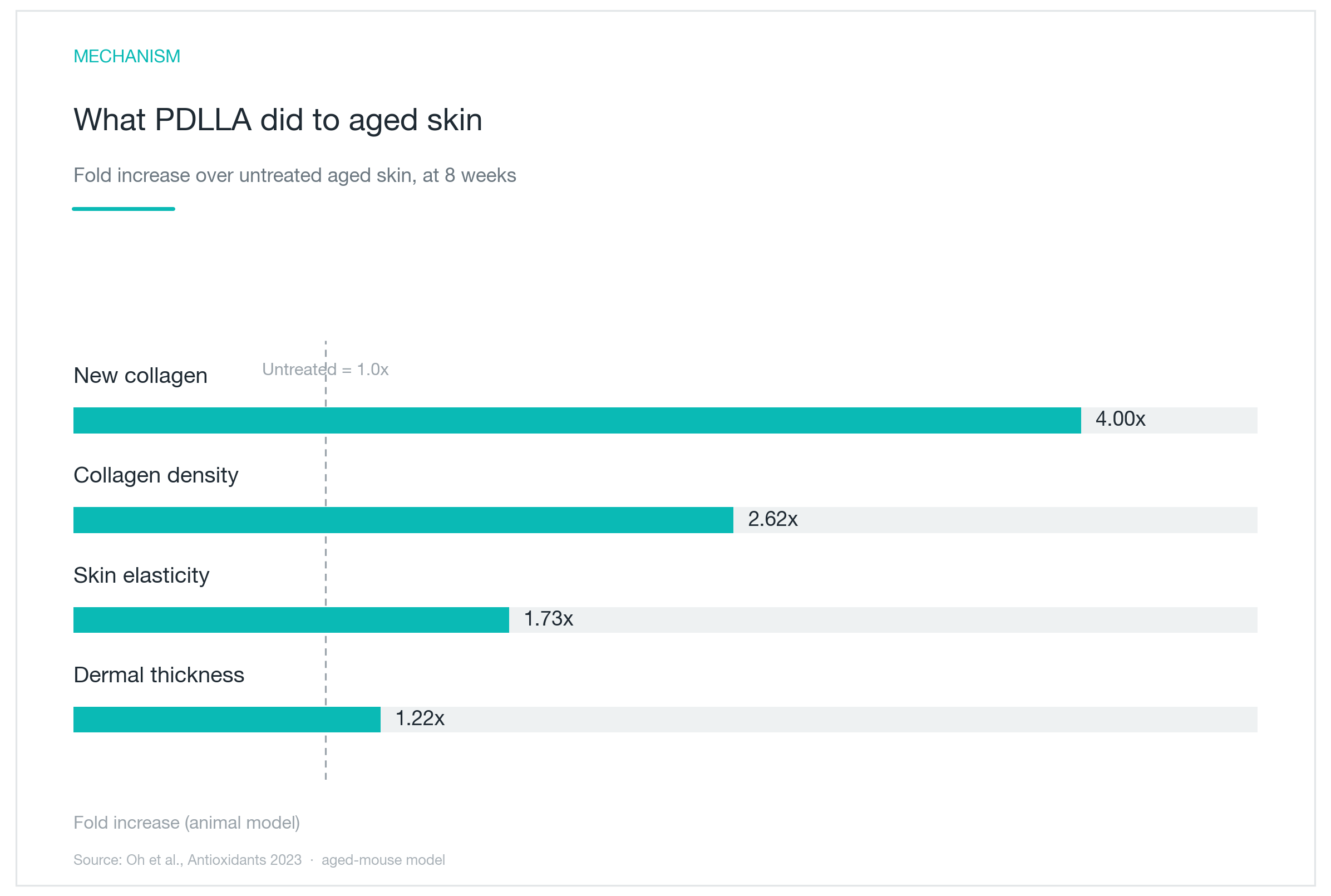
The bar graph above comes from an animal study of aged skin treated with PDLLA, evaluated at eight weeks. Against untreated skin as the 1.0× baseline, new collagen production reached 4×, collagen density 2.62×, and skin elasticity 1.73×. Every bar clears the baseline by a substantial margin.
Mechanistically, the sequence goes like this: PDLLA microparticles enter the dermis and trigger an initial macrophage response. That activates local dermal stem cells, which begin releasing growth factors, primarily TGF-β and FGF2. These signals instruct fibroblasts to produce collagen and elastin, rebuilding the extracellular matrix from within. The result is new structural tissue, not injected filler. The HA in the formula plays a supporting role during this window, maintaining hydration and some temporary lift while collagen induction is still underway.
The animal-study caveat applies here. These numbers don't translate directly to human facial skin; tissue thickness, cellular density, and repair kinetics differ. What the data credibly shows is that PDLLA is a meaningful collagen stimulus. What it can't tell us is exactly how much in any given patient. In practice, I see real variation: some patients respond robustly, others more modestly, and the determining variable appears to be fibroblast responsiveness, something we can't precisely predict beforehand. The logical next question is what happens in human trials.
Particle and ingredient differences from Sculptra
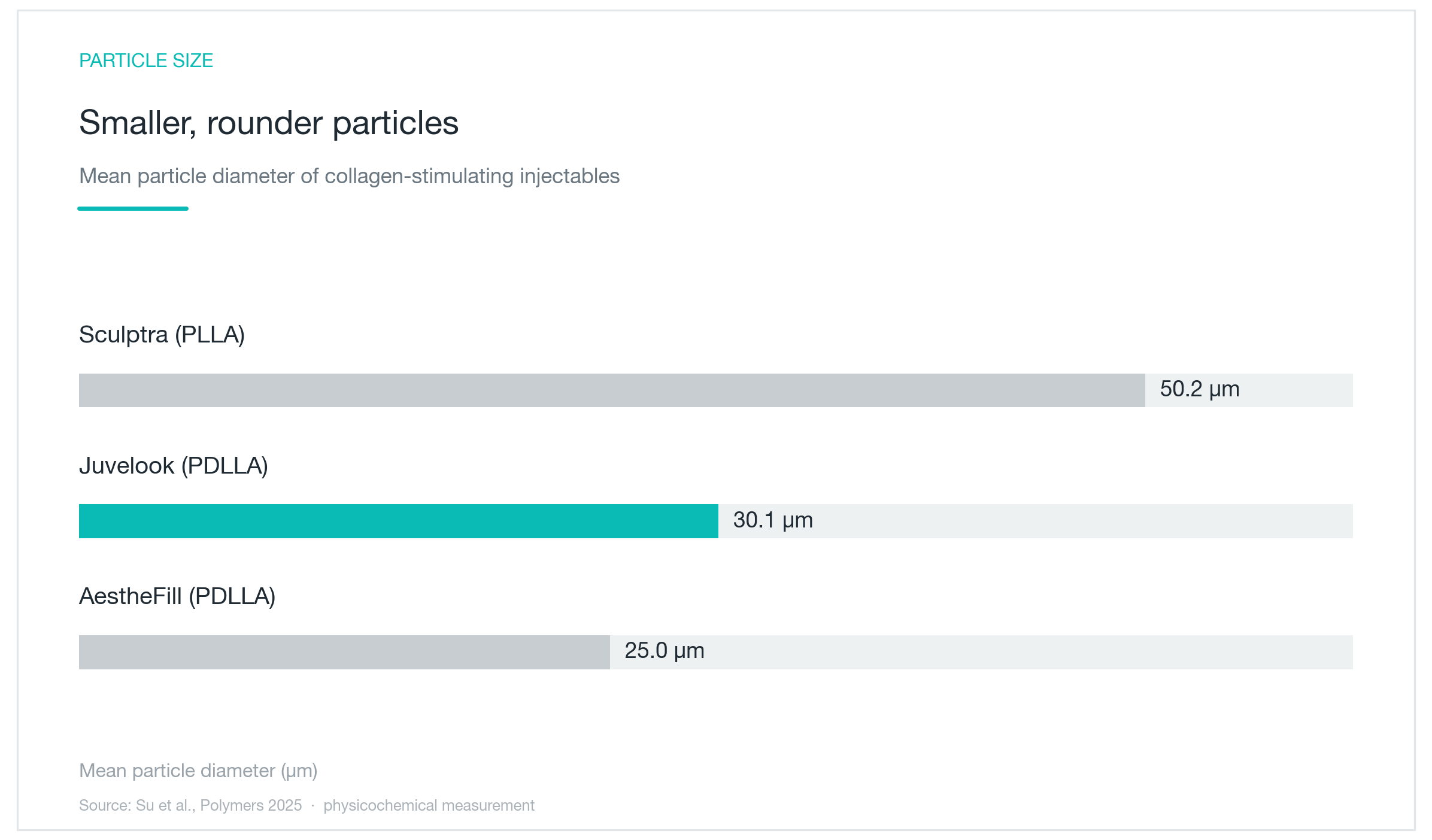
The comparison above makes the first difference concrete: particle size. Juvelook's PDLLA microparticles average around 30 µm; Sculptra's PLLA particles average around 50 µm. Shape also differs. PDLLA particles are rounder and more spherical, while PLLA particles are more irregular and plate-like. Smaller, rounder particles distribute more evenly through tissue and are less likely to clump into palpable nodules.
The molecular architecture differs as well. PDLLA is amorphous: its polymer chains lack a regular crystalline arrangement, which allows for more uniform, predictable degradation. PLLA contains crystalline regions that degrade more slowly and less evenly. Then there's the formulation difference patients feel most directly: Juvelook contains HA, so there's something perceptible on day one. Sculptra contains no HA, meaning the early weeks show essentially nothing, and the full effect builds over months. That said, Sculptra has decades of clinical data and FDA approval behind it. That's not a trivial advantage, and I don't dismiss it.
These are complementary tools, not head-to-head competitors. Sculptra tends to fit patients looking for longer-lasting, broad structural volume restoration in areas like the midface or temples, delivered over a multi-session program. Juvelook tends to fit patients who want overall skin quality improvement across larger surface areas, with at least some early visible change, and who are willing to commit to a few sessions over several months. Which one fits depends on the area, the timeline, and what the patient is actually trying to solve.
Are effects confirmed in human faces?
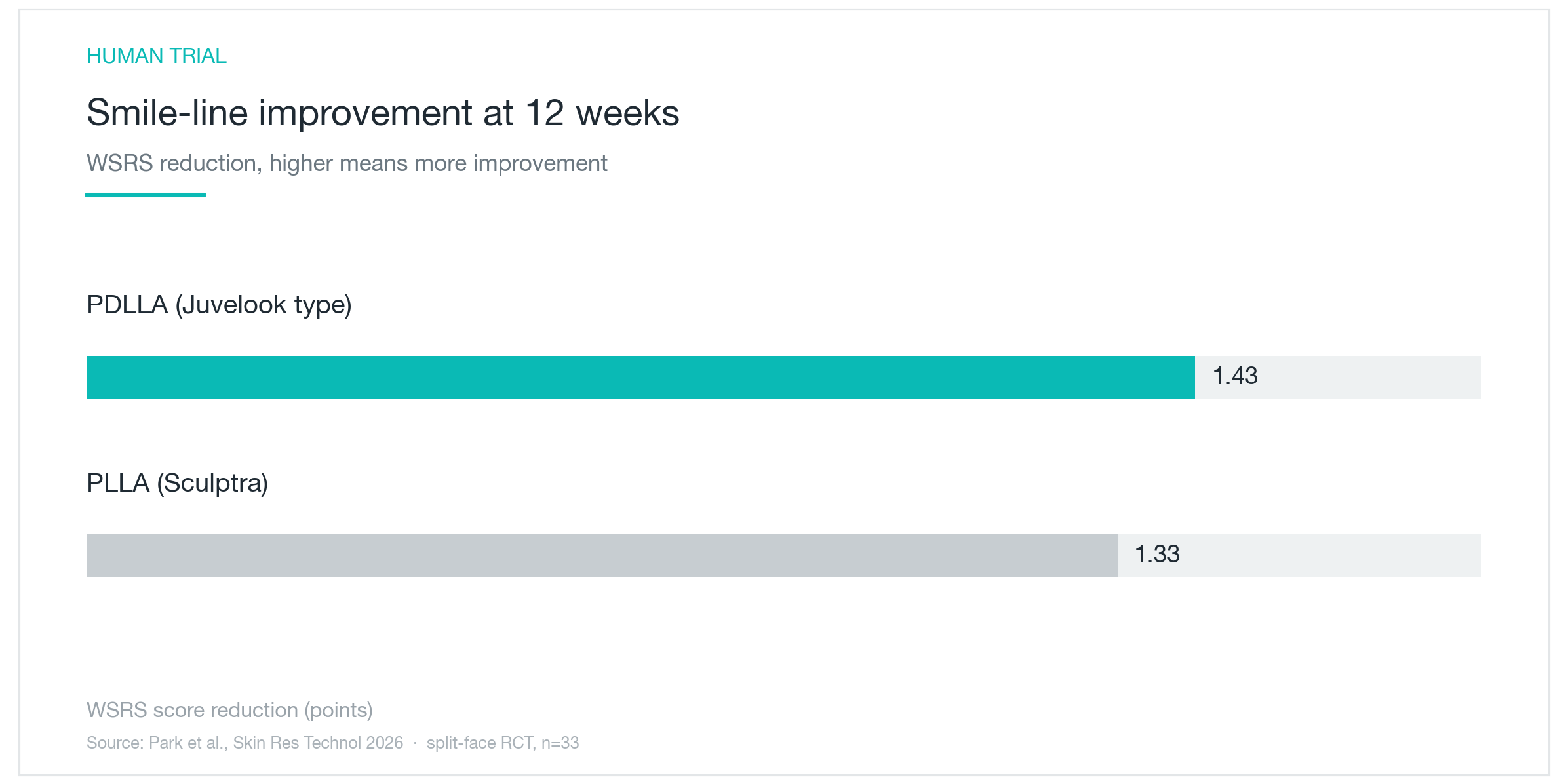
The study above is the most relevant head-to-head comparison available right now. Thirty-three participants received PDLLA on one side of the face and Sculptra's PLLA on the other, a split-face design that controls well for individual variation. At 12 weeks, wrinkle severity scores in the nasolabial folds improved 1.43 points in the PDLLA group and 1.33 points in the PLLA group. Statistically comparable. A newer formulation holding its own against the established standard is meaningful, even at this sample size.
The same study found sustained improvement through week 24. Over 80% of participants rated satisfaction as good or better. No nodules were observed. One episode of temporary swelling and tenderness appeared after the second injection, a side effect that was transient and manageable.
Thirty-three participants is a small study. Juvelook-specific long-term data from larger trials hasn't been published yet; those trials are ongoing. Separate smaller studies on the same PDLLA-plus-HA formulation have confirmed increased dermal collagen and elastin on biopsy post-treatment, which adds mechanistic support, but sample sizes remain limited.
The current picture: PDLLA stimulates collagen. Early human data shows results on par with Sculptra in the short to medium term. Long-term efficacy and safety data specific to Juvelook is still accumulating. I make a point of separating "there's evidence this works" from "there's enough evidence to be fully confident long-term." The first is true. The second isn't there yet.

Who it suits and who it isn't recommended for
The patients who respond best, in my experience, share a particular profile: diffuse skin quality decline, mild laxity, rougher texture, and early fine lines across larger surface areas, rather than a defined area of focal volume loss. They want to improve the skin's foundation broadly, not sculpt a specific contour. They want at least some early visible response, not months of patience with nothing to show. And they're comfortable with a multi-session approach, typically two to three sessions spaced about four weeks apart, and a gradual, natural progression of change.
Where I'm less likely to recommend Juvelook: patients with significant midface hollowing who need meaningful structural volume are usually better served by a volumizing HA filler like Juvederm Voluma or Restylane Lyft, which is faster, more predictable, and more controllable. Patients with moderate to significant facial sagging generally do better when a lifting modality (thread lift, HIFU, radiofrequency microneedling) is part of the plan alongside any biostimulator work. Juvelook builds the foundation; it doesn't reposition tissue. That distinction gets confused more often than it should.
Technique matters considerably with this product. I use a fine cannula to deposit small aliquots through the dermis, distributing them evenly to prevent any local concentration of particles, which is the simplest way to reduce nodule risk. Bruising and swelling for a few days after treatment are common. Nodule formation is possible, and risk increases with improper technique, injecting too superficially, or using larger-particle formulations in areas where they don't belong. Juvelook is contraindicated during pregnancy and in any area with active infection or inflammation.
The bottom line on risk: this is a newer injectable with a sound mechanism and promising early results, but not yet a deep long-term safety record. That's not a reason to avoid it; it's a reason patients should understand both what it offers and what's still being established, and should seek out practitioners with real hands-on experience in biostimulator technique before committing.
Was this helpful?
About this article
Written by a practising aesthetic physician and intended for general education — not a substitute for individual medical advice.
Read next
Juvelook and Sculptra Differences: When Effects Appear and Lump Side Effects Compared
Juvelook is a collagen-stimulating filler that combines PDLLA with HA, while Sculptra is made purely of PLLA. Here is a verified breakdown of how they differ in immediate volume, collagen-stimulating mechanism, duration, and evidence level.
By Dr. Lee
Radiesse Skin Booster: Results, How Long It Lasts, and Differences From Sculptra
Radiesse (CaHA) delivers immediate volume while triggering your body to produce new collagen in the neck, décolleté, and hands. What the biopsy data and ultrasound measurements actually show, how long results last, how it compares to Sculptra, and who makes a good candidate.
By Dr. Lee
CELLREDM and Re2O: Differences and How Long Their Effects Last
CELLREDM delivers human-derived extracellular matrix directly into the dermis rather than waiting on collagen stimulation. An honest clinical breakdown of its ECM composition, the phADM split-face trial data (Lee YI et al., IJMS 2026), how it compares to Re2O, and who is genuinely a good candidate.
By Dr. Lee