Juvederm Filler Types Compared: Voluma and Volbella Duration
By Dr. Lee7 min read
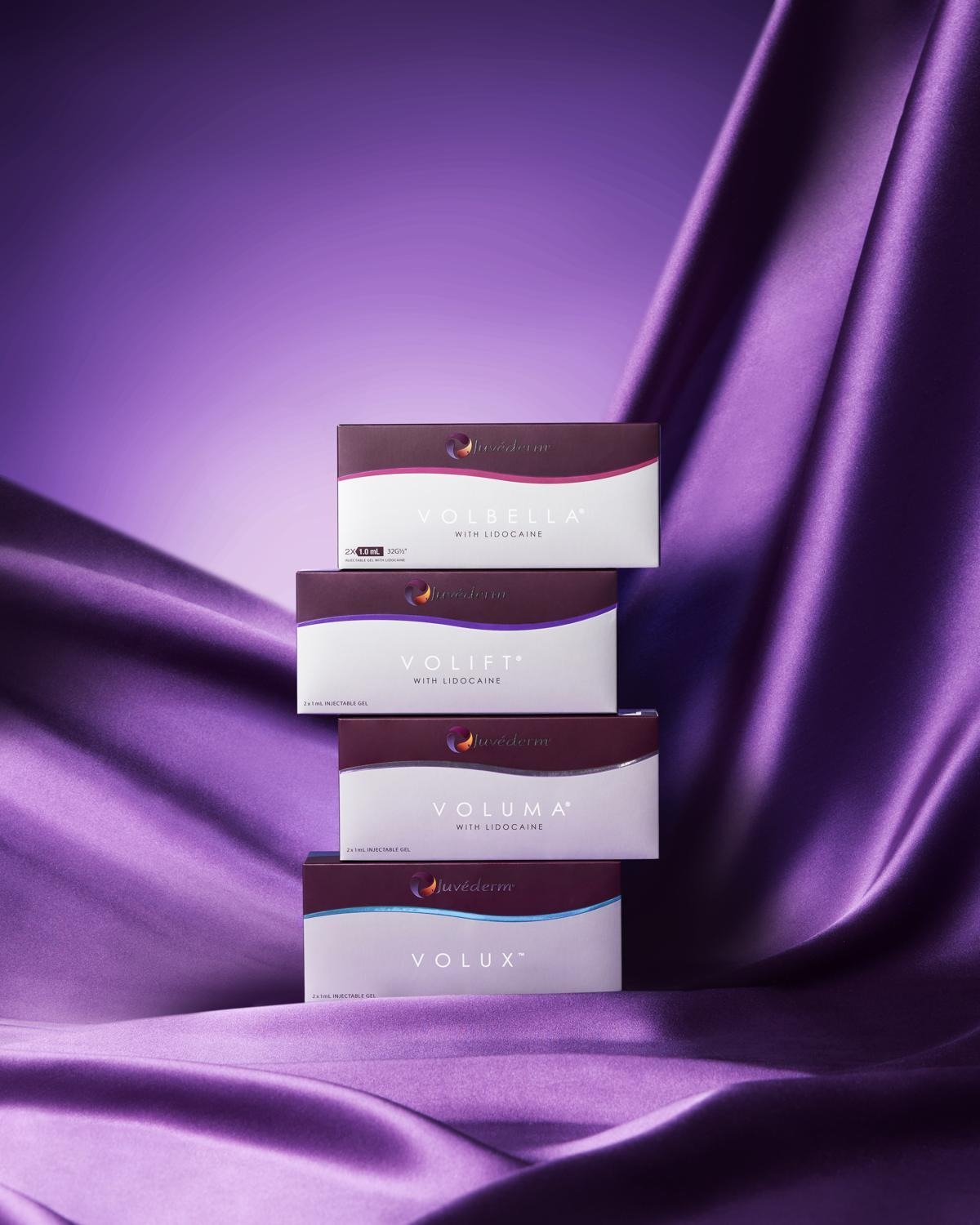
If you've been looking into fillers, Juvederm is probably the name you encounter most. The confusing part is all the suffixes: Voluma, Volux, Volbella, Volift, Vollure, Ultra, Ultra Plus. It's easy to wonder what any of it means and which one would actually apply to you.
The short answer: Juvederm is not a single product. It's a family of hyaluronic acid fillers made by Allergan, each one formulated with different firmness and depth for a different area of the face. Some are firm enough to rebuild cheekbones or define the jawline. Others are soft enough for lips or under the eyes. The one thing every member of the family has in common is reversibility. If something goes wrong or you simply don't like the result, there is an enzyme that dissolves it. Below is a breakdown of what Juvederm is, why there are so many lines, how long each one lasts, and what the safety data actually shows.
Is Juvederm a single product?
Juvederm is a hyaluronic acid (HA) filler made by the American company Allergan. HA is a molecule that occurs naturally in the skin. It binds water and keeps tissue plump and hydrated. In filler form, it's processed into a gel and injected directly into areas that have lost volume, restoring fullness immediately.
A bit of background on how it works. Pure HA breaks down quickly in the body, so Allergan cross-links the HA chains using a compound called BDDE. Cross-linking is what gives the gel structure. The more tightly cross-linked it is, the firmer and longer-lasting it becomes. Juvederm uses two cross-linking technologies. The older one is called Hylacross. The newer one is Vycross, which blends HA molecules of different sizes to pack them more tightly. The practical difference: Vycross products tend to produce less post-injection swelling and hold their shape longer.
One thing worth being clear about. Juvederm is not the same category as Sculptra or Radiesse, which stimulate collagen production over several months. Juvederm replaces volume directly, right away. You see the result the same day. The trade-off is that it isn't permanent.
The most important safety feature of any HA filler is reversibility. If the result is unwanted or something goes wrong, a clinician can inject hyaluronidase (the enzyme that dissolves HA) to break down the filler. This is the core safety advantage that HA fillers hold over non-dissolvable alternatives.
Why different products are used for different areas
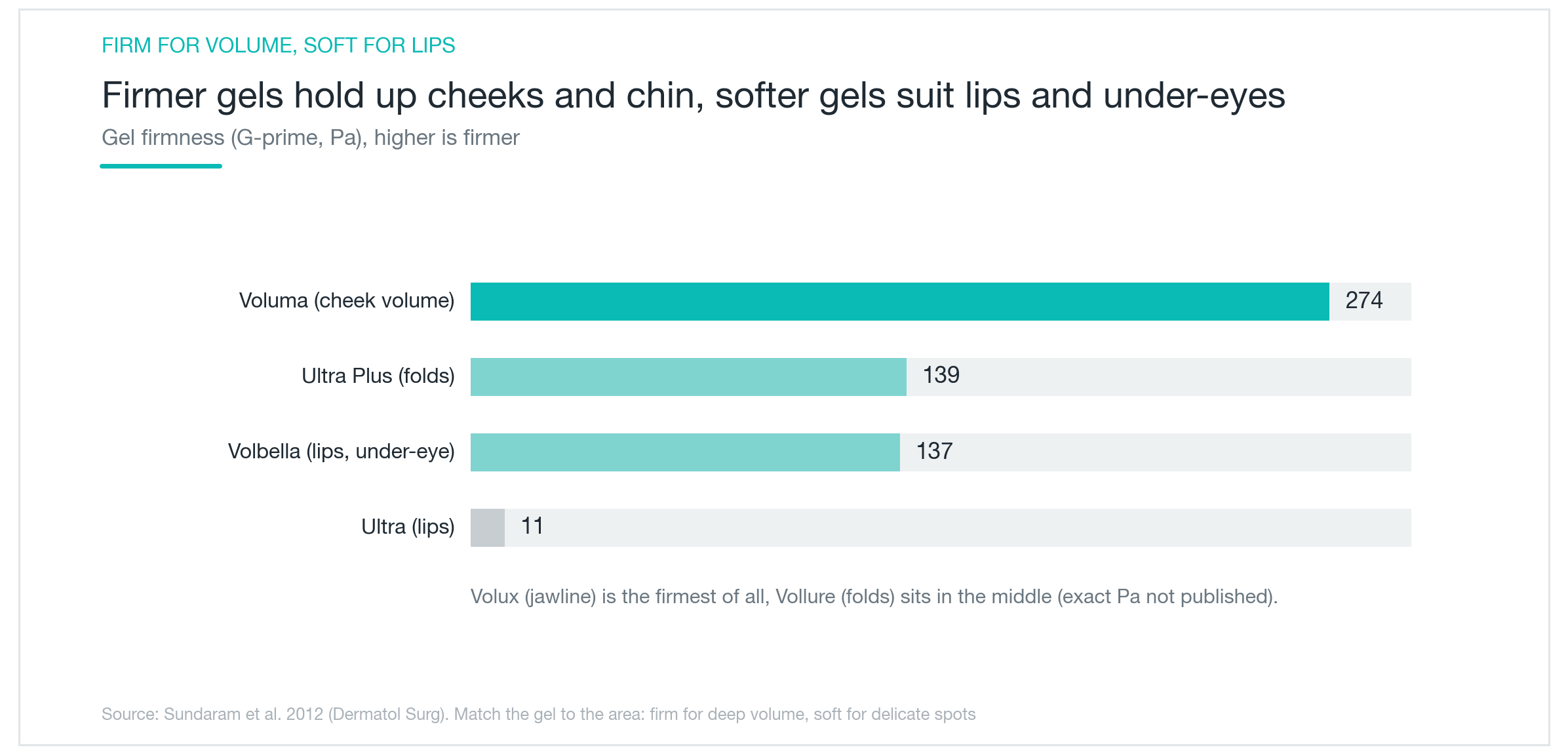
Different areas of the face need different properties. Cheeks and the chin need something firm enough to support weight and hold structure. Lips and under the eyes need something soft enough to move naturally without looking lumpy.
As the chart above shows, firmness varies significantly across the product lines. Volux is the firmest and is used for jawline definition and chin projection. Voluma, the next firmest, rebuilds volume in sunken cheeks, cheekbones, and temples. Volift sits in the middle range and is well suited for nasolabial folds and deeper lines. Volbella is the softest and is designed for lips, under-eye hollows, and fine surface lines. The older products, Ultra and Ultra Plus, are primarily used for lips and wrinkles.
The logic is straightforward: firmer products go deeper for structural volume, softer products go shallower for subtle refinement. Using a volume-grade product in the lips results in hard, unnatural lumps. Using a soft product in the cheeks means it disappears quickly. Getting the product-to-area match right is one of the main things that separates a natural-looking result from one that looks off, and that decision rests entirely with the treating clinician.
How long does Juvederm last?
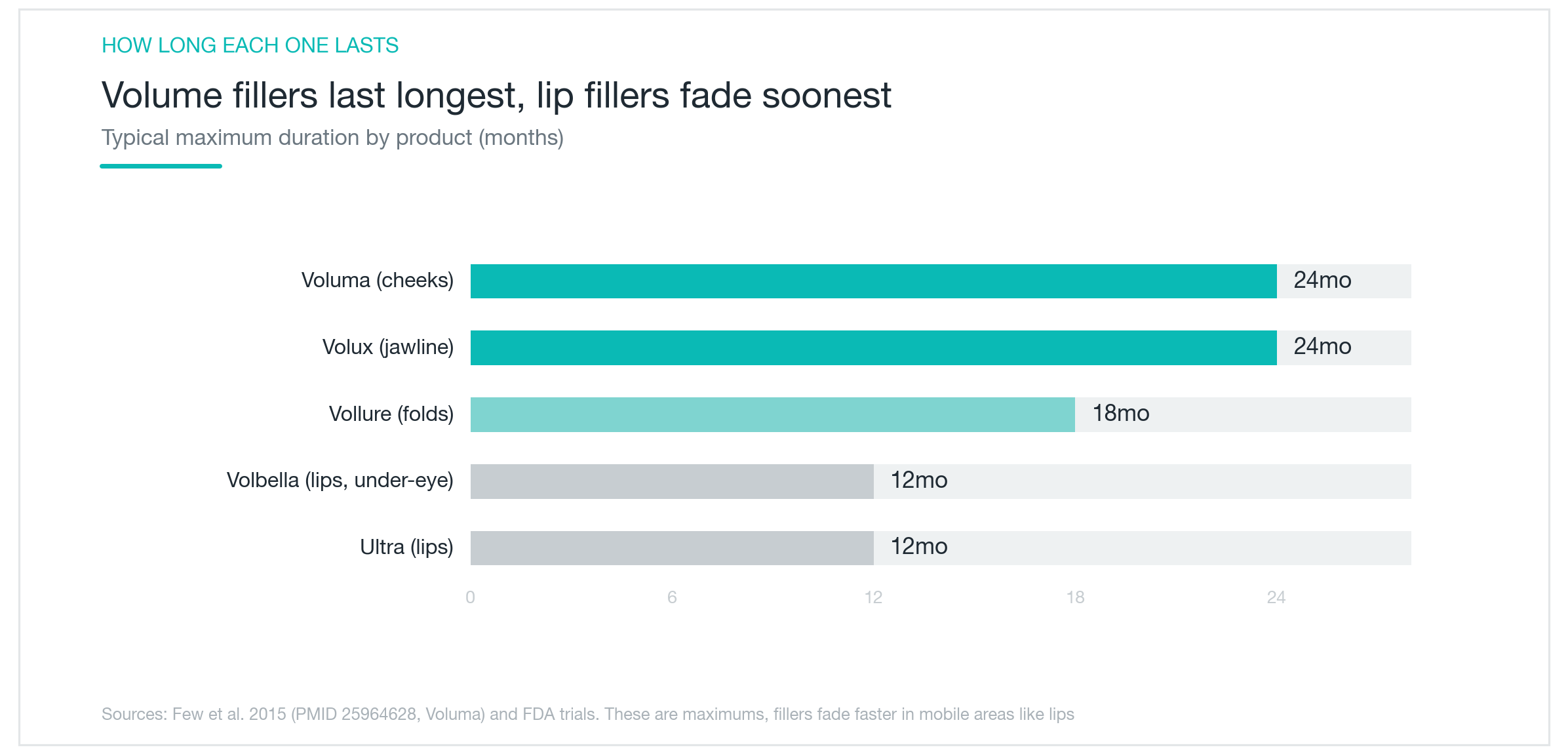
Fillers are not permanent. Over time, the body gradually absorbs them. But as the chart shows, the timeline varies considerably depending on which product is used.
The longest-lasting products are the volume fillers. In one study of 235 patients followed for 2 years, 79% still showed maintained results at the 2-year mark after Voluma. Volux, the jawline filler, also lasts up to around 24 months. Volift, used for wrinkles, typically lasts about 18 months. Volbella and Ultra, used in the lips and under the eyes, generally last around 12 months. The pattern matches the science: more tightly cross-linked products break down more slowly, softer ones absorb faster.
These numbers represent roughly the upper end of the range. The actual duration depends on where it's placed and how the individual's body processes it. High-movement areas wear down faster. Lips, which move constantly and have active circulation, tend to lose filler well before cheeks do. People with higher metabolic rates or who are very lean often absorb filler faster as well.
The practical implication is that Juvederm is a maintenance treatment, not a one-time fix. Thinking of it as something that needs refreshing every 1 to 2 years is a more realistic frame than expecting permanence. When budgeting for it, account for that cycle. The immediate visible result is the upside. The need to repeat is the trade-off.
Same-day results and a natural look
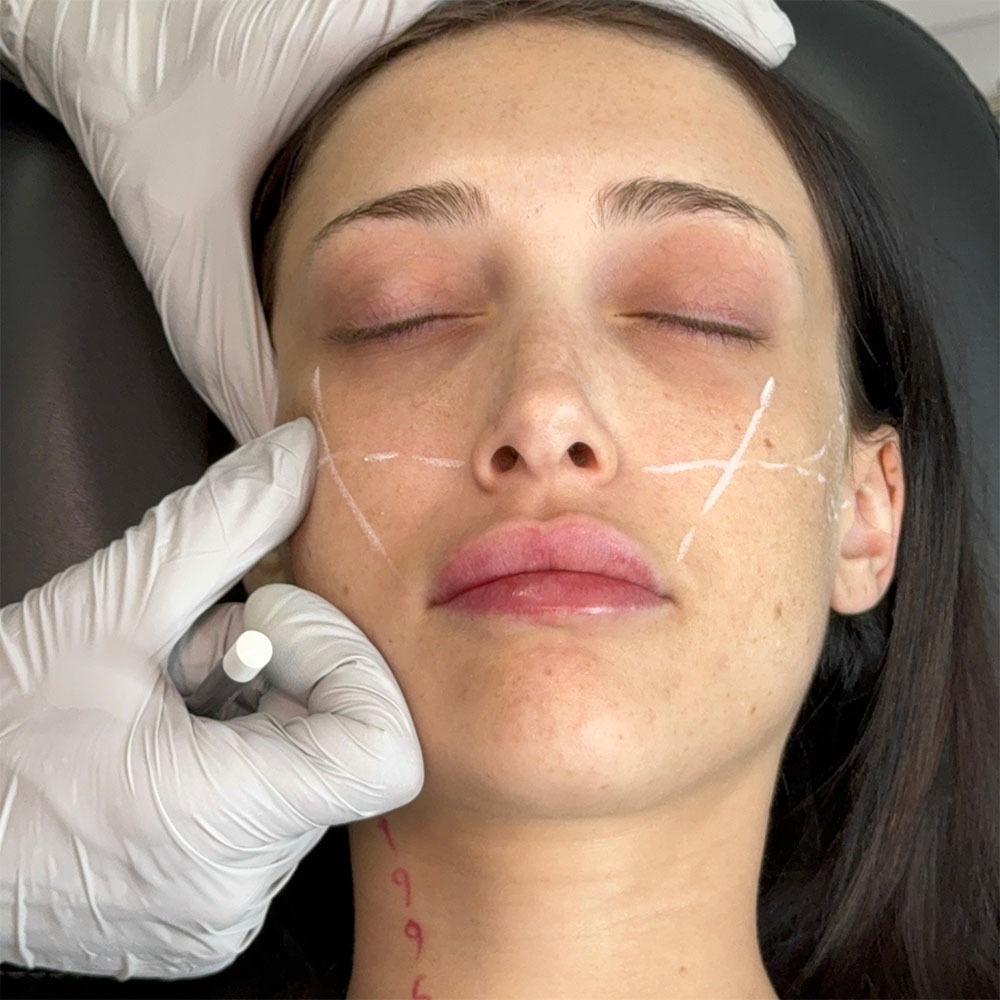
The effectiveness is real. Volume appears the same day. In the Voluma clinical study mentioned above, more than 90% of participants reported satisfaction with the result. The final appearance settles in around 2 weeks once post-injection swelling resolves.
Whether it looks natural comes down almost entirely to how much is used and the skill of the injector. Overfilling pushes the face into what's sometimes called the "balloon face" effect: bloated, overdone, and immediately recognizable as filler. The safer approach is to inject conservatively, assess, and add more at a follow-up if needed. Adding is simple. Scaling back a result that's already too much is harder. Starting on the lower side protects against the most common aesthetic mistake.
Certain areas carry specific risks worth knowing. Lips and under the eyes are high-movement zones where filler can migrate away from the intended placement. Under the eyes in particular: injecting too superficially can cause the Tyndall effect, a bluish discoloration that appears when the filler sits close enough to the surface for light to scatter through it. These are exactly the areas that demand the smallest volumes placed with the most precision, which is why experienced injectors make the most difference in those zones.
A note on timing: the area will look slightly fuller immediately after injection because of swelling. Waiting 1 to 2 weeks before assessing whether more is needed avoids overcorrecting based on early post-procedure puffiness.
The summary: Juvederm delivers fast, visible volume. Done well, it looks natural. Done poorly, with too much product or the wrong product for the area, it doesn't. Product selection, volume calibration, and the injector's technique are the three variables that determine the outcome.
How dangerous are side effects such as vessel blockage?
Most side effects are minor. Swelling, bruising, and firmness at the injection site are common in the first few days and typically resolve within 2 weeks. These are expected and not a sign that something is wrong.
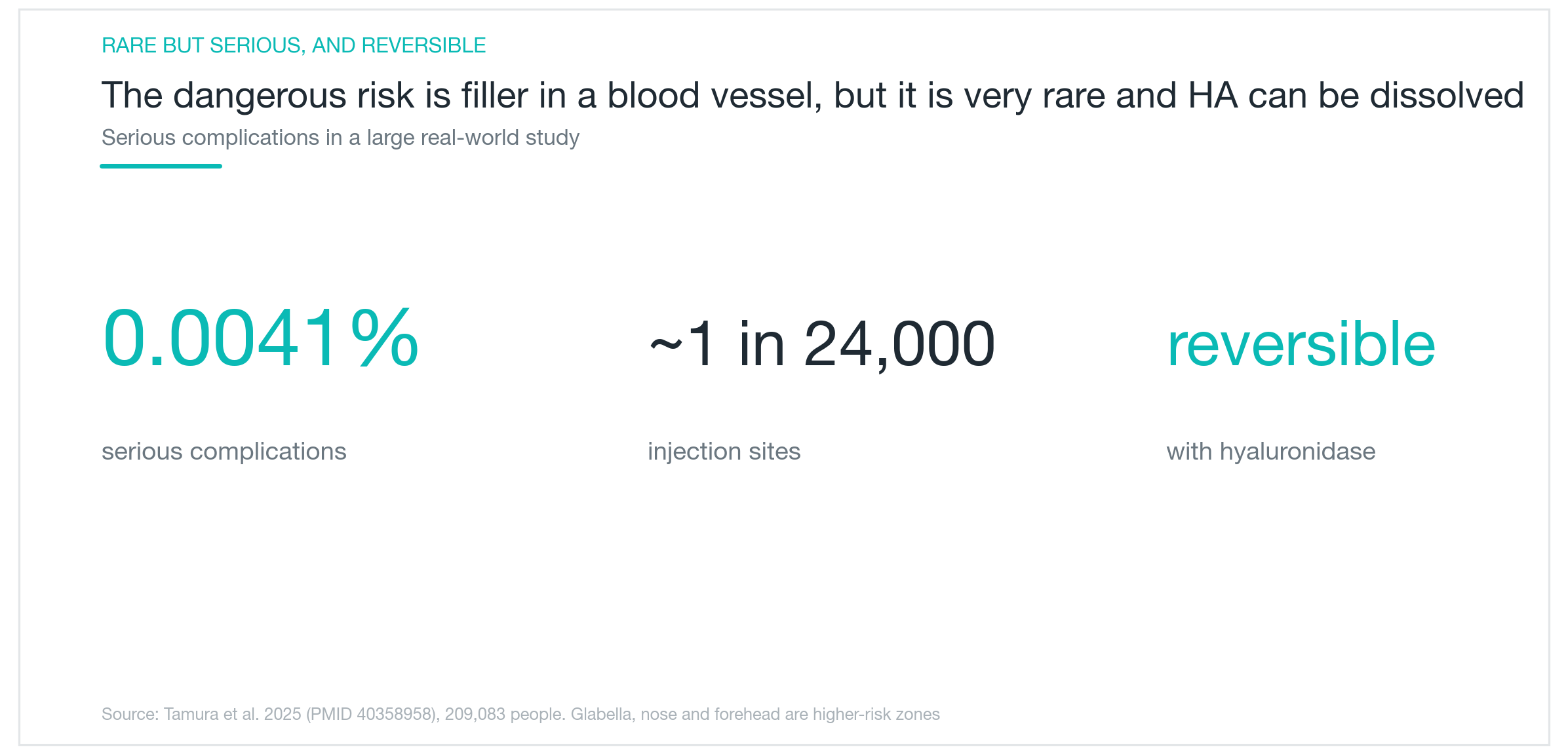
The serious risk, though rare, is vascular occlusion: filler accidentally injected into or compressing a blood vessel, cutting off circulation. In the worst cases, this leads to skin necrosis. In extremely rare cases, it can affect vision. As the chart shows, a large analysis of approximately 200,000 patients found serious complications in 0.0041% of cases (Tamura 2025). That's a very low rate, but it is not zero. The glabella (between the eyebrows), the nose, and the forehead carry higher vascular risk because of the specific blood vessels running through those areas.
Two things follow from that risk. First, the treatment should be performed by a clinician who thoroughly understands facial vascular anatomy. Second, the clinic should have hyaluronidase (the enzyme that dissolves HA) on hand and ready to use immediately if a vascular event occurs. This is the main reason HA fillers are considered the safer category compared to non-reversible fillers: a problem can be addressed in real time.
Juvederm is not appropriate during pregnancy or breastfeeding, for anyone with a known hypersensitivity to hyaluronic acid, or if there is active infection or inflammation in the treatment area.
To summarize: Juvederm is a same-day volume filler that is reversible when something goes wrong. It works best when the right product is matched to the right area, placed in the right amount, by a clinician who knows what they're doing. That combination is what makes it both safe and natural-looking.
Was this helpful?
About this article
Written by a practising aesthetic physician and intended for general education — not a substitute for individual medical advice.
Read next
Restylane Types and Results: How Long They Last and Side Effects
A clear breakdown of what Restylane is, how NASHA and OBT technology differ, which products go where across Lyft, Defyne, Refyne, Kysse, and Contour, and what the honest safety picture looks like, including how to reverse it with hyaluronidase.
By Dr. Lee

Belotero Types and Differences: Under-Eye Filler Duration and Side Effects
A clear breakdown of what Belotero is, how Soft, Balance, Intense, and Volume differ in HA concentration, firmness, and depth, why CPM technology gives it an edge under the eyes, and what the honest safety picture looks like, including how to reverse it with hyaluronidase.
By Dr. Kim
Exosome Treatment Effects and Side Effects: Human Study Evidence for Hair Loss and Scars
A clear-eyed look at what exosomes are, how far peer-reviewed human evidence actually goes for acne scars, fine lines, and hair thinning, what the real side-effect picture looks like, and why the FDA has never approved a single injectable exosome product.
By Dr. Lee