Exosome Treatment Effects and Side Effects: Human Study Evidence for Hair Loss and Scars
By Dr. Lee9 min read
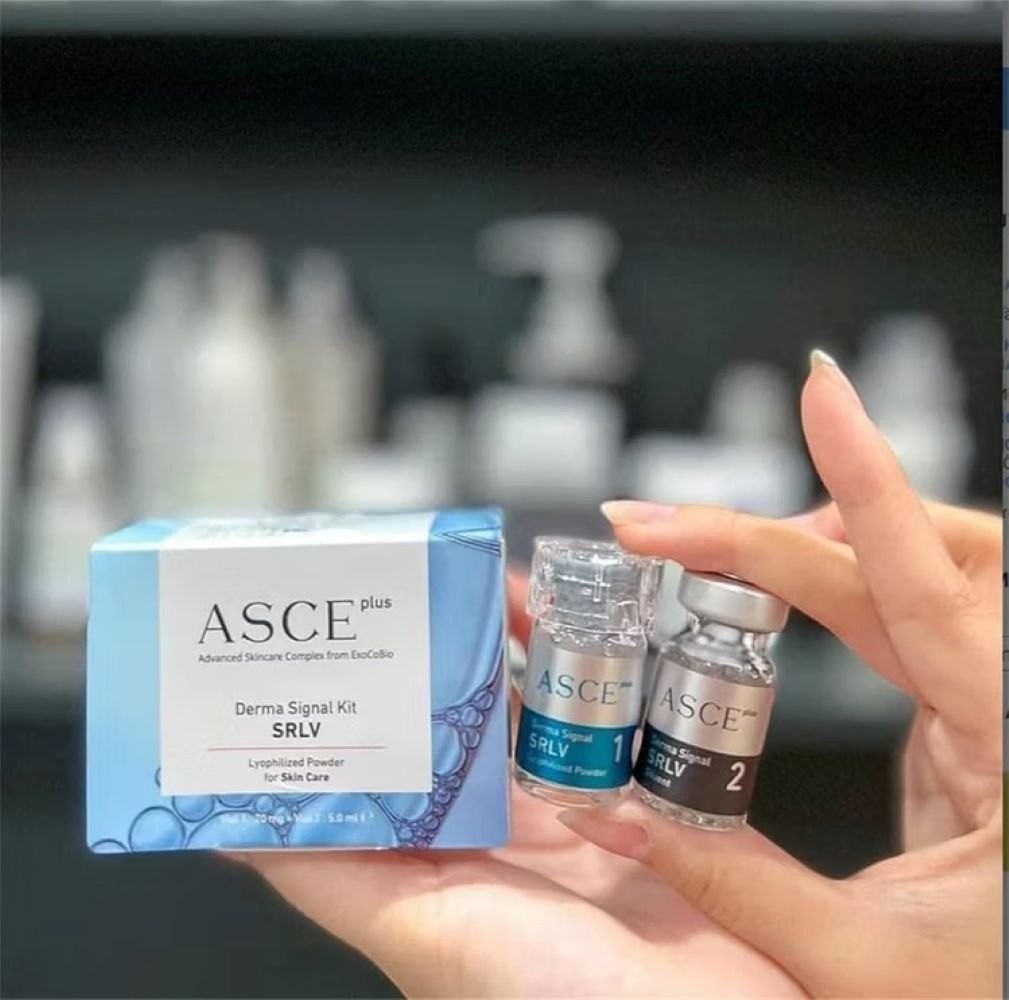
Walk into almost any medspa or aesthetic dermatology practice right now and you'll hear about exosomes. After your fractional laser or microneedling session, the clinician reaches for a serum or ampoule, and increasingly, that product contains exosomes derived from stem cells. The marketing pitch writes itself: regenerative signals straight from stem cells, promising clearer skin, faded acne scars, even thicker hair.
The hype has run well ahead of the science. The FDA has never cleared an exosome product for injection and has sent multiple warning letters to companies marketing injectable preparations. So what exactly are these things, what do legitimate peer-reviewed human studies actually show, and where should your skepticism kick in?
What are exosomes?
Exosomes are tiny vesicles, microscopic pouches, that cells shed as part of normal intercellular communication. They run between 30 and 200 nanometers in diameter, a tiny fraction of the width of a human hair. Packed inside are growth factors, structural proteins, and snippets of genetic material called microRNA. When stem cells produce exosomes, those packets carry pro-regenerative signals, which is what caught the aesthetic medicine world's attention.
Commercial exosome products are typically harvested from cultured stem cells or platelet concentrates. You're not receiving cells themselves, just the signaling molecules those cells secrete. Think of it less as getting stem cells and more as receiving the messages stem cells were sending. The catch is that content and potency vary enormously depending on source material, extraction method, and manufacturing standards. There's no standardized specification for what "an exosome product" must contain, which makes sweeping claims about "exosome treatments" almost meaningless without knowing which product, from which source, at what dose.
It's easy to conflate exosomes with other regenerative injectables that carry more established track records. PRP, platelet-rich plasma drawn from your own blood, has been used in aesthetic medicine for well over a decade. Polynucleotides, sold under brands like Rejuran and increasingly marketed in US clinics as PDRN or PN therapy, are purified DNA fragments with a growing body of clinical literature. Both have longer histories and more peer-reviewed data than exosomes. Exosomes are the newest player, with the thinnest body of human evidence. That's the honest starting point.
Do they help when added to scar laser treatment?
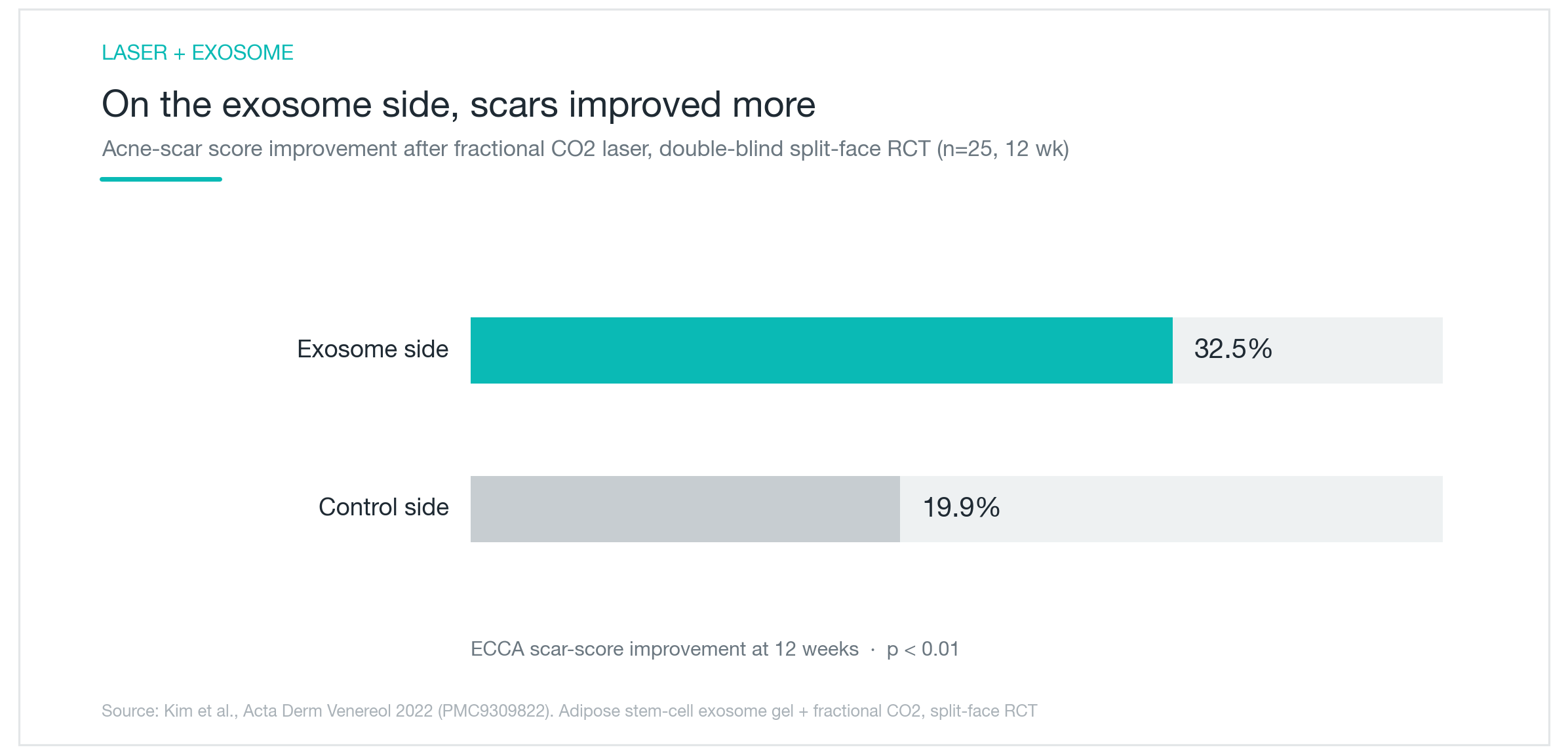
If there's one application where published data looks most convincing, it's post-laser acne scar treatment. A 2022 double-blind split-face trial enrolled 25 patients with acne scarring and treated one side of each face with fractional CO2 laser plus topical exosomes, the other with fractional CO2 laser alone. Because each participant's two sides serve as their own internal comparison, this design controls for most confounding variables. It's a genuinely clean setup.
At 12 weeks, scar score improvement measured 32.5% on the exosome side versus 19.9% on the laser-only side. The chart above shows that gap clearly. Physician global assessment found two-grade improvement in 16 of 25 patients on the exosome side versus 12 on the laser-only side. Post-procedure redness was also modestly lower where exosomes were applied.
Interpretation matters here. This is not evidence that exosomes fix scars on their own. The heavy lifting is entirely done by the fractional laser creating controlled thermal injury and triggering collagen remodeling. What the exosomes appear to do is amplify the healing response already underway. That's a meaningful supporting effect for a difficult indication, but it's a supporting role, not the lead. For acne scar treatment specifically, this is where I'd say the science is most credible, though 25 patients remains a small sample and we need larger replications before drawing firm conclusions.
Does recovery after laser get faster?
For most patients, the harder part of fractional laser isn't the treatment itself. It's the four or five days of redness, sensitivity, and peeling afterward. If you've ever had to schedule a work trip or a wedding around your laser recovery window, you understand the appeal of anything that shortens it.
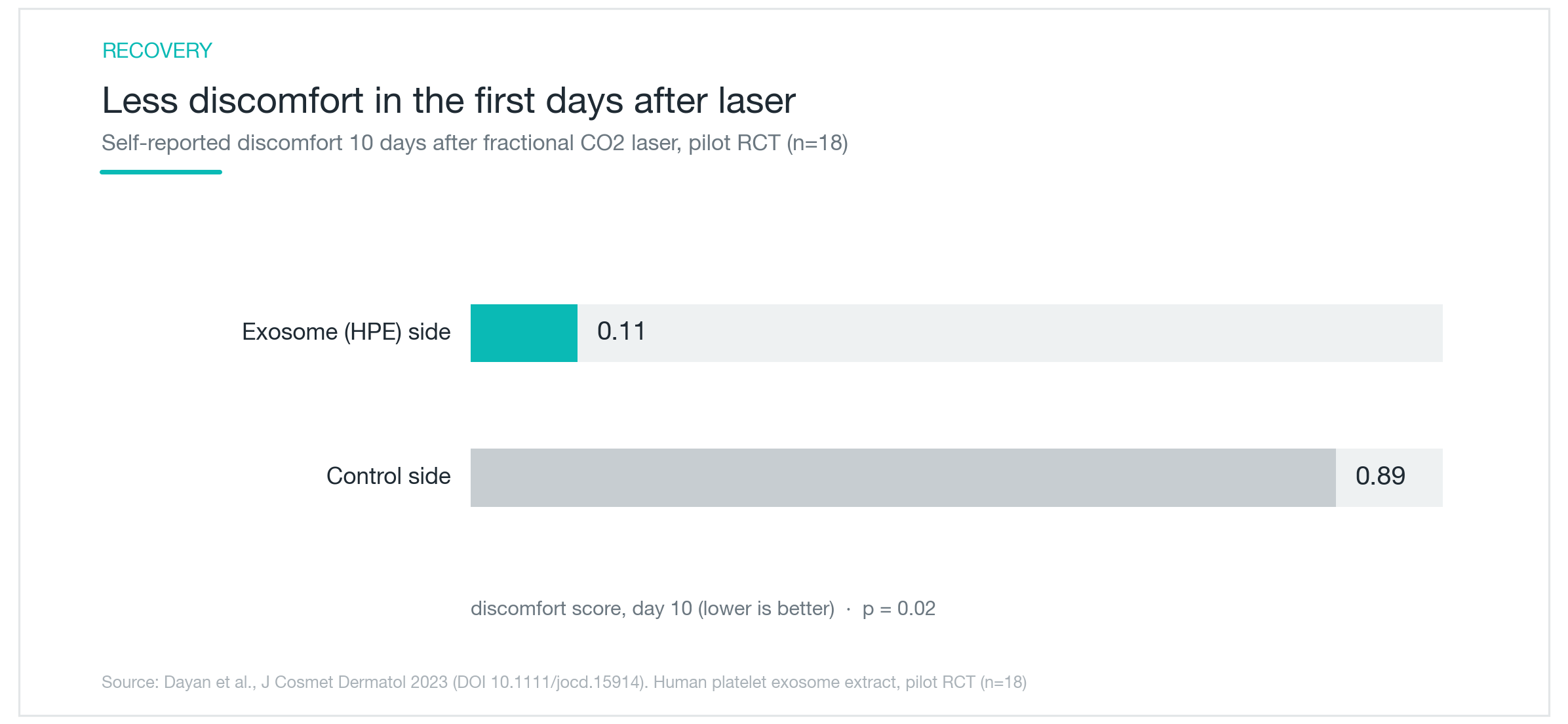
A 2023 pilot RCT applied platelet-derived exosomes immediately after fractional CO2 laser in 18 subjects. At day 10, discomfort scores were 0.11 in the exosome group versus 0.89 in the control group, a notable difference for such a small trial, as shown in the chart above. Skin brightness and overall appearance also rated better at two weeks, and surface crusting was reduced at day 10.
Eighteen patients is preliminary by any measure. But the direction is consistent with what the scar study showed: exosomes appear to modulate the inflammatory phase of wound healing, applied right when that phase begins. For patients in professions where visible redness carries real professional consequences, someone client-facing, a performer, a person with an event on the calendar, shaving a day or two off laser downtime has genuine practical value.
Honest caveat: a day or two of earlier recovery is a modest effect, and whether that's worth the cost depends entirely on what you're paying. Post-laser protocols built around basic barrier-repair products and anti-inflammatory skincare can achieve similar calming results without premium pricing. Exosomes aren't the only route to a faster recovery.
Effects on wrinkles and firmness
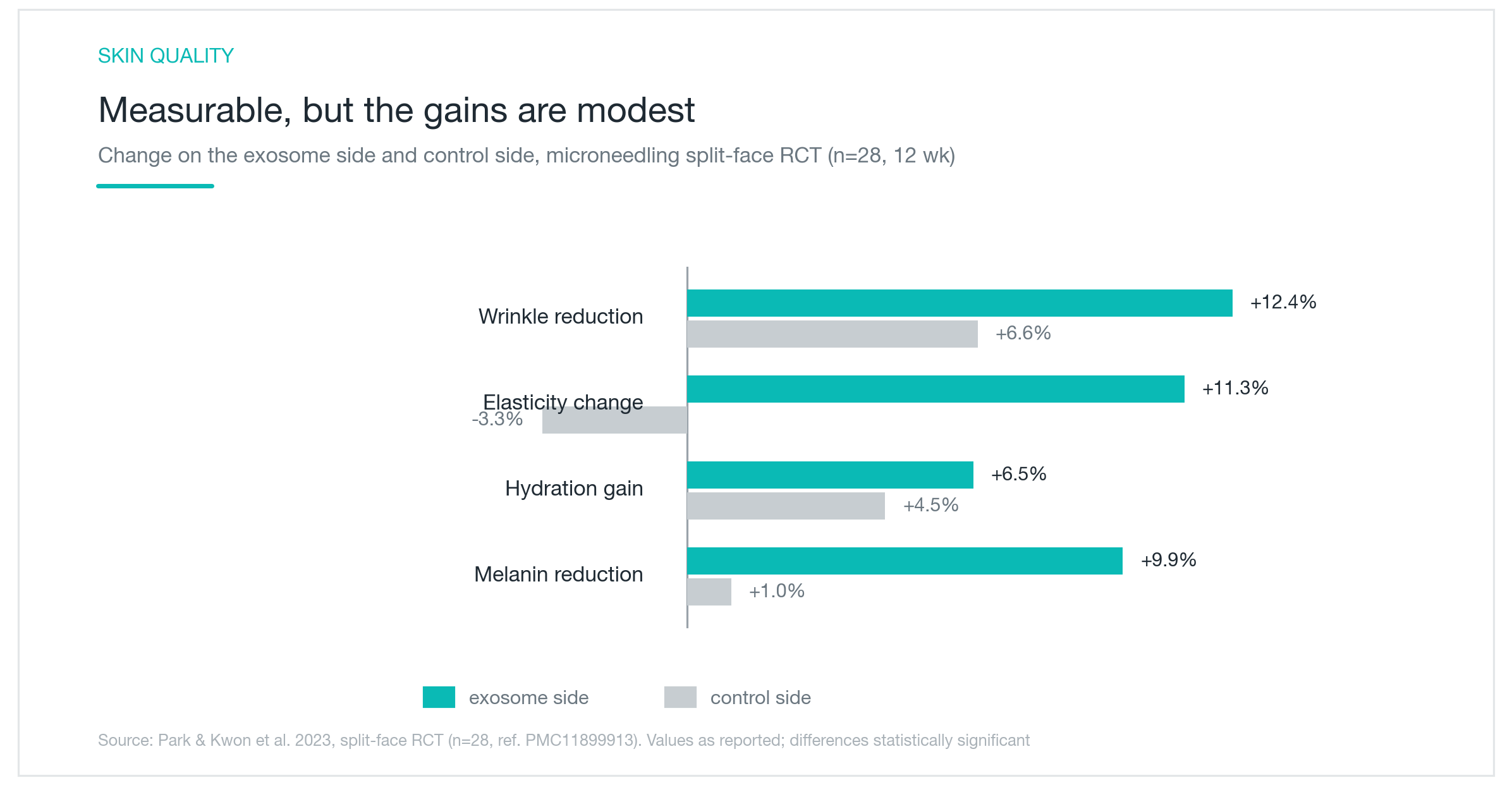
For general skin rejuvenation, the texture-smoothing, glow-restoring kind, a 2023 split-face study combined microneedling with exosomes and tracked 28 participants over 12 weeks. The exosome side showed a 12.4% reduction in wrinkle depth versus 6.6% on the microneedling-only side. Elasticity improved 11.3% on the exosome side while actually declining 3.3% on the control side. Hydration and pigmentation indices also favored the exosome arm across the board.
The chart above breaks down each metric. The numbers consistently point the same direction, but a 12.4% wrinkle reduction measured by skin surface imaging equipment is not the same as looking visibly younger in the mirror. These are instrument-detected microchanges. Meaningful, yes. Dramatic, no.
And notice what the control side, microneedling alone, still achieved: 6.6% wrinkle improvement without any exosomes at all. Needling creates micro-injuries that stimulate collagen remodeling all by itself. The exosomes are enhancing a process already in motion. Improved skin texture and a healthier glow are realistic expectations after a proper course of treatment (usually multiple sessions spaced three to four weeks apart). Deep static lines or significant facial laxity are an entirely different category. Those respond to energy-based lifting, neurotoxins, fillers, or surgery. Positioning exosomes as a skin quality treatment rather than a rejuvenation substitute keeps expectations where they need to be.
Do they work for hair loss too?
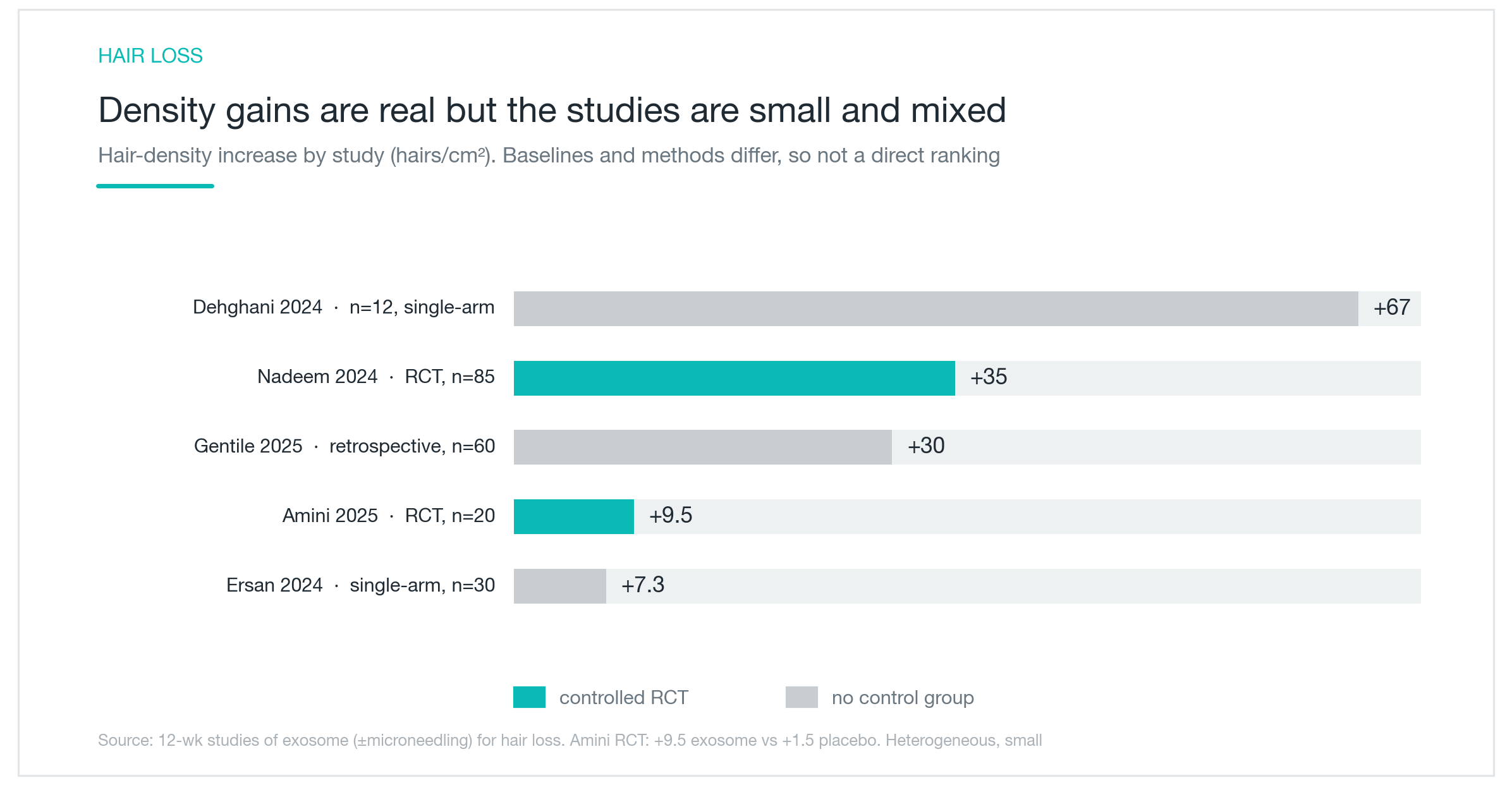
The most aggressively marketed application right now is hair restoration. Clinics pair scalp microneedling with exosome application and report increases in hair density. The chart shows why the picture is complicated. One study reports a gain of 67 hairs per cm² at 12 weeks. Another reports 7. Same general approach, wildly different outcomes.
The spread comes down to sample size and study quality. The 67-hair study enrolled 12 patients with significant dropouts and no control arm, exactly the conditions that inflate results. Better-controlled studies are far more conservative. The most rigorous entry currently in the literature, a 2025 randomized trial, found 9.5 hairs per cm² gained in the exosome group versus 1.5 in the sham group. A statistically meaningful gap, but nowhere near the lush before-and-after transformations you see in clinic marketing.
Hair loss is also inherently variable: the same protocol can produce a striking response in one patient and barely move the needle in another, depending on the cause, stage, and genetic pattern of their androgenetic alopecia. The evidence-based first-line treatments, minoxidil (Rogaine) and finasteride (Propecia), rest on decades of large randomized trials. Exosomes don't come close to that evidentiary base yet.
That doesn't make them useless. Used as a complement to first-line therapy, applied to support a healthier scalp environment while you're already on minoxidil or finasteride, exosomes may have a reasonable supporting role. Replacing proven treatment with exosomes alone because you've seen dramatic Instagram results is a mistake. Those transformations are almost always the product of multiple simultaneous treatments, photographed under favorable lighting conditions.
Side effects and the injection ban
Topical exosome application after laser or microneedling has been well tolerated in every published clinical study. Transient redness and mild stinging are the most commonly reported effects, and no serious adverse events have appeared in the small trials completed to date.
The regulatory concern isn't primarily the ingredient, it's delivery method and quality control. Because no standardized specifications exist for exosome products (no required potency benchmarks, purity testing, or sterility standards equivalent to a pharmaceutical), injecting an unregulated biologic directly into tissue or the bloodstream introduces real risks: contamination, infection, and unpredictable immune responses.
The FDA has never approved any exosome product for injection. Since 2019, the agency has issued warning letters to multiple companies marketing injectable exosome preparations, citing lack of premarket approval and unresolved safety concerns. Some clinics continue offering "exosome injections" or "IV exosome infusions" regardless. That falls outside FDA enforcement policy, and patients taking on that treatment are assuming risks they may not fully appreciate.
South Korea's regulatory picture hardened further in 2025: injectable exosome treatments were explicitly prohibited, and the term "exosome" was restricted in cosmetic advertising. The reasoning wasn't that exosomes were proven ineffective, it's that unverified therapeutic claims and inadequate safety data were being used to justify increasingly aggressive delivery methods.
The evidence-supported, legally compliant form of exosome treatment right now is topical application after a procedure that opens transient channels in the skin: fractional laser, microneedling, radiofrequency microneedling. If a provider offers to inject exosomes, claims "stem cell-equivalent regeneration," or cites "FDA approval" for an exosome product, those are red flags worth examining carefully.
Exosomes are a genuinely interesting adjunct with modest but real supporting evidence, particularly for post-laser healing and incremental improvement in scar and skin quality outcomes. They are not a standalone regenerative treatment. Set expectations at that level, and they can earn a reasonable place in a well-designed treatment plan. Set them at the level of the marketing, and disappointment is almost guaranteed.
Was this helpful?
About this article
Written by a practising aesthetic physician and intended for general education — not a substitute for individual medical advice.
Read next

Exosome Treatment Effects: How Are They Different From Stem Cells?
Exosomes are tiny signal packets that cells release into their surroundings, delivering only the messages a stem cell creates rather than the stem cell itself to the skin. Here is a plain look at how exosomes carry regeneration and calming signals, why clinics so often pair them with laser treatments, and how much evidence has actually built up so far.
By Dr. Kim

Finasteride and Minoxidil: Differences and Combined Effect Compared
A clear look at how finasteride and minoxidil tackle male-pattern hair loss through completely different mechanisms, what the clinical evidence actually shows for each, why combining them tends to outperform either alone, and what to know about sexual side effects and the pregnancy warning.
By Dr. Kim
Juvederm Filler Types Compared: Voluma and Volbella Duration
A clear breakdown of what Juvederm is, why there are so many lines (Voluma, Volux, Volbella, Volift, and more), which product goes where, how long each one lasts, and what the real safety picture looks like, including how to reverse it if something goes wrong.
By Dr. Lee