Juveacell Effects and Side Effects, Including the Difference From Rituo and Cellredm
By Dr. Kim9 min read

When skin starts losing elasticity and texture turns rough, skin boosters become a real consideration. Lately, Juveacell has been coming up in clinics more frequently. The concept is compelling: material extracted from human skin, injected to rebuild the skin's structural foundation. But if you've also heard of Rituo or Cellderm and wondered what separates them, it's worth getting a clear picture of what actually sets them apart.
The short version: Juveacell, Rituo (Re2O), and Cellderm all belong to the same category. They each deposit human-derived dermal matrix directly into the dermis rather than simply hydrating it or sending a collagen signal. What separates them is concentration and volume. Juveacell's standout trait is a high-concentration 8% formulation that packs more ECM into a smaller injection volume. The sections below cover the mechanism, how the three products actually compare, what effects to expect, and when.

What kind of treatment is Juveacell?
Juveacell is made by VAIM, a South Korean company that also produces Juvelook, a collagen-stimulating injectable. The defining feature of Juveacell is that it doesn't synthesize its active ingredient artificially. Instead, it takes donated human skin, removes the cells, and processes what remains, the dermal scaffold itself, into an injectable form.
Here's what that actually means. Beneath the skin's surface, the dermis contains an interwoven network of collagen, elastin, hyaluronic acid, and fibronectin. Together, these form the structural foundation that keeps skin firm and resilient. This network is called extracellular matrix, or ECM. Juveacell takes that finished architecture and delivers it directly into the dermis.
The decellularization process uses supercritical carbon dioxide rather than surfactants, which VAIM says better preserves the structural proteins. Particle size is calibrated to an average of 70µm. The product comes in two formulations: the 3% version contains 30 mg of ECM per 1cc syringe and is aimed at overall skin texture and conditioning. The 8% version contains 80 mg per 1cc and is intended for areas where more density is needed. Both are ready-to-use liquids, no mixing required, and are injected with a fine needle across 100 to 200 microinjection points on the face, or with a blunt cannula. Common treatment areas include rough-textured cheeks, lax facial skin, and thin undereye zones where structural support has been lost.
How does its concentration differ from Rituo and Cellredm?
Looking at Juveacell alongside its category peers clarifies what actually differentiates them. Rituo (Re2O) and Cellderm use the same underlying principle: human acellular dermal matrix (hADM) injected into the dermis. All three belong to a distinct class separate from biostimulators like Rejuran or Juvelook, which work by prompting the skin to produce new collagen rather than delivering structural material directly.
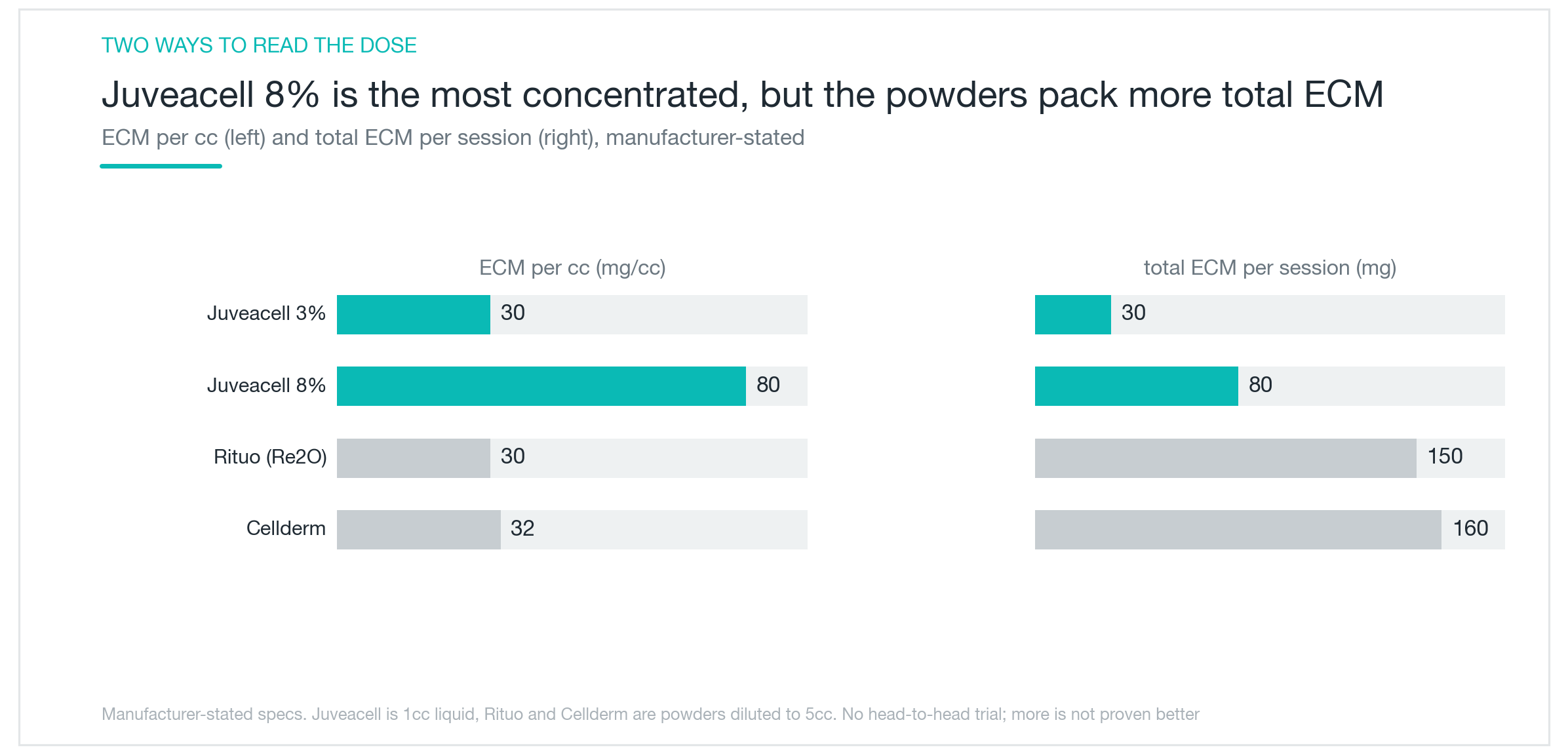
The key differences come down to concentration and total dose per session. Concentration, meaning ECM per 1cc, looks like this: Juveacell 8% contains 80 mg per 1cc, making it the most concentrated. Juveacell 3% and Rituo sit at 30 mg per 1cc, and Cellderm at 32 mg per 1cc. Those three are roughly equivalent in concentration.
Total ECM delivered per session tells a different story. Rituo delivers 150 mg per session and Cellderm delivers 160 mg, both higher than a single vial of Juveacell. The reason is formulation format. Juveacell is a concentrated liquid in 1cc. Rituo and Cellderm are lyophilized powders reconstituted in saline to 5cc, distributing a larger total ECM mass across a greater volume. Juveacell is dense in a small volume. Rituo and Cellderm are more dilute but cover more surface area per session.
Here is a side-by-side look.
| Feature | Juveacell | Rituo (Ellavie Re2O) | Cellderm |
|---|---|---|---|
| Maker | Vaim | Humedix | Hansbiomed |
| Source material | Human dermal ECM | Human dermal ECM | Human dermal ECM |
| Formulation | Liquid, ready to use | Powder, reconstituted in saline | Powder, reconstituted in saline |
| Concentration (per 1cc) | 30 mg (3%) or 80 mg (8%) | 30 mg | 32 mg |
| Volume per session | 1cc | 5cc | 5cc |
| Total ECM per session | 30 to 80 mg | 150 mg | 160 mg |
| Particle size | Approx. 70µm | Limited published data | Approx. 75µm |
| Dedicated human clinical trial | None yet | 1 trial (n=20, 24 weeks) | None yet |
| Best suited for | Targeted zones needing higher local density | Broad surface treatment with even distribution | Broad surface treatment with even distribution |
The practical framing: Juveacell suits targeted zones where higher local density is the goal. Rituo and Cellderm suit broader surface treatment where even ECM distribution matters more than concentration at a specific point. Higher concentration has not been proven to mean better clinical outcomes, so choosing by density alone misses the point. Treatment area and goals should drive the decision.
How does skin change as collagen increases?
Juveacell works from the inside out. The structural material deposited into the dermis doesn't just occupy space. Skin cells migrate into the scaffold and begin reorganizing around it as their own tissue.
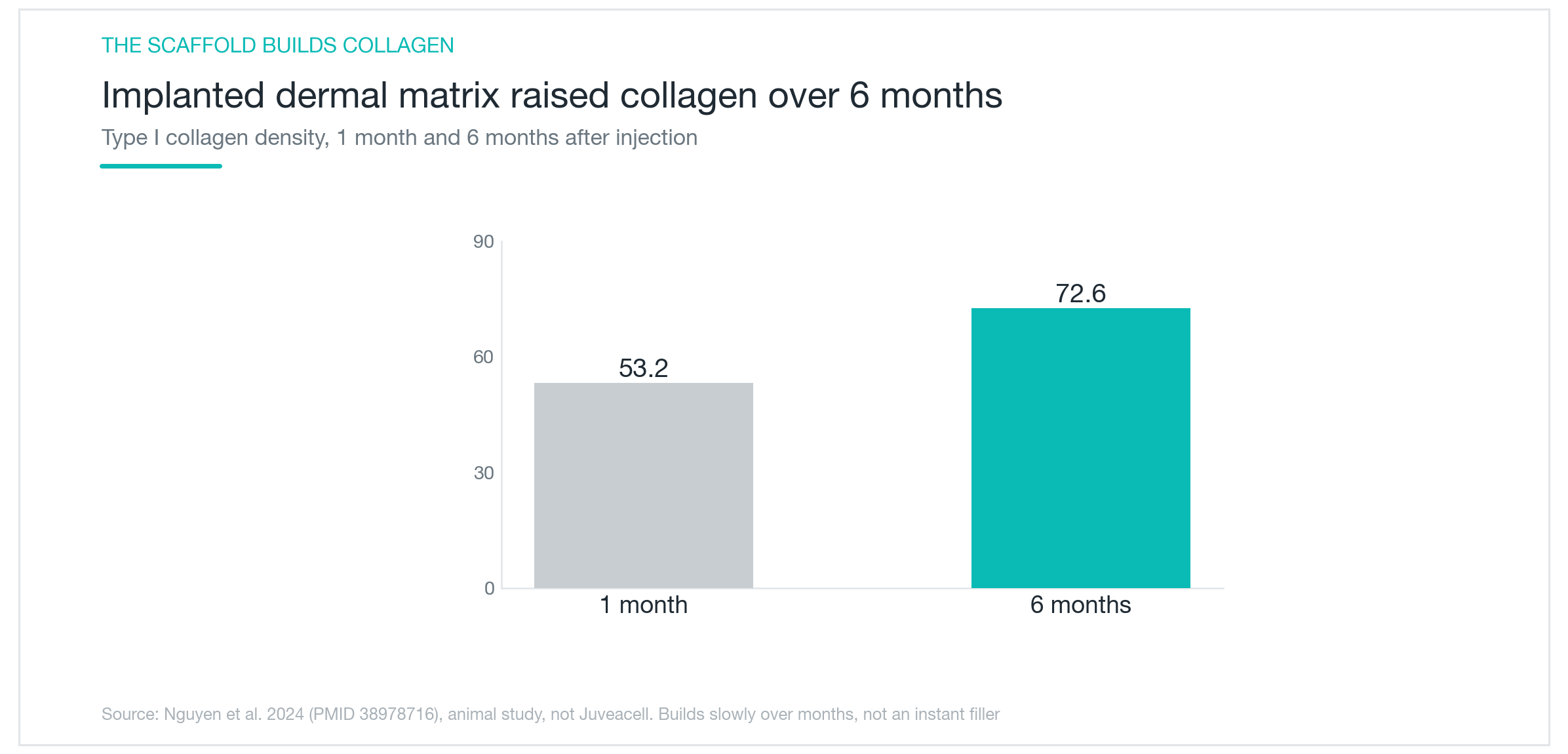
Collagen increases during this process. In an animal study tracking what happens after ECM injection, type I collagen density rose from approximately 53 at 1 month to approximately 73 at 6 months, a steady climb (Nguyen 2024). As collagen accumulates, the changes at the skin surface follow a recognizable pattern. Hydration improves first, as the dermis gains greater capacity to hold water. Texture smooths next, and enlarged pores become less prominent. Elasticity increases and fine surface lines soften. Thin undereye skin that looks dark and hollow gains structural backing and begins to look more rested. The overall character of results is skin that looks genuinely healthier rather than treated. The improvement is diffuse and natural rather than regionally obvious.
One important expectation to set: Juveacell is not a filler. Deeply hollowed areas do not fill immediately after injection. The mechanism builds over months. It's the right treatment for improving overall skin quality, texture, and elasticity progressively. For immediate volumetric correction of deep folds or significant sagging, other tools fit better.
When and in what order do effects appear?
Managing expectations well means knowing the timeline, not just the outcome. Because Juveacell builds structural change gradually, the timing matters more than it does for faster-acting treatments.
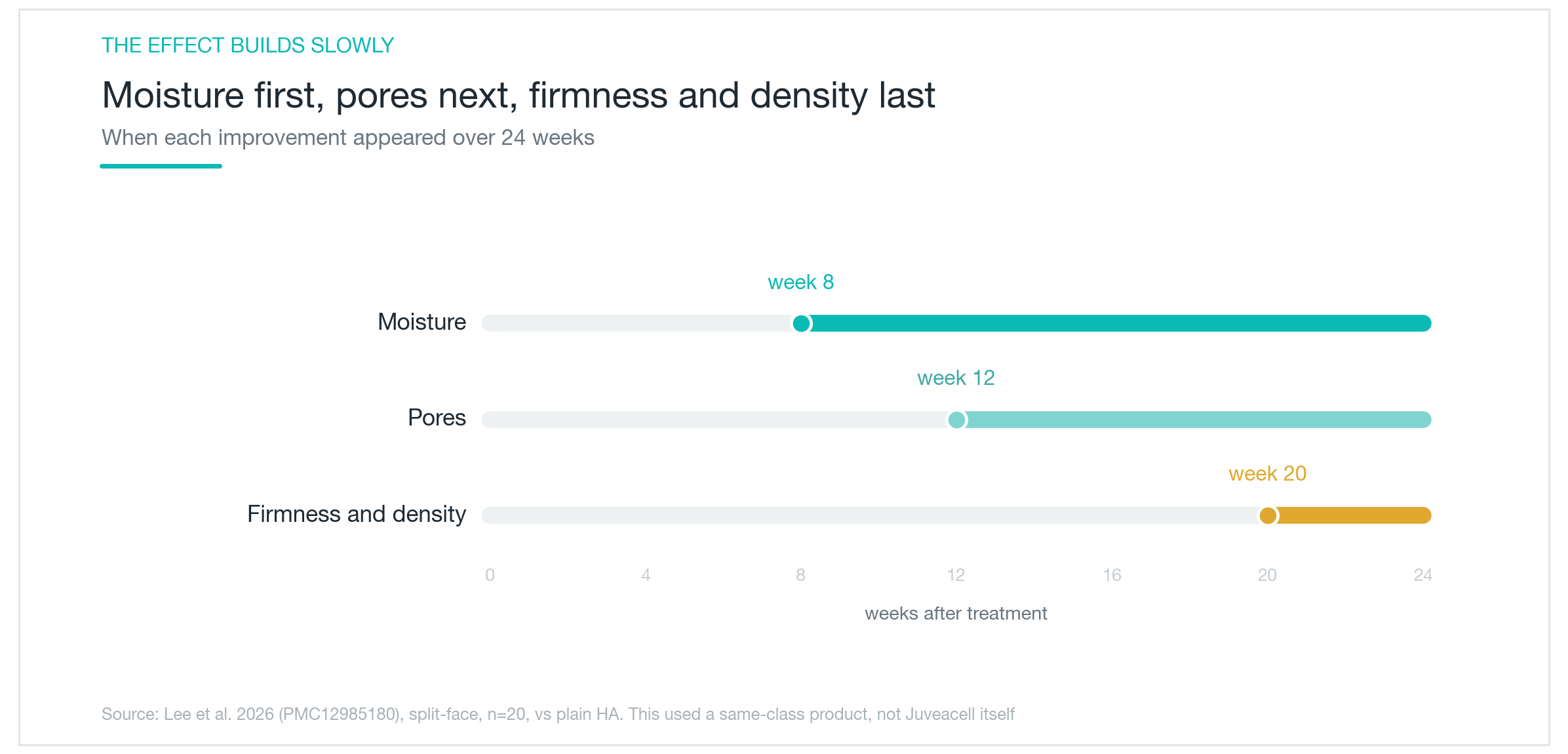
The clearest timeline evidence comes from a human trial on Rituo, the same ECM category. In a split-face trial, 20 subjects received ECM on one side and standard HA on the other, tracked over 24 weeks. Results did not appear all at once. Skin hydration improved first, by week 8. Pore reduction was measurable by week 12. Elasticity and skin density kept improving through week 20, consistently ahead of the HA side. The pattern is sequential: hydration, then texture, then structural density.
Practically, this means expecting significant visible change within days of treatment is unrealistic. Comparing photos taken at the same angle and lighting over 2 to 3 months is a better way to track progress. For sustained results, a single session is rarely sufficient. Most patients go through several sessions to build the ECM foundation cumulatively. Between sessions, consistent sun protection and moisturization support the remodeling process and help results stabilize.
One note on interpreting this data: the trial used Rituo, not Juveacell. The directional pattern is likely similar given the shared mechanism, but the precise magnitude of effect per session will vary between products and between individuals.
Clinical evidence and side effects
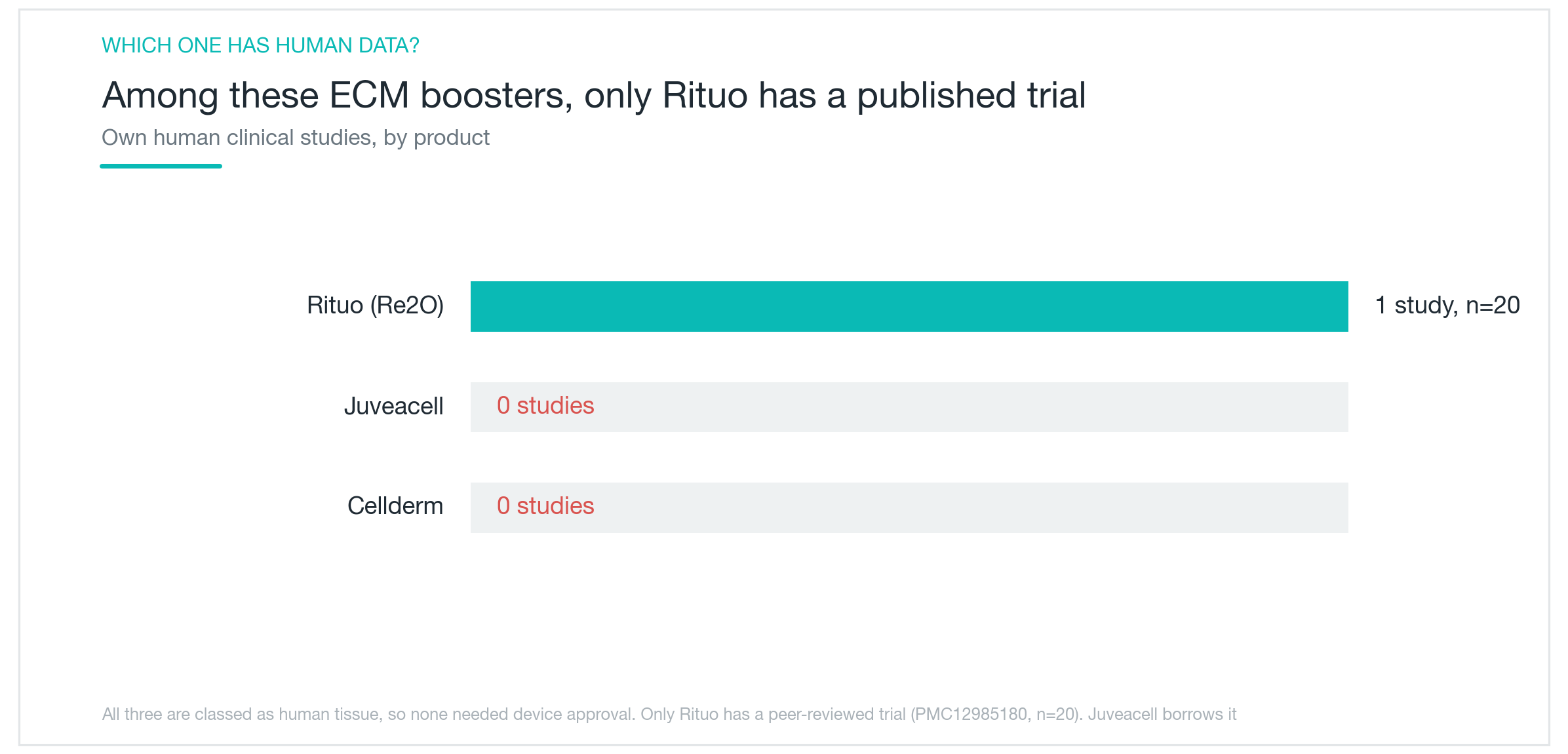
The evidence picture for this category is honest about its limits. Among the three ECM boosters, only Rituo has a published human clinical trial, the Lee 2026 split-face study with 20 participants. Juveacell and Cellderm have no dedicated human clinical data of their own yet. Any evidence-based projection of what Juveacell does clinically is extrapolated from Rituo's results, not generated from Juveacell-specific trials. The directional case for ECM injection is supported, but Juveacell's own numbers are still accumulating.
On the safety side, most reactions are mild and self-resolving. The common ones are redness, swelling, bruising, and tenderness at injection sites, typically resolving within a few days. Rare risks include nodule formation at the injection site, infection, and theoretically vascular occlusion if material enters a blood vessel.
One safety point that carries real practical weight: HA fillers can be dissolved with hyaluronidase if something goes wrong. Juveacell cannot be reversed. There is no dissolving agent for ECM. Starting with conservative volumes, especially with the 8% formulation, is the appropriate approach. Dose can always be increased across sessions. It cannot be taken back.
Experienced injector judgment on volume and concentration per area matters more here than with reversible treatments.

Who it suits and who it doesn't
Juveacell fits patients who have noticed progressive roughening of texture, reduced elasticity, and early fine lines, and who want to improve the quality and foundation of their skin over time rather than achieve an immediate visible change. It suits the patient who wants the skin itself to look better, not the skin to look treated.
It is not well matched to patients whose primary goal is immediate correction of deep folds or significant tissue sagging. For those goals, lifting treatments, volumetric fillers, or contouring procedures address the right layer. Juveacell can meaningfully complement those approaches by improving the skin quality sitting on top of them, but it is a poor standalone answer to structural volume loss.
There are also situations where treatment should wait or be avoided. Pregnancy and breastfeeding, prior reactions to human-derived materials, active inflammation or infection at the treatment site, and autoimmune conditions all warrant caution or exclusion.
Juveacell is not a one-session transformation. It is the most concentrated liquid formulation in its ECM category, best used to progressively rebuild the dermal foundation in a targeted way. When matched to the right area, the right patient, and a provider with hands-on ECM experience, it delivers results that deepen over time rather than peak and fade.
Was this helpful?
About this article
Written by a practising aesthetic physician and intended for general education — not a substitute for individual medical advice.
Read next
CELLREDM and Re2O: Differences and How Long Their Effects Last
CELLREDM delivers human-derived extracellular matrix directly into the dermis rather than waiting on collagen stimulation. An honest clinical breakdown of its ECM composition, the phADM split-face trial data (Lee YI et al., IJMS 2026), how it compares to Re2O, and who is genuinely a good candidate.
By Dr. Lee
Re2O ECM: How It Differs From Hyaluronic Acid Boosters
Re2O (Elravie Re2O) deposits human-derived extracellular matrix straight into the dermis rather than waiting for your skin to build it. A clinical breakdown of its composition, what a 20-week split-face trial against HA actually revealed, and who genuinely benefits.
By Dr. Kim

Pebbled Chin Botox: Results, How Long It Lasts, Dosage, and Side Effects
Chin botox (mentalis botox) smooths out the pebbled, orange-peel texture that shows up on an overactive chin. Here's how relaxing the mentalis muscle evens out the skin, the typical dose and injection points, when results appear and how long they last, how this differs from a weak or protruding chin, and the side effects worth knowing about, all backed by real evidence.
By Dr. Kim