IPL Versus Laser for Dark Spots and Redness: Differences and Effects Compared
By Dr. Lee8 min read
IPL used to be practically synonymous with spot treatment. These days, though, clinics tend to reach for pico or Q-switched lasers first when a spot is clearly defined or the pigment sits deep. That doesn't mean IPL has become obsolete. Judged purely on pigment, it looks like it's losing ground, but IPL was never designed to target pigment alone in the first place. Its original strength was handling redness, fine hair, and skin texture all at once. So it's more accurate to think of IPL and lasers not as competitors but as tools that are each good at different things. Some concerns suit IPL, others suit lasers. This article walks through where IPL has lost ground and where it's still ahead.
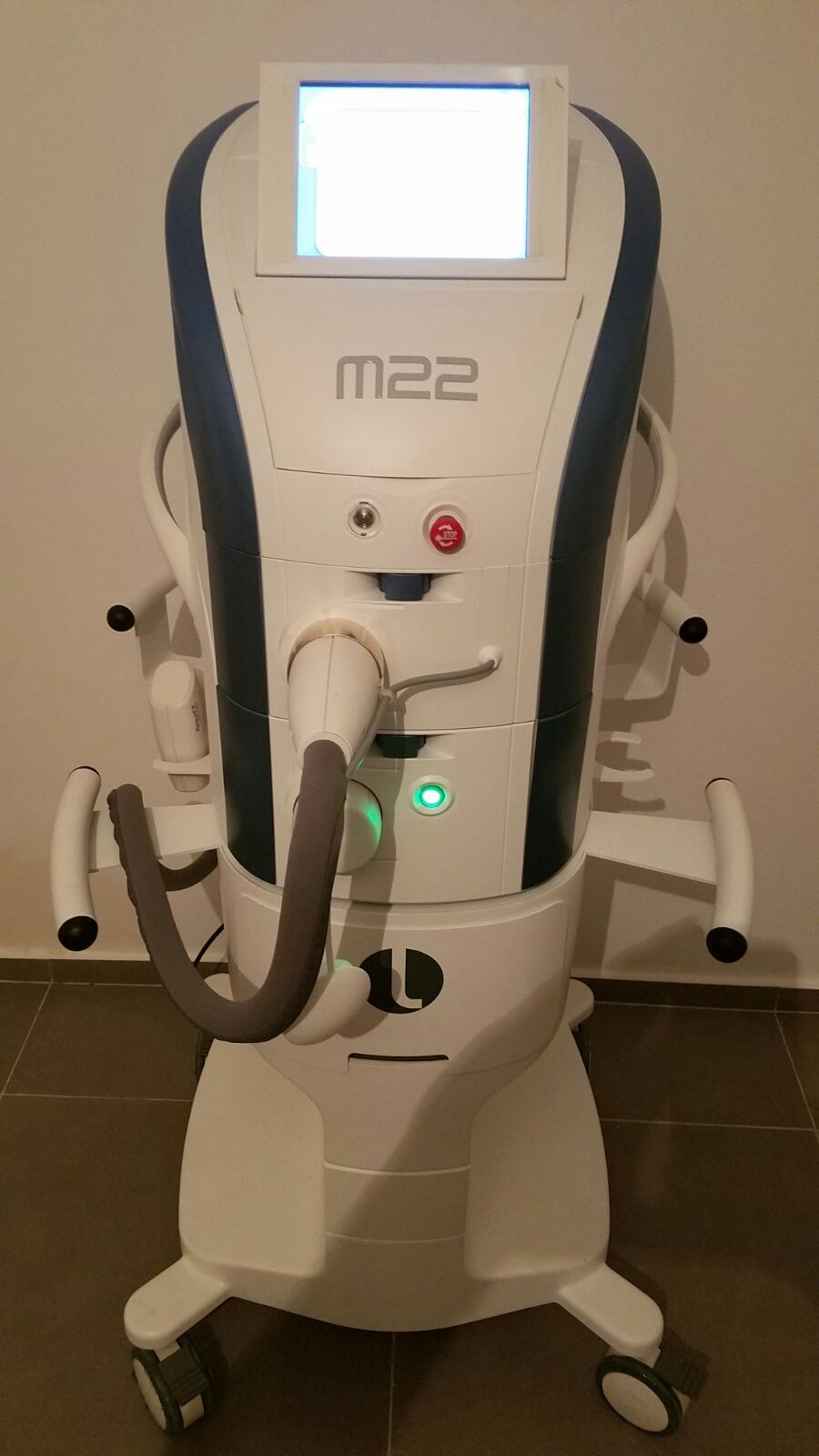
How does the light of IPL and laser differ?
IPL stands for intense pulsed light. Unlike a laser, which fires a single wavelength, IPL emits a broad band of light spanning roughly 500 to 1200nm all at once. When this light penetrates the skin, it hits melanin, hemoglobin, and water simultaneously. It's a method that heats up multiple targets at once, treating pigment and blood vessels together. It also uses a filter at the front to cut out shorter wavelengths, leaving only the band you want, so the same device can be reconfigured for pigment or for vessels depending on the settings.
Lasers work differently. A laser is a precise beam tuned to a single wavelength, so it hits one specific target. If the target is pigment, all the energy focuses on pigment. If it's a vessel, the energy focuses there. Pico lasers, in particular, use extremely short pulses to shatter pigment through vibration rather than burning it. Because less heat lingers, they're gentler on the surrounding tissue.
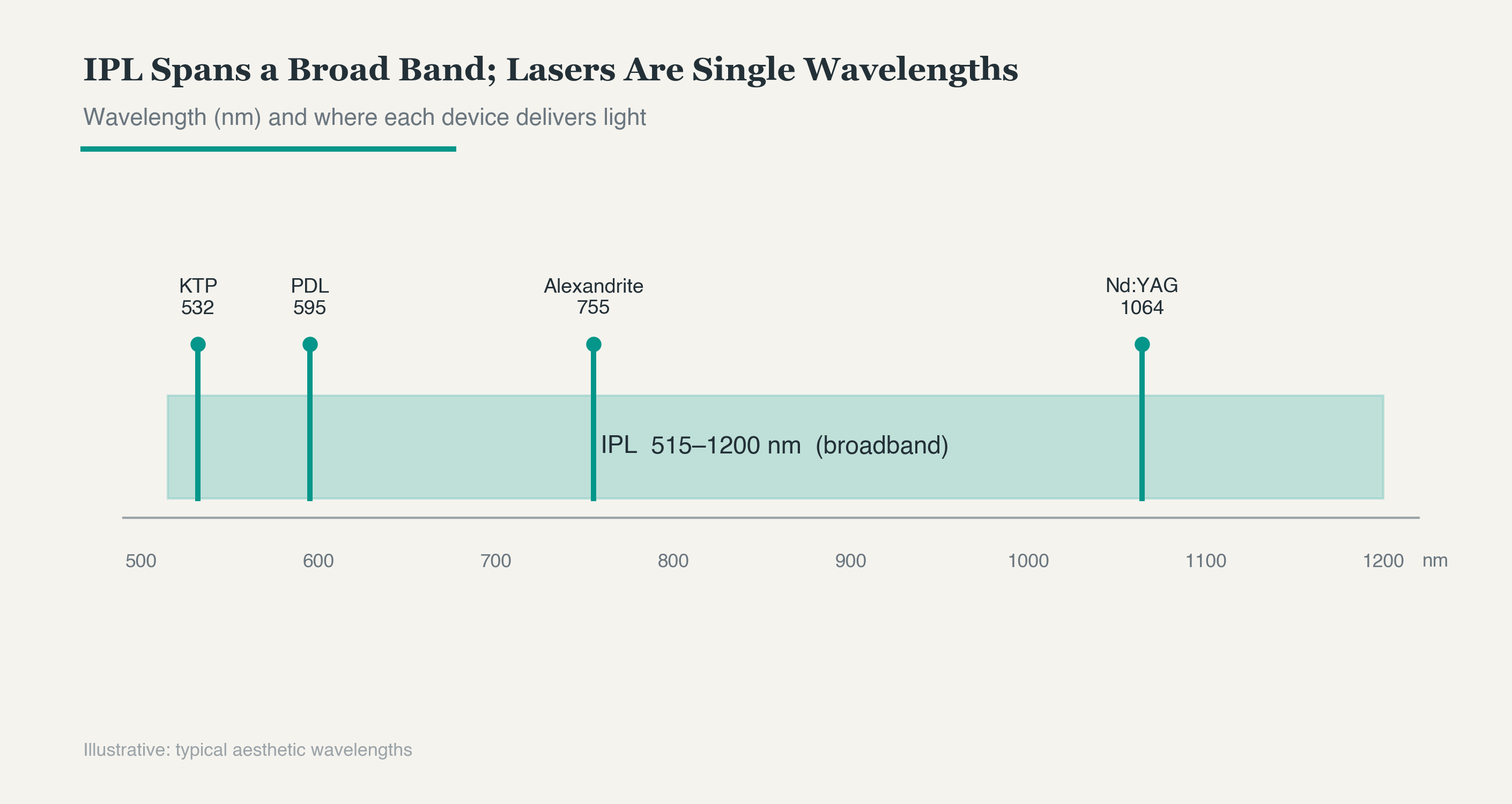
A simple way to picture it: IPL is a broad light that warms an entire room. A laser is a laser pointer aimed at just one color. Pico shatters pigment through vibration rather than burning it. Because the two devices use light so differently from the start, what each one is good at was always going to diverge.
IPL or laser: which is better for dark spots?
| IPL | Q-switched | Pico | |
|---|---|---|---|
| Light | Broad band, multiple targets | Single wavelength | Single wavelength, ultra-short pulse |
| Depth | Mostly surface | Surface and dermis | Surface and dermis |
| Sessions for pigment | 3-5 | 1-2 | Usually 1 |
| PIH risk | Moderate | High | Low |
IPL is quite strong on pigment that sits shallow, close to the surface. The broad light warms melanin across a wide area, fading spots down. That's why lightly scattered spots across the whole face, or pigment built up over years of photoaging, still tend to respond well to it today.
The problem is depth. Pigment that has settled deeper into the dermis doesn't get enough of IPL's light to reach it. As the table shows, response to deep pigment often drops below 25%, meaning it takes 3 to 5 sessions to get the same result you'd otherwise get faster, which adds up in time and cost.
Lasers have the edge here. A single wavelength targets both the surface and dermis at once, which clears a clearly defined spot in one or two sessions. Fewer sessions means easier management and more predictable results. That's exactly why clinics now tend to recommend lasers first for anyone who wants a dark, defined spot gone quickly.
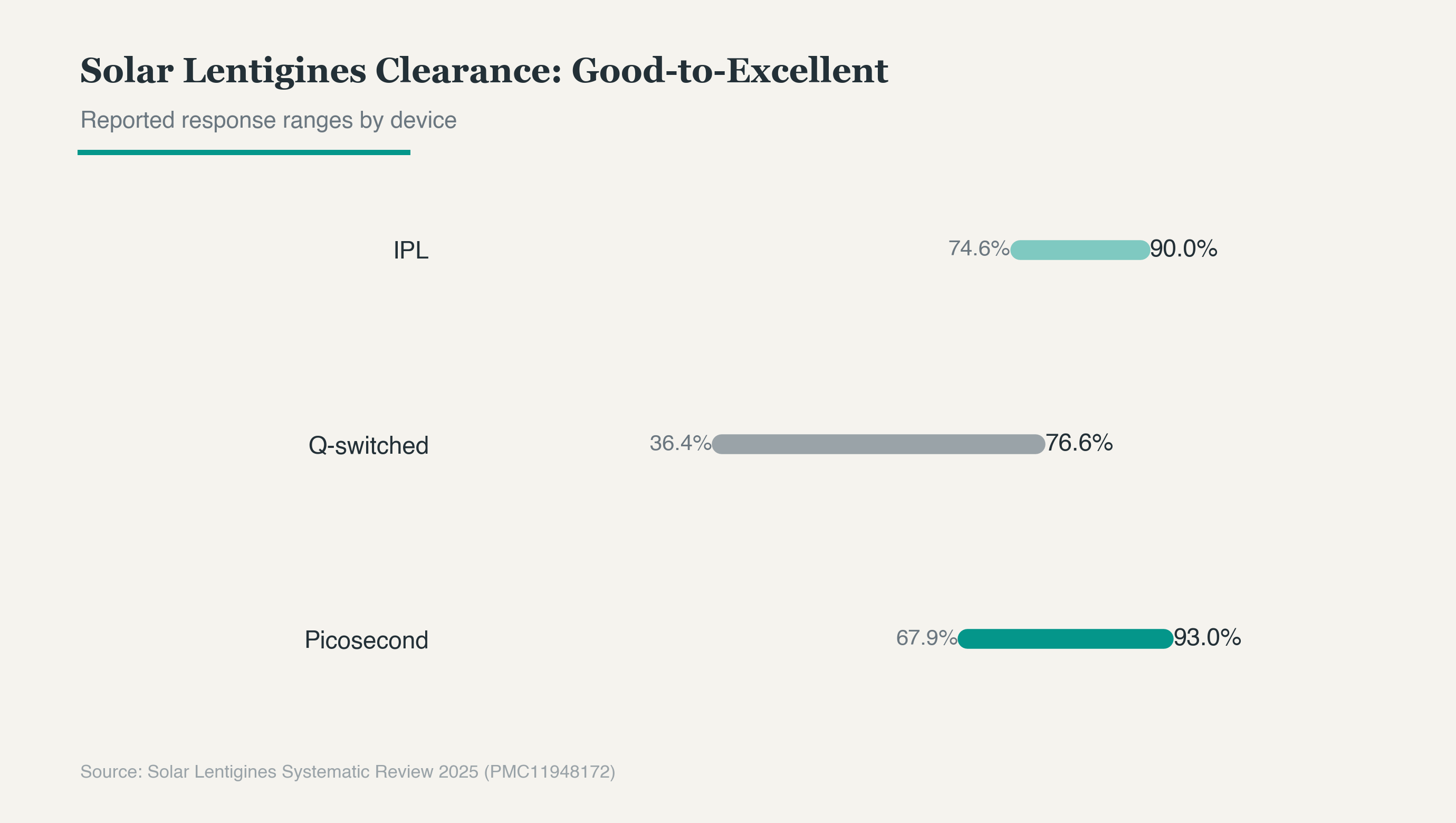
Pico's pigment effect and risk of pigmentation
Looking at the numbers alone, IPL does well on surface pigment. The share rated good to excellent sits at 74.6 to 90%, which is far from low. But pico delivers 67.9 to 93% in fewer sessions. The real difference is that pico produces reliably good results within just one or two rounds.
The real gap shows up in pigmentation.
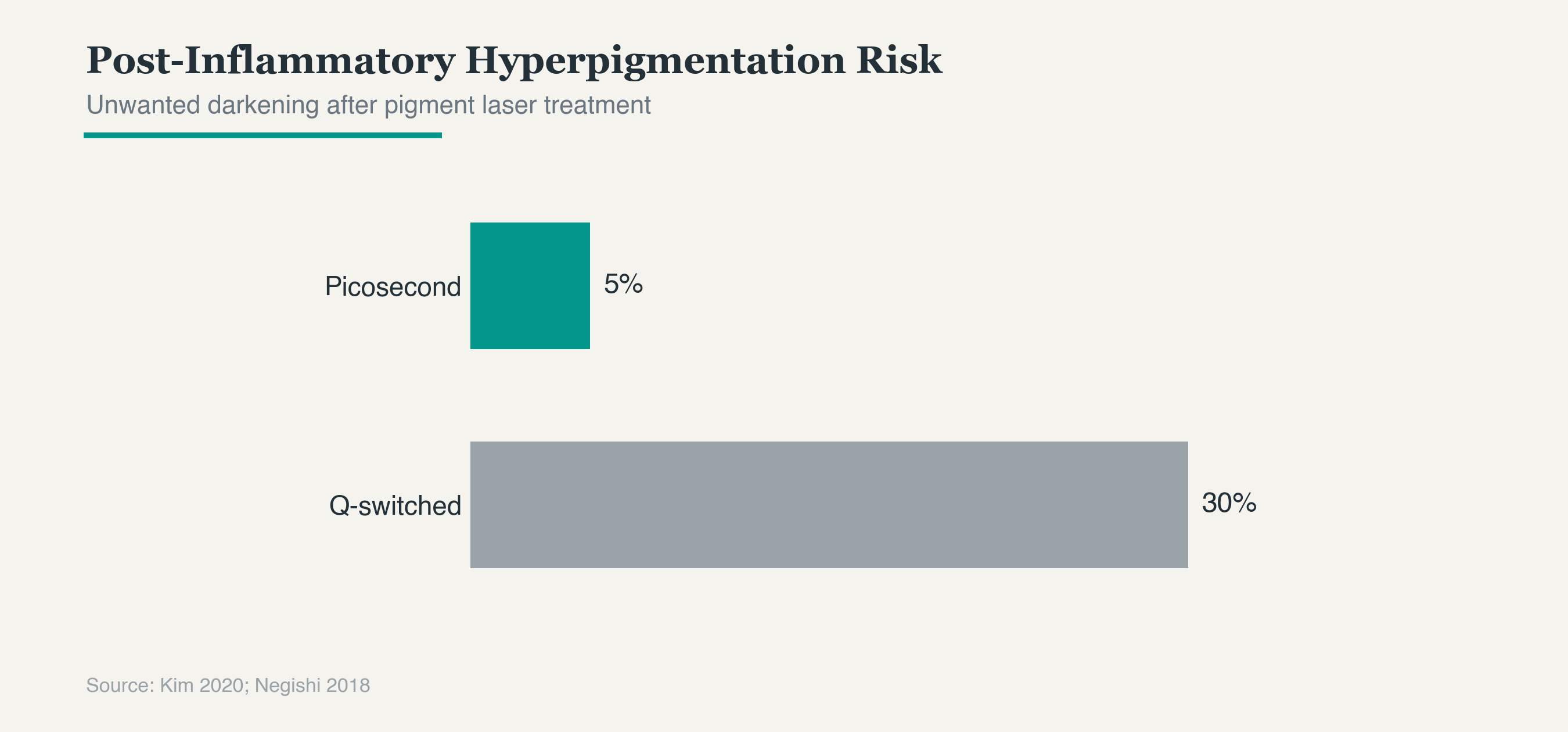
When color darkens unexpectedly after treatment, that's called PIH. Pico sits at around 5%, while Q-switched reaches about 30%. Because pico causes less thermal damage, it lowers this risk considerably, a difference that carries real weight for Asian skin, which tends to develop post-inflammatory pigmentation easily. This particular comparison is between two lasers, pico and Q-switched, and it goes a long way toward explaining why pico so quickly pushed aside older pigment devices and IPL alike.
That said, assuming lasers always win on pigment would be an oversimplification. In a split-face study on Asian patients, IPL actually outperformed Q-switched Alexandrite on lentigo. Freckles, on the other hand, responded better to laser. In other words, even within the same category of pigment, the answer changes depending on the specific type.
IPL's strengths in redness and photoaging
| Details | |
|---|---|
| Photoaging | Spots, redness, and texture at once |
| Rosacea and redness | Eases vascular redness |
| Hair removal | Reduces fine hair |
| Acne | Calms inflammation |
IPL's real strength is treating several problems at once. It's particularly well suited to photoaging skin, where redness, brown spots, and rough texture all show up together, since the broad light hits multiple targets in a single session.
The numbers back this up. Among rosacea patients with redness, 69.5% saw their redness fade by more than 75%. In photoaging treatment done over 5 sessions, redness improved by 70%, pores by 67%, and fine lines by 49.5%, each more than half improved. Inflammatory acne lesions dropped by about 67% as well.
In short, IPL handles redness, brown pigment, and skin texture together in a single pass. Judged on pigment alone, it loses out to lasers, but for a face dealing with several overlapping concerns at once, IPL has the advantage. It also has short downtime, with only mild redness lingering for a few days after treatment, which makes it an easy fit for a busy schedule. That's exactly why IPL has stayed popular for so long, and it's a spot lasers can't easily take over.
Can IPL be used for melasma?
| Caution | Reason |
|---|---|
| Melasma | Heat can trigger it to darken instead |
| Darker skin | Higher PIH and burn risk |
| Operator dependence | Results vary heavily by settings |
| Deep pigment | Light doesn't reach it well |
Melasma is where IPL's weakness shows up most clearly. Melasma pigment is unusually sensitive to heat, and IPL's heat can end up stimulating those pigment cells rather than calming them. Right after treatment, it can look lighter for a moment, only to rebound darker not long after. That's why IPL isn't recommended as a first-line option for melasma.
Darker skin tones need caution too. Since the broad light warms surface melanin across the board, the risk of pigmentation or burns rises accordingly. As the table notes, skin tones in the Fitzpatrick IV to VI range require much more careful energy settings.
IPL is also a device where results vary quite a bit depending on settings and the operator's skill. Because it's a broad light spread across multiple targets, results can differ noticeably on the same skin depending on how the energy and filters are dialed in. This isn't meant to alarm anyone, but if melasma is the concern, it's much safer to go with a lower-heat approach alongside consistent sun protection and ongoing maintenance.
Which one suits my skin?
| Concern | Better fit |
|---|---|
| Surface spots, photoaging, redness | IPL |
| Clearly defined, dark spots | Q-switched, pico |
| Melasma, darker skin | Pico (with ongoing maintenance) |
| Fine hair | IPL or hair-removal laser |
In the end, the answer comes down to the target and your skin tone. If your concern is faint spots scattered across the whole face, redness, and photoaging, IPL is a good fit, since its strength in handling multiple issues at once really shows here. If you also want to reduce fine hair at the same time, IPL or a hair-removal laser is worth considering.
If instead you have one or two clearly defined, dark spots, Q-switched or pico is the better choice, clearing things up cleanly in fewer sessions with more predictable results. For melasma or darker skin, going with lower-heat pico alongside ongoing maintenance is the safer route.
No single device solves everything. And since spots, redness, and melasma often overlap on the same face, it sometimes makes more sense to use IPL and lasers at different points in time rather than picking just one. So instead of choosing a treatment by name first, the right order is to get the cause of the pigment and your skin tone properly diagnosed in a consultation. Once that diagnosis is clear, whether IPL or laser fits your skin follows naturally.
Was this helpful?
About this article
Written by a practising aesthetic physician and intended for general education — not a substitute for individual medical advice.
Read next
IPL Effects on Dark Spots and Redness, Including Sessions and Differences From Laser
Unlike a laser, which fires a single wavelength, IPL releases a broad spread of light all at once. That's what lets it reach two very different targets, melanin and hemoglobin, in the same pass, and understanding that mechanism explains why it's said to treat multiple concerns in one session.
By Dr. Kim

Tiny Facial Bumps: How to Tell Flat Warts, Milia and Skin Tags Apart, and How to Treat Them
The small bumps that show up on the face can look alike, but flat warts, milia, and skin tags have different causes and different treatments. Here is how to tell the three apart at a glance, the right CO2 and Er:YAG laser or electrocautery approach for each, how common they are, how they tend to recur, and real evidence on why removing them at home is risky.
By Dr. Lee

Laser Toning and IPL: Differences and Recovery Time Compared
Laser toning breaks down pigment gradually with many low energy passes, while IPL fires a broad band of light in one go, treating pigment and blood vessels together. Here is how the two approaches to pigment differ and which situations each one suits.
By Dr. Kim