Ultrasound Versus Radiofrequency Lifting: Which One Is Right for My Sagging?
By Dr. Lee9 min read

Look into lifting treatments, and ultrasound and RF always come up together. Since both are non-surgical treatments that use heat to firm the skin without cutting, it's easy to assume they're basically the same thing under different names.
In fact, ultrasound and RF target different layers of the skin. Ultrasound focuses energy into a single point that reaches a precise, set depth, while RF uses electrical current to heat the dermis broadly. The lifting power that pulls up sagging tissue and the firming power that tightens texture come from two different places, so which one fits you depends on what you're actually trying to fix. There's no direct head-to-head clinical trial pitting the two against each other yet, but looking at how tissue responds to each and what the clinical outcomes show is enough to lay out the real differences.
Here's a quick side-by-side of the two treatments.
| Category | Ultrasound (HIFU) | RF (Radiofrequency) |
|---|---|---|
| Mechanism | Focuses energy into a point to create a coagulation point | Uses current to heat the dermis broadly |
| Depth reached | 1.5, 3.0, 4.5 mm (4.5 mm reaches the SMAS) | Broadly across the whole dermis |
| Best suited for | Sagging, jawline, brow drooping | Texture, firmness, pores, fine lines |
| Pain | 5.4–5.9 out of 10 at 4.5 mm depth | Comparatively mild warmth |
| Duration | About 6–12 months | About 6–12 months |
Here's each of those points broken down.
Heat focused on a point, heat spread across a surface
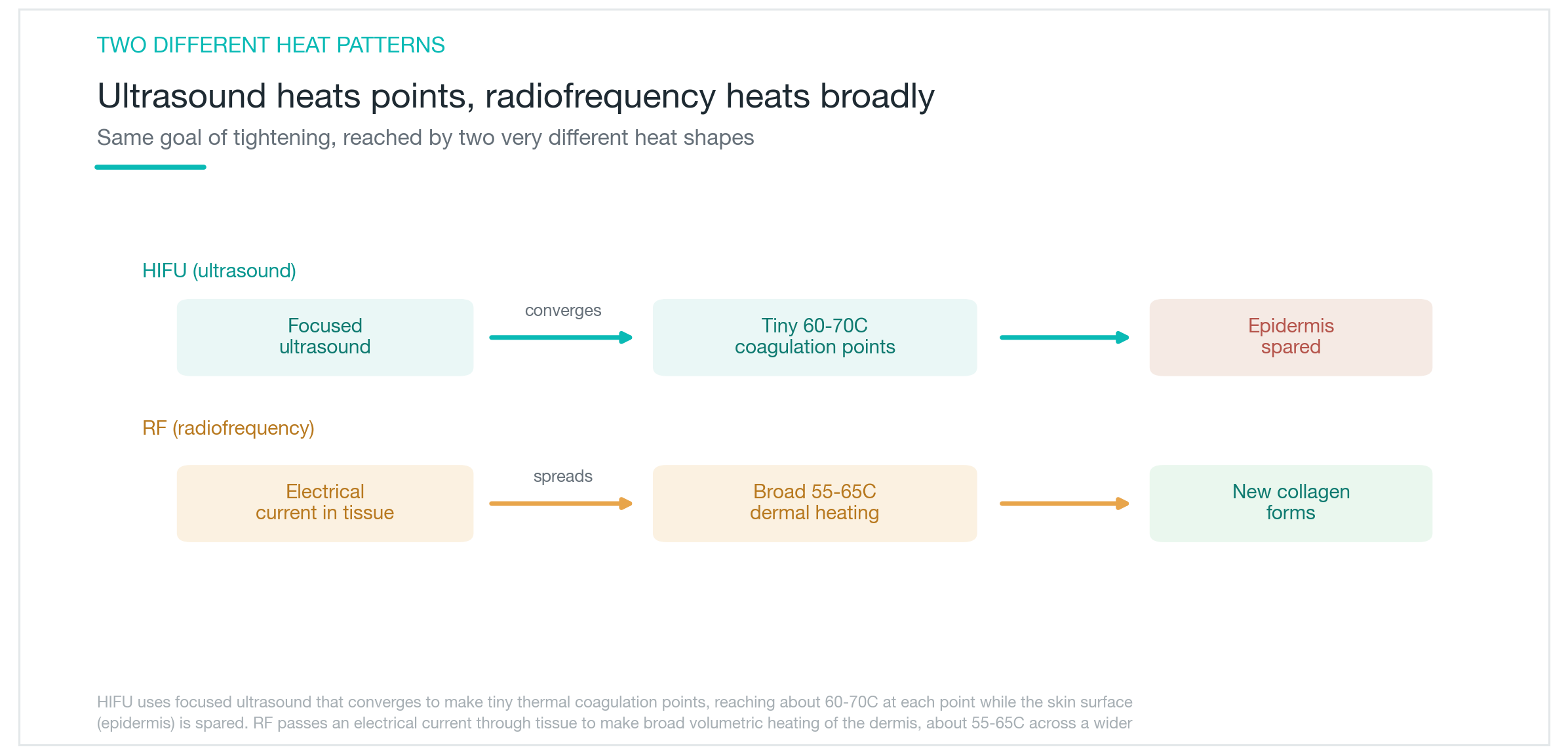
HIFU, the ultrasound-based treatment, focuses ultrasound energy into a single point inside the skin. That focal point is called a thermal coagulation point, where temperature rises to 60–70°C and coagulates tissue at that exact spot. Above the focal point, the energy simply passes through the epidermis and the layers above it without raising their temperature much, so the surface skin stays undamaged.
RF takes a different approach. It runs current through the tissue and uses the resistive heat that generates, warming the dermis broadly as a surface rather than at a single point. The temperature runs between 55°C and 65°C, and that heat denatures collagen, which then triggers new collagen to start forming. Depending on the device, monopolar RF spreads deep and wide, while bipolar RF concentrates more in the shallower layers.
Studies comparing actual tissue confirm this difference. Skin treated with monopolar RF showed new collagen forming broadly across several layers, from the papillary dermis down to the deep reticular dermis, while skin treated with ultrasound showed a response concentrated narrowly and deeply in the mid-to-deep reticular dermis. Think of ultrasound as digging deep at a point, and RF as spreading broadly across a surface.
Where does the depth differ?
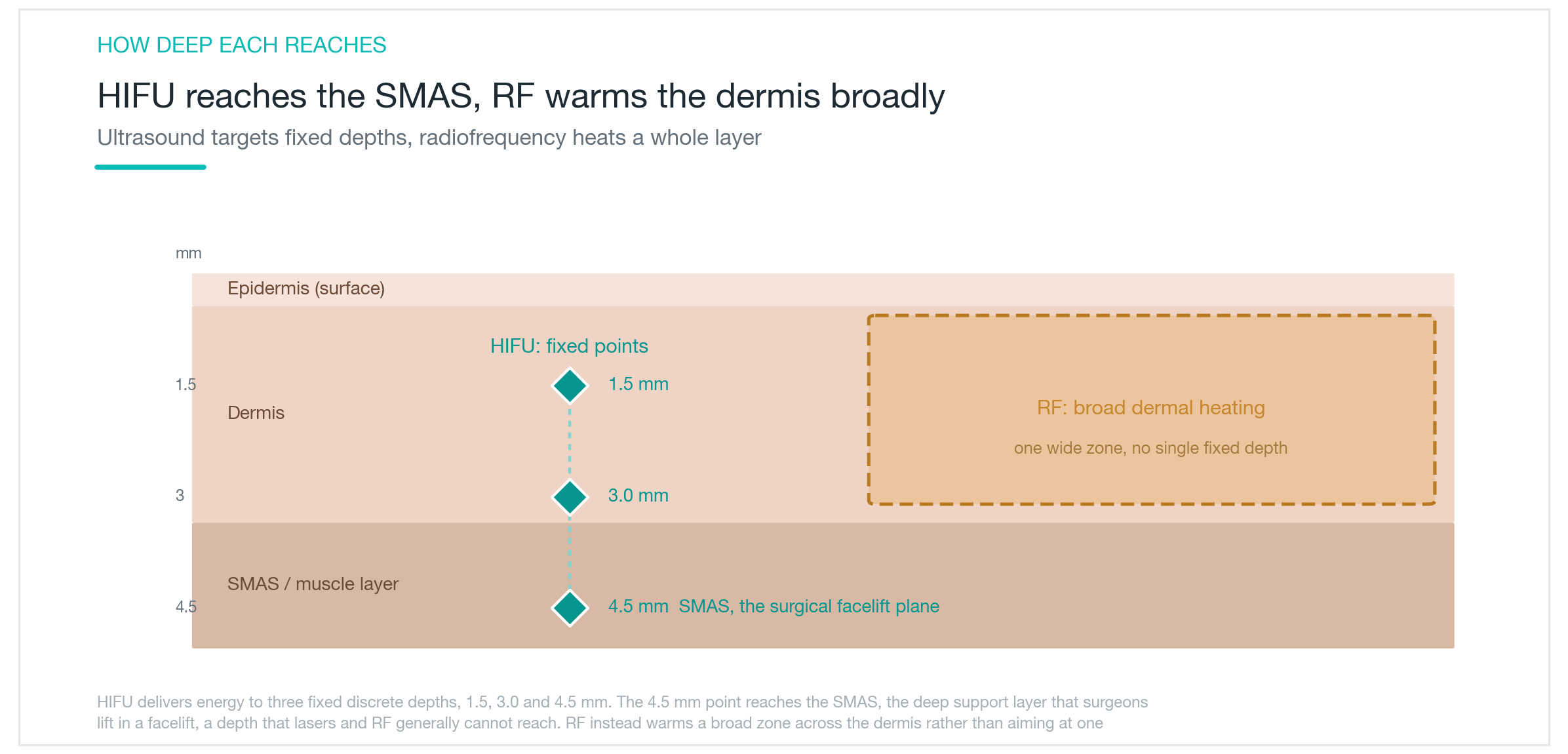
HIFU lets you choose depth by swapping cartridges. The shallow cartridge goes to 1.5 mm, the medium one reaches 3.0 mm to firm the dermis, and the deepest cartridge reaches 4.5 mm. That 4.5 mm mark is the SMAS, the fascia layer that surgeons actually dissect during a surgical facelift. Lasers, fillers, and fractional RF have a hard time reaching this depth.
RF doesn't offer that kind of layer selection and instead focuses on heating the dermis broadly. Monopolar spreads relatively deep and wide, while bipolar concentrates more on the shallow layer, but neither one precisely targets a fascia layer like the SMAS. What it's good at instead is delivering heat evenly across the whole dermis.
Ultrasound is a treatment that precisely hits a set depth at a point, while RF is a treatment that heats the broad surface of the dermis. Actually lifting a sagging face requires reaching a deep layer like the SMAS, and that's the job ultrasound handles. On the other hand, widespread issues like surface texture or shallow fine lines respond better to even heating across a surface than to point-by-point treatment, which is where RF fits better. Both fall under the umbrella of lifting, but the depth each one actually works at is what really separates them.
Sagging or loss of firmness: which concern does each suit?
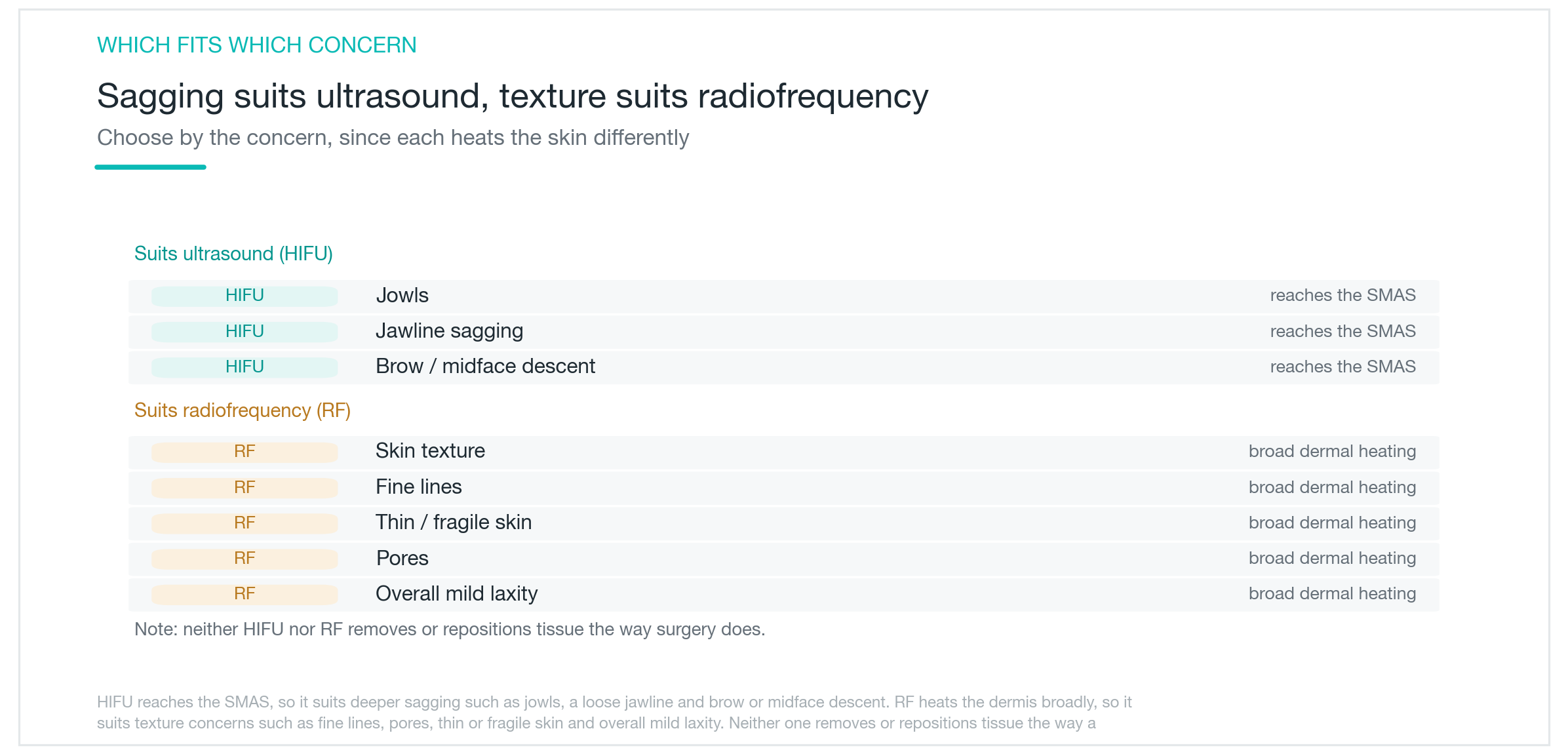
Since they reach different layers, they suit different concerns. Because ultrasound reaches the SMAS, it has a real edge at lifting tissue that's actually loosened, like a jawline that's lost definition, a sagging neck, or a drooping brow. Stimulating the fascia layer itself gives it comparatively more power to redefine contour.
RF firms the dermis broadly, so it's suited less to lifting a specific area and more to improving overall skin texture and firmness. It's particularly helpful when fine lines have increased, skin has thinned, and firmness has dropped generally, or when pores have become more visible. It's used for skin texture not just on the face but on broader areas like the neck or abdomen too.
If your concern is a jawline and neck that have lost their shape, ultrasound is the reasonable first choice. If it's less about sagging and more about skin that's generally dull and rough in texture, RF is worth considering first. It's common to have both sagging and reduced firmness at the same time, and in that case it makes sense to figure out which concern is dominant rather than insisting on just one. That said, neither treatment can cut away or reposition sagging tissue, so if sagging has already progressed significantly, it's realistic to also consult about surgical lifting options.
What do the numbers say about results?
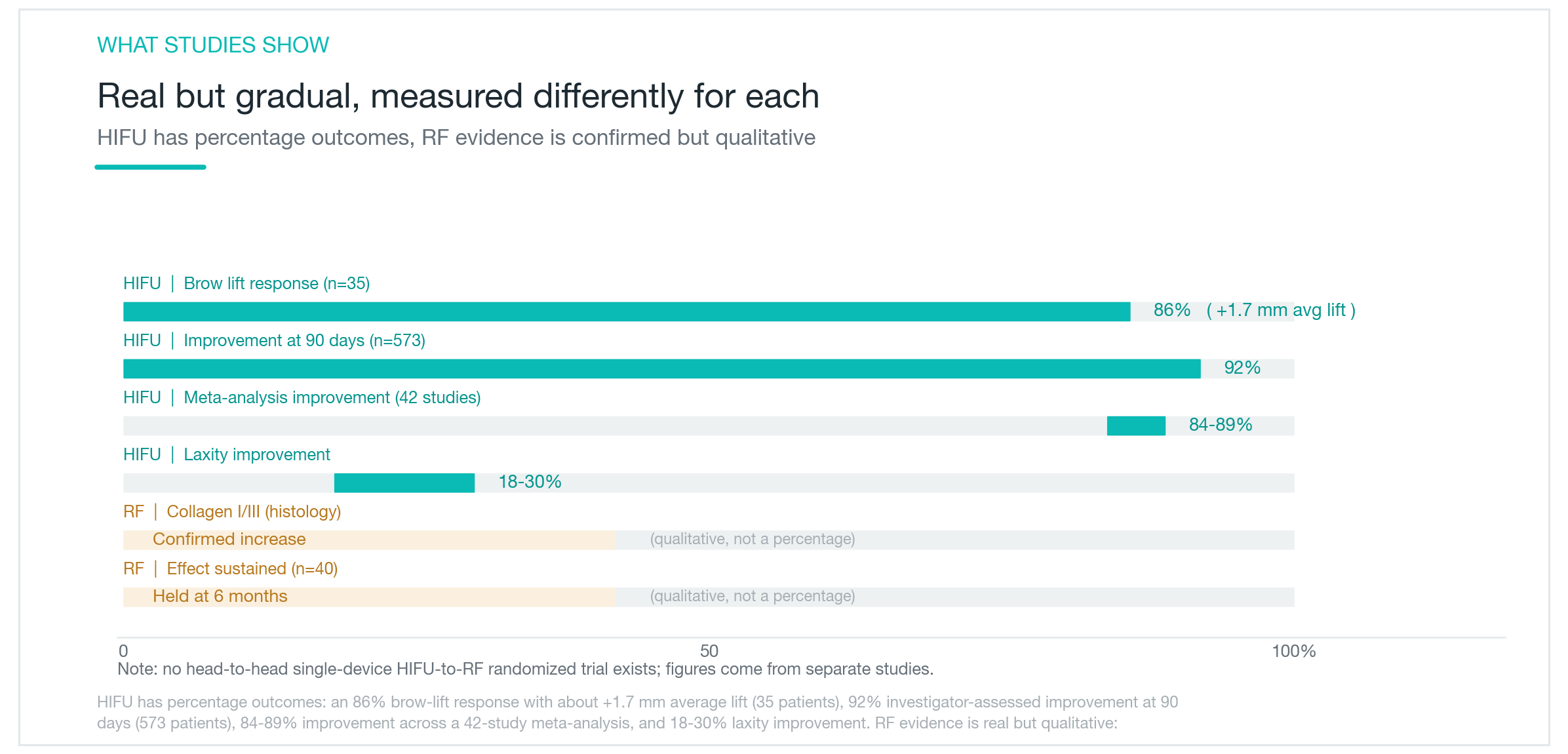
There's a fair amount of research on HIFU's effect. One study looking at the brow area found that in 35 patients, brows lifted an average of 1.7 mm at 90 days, with improvement confirmed in 86%. A review pooling 16 studies and 573 patients found a 92% physician-rated improvement rate at 90 days, with satisfaction climbing from 42% right after treatment to 53% at 360 days. A separate meta-analysis of 42 studies reported improvement rates of 89% and 84%, and laxity generally improved by 18–30% across various studies.
Studies on RF tend to be smaller in scale. One study confirmed histological changes, an increase in type 1 and type 3 collagen alongside a decrease in elastin, and another study of 40 patients showed improvement continuing through 6 months. That said, RF doesn't yet have as much large-scale meta-analysis data as ultrasound, so it's worth being cautious about pinning improvement to a single number.
There's no direct head-to-head clinical trial pitting the two against each other yet. Rather than ranking them by whose numbers look bigger, it's more accurate to see it as each one proving its effectiveness toward a different goal, as shown above: ultrasound for sagging, RF for texture and firmness.
Pain, downtime, and duration
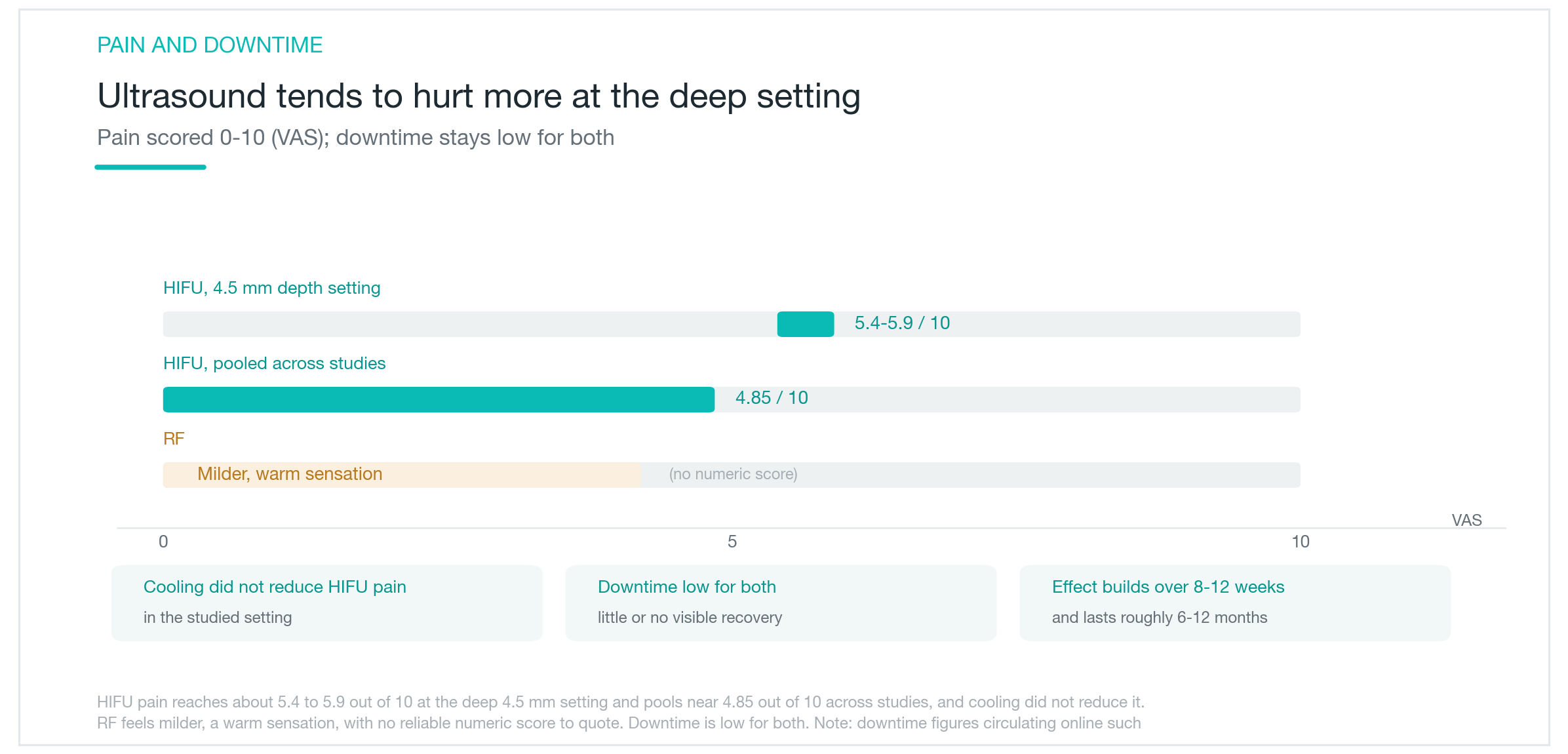
Because ultrasound focuses energy down into deep layers, the pain during treatment tends to be noticeable. In a study of 21 patients, treatment with the deepest 4.5 mm cartridge scored 5.4–5.9 out of 10 for pain, and pre-cooling the area didn't reduce the pain by much. A meta-analysis of 42 studies also found an average pain score of 4.85, which isn't exactly low. Specific comparisons circulating online, like "RF scores 2 to 4 and ultrasound scores 6 to 8," aren't backed by verified research, so they shouldn't be taken at face value.
RF is generally known to be milder than this. Since it heats broadly with current, most people describe it as a warm heat rather than a sharp sting. That said, there isn't yet enough research directly comparing pain between the two under the same conditions, so it's too early to put an exact number on the gap.
Downtime is low for both. Redness or slight swelling right after treatment is common, and it usually settles quickly enough to go straight back to your day. The effect doesn't appear right away: it becomes gradually more visible over 8–12 weeks as new collagen fills in, and it's most noticeable between 3 and 6 months. Duration is reported at roughly 6–12 months, and there's no evidence yet that it lasts longer than that.
Can you get both treatments?
It's common to receive ultrasound and RF together, in sequence. In a study of 24 people that treated the two halves of the face in a different order, the side that got RF first and ultrasound second showed slightly better results. Another study of 56 people found improvement in 96.4% of patients who received both treatments together, suggesting combined treatment itself tends to produce good outcomes.
The combination makes sense mechanically. Ultrasound stimulates deep down to the SMAS to lift sagging, while RF heats the dermis broadly to firm surface texture and tightness at the same time. Since they reach different layers, one essentially fills in what the other misses.
There isn't yet a large enough comparison study to say combining is always better than getting just one. If you have both sagging and reduced firmness, combining is worth considering, but if your concern clearly points to one side, focusing on the treatment that matches your condition is also a reasonable choice. Since combining adds cost and treatment time, doing both isn't automatically the right answer. In the end, ultrasound and RF are less like competitors and more like two tools that reach different layers; pick one or use both together depending on which your skin needs more right now.
Was this helpful?
About this article
Written by a practising aesthetic physician and intended for general education — not a substitute for individual medical advice.
Read next

Effects After Lifting Treatment and Duration, Including Swelling and Aftercare
A look at downtime and recovery after non-surgical lifting treatments like HIFU, RF, and thread lifts, how long the effect lasts, and when retreatment makes sense, based on real study numbers. Also separates aftercare advice that's well supported by evidence, like SPF and not smoking, from advice that's closer to clinical folklore.
By Dr. Kim
Emface Lifting Effect and Wrinkle Improvement, Including Number of Sessions
Here is what EMFACE actually does, how HIFES and synchronized RF work on facial muscles and skin at the same time, and how far the wrinkle and lifting results hold up under real research. We also look at how it differs from surgical facelifts and who tends to suit it best.
By Dr. Kim

Nasolabial Fold Treatment: Which Is Right for You, Filler or Thread Lift?
Whether your nasolabial folds come from sagging, lost volume, or aging skin decides whether filler, thread lifting, or a collagen stimulator is the right call. Here is what actually works for each cause, how long the results hold, and how to stay safe around the vessels beside the nose, all explained simply with real study numbers.
By Dr. Lee