Hairline Botox Effects: Does the Hairline Really Come Down?
By Dr. Kim7 min read
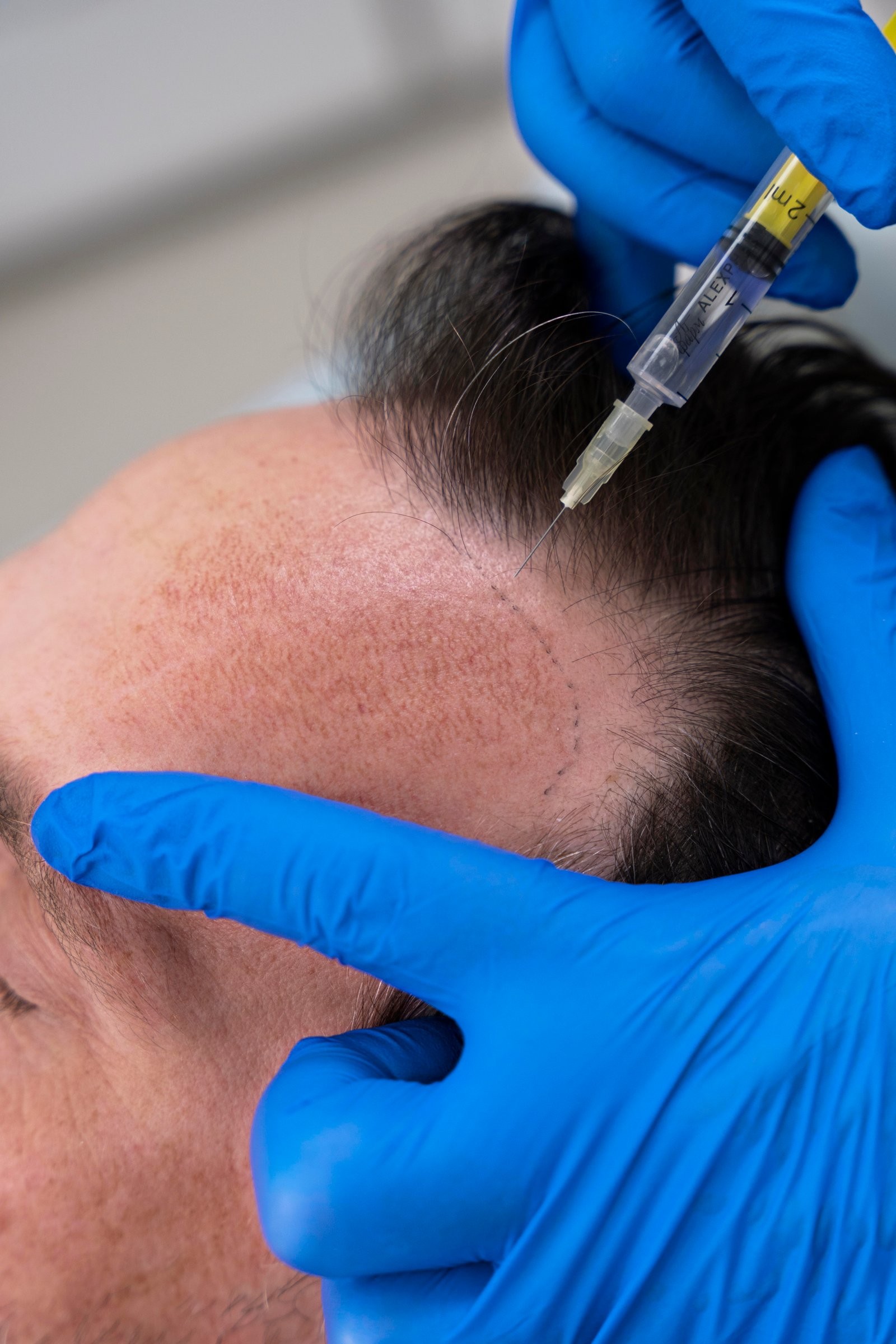
The name "hairline Botox" tends to cause confusion. It sounds like a treatment that lowers your hairline by pulling the hair follicles down. But a muscle injection cannot move where a follicle sits.
What the treatment actually does is different. It weakens the pull of the forehead muscle, which adjusts eyebrow position and forehead lines together, and that combination is what makes the hairline area look more refined. One name is covering two separate mechanisms, so it helps to break them apart one at a time.
Where is hairline Botox injected?
Hairline Botox does not treat the whole forehead. It targets the upper forehead and temple area closest to the hairline, where the tail end of the frontalis muscle (the muscle that lifts the forehead) runs.
The frontalis is what raises your eyebrows. It is also why your forehead lines horizontally when you look surprised, since the muscle contracts and pulls the skin up with it. Injecting Botox near the hairline weakens that contraction, so the upward pull on the upper forehead skin eases up too.
In other words, the follicles are not moving. What changes is the direction and strength of the pull the muscle puts on the skin. Think of it the way a curtain relaxes once someone loosens their grip on the cord, the fabric was never physically shortened, but it hangs differently.
Does a long-looking forehead come from muscle?
How wide a forehead looks depends on more than just where the hair actually starts. It also depends on how tightly the forehead skin is being held. When the frontalis stays chronically overactive, the forehead skin tends to get locked in a slightly lifted position.
In that state, the eyebrows sit a touch higher and the upper forehead skin stretches tauter, which can make the forehead look longer and wider even though the hairline itself has not physically moved. It is a shift in visual proportion, not an actual change in the hairline.
Once Botox relaxes that muscle tension, the eyebrows settle back into a more natural position and the tightness in the upper forehead eases. The visible result is that the space between the hairline and the eyebrows appears shorter. Measure it with a ruler and the difference may be minimal, but to the eye, the forehead reads as more proportionate.
The relationship between brow position and forehead length
Eyebrows act as a reference point for judging facial proportions, since the distance from the brow to the hairline is one of the main cues people use to gauge how wide a forehead looks.
People with a strong frontalis often develop a habit of unconsciously raising their eyebrows throughout the day. This shows up especially in people with slightly hooded eyelids, who tend to recruit the forehead muscle to lift the brow and open up their field of vision. Over time, that habit also deepens the horizontal lines across the upper forehead.
When Botox reduces overuse of this muscle, the eyebrows drop back to their natural resting position and the forehead lines soften along with them. The visual distance between the brow and the hairline shrinks while the lines smooth out at the same time, and both changes together are what make the whole forehead look softer and shorter. It is worth noting that both effects come from relaxing the same single muscle.
Does scalp Botox help hair loss?
Scalp Botox is often mentioned alongside hairline Botox, but the two target different areas for different purposes. Scalp Botox is injected into the crown and the galea aponeurotica across the scalp (a thin, tough layer of connective tissue that sits just under the scalp skin).
The theory behind this treatment goes as follows. When the galea stays chronically tight, it can compress the blood vessels underneath, reducing blood flow to the hair follicles. Reduced blood flow means less oxygen and fewer nutrients reach the follicles, and some researchers also propose that it allows DHT (dihydrotestosterone, a hormone byproduct known to shrink hair follicles) to linger in the tissue longer than it otherwise would.
The logic is that relaxing the scalp fascia with Botox improves blood flow, which in turn improves the environment around the follicles. That said, most of the research behind this theory comes from small studies, and it has not been established as a standard hair loss treatment. Compared to treatments with a solid evidence base, like minoxidil or finasteride, it is realistic to think of scalp Botox as a supporting option rather than a primary one.
For that reason, scalp Botox is usually presented as something used alongside minoxidil or finasteride, not as a replacement for them. Loosening fascial tension to improve blood flow and adjusting hormone metabolism directly are two different mechanisms acting on different targets, so the evidence supports treating them as complementary rather than interchangeable.
When does it start to work and how long does it last?
Botox does not stop a muscle from working the moment it is injected. It takes time for it to block the signal between the nerve and the muscle.
Most people start to notice the muscle weakening somewhere between 3 and 7 days after treatment, with results becoming most noticeable around the 2 week mark. Both hairline Botox and scalp Botox tend to follow a similar timeline.
Results are generally reported to last somewhere between 3 and 6 months. After that window, nerve endings regrow and reconnect with the muscle, and strength gradually returns. Because of that, keeping up with periodic touch ups is necessary to maintain the effect, the same as with most other Botox treatments.
What to check before getting it
A few things are worth reviewing before considering hairline Botox.
- Whether your eyebrows are prone to drooping: Over relaxing the frontalis can drop the eyebrows too far, which can make the eyes look heavier rather than more open. If a person relies almost entirely on this one muscle to lift the brow, dose control matters even more.
- How strong your forehead muscle already is: People with deep forehead lines and a strong frontalis tend to notice a bigger change, while people with a weaker muscle may see a smaller shift. This comes down to how much movement the muscle was producing to begin with.
- Whether you also have drooping eyelids: If a person already compensates for sagging eyelids by using the frontalis to lift the brow and improve their field of vision, relaxing that muscle can actually narrow their visual field, so this needs to be checked beforehand.
- Scalp condition and how advanced any hair loss is: If scalp Botox is also being considered, it is generally advised to try it in the earlier stages of hair loss rather than in areas where thinning is already advanced, based on the current evidence.
How to spend the days after treatment
- Staying upright for about 4 to 6 hours right after treatment is recommended, to reduce the chance of the Botox spreading into nearby muscles.
- Avoid pressing on or massaging the treated area on the day of treatment, since the product has not fully settled and could migrate to an unintended spot.
- Changes like brow drooping tend to show up most clearly between 1 and 2 weeks after treatment, so checking in during that window is helpful.
- Since results fade gradually rather than all at once, it makes sense to time the next session based on how long the previous effect actually lasted.
- Repeating treatments too close together can make the muscle overly accustomed to staying weak, so it is generally advised to space sessions out and respect the typical duration of the effect.
References
Korean Dermatological Association, American Academy of Dermatology (AAD), and Ministry of Food and Drug Safety (MFDS).
Was this helpful?
About this article
Written by a practising aesthetic physician and intended for general education — not a substitute for individual medical advice.
Read next

Forehead Botox: When It Starts Working, How Long It Lasts, and Aftercare
Forehead lines form when the frontalis muscle contracts over and over with everyday expressions. Botox works by blocking the nerve signal that tells this muscle to move, not by dissolving the wrinkle itself. Here is how the muscle gets quieted down and why the effect eventually wears off.
By Dr. Kim
Nostril Botox: When Does It Start Working and How Long Does It Last?
Nostril botox targets the small muscle that makes the sides of your nose flare out when you smile or take a deep breath. Rather than reshaping or narrowing the nose, it only dials down that muscle's pull, which is what sets it apart from other nose treatments. Here is a breakdown of which muscle is responsible and exactly how botox acts on it.
By Dr. Lee

Menopausal Skin: Causes of Dryness and Loss of Firmness, Collagen Loss, and Care
As menopause sets in, falling estrogen levels take collagen production and moisture retention down with them. The result is drier skin, less firmness, and more fine lines. Here is the science behind that shift, along with the care habits that actually help.
By Dr. Kim