Hyaluronic Acid Filler Duration: Why Does It Differ Between Products?
By Dr. Kim7 min read
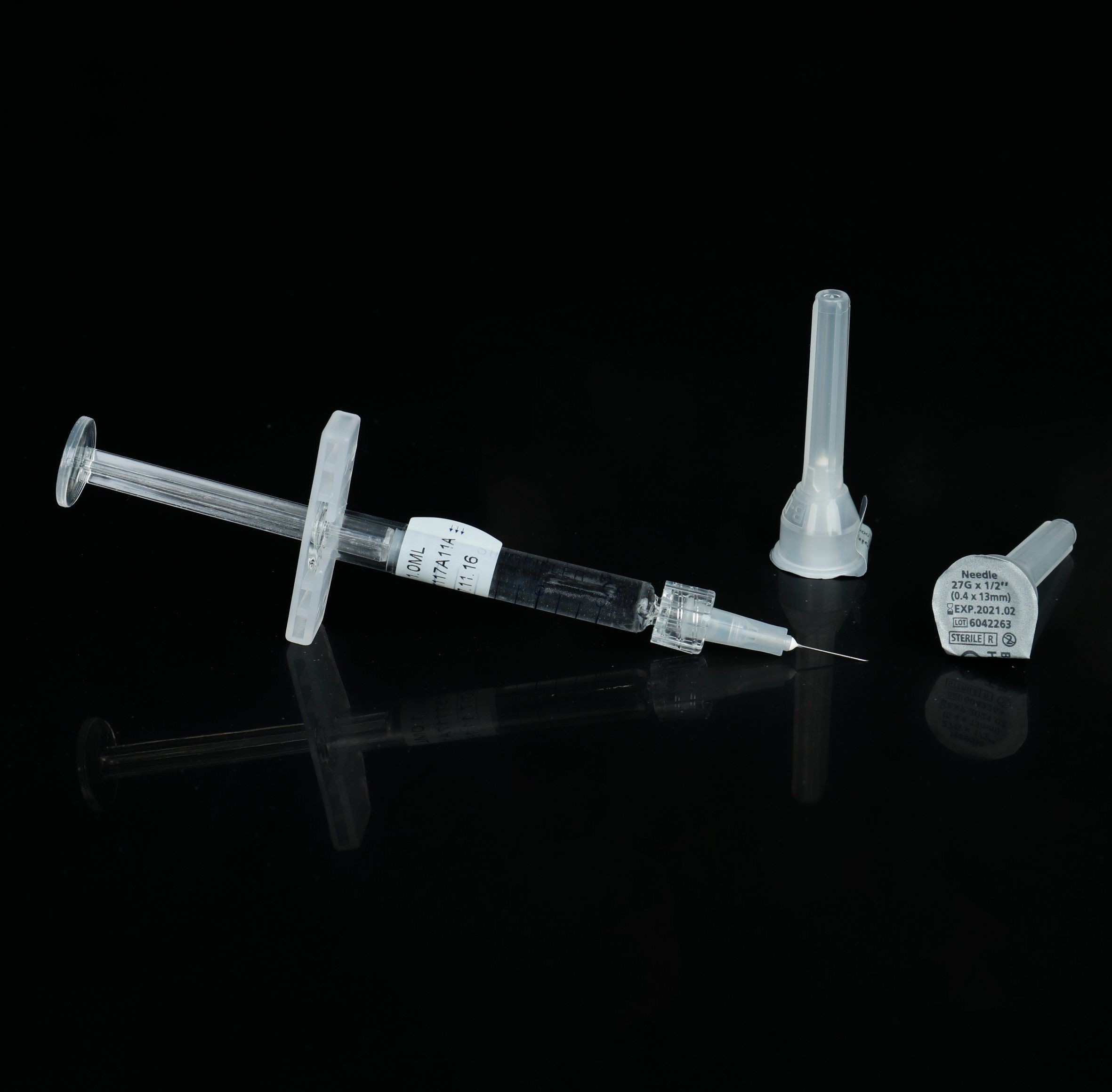
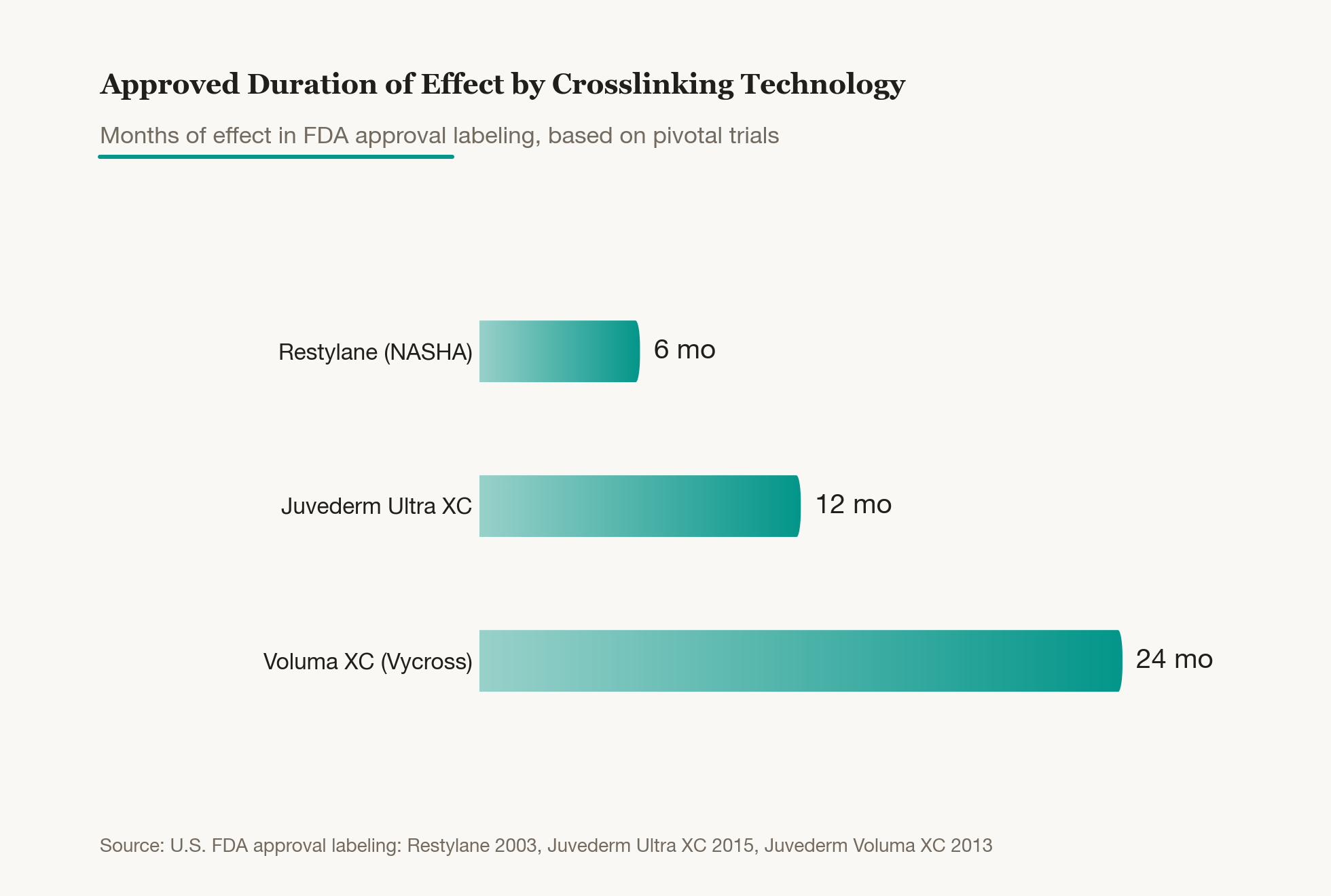
Ask about fillers during a consultation and the ingredient name that comes up is always the same, hyaluronic acid (HA). Yet the product descriptions tell a different story. One filler wears off in 6 months, another holds for a year, and some claim to last close to 2 years. Same raw material, wildly different lifespans. It is a fair thing to wonder about.
The answer is not in the hyaluronic acid itself, but in how that hyaluronic acid was processed. How tightly the thread-like HA strands are woven together, and how firm or soft the resulting gel turns out, changes both how long it lasts and how it feels under the skin.
Why does lifespan differ when the ingredient is the same hyaluronic acid?
Hyaluronic acid already exists naturally in our skin and joints. It holds onto huge amounts of water, which is what keeps skin plump and hydrated. But the HA our bodies make on their own floats around as loose, individual strands, and it gets broken down and cleared within a day or two.
For HA to work as a filler, those loose strands need to be reinforced so the body cannot clear them so quickly. Manufacturers do this by linking the strands together into a tight, net-like mesh. This process is called crosslinking. Just as a net with tight, small openings is harder to pull apart, a filler with more crosslinking holds up longer once it is inside the body.
How does the crosslinked structure resist enzyme breakdown?
Think of crosslinking as building bridges between individual HA strands. Most fillers use a linking agent called BDDE (butanediol diglycidyl ether) to chemically bond one strand to the next. The body finds this bridged, net-like structure far harder to break down than loose individual strands.
Inside the body, an enzyme called hyaluronidase is constantly at work breaking down hyaluronic acid. It acts like a pair of scissors, snipping strands one at a time. A single loose strand with no crosslinking gets cut through easily on the first pass. But a tightly woven mesh can absorb many of those snips before the whole structure gives way. That is why fillers with higher crosslinking withstand the enzyme's attack for longer, and end up lasting not 6 months, but 1 year, or even 2 years.
Crosslink density and filler firmness
Two main factors determine the level of crosslinking. One is how many bridges are built between strands (crosslinking density), and the other is how long the individual HA strands are to begin with (molecular weight). More bridges and longer strands both make for a tighter, sturdier mesh.
That said, more crosslinking is not automatically better. Push it too far and the gel becomes overly stiff and clumped, which makes it hard to inject through a needle and prevents it from spreading naturally once it is under the skin. This is why each manufacturer relies on its own proprietary crosslinking technology to find the sweet spot, a filler that lasts a long time but is still easy to work with.
How is viscoelasticity like corn syrup?
If crosslinking decides how long a filler lasts, viscoelasticity decides how natural it feels to the touch. The word sounds technical, but a simple comparison makes it easy: think of corn syrup. Corn syrup flows and spreads (viscosity), but it also has a tendency to hold and regain its shape when you press it with a finger and let go (elasticity). Filler gel carries both of these properties at once, which is why it is described as viscoelastic.
A gel with strong elasticity resists being flattened and holds its original shape well. A gel with strong viscosity, by contrast, spreads smoothly through tissue and feels softer to the touch. Where a given filler sits on this spectrum determines whether it suits an area that needs volume, like the cheeks, or an area that needs to move naturally, like the lips.
How do firm gels and soft gels differ in use?
The degree of viscoelasticity is usually expressed as the elastic modulus, commonly written as G prime (G'). In simple terms, it is a number describing how firmly a gel pushes back against outside pressure. Fillers with a high G prime are stiffer and firmer, so they are typically used in areas like the chin, nose, and cheekbones, where the goal is to build and hold structure, much like reinforcing a bone framework.
Fillers with a low G prime, on the other hand, are soft and spread easily through tissue, making them a better fit for areas that need to move naturally with expression, such as the lips, nasolabial folds, or under the eyes. Inject a stiff filler into one of these areas and it can look rigid and out of place the moment you smile or talk. Matching viscoelasticity to how much an area moves is generally considered the key to a natural-looking result.
Criteria for choosing a filler formula by area
In actual practice, both crosslinking level and viscoelasticity are weighed together to select the right formula for each area. This is exactly why even a single brand offers several different product lines.
- For areas that need structural support, like the chin, nose, and cheekbones, a firm formula with high crosslinking and a high G prime is used, since it needs to hold its shape for a long time, much like a framework.
- For areas that need moderate volume while still moving naturally, like the nasolabial folds or forehead, a mid-range viscoelasticity formula is used. Too firm and expressions look stiff, too soft and the volume fades quickly.
- For thin, sensitive, highly mobile areas like the lips or under the eyes, a soft formula with low crosslinking is used, since it puts less strain on the tissue and feels less noticeable to the touch.
- For shallow injections meant to fill fine lines or refine skin texture, a very soft formula is used. Injecting a formula meant for deeper placement too close to the surface can cause lumps or the Tyndall effect, where the skin takes on a bluish tint.
Where does filler go over time?
No matter how tightly a filler is crosslinked, it does not stay in place forever. The hyaluronidase enzyme mentioned earlier keeps cutting away at the mesh over time. At first, the mesh is dense enough to hold up, but as more and more links get severed, the entire structure gradually loosens.
Along the way, the filler steadily loses its ability to hold onto water. As the mesh opens up, there is simply less space to trap moisture inside. So rather than disappearing all at once, volume typically shrinks gradually, often starting around 2 months after treatment and continuing out to about 18 months. Fillers with higher crosslinking and higher molecular weight loosen more slowly, which is why they end up lasting longer overall.
How to choose a filler that fits your area
In the end, how long a filler lasts comes down to how tightly it is crosslinked, and how natural it looks comes down to how well its viscoelasticity matches the movement of the treated area. Neither of these can be judged by eye, so they need to be assessed against each product's published properties and clinical data.
For that reason, it helps to walk into a consultation talking not just about brand names, but about how much the treatment area moves and how long you would like the results to last. From there, it is generally recommended that your provider select a formula whose crosslinking level and viscoelasticity match that specific area.
Once you understand these two factors, crosslinking and viscoelasticity, the explanations you hear during a filler consultation become much easier to follow. Even an unfamiliar product name starts to reveal something about the mesh structure and firmness hiding behind it.
References
Korean Dermatological Association, Ministry of Food and Drug Safety (MFDS), American Academy of Dermatology (AAD), and U.S. Food and Drug Administration (FDA).
Was this helpful?
About this article
Written by a practising aesthetic physician and intended for general education — not a substitute for individual medical advice.
Read next
Under-Eye Hollow Filler: Effect and Side Effects, and the Tyndall Effect to Watch
The dark, sunken look under the eyes often comes less from pigment than from hollowing and the shadow it casts. Here's how the tear trough ligament and lost volume under the eye create that shadow, how a soft hyaluronic acid filler placed shallowly and sparingly smooths it out, why thin skin and the bluish Tyndall effect make this area tricky, and how long results actually last, all backed by real published numbers.
By Dr. Kim

Filler and Fat Grafting: Differences, Duration, and Reversibility Compared
Filler is made of hyaluronic acid that the body's own enzymes slowly break down, so it can be reversed with a dissolving injection if needed. A fat graft is different: the fat cells that survive settle in permanently, which means the result is much harder to undo once it takes. Here is the biology behind why these two treatments behave so differently under the skin.
By Dr. Lee
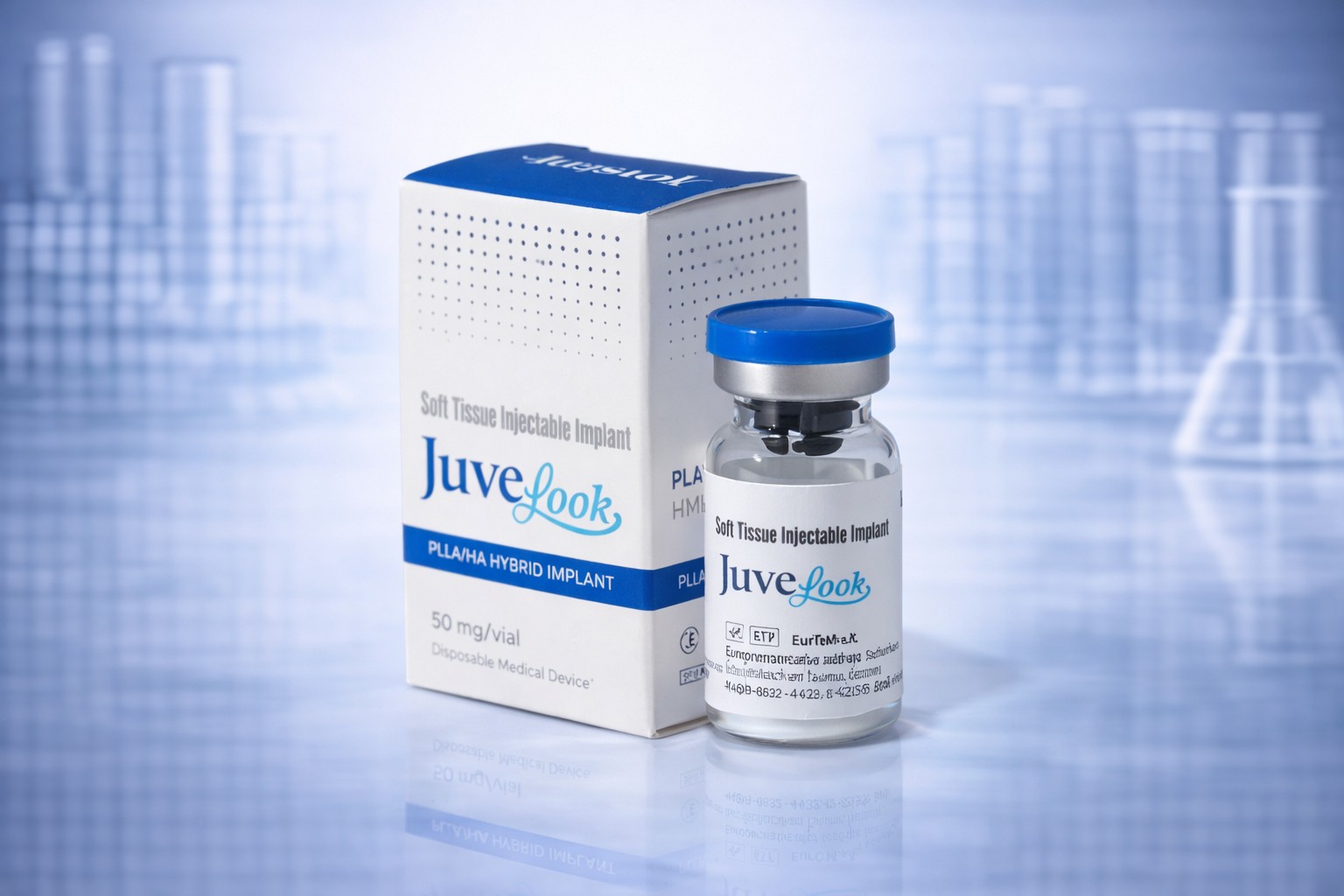
Juvelook: When Effects Appear and How Long They Last, Dewy Glow Versus Volume
The dewy glow you feel right after a Juvelook treatment and the collagen volume that slowly builds over 6 weeks to 6 months actually come from two completely different mechanisms. This article breaks down, step by step with simple comparisons, how PDLLA, Juvelook's key ingredient, drives your body to produce collagen.
By Dr. Kim