Everwrinkle PLLA Effects and the Difference From Everwrinkle V, Including Nodule Side Effects
By Dr. Kim6 min read
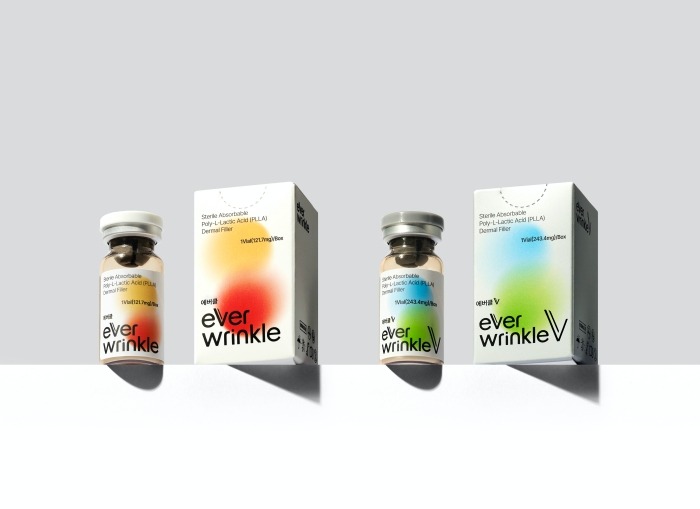
When people hear about a treatment that builds fresh collagen in the skin, thread lifting or PLLA-based fillers like Sculptra usually come to mind first. Everwrinkle belongs to that same family. It is a PLLA-based collagen biostimulator from Pharmaresearch, and unlike a lift that pulls the surface up, it works by coaxing the skin to manufacture its own new collagen from within.
The word "booster" in its category name makes it easy to confuse with hydration boosters that plump the skin with water. But the whole point of Everwrinkle is collagen stimulation, not hydration. Let's go through why PLLA triggers collagen production and what separates Everwrinkle from Everwrinkle V.
How is Everwrinkle different from a skin booster?
Everwrinkle is a collagen-inducing injectable built around PLLA (poly-L-lactic acid, a biodegradable polymer that breaks down slowly in the body) as its main ingredient. The box itself labels it an absorbable PLLA dermal filler, and a single vial contains 217.7mg of PLLA.
PLLA powder alone, though, is hard to push evenly through a syringe. That's why Everwrinkle includes carrier ingredients that keep the PLLA particles evenly suspended in liquid: CMC (carboxymethylcellulose, a viscous substance that keeps particles from settling) and mannitol (a sugar that keeps particles from clumping together). Both simply help the injection go smoothly. The one actually responsible for building collagen is PLLA, and PLLA alone.
How does PLLA stimulate collagen?
Once PLLA particles reach the dermis, the body recognizes them as foreign material. Macrophages (immune cells that patrol the body and clear away anything that doesn't belong) gather around the particles and begin breaking them down gradually, not unlike a cleanup crew converging on something unfamiliar left on the ground.
While doing this, macrophages also send out signals that call in fibroblasts (the cells in the skin that manufacture collagen). Once fibroblasts pick up the signal, they move to the site and start producing new collagen. Much like a planted seed doesn't sprout instantly but needs time before roots and stems appear, PLLA doesn't work the moment it's injected either. It builds collagen slowly over the course of several weeks.
The collagen that forms this way acts like a support beam underneath the skin. As these beams accumulate, the skin's own firmness and thickness gradually improve, and this is a completely different mechanism from a filler that adds instant volume. That's why changes become noticeable weeks after treatment rather than right away.
Content difference between Everwrinkle and Everwrinkle V
Everwrinkle comes in two lines depending on the intended use. The standard version contains 217.7mg of PLLA per vial, while Everwrinkle V has a higher concentration at 243.4mg. A higher concentration changes how intense the collagen stimulation feels and how much fullness builds up, even in the same area.
Because of this, the standard version tends to suit areas where the goal is broad, shallow refinement of skin texture and firmness, while the higher-concentration version fits areas that need more volume. The same patient might even use both lines together, choosing the standard formula for a broad flat area like the cheeks and the stronger one for a deeper concern like nasolabial folds.
Which line to use, and how much, is something decided during consultation based on skin condition and goals rather than settled in advance. A higher concentration isn't automatically better. What matters is matching the product to the area and purpose so the result looks natural.
The shallow, multi-point injection technique
The procedure itself isn't much different from other collagen-stimulating injections. It's delivered shallowly in multiple small doses using a fine needle or a cannula (a blunt-tipped needle with a rounded end) into areas that have lost firmness, such as the cheeks, forehead, or neck.
Rather than pushing a large amount into one spot, the practice is to spread small amounts evenly across many points. When particles cluster together, the reaction concentrates in that same spot and raises the risk of nodules, so shallow, even distribution is considered a basic principle of safe treatment. Using a cannula instead of a needle also reduces the number of entry points, making it possible to cover a wide area evenly without puncturing the same spot over and over.
Treatment time varies by area and scope, but even including the wait for numbing cream to take effect, it usually isn't a long session.
How can side effects like nodules be reduced?
The most commonly reported reactions are swelling, bruising, and mild soreness right after injection. These are typical responses to the needle passing through the skin, and most settle within a few days.
The side effect that calls for particular attention with PLLA-type products is delayed nodule formation. These are firm lumps that can be felt weeks to months after treatment, and they're understood to form when particles fail to spread evenly and clump together within the tissue instead. Everwrinkle's CMC and mannitol help disperse the particles more evenly, but the injector's technique and choice of area remain important variables all the same.
A few other points are worth keeping in mind.
- Avoid massaging the treated area firmly: pressure applied before newly injected particles have settled can push them off to one side.
- Stick to the recommended interval between sessions: collagen buildup takes time, and repeating treatment too often can let particles overlap and trigger an excessive reaction.
- Avoid areas with infection or dermatitis: injecting a foreign substance into already-inflamed tissue can send the body's response in unpredictable directions.
When do results start to appear?
Everwrinkle isn't a treatment that leaves skin looking tight the same day. Once the initial swelling settles, the area can even look a little flat for a while, but underneath, fibroblasts are already getting to work making collagen. That's why changes show up gradually as the weeks pass.
PLLA takes a fairly long time to fully break down in the body, and collagen is understood to keep forming throughout that stretch, gradually improving firmness. That said, the speed and extent of this response vary a good deal from person to person depending on age, skin condition, and the amount and area injected, so it's hard to pin down duration to a specific number.
The collagen response also tends to be designed around several sessions spaced a few weeks apart rather than a single treatment. Each session adds a fresh round of stimulation, and as these layer on top of each other, the overall change in firmness becomes progressively clearer. For that reason, following a set schedule of sessions is generally recommended over relying on just one.
Aftercare and precautions
The key to aftercare is not disturbing the particles and the collagen response while they're still settling in. On the day of treatment, it's best to avoid saunas or steam rooms where heat runs high, since heat can make tissue swell and loosen, which can shift the particles out of place.
For a few days after treatment, it also helps to limit strong sun exposure. UV light works to break collagen back down, so wearing sunscreen helps keep it from canceling out the collagen that's newly forming. Swelling and bruising generally fade on their own with time, though recovery speed differs from person to person.
References
Korean Dermatological Association, American Academy of Dermatology (AAD), and Ministry of Food and Drug Safety (MFDS).
Was this helpful?
About this article
Written by a practising aesthetic physician and intended for general education — not a substitute for individual medical advice.
Read next
Juveacell Effects and Side Effects, Including the Difference From Rituo and Cellredm
What Juveacell is, what happens when you inject human-derived dermal matrix directly into skin, how its concentration and volume stack up against Rituo (Re2O) and Cellderm, and when the evidence says results actually appear.
By Dr. Kim

Keloid Scar Causes and Treatment, Including Recurrence and Management
A keloid is a scar that keeps piling up collagen even after the wound has fully healed, growing larger than the injury that started it. Here's why the collagen never seems to know when to stop, how a keloid differs from an ordinary scar, how injections and laser treatments work to calm it down, and why it tends to come back so often.
By Dr. Lee
Ultracol PDO Effect and Duration, Including Differences From Lifting Threads
Ultracol isn't a thread lift. It's a skin booster made by grinding PDO into microscopic particles, suspending them in liquid, and injecting them to trigger new collagen. Here's how the particles work as they break down, where they're placed, what determines how long results last, and how to care for your skin afterward.
By Dr. Lee