Dyshidrotic Eczema: Causes and Are Palm Blisters Caused by Sweat?
By Dr. Kim8 min read
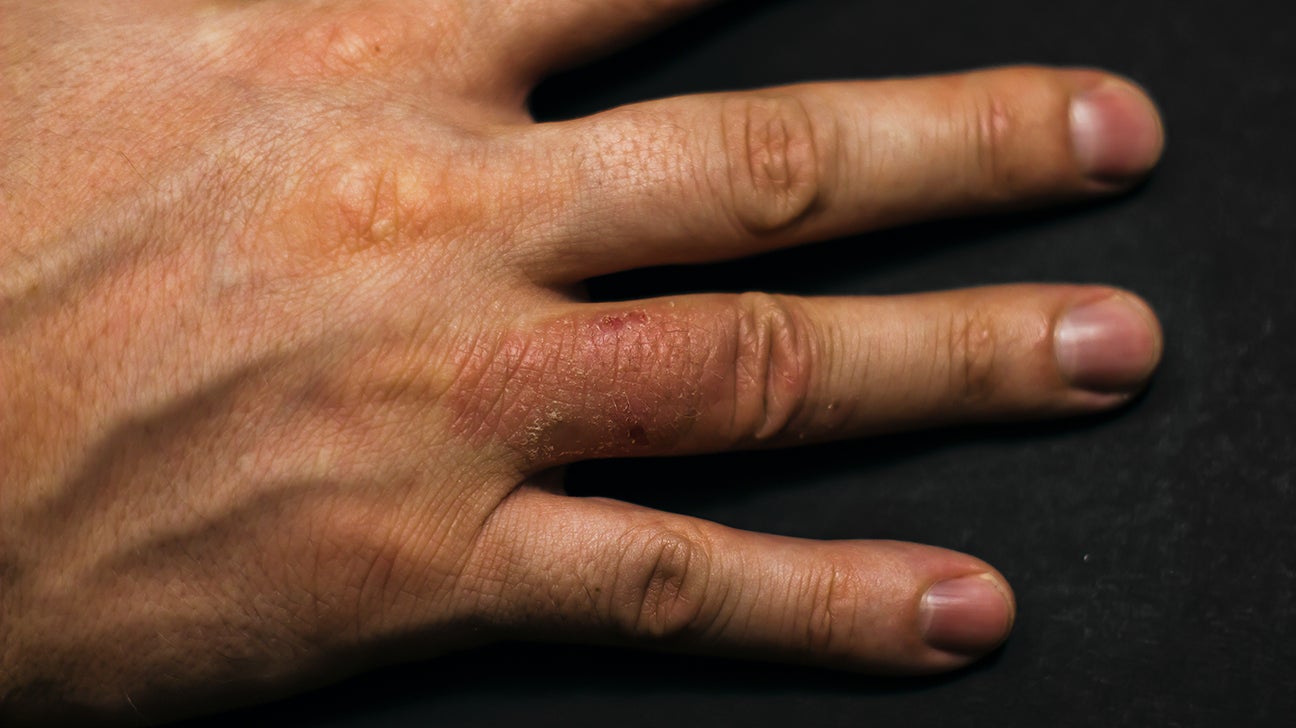
If your fingertips have suddenly started itching, followed by rows of tiny, tapioca-like blisters along the sides of your fingers and across your palms, dyshidrotic eczema is worth considering. The blisters tend to be clear, firm, and hard to pop, with a bumpy texture when you run a finger over them. Because the itching shows up first and the blisters follow, a lot of people brush it off at first as nothing more than dry skin.
Going by the name alone, this sounds like a condition where something goes wrong with sweat production. That is actually a mislabel from decades ago, and the sweat glands have nothing to do with it. Let's walk through why the name is misleading, what is really going on underneath the skin, and how to manage it so flare-ups happen less often.
Why do dyshidrotic eczema blisters appear on the palms?
Dyshidrotic eczema blisters show up almost exclusively on the palms, the sides of the fingers, and the soles of the feet. Even in the same person, the same underlying condition will not produce blisters like this on the forearm or the face. The reason comes down to how differently the skin is built in those spots.
The stratum corneum (the outermost layer of skin, made up of stacked dead cells) on the palms and soles is far thicker than anywhere else on the body. It builds up that way because those areas take constant friction from gripping, pressing, and rubbing. The problem is that this same thick layer works against the skin when inflammation shows up. Once inflammation develops underneath, fluid starts seeping out, and a thick stratum corneum blocks that fluid from reaching the surface and evaporating away. Instead, it gets trapped just under the skin, and pockets of trapped fluid cluster together into firm blisters.
Think of rain pooling under a tarp: the sturdier and more watertight the tarp, the more the water bulges upward instead of seeping through. The stratum corneum is playing the role of that tarp.
Is dyshidrotic eczema caused by sweat?
The English medical term for dyshidrotic eczema comes from a root tied to excessive sweating. Physicians in the past assumed the sweat gland openings were getting clogged, trapping sweat under the skin and forming blisters. That is exactly where the name came from.
Later research using tissue biopsies showed that theory did not hold up. When the fluid inside the blisters and the surrounding tissue were examined closely, the sweat glands and sweat ducts themselves showed nothing unusual. The blisters were forming inside the epidermis, in the spaces between skin cells, nowhere near the path sweat actually travels.
It is true that people with hyperhidrosis (a tendency to sweat heavily) do develop dyshidrotic eczema more often. But the explanation is not that sweat becomes the raw material for blisters. It is that sweat keeps the skin damp more often, which creates the kind of irritated, inflammation-prone environment where blisters are more likely to form. In other words, sweat plays more of a supporting role as a trigger, not the actual ingredient the blisters are made from.
How do the blisters rise?
What is actually happening in dyshidrotic eczema is a type of inflammatory reaction called spongiotic dermatitis. "Spongiotic" refers to fluid seeping into the spaces between skin cells and swelling them up, much like a sponge soaking up water.
When immune cells in the skin flag some trigger as foreign, they send out inflammatory signals from that spot. Following that signal, fluid and inflammatory substances leak out from nearby blood vessels, and the gaps between skin cells fill with that fluid and swell up like a sponge. Those swollen pockets then cluster together to form small blisters.
On most areas of skin, this kind of swelling gradually works its way out through the surface of the stratum corneum and settles down on its own. But as mentioned above, the palms and soles have such a thick stratum corneum that this escape route is essentially sealed off. So inflammation that would pass unnoticed anywhere else on the body ends up showing up here as a visible, firm blister.
What makes dyshidrotic eczema worse?
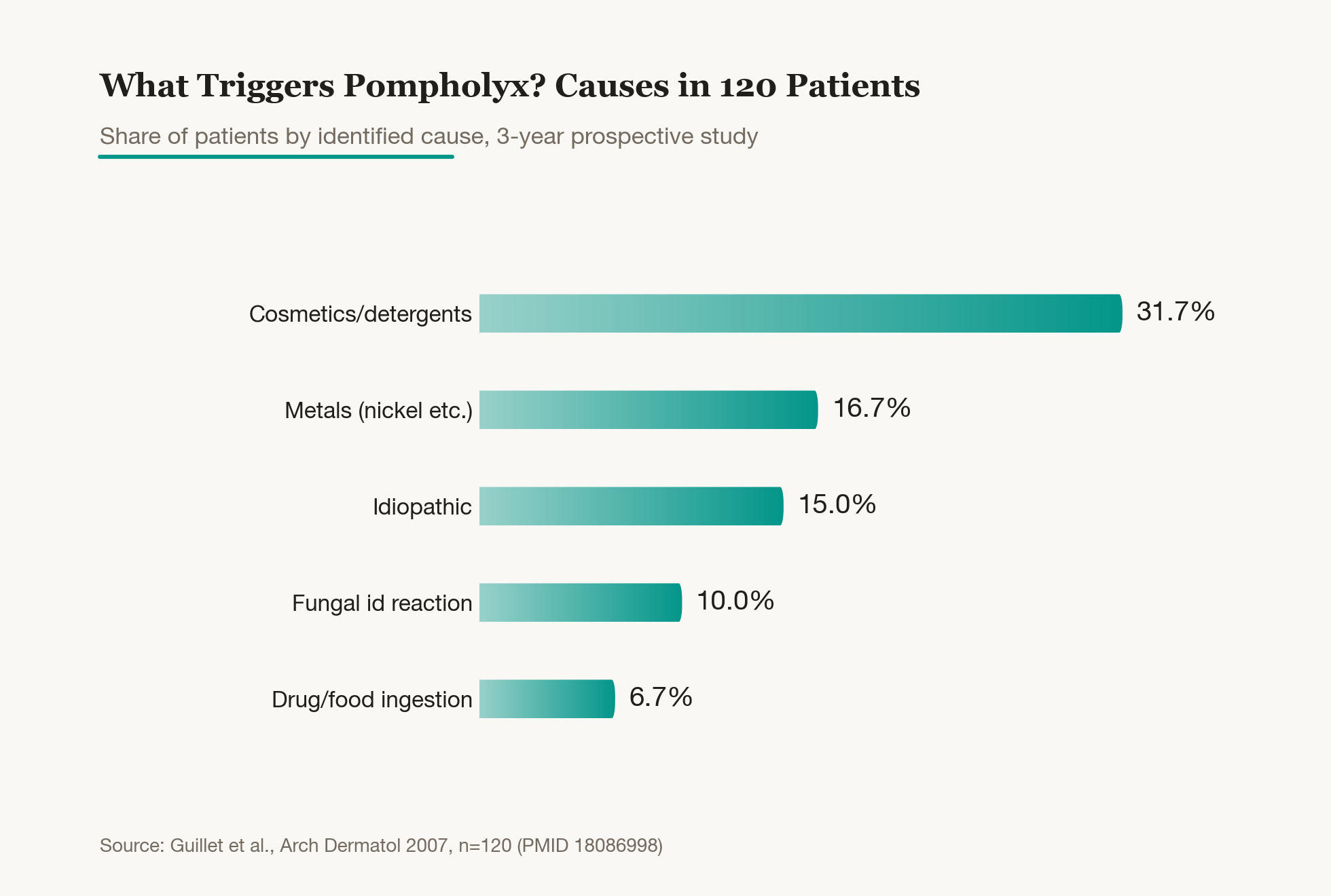
Dyshidrotic eczema rarely comes down to a single cause. It tends to show up when several factors line up at once, creating a state where the immune system is primed to overreact. The factors most commonly cited include the following.
- A history of atopic dermatitis: With atopic dermatitis, the skin barrier itself is inherently weaker, so even minor irritation can trigger an inflammatory response more easily.
- Contact with metals like nickel or cobalt: If you are allergic to metals found in jewelry, coins, or zippers, blisters have been reported to appear not just where the metal touched but on the palms as well. This is thought to happen because metal absorbed into the body triggers a broader immune response.
- Fungal infections such as athlete's foot: Blisters can appear on the hands even though the infection is on a completely different part of the body. This is understood as the immune system reacting to fungal components and that signal spreading to affect skin elsewhere.
- Frequent contact with water, detergents, and other irritants: Hands that are constantly exposed to dishwashing or cleaning have their skin barrier repeatedly stripped away and thinned, making them that much more vulnerable to irritation.
Does stress play a part?
A large share of people with dyshidrotic eczema report that blisters flare back up during particularly stressful periods. Mental strain and skin blisters might sound unrelated at first glance, but they are actually connected through the body's internal signaling systems.
Under stress, the body releases more cortisol (the stress hormone released when the body is in a heightened, tense state). Under normal circumstances, this hormone is supposed to keep inflammation in check. But when stress drags on, immune regulation ends up thrown off instead, and the skin's inflammatory response becomes more reactive. On top of that, the lipid synthesis needed to maintain the skin barrier tends to take a back seat during periods of stress.
The end result is a barrier that has weakened combined with an immune system on edge, so blisters can form from irritation that would not normally register at all. The full pathway is not completely mapped out, but the tendency for flare-ups to cluster around stressful periods is something clinicians commonly observe.
How long does dyshidrotic eczema take to heal?
Dyshidrotic eczema blisters are, for the most part, a self-resolving condition. The blisters themselves typically clear up within two to three weeks, and the affected skin sheds like dry flakes as it heals.
The catch is that if the underlying trigger sticks around, the blisters keep coming back. When the same spot goes through repeated flare-ups, the skin can gradually thicken and crack, shifting into something closer to chronic eczema. Once that happens, recovery takes considerably longer, and without proper management, symptoms can flare up and settle down over months or even longer.
That is why managing dyshidrotic eczema is less about calming down a single flare-up and more about addressing whatever is driving the repeated recurrences.
How is dyshidrotic eczema treated?
The first-line treatment is topical corticosteroid ointment. It calms down the inflammatory response itself, which cuts down on the fluid leaking out and helps settle blisters before they get bigger.
Early on, when blisters feel taut and the itching is intense, cold compresses with a chilled wet cloth can help. Constricting the blood vessels reduces the amount of inflammatory substances flowing to that spot.
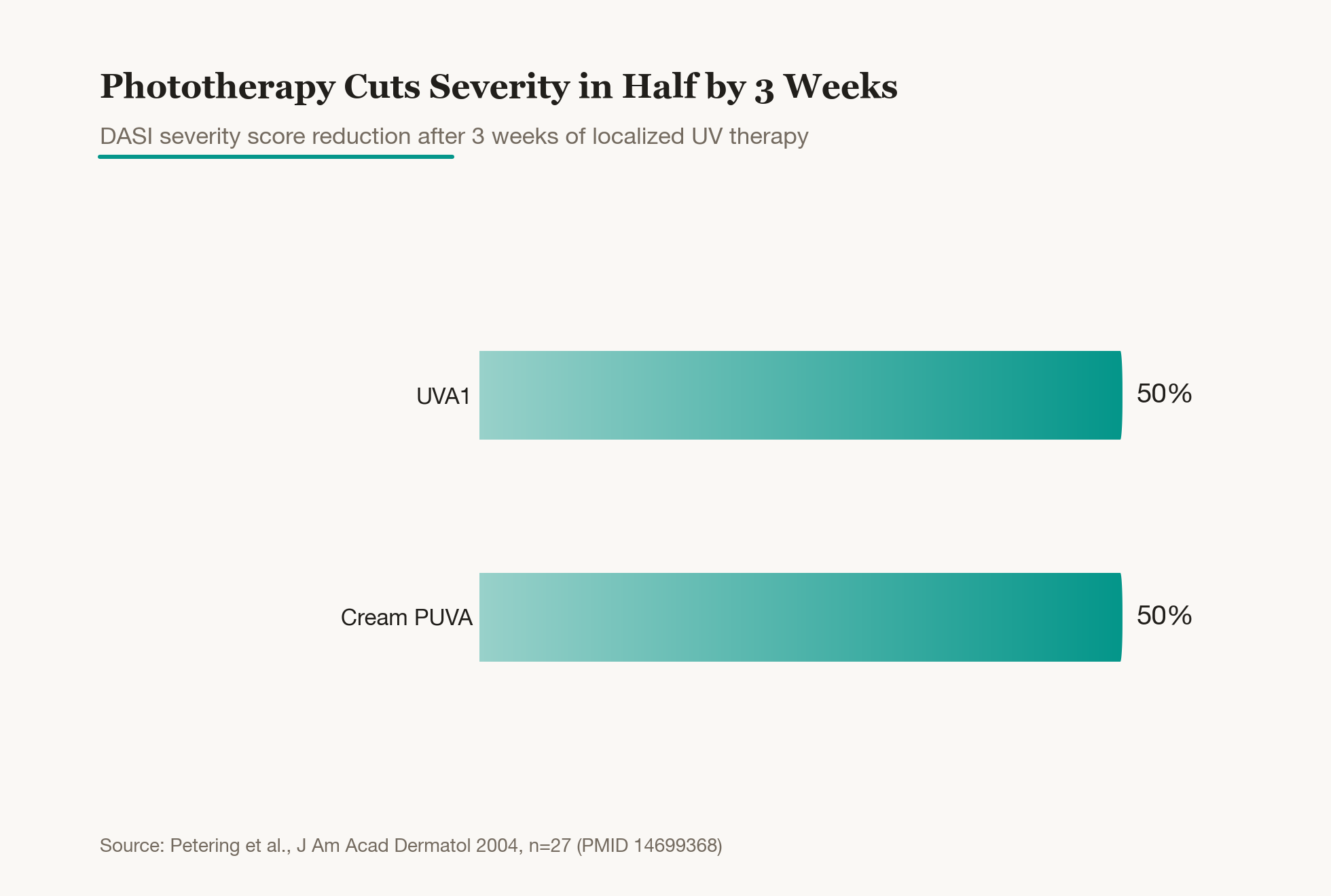
For cases that are severe or keep recurring, phototherapy using ultraviolet light is sometimes used. The idea is that UV exposure gradually calms an overactive immune response in the skin, though seeing results usually takes consistent sessions over several weeks up to around 20 weeks. In particularly severe cases, a short course of oral steroids may be added, but this is never meant to be a long-term approach.
Daily care to reduce recurrence
With dyshidrotic eczema, everyday habits matter just as much as treatment when it comes to how often flare-ups return. The following habits are commonly recommended.
- Cut down on direct contact with nickel-heavy jewelry, belt buckles, and coins. Less contact means fewer chances for the immune system to react in the first place.
- Apply moisturizer right after washing your hands to replenish the barrier. The key is shortening the window where the skin dries out as the water evaporates.
- Wear gloves and use a mild detergent when washing dishes or cleaning. This limits how much time detergent has to strip away lipids from the stratum corneum.
- If athlete's foot is also present, treat that at the same time. This removes the trigger for that distant immune reaction altogether.
- During stressful periods, pay extra attention to moisturizing your hands and avoiding irritants. The barrier is already weakened during these times, so reactions to minor irritation come on faster.
None of this eliminates blisters completely, but it does stretch out the time between flare-ups and keeps outbreaks from spreading as severely. Rather than expecting a quick fix, staying consistent with this kind of care is ultimately what gives your hands an easier time.
References
Korean Dermatological Association, American Academy of Dermatology (AAD), and Ministry of Food and Drug Safety (MFDS).
Was this helpful?
About this article
Written by a practising aesthetic physician and intended for general education — not a substitute for individual medical advice.
Read next

Tiny Facial Bumps: How to Tell Flat Warts, Milia and Skin Tags Apart, and How to Treat Them
The small bumps that show up on the face can look alike, but flat warts, milia, and skin tags have different causes and different treatments. Here is how to tell the three apart at a glance, the right CO2 and Er:YAG laser or electrocautery approach for each, how common they are, how they tend to recur, and real evidence on why removing them at home is risky.
By Dr. Lee

Exosome Treatment Effects: How Are They Different From Stem Cells?
Exosomes are tiny signal packets that cells release into their surroundings, delivering only the messages a stem cell creates rather than the stem cell itself to the skin. Here is a plain look at how exosomes carry regeneration and calming signals, why clinics so often pair them with laser treatments, and how much evidence has actually built up so far.
By Dr. Kim
Age Spots on the Hands: Causes, Treatment and Do They Last Longer Than on the Face?
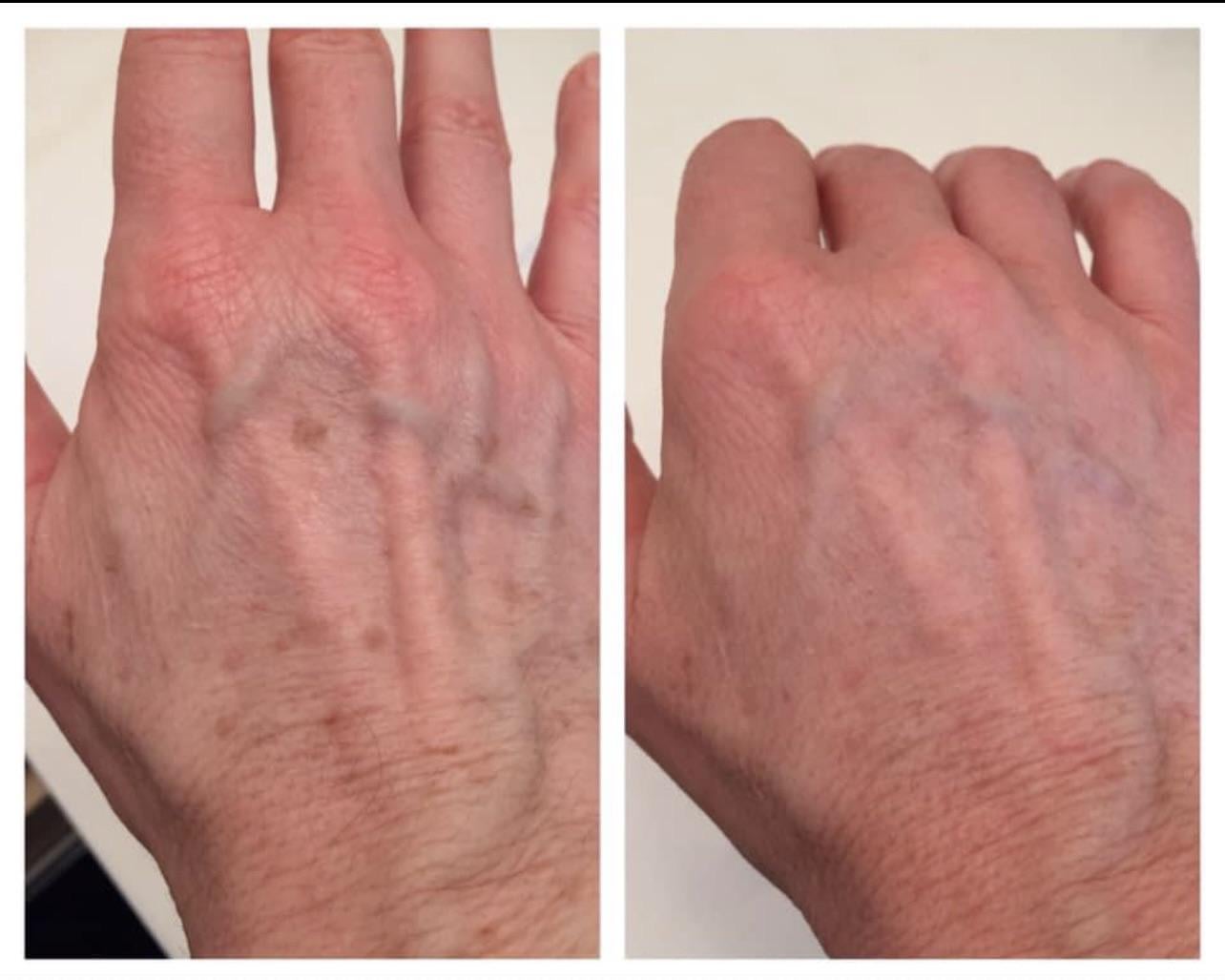
Age spots on the hands form when melanin clusters in skin that has absorbed years of sun exposure. Here is why they take root more stubbornly than the same spots on the face, and how the treatments clinics actually use work to fade them.
By Dr. Kim