Fractional CO2 Laser for Scars: How Many Sessions Do You Need?
By Dr. Kim7 min read
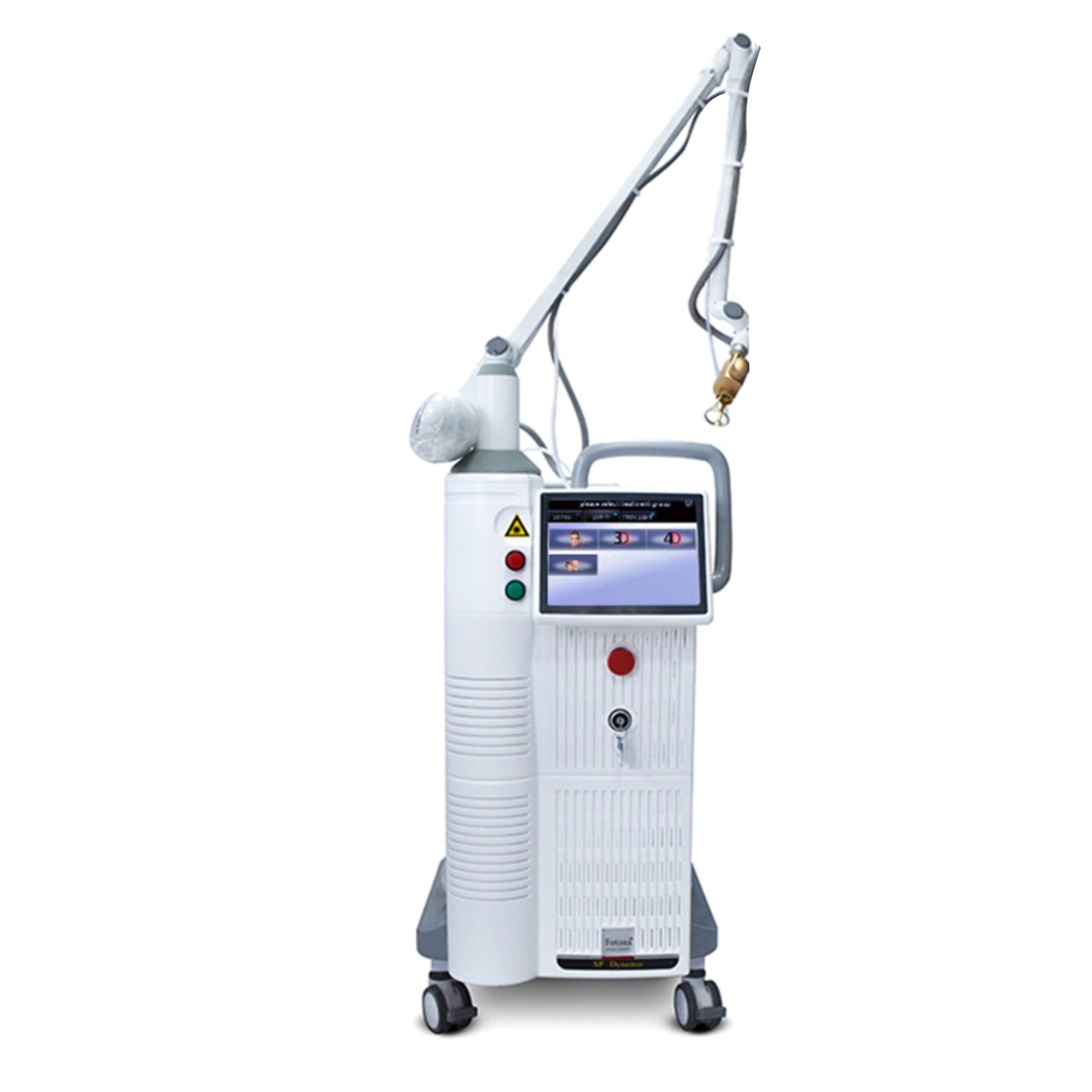
Anyone who has struggled with acne for years, or who has pores that just won't stay small, tends to hear the same name at the dermatologist's office: fractional CO2 laser. The name alone can sound intimidating, like the skin is about to be scorched from end to end. In practice, it works quite differently.
Instead of treating the entire surface, this laser fires precise, narrow columns into the skin, spaced out in a pattern. As those tiny wounds heal, new collagen fills in behind them, and scars and pores gradually become shallower. Let's walk through why the laser is built to make holes in the first place, how those holes end up rebuilding the skin, and what recovery actually looks like.
How does a CO2 laser work on the skin?
CO2 laser light has a wavelength that water absorbs extremely well. Since skin is mostly water, aiming this light at the skin makes the water in that spot flash into vapor almost instantly. Think of it as an extremely precise heat stamp.
That heat vaporizes the surface layer and the shallow tissue just beneath it in an instant, taking old or damaged tissue along with it. The key feature of this laser is that it only delivers heat down to a controlled depth, no further. Because the damage can be dialed in to exactly the depth needed and then stopped, it's well suited to problems like scarring that sit deep in the skin.
Why does a fractional laser treat in dots?
CO2 lasers used to be applied evenly across the entire surface of the skin. That older, fully ablative approach was powerful, but because the whole face was wounded at once, recovery took a long time and the risk of infection or pigmentation problems was higher.
"Fractional" simply means treating a fraction of the surface rather than the whole thing. A fractional laser splits the beam into hundreds of hair thin points, almost like a stamp made of tiny needles instead of one solid plate. Picture pressing that needle-stamp into the skin rather than the whole flat surface. This way, the skin gets stimulated everywhere it needs to without being stripped all over, so the results hold up while the toll on the skin drops.
How do micro-burns trigger collagen?
Each of these microscopic points is called a microthermal zone, essentially a tiny controlled burn. To the body, that small burn registers as an injury, and injuries set off repair work immediately.
Blood flow rushes to the site, and fibroblasts, the cells in the dermis (the collagen-rich layer beneath the surface) that manufacture collagen, kick into gear. Fibroblasts work at a steady pace under normal conditions, but once they get the injury signal, they speed up and start producing new collagen faster and in greater volume. In effect, the laser's microscopic wounds act as a trigger that restarts the collagen factory inside the dermis.
What role does healthy skin between the dots play?
Another advantage of the dot by dot approach is that undamaged, healthy skin remains between each treated point. Unlike fully ablative treatment, the area right next to each wound is still packed with intact cells, blood vessels, and hair follicles.
That healthy tissue becomes a shortcut for recovery. During re-epithelialization, the process where new skin cells migrate in to resurface the wound, nearby healthy cells travel in quickly to cover the injured spot. If the entire skin surface were damaged, those cells would have farther to travel and there would be fewer of them, slowing everything down. Because so much healthy tissue survives between the treated points, there are plenty of cells ready to mobilize, and healing moves faster as a result.
How much do scars and pores improve?
Acne scars and enlarged pores usually come down to the same underlying issue: a lack of collagen leaving the area sunken. Scars form where inflammation damaged collagen that was never fully replaced, and pores often look enlarged because the collagen and elastic support around the oil glands has weakened, letting the pore walls sag outward.
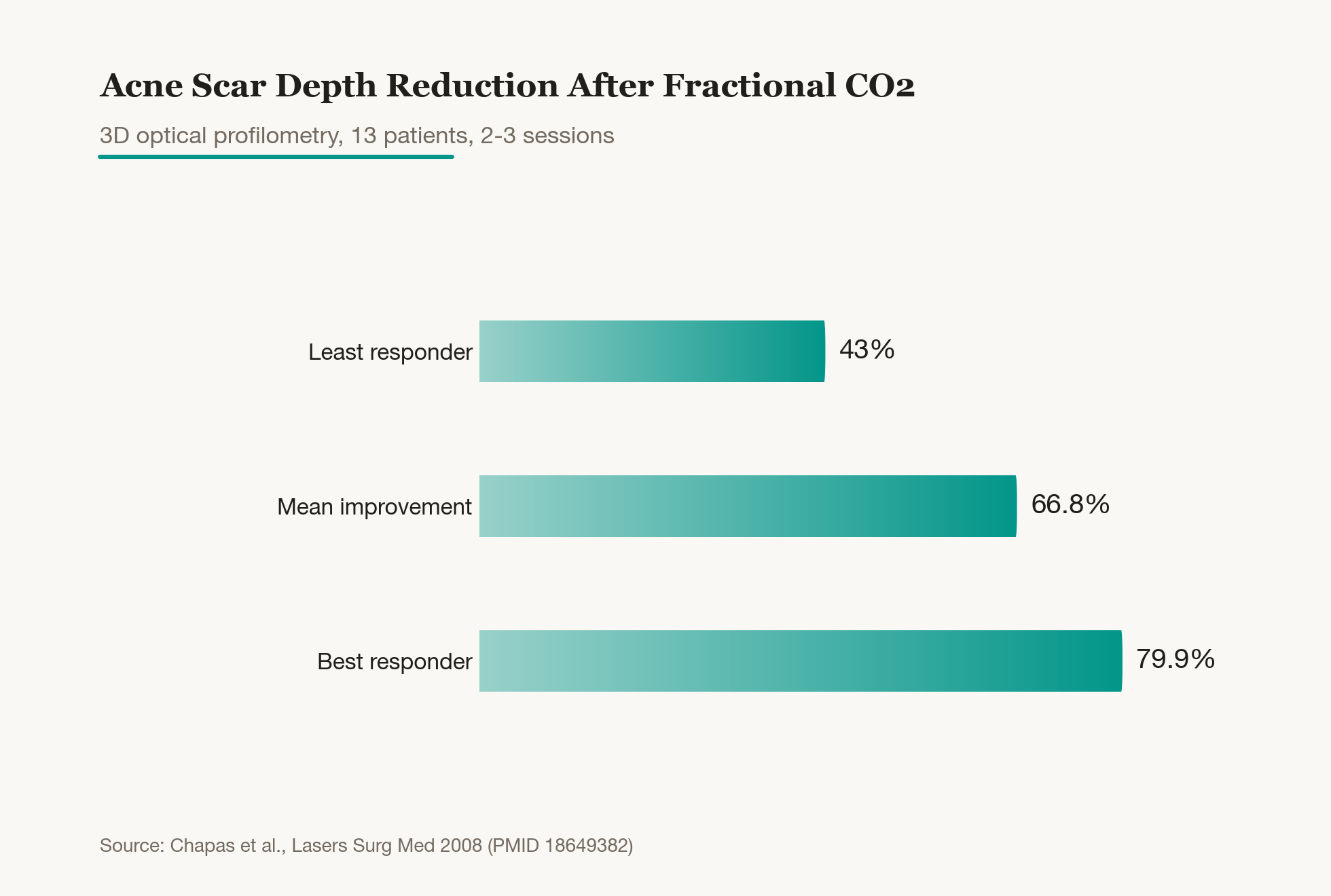
As described above, the microscopic wounds the laser creates trigger new collagen production right beneath them in the dermis. That new collagen settles in gradually over three to six months, filling in the sunken scar base and shoring up the sagging pore wall. Scars don't disappear entirely, but as collagen fills back in, they're reported to become shallower with softer edges. Pores are reported to tighten as well, once the supporting structure around them is rebuilt.
Effect on skin texture
Fractional CO2 laser doesn't just address visible problems like scars and pores, it also changes the overall feel of the skin. Two things are happening here.
First, the laser clears away surface keratin and old cells along with the treated tissue, so the fresh layer of cells that comes in afterward sits smoother and more evenly. Second, elastin, the fiber that gives skin its bounce, is thought to get stimulated alongside collagen during this same regenerative process and gradually reinforced. Combined, these two effects often leave the surface smoother and the tone more even overall.
How long is recovery?
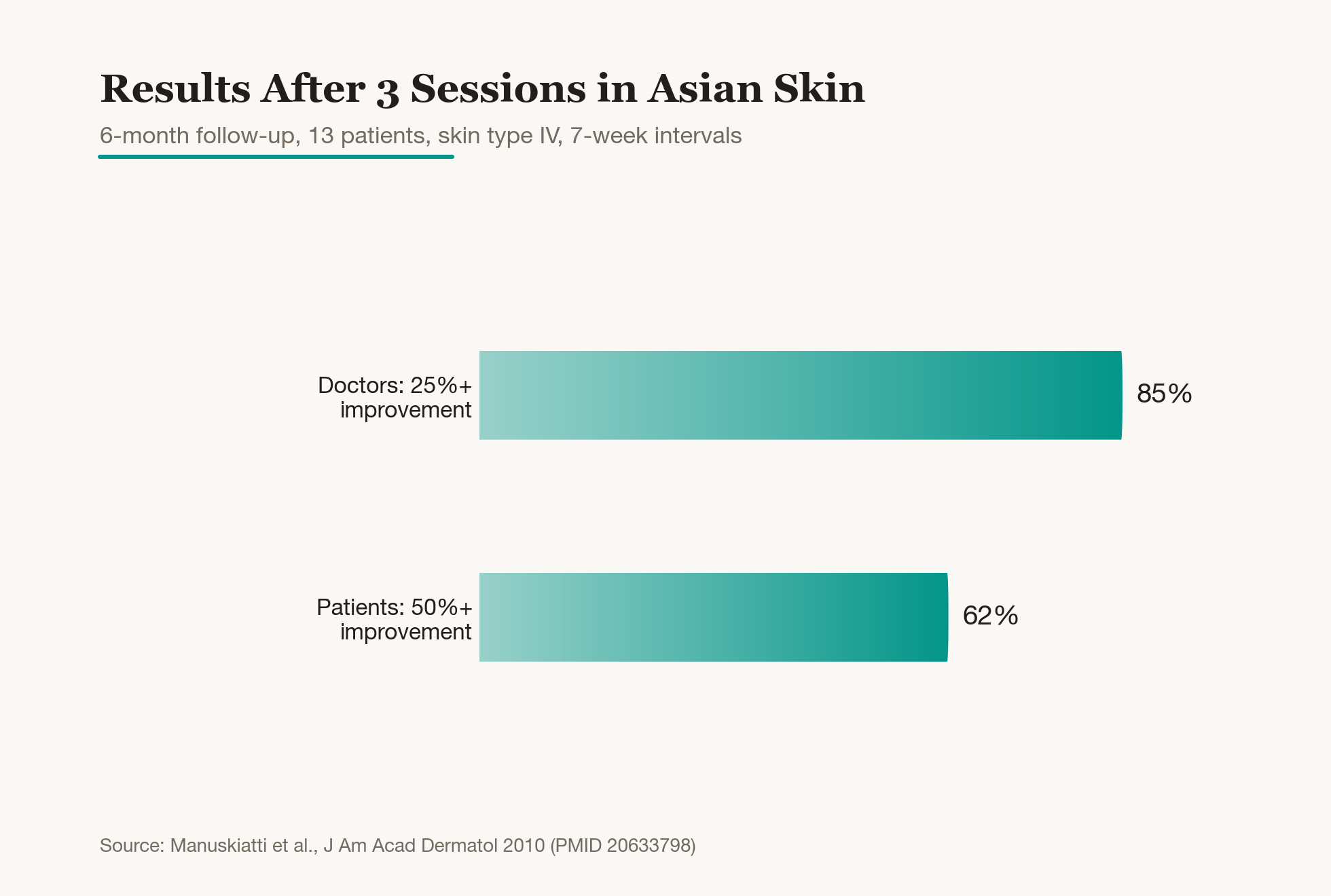
Because fractional CO2 laser genuinely creates microscopic wounds on the surface, some recovery time is unavoidable. Right after treatment the skin turns red and swells, and between day two and day four it's common to see fine crusting or flaking form on the surface.
It's important to let those tiny crusts fall off naturally rather than picking at them, since new skin is already forming underneath through re-epithelialization. Depending on the intensity used, redness typically settles within one to two weeks, while the deeper changes from collagen rebuilding are reported to continue quietly for three to six months, and sometimes up to a year. Diligent sun protection and moisturizing during this window are said to make a real difference in both how fast the skin recovers and how the results turn out.
How many sessions, and at what interval?
Since new collagen takes time to form and settle into place, a single session rarely produces a dramatic change. That's why the typical approach is three to five sessions, spaced four to eight weeks apart.
The spacing exists because of that same collagen production cycle. The dermis needs enough time after each session to finish building and settling new collagen before it takes on the next round of stimulation, so results build up steadily without overloading the skin. Depending on how deep the scarring or how enlarged the pores are, working through three to five sessions and watching the improvement unfold gradually is the standard path.
Four precautions during recovery
- Apply sunscreen generously. Skin that's actively regenerating is especially prone to pigmentation, so sun exposure during this window can leave the treated area darker instead of clearer.
- Don't pick at crusts or flakes. Re-epithelialization is happening underneath, and forcing them off can pull away the new skin along with them, raising the risk of scarring.
- Moisturize more than usual. The skin's surface barrier is temporarily weaker, so moisture escapes more easily and the skin becomes more reactive to irritation.
- Skip intense workouts or saunas right after treatment. Raising your body temperature and sweating can amplify the inflammatory response in skin that's still healing.
References
Korean Dermatological Association, Ministry of Food and Drug Safety (MFDS), American Academy of Dermatology (AAD), and U.S. Food and Drug Administration (FDA).
Was this helpful?
About this article
Written by a practising aesthetic physician and intended for general education — not a substitute for individual medical advice.
Read next
Burn Scar Laser Treatment: Can Red, Hard Scars Improve Too?
Burn scars stay red and thickened because the collagen that fills the wound never gets properly trimmed back. Here's how fractional and vascular lasers each work on that texture and redness, plus when to start treatment and how many sessions it typically takes.
By Dr. Kim
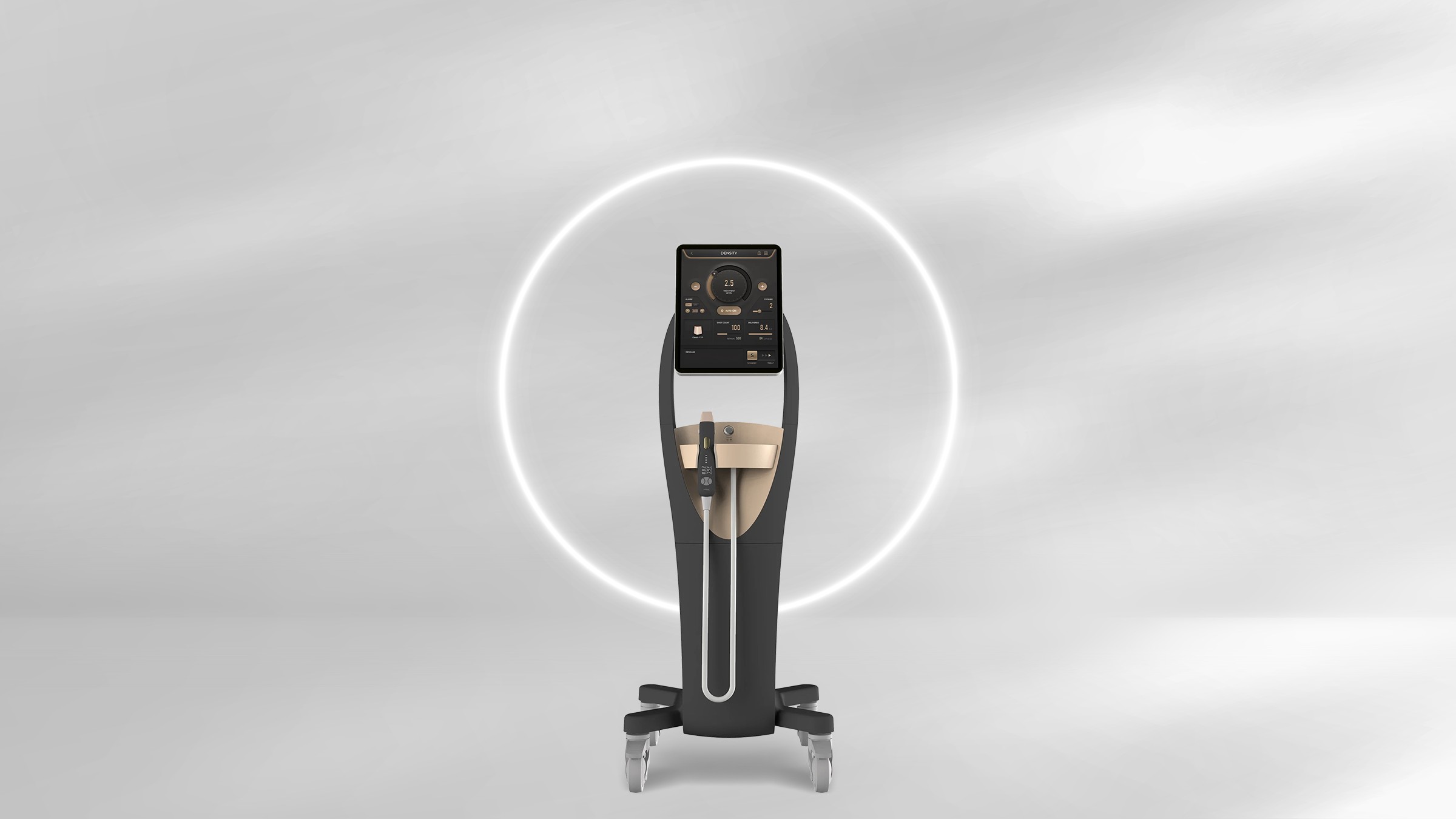
Density RF Effects: How Many Sessions and How Long Do Results Last?
Density RF pairs two radiofrequency modes with very different personalities to chase two goals at once: the instant tightening you feel right after treatment, and the collagen renewal that builds slowly over the following 4 to 12 weeks. Here is why two modes are needed, the order in which heat actually works inside the skin, and why the treatment is spread across multiple sessions instead of done all at once.
By Dr. Kim
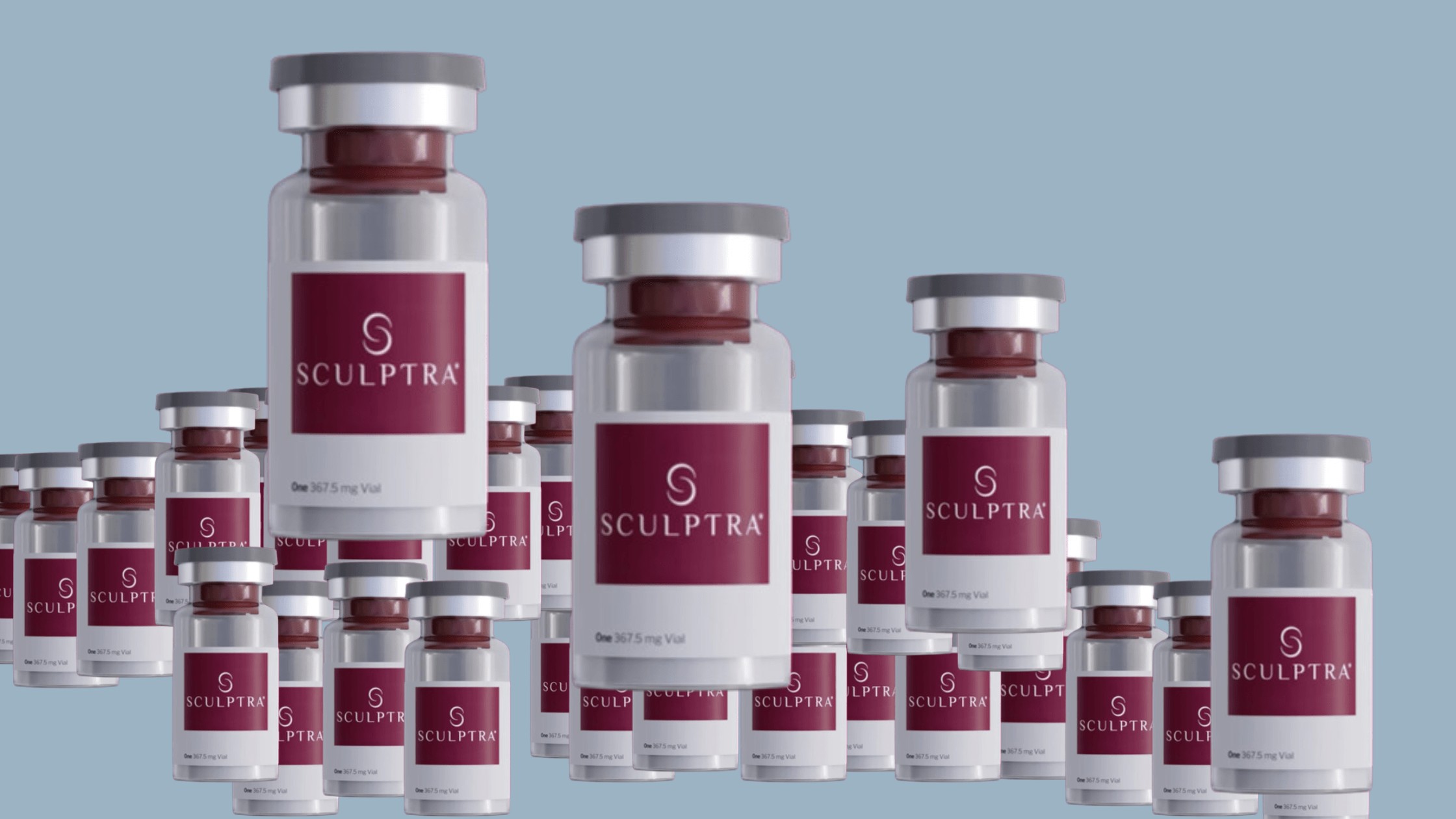
Why Sculptra Takes 4 Weeks to Show, and How Long It Lasts
Sculptra volume does not appear right after injection. It builds gradually over 4 to 12 weeks because the ingredient itself does not fill space instantly, it works by stimulating collagen production in the skin. Here is a close look at how PLLA triggers that collagen response and why treatment is spread across 2 to 4 sessions.
By Dr. Lee