Clarity II Toning: Effects, How It Works and the Difference Between 755 and 1064 Nanometers
By Dr. Kim7 min read
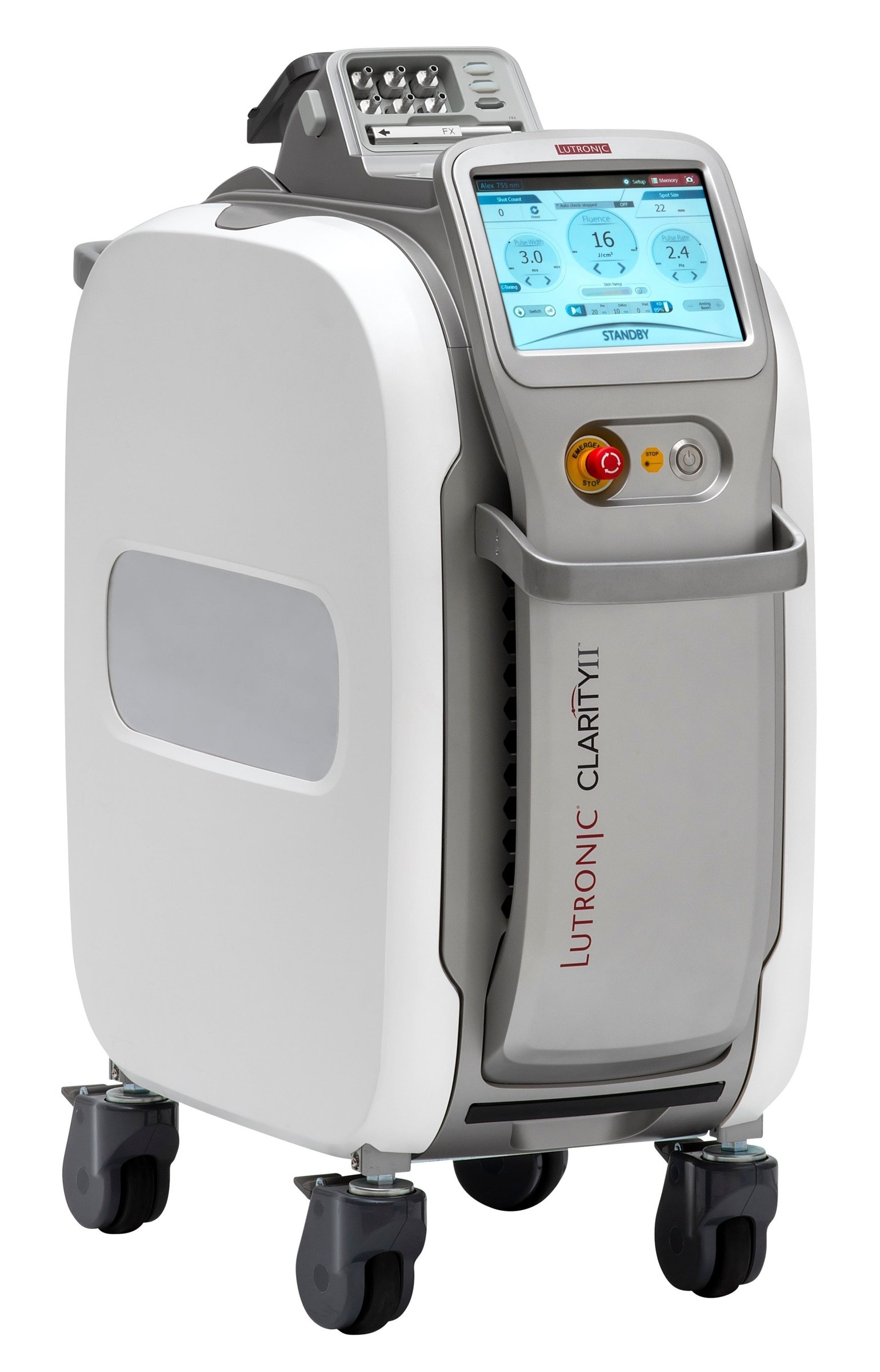
Clarity II comes up often in pigment laser consultations. The term "dual wavelength" can sound like it simply means a stronger laser, but that is not really what is happening. The real issue is not strength. It is depth, since pigment does not all sit in the same layer of skin.
Freckles and shallow spots tend to cluster in the epidermis, the outermost layer of the skin. Melasma, on the other hand, is a paler brown that often spreads down into the boundary with the deeper dermis. A single wavelength struggles to reach both depths well, and that is exactly why Clarity II is built around two.
Why are there two laser wavelengths?
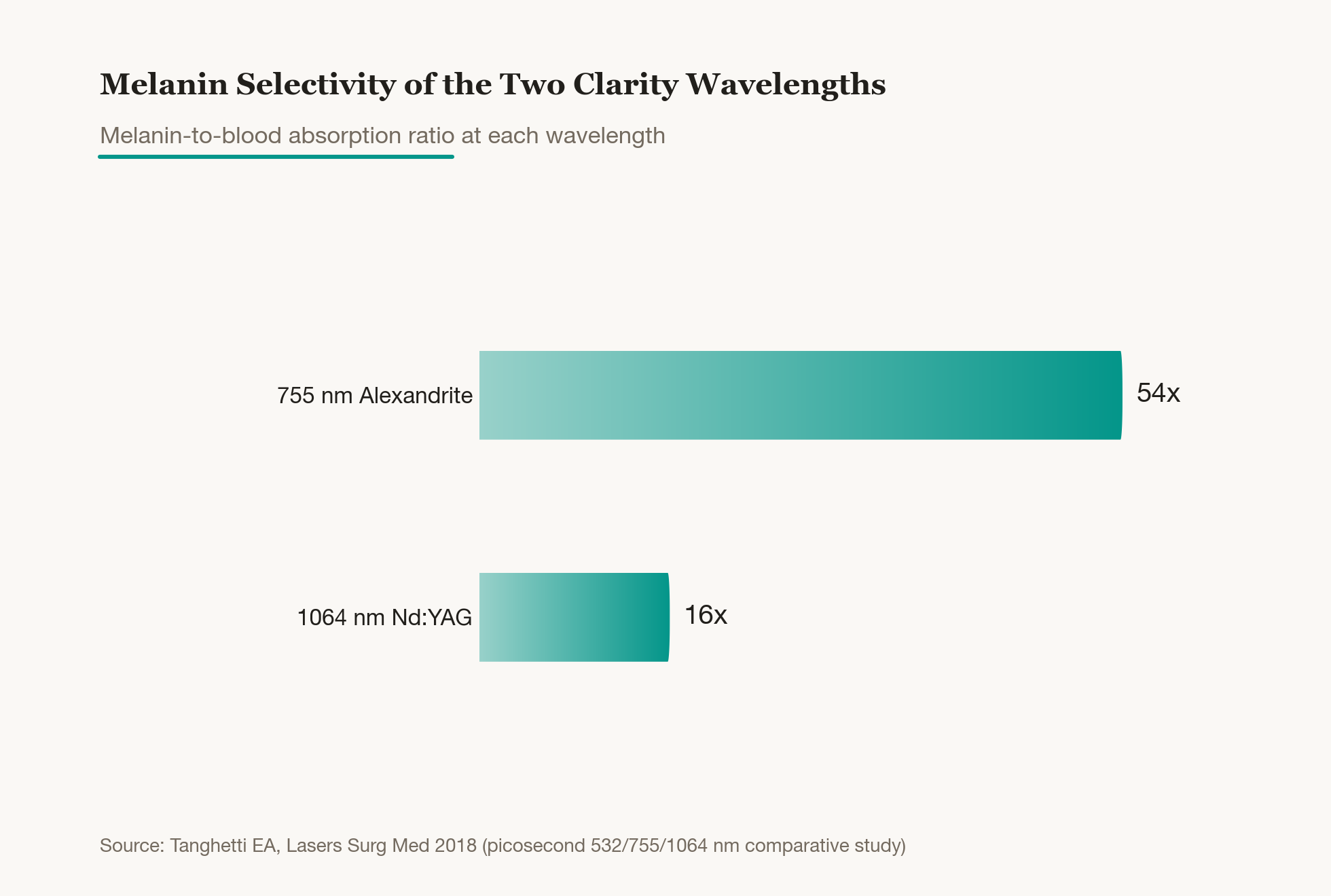
Clarity II combines a 755nm alexandrite laser (the number describes the wavelength of light, and the smaller it is, the more shallowly it gets absorbed) with a 1064nm Nd:YAG laser in one device. Both wavelengths are absorbed well by melanin, the brown pigment that gives skin its color, but they are absorbed at different depths.
Shorter wavelengths of light get absorbed mostly near the surface of tissue, while longer wavelengths push further in. You can see the same principle if you shine a flashlight against your palm. The light that leaks through to the other side looks red, because longer red wavelengths travel deep into tissue, while shorter wavelengths get absorbed or scattered near the surface. Treat shallow and deep pigment with the exact same wavelength, and one of the two ends up underpowered or overtreated.
Which pigment is 755 nanometers used for?
The alexandrite wavelength has a particularly high melanin absorption rate, and most of its energy is spent in the relatively shallow layers. That makes it the go-to choice for freckles, age spots, and other epidermal pigment with fairly well-defined borders.
When melanin granules inside pigment cells absorb this light, they heat up instantly and break apart into smaller fragments. Over time, those fragments get taken up by macrophages, the immune cells that clean up debris, and gradually cleared away. Epidermal pigment tends to fade relatively quickly because this cleanup route is short.
Which pigment does 1064 nanometers target?
The Nd:YAG wavelength reaches deeper than alexandrite while being absorbed less by the epidermis along the way. That makes it the better choice for pigment like melasma that extends down toward the dermal boundary, and for darker skin tones where minimizing epidermal damage matters.
The dermis, though, carries more blood vessels and nerves than the epidermis, and it heals more slowly. So instead of one strong pass, 1064nm is usually delivered as multiple lower-energy passes layered on top of each other. Spreading the heat out in smaller doses is what lets it reach deep pigment without harming the surrounding tissue.
Why is toning done gently, many times?
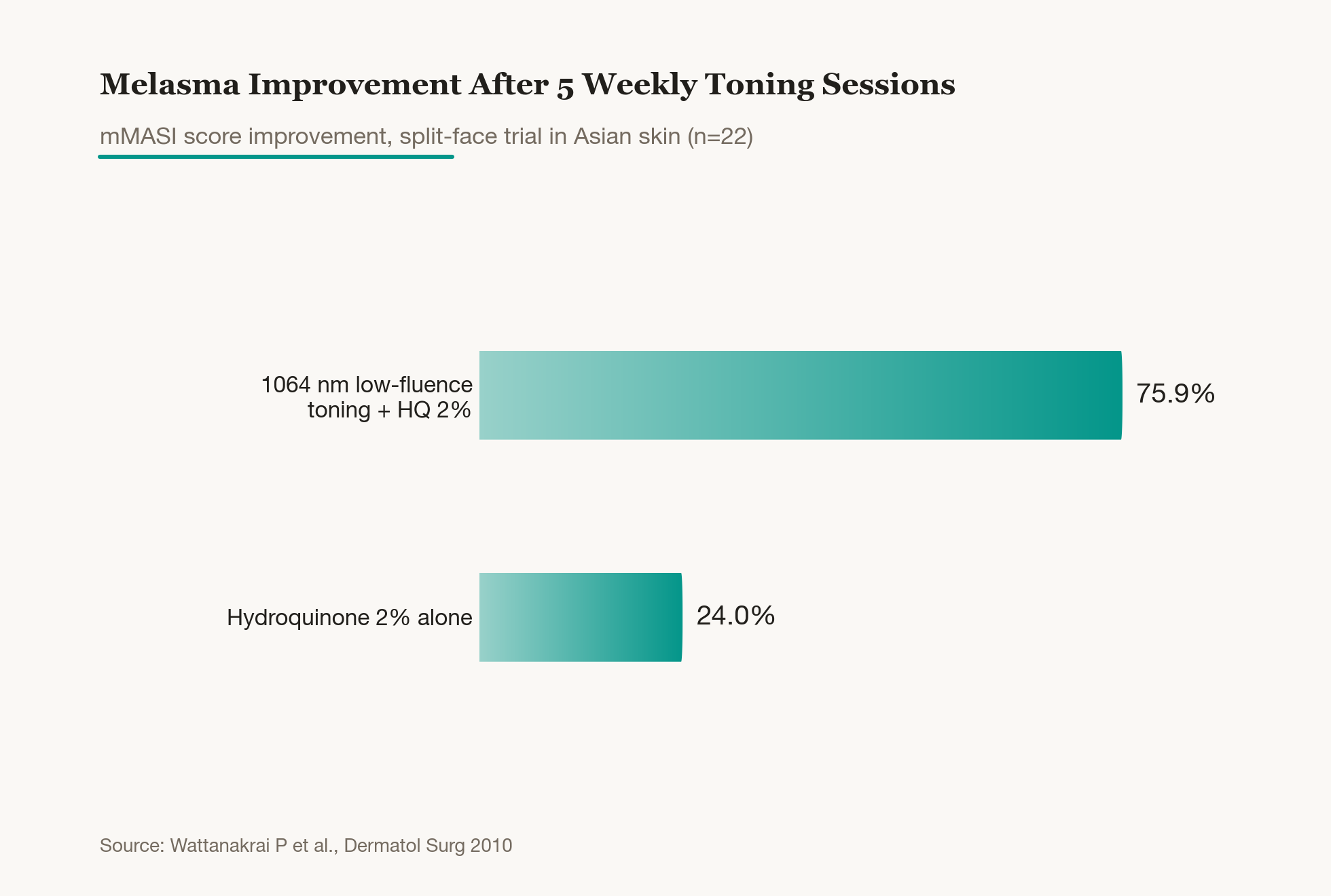
The same laser can behave very differently depending on whether it is being used in "toning" mode. To remove something with a clear border, like a mole or an age spot, a single strong burst of energy destroys the lesion outright. Melasma is different. It is shallow but spread widely across the face, so it gets treated with low energy passed over the whole area multiple times.
The reason for lowering the energy is simple. Treating a broad area with strong energy tends to trigger a rebound reaction during healing, where the pigment actually gets darker (post-inflammatory hyperpigmentation). Asian skin in particular has melanocytes that react more sensitively to stimulation than in lighter skin types, so a strong, broad pass is more likely to leave new, blotchy discoloration rather than an even result.
Splitting the same energy into many low-dose passes means each individual pass delivers a mild stimulus, but the effect builds as the passes accumulate. It is a bit like opening a heavy door with a series of gentle pushes instead of one hard shove. Each push is weak on its own, but the door still opens, and there is much less risk of hurting your hand along the way. That repeated, low-intensity approach is the core idea behind toning.
How does pigment fade?
A single toning session will not make pigment visibly lighter on its own. Low energy chips melanin granules into smaller pieces bit by bit, and that change only becomes visible once enough sessions have let macrophages clear the fragments away session after session. It works a bit like breaking off small pieces of dough repeatedly instead of tearing off one big chunk at once.
Through this whole process, the melanocytes, the cells that actually produce pigment, mostly stay intact. Toning does not eliminate the pigment-producing cells. It breaks down pigment that has already been made and lets the body clear it out on its own. That is also why pigment can return if sun exposure or hormonal changes reactivate the melanocytes, and why ongoing maintenance matters just as much as the procedure itself.
Melasma in particular responds to both female hormones and UV exposure, so no matter how finely the laser breaks down existing granules, pigment can form again if the conditions that reactivate melanocytes keep recurring. Toning is less a procedure that ends pigment for good and more a way of keeping the color light by clearing it out faster than it forms.
Do collagen and pores improve too?
Repeated low-energy toning passes affect more than just pigment. They also influence skin texture. As some of that heat reaches down into the dermis, fibroblasts (the dermal cells that produce collagen) pick up a mild stimulus and respond to it. Much like the body switches on a healing response after a wound, cells respond in a similar way to a very gentle dose of heat, nudging collagen production up slightly.
This effect is really a side benefit of energy that was applied to treat pigment in the first place. The collagen change is not as pronounced as the pigment improvement, but it is also why people often report that their pores and overall texture look more refined after a series of sessions.
Because a noticeable collagen increase requires stimulation to build up over time, it is unrealistic to expect one or two toning sessions to visibly change pore size or elasticity. It makes more sense to treat any texture improvement as a natural bonus that comes along while sessions are continued mainly for pigment.
Care between sessions
Toning tends to have a fairly quick recovery, but because it is done in repeated sessions, what happens between sessions matters for the results.
- Sun protection: Right after toning, skin is more sensitive to stimulation, and UV exposure can reactivate melanocytes and bring pigment back. This matters especially in the days right before and after each session.
- Moisturizing: Repeated heat exposure to the shallow layers can temporarily weaken the skin barrier. Moisturizing well helps the barrier recover so the next session can go ahead safely.
- Spacing between sessions: Since pigment needs time to be broken down and cleared away, packing sessions too close together means restimulating skin before cleanup has finished. Sessions are usually spaced two to four weeks apart.
- Avoiding harsh care: Exfoliating or massaging vigorously right after a session can add extra stimulation to already sensitive skin, so it is best to hold off for a few days.
Pigment does not disappear completely from a single procedure. It is something that keeps forming and getting cleared away in an ongoing cycle. That is why Clarity II toning is easier to understand as an ongoing process paired with aftercare, rather than a one-time fix.
References
Korean Dermatological Association, American Academy of Dermatology (AAD), and Ministry of Food and Drug Safety (MFDS).
Was this helpful?
About this article
Written by a practising aesthetic physician and intended for general education — not a substitute for individual medical advice.
Read next

CureMax Laser: How Dual Wavelengths Work and the Difference From Picosecond
CureMax is an Nd:YAG pigment laser that pairs two wavelengths, 532 nm and 1064 nm, in one device. Here is how selective photothermolysis targets melanin and how nanosecond pulses break pigment apart, plus which pigment conditions it treats and how to care for skin afterward.
By Dr. Lee
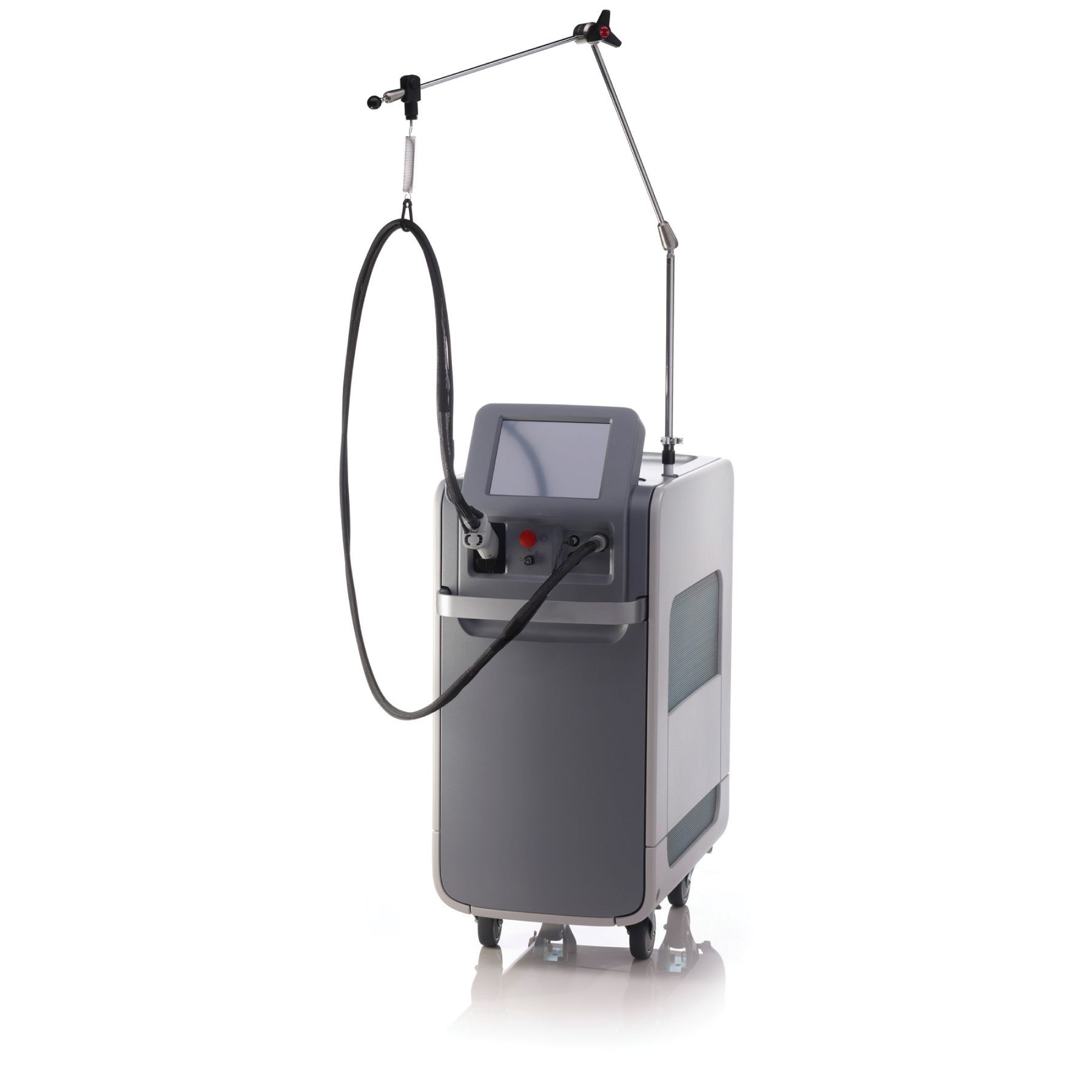
Alex Toning: Effects, How It Works, Side Effects and Aftercare
Alex toning uses a 755nm alexandrite laser that is selectively absorbed by melanin to fade dark spots and pigmentation. Here is how the wavelength concentrates heat only in pigment cells, and why treatments are split into multiple low-energy sessions.
By Dr. Kim
GentleMax Pro Hair Removal: Alexandrite or Nd:YAG, Which One Is Right?
The GentleMax Pro packs two wavelengths, an Alexandrite laser and an Nd:YAG laser, into a single device, letting practitioners switch between them based on skin color and hair thickness. Here is how each wavelength works and why cooling is always built in alongside them.
By Dr. Lee