Recessed Chin Filler and Implant: Differences, Duration and Recovery Compared
By Dr. Kim7 min read

A recessed chin is when the lower jaw sits further back than the rest of your facial contour. Seen from the side, if the tip of your chin falls behind your lips, the profile can look flat, and the line between your neck and chin can blur into what looks like a double chin. Two approaches correct this: filler and implants.
Both aim to bring the chin forward, but they build that projection through different mechanisms, last for different lengths of time, and differ in whether the result can be undone later. Understanding these differences makes it much easier to pick the approach that suits you.
Why does a recessed chin happen?
A recessed chin often comes down to the jawbone itself being small or set back. In some people, the lower jaw (the mandible) simply develops smaller from birth. In others, the upper and lower jaw grow at different rates during childhood, leaving the lower jaw looking relatively short by comparison.
The soft tissue around the chin, muscle, fat, and skin, also plays a role. Even a normal sized bone can look recessed if the tissue covering the chin tip is thin, while a slightly smaller bone can go largely unnoticed if the tissue over it is thicker.
Because of this, correcting a recessed chin sometimes involves repositioning the bone itself. This article focuses on the two approaches that leave the bone untouched and instead add volume at the chin tip to build out the profile: filler and implants.
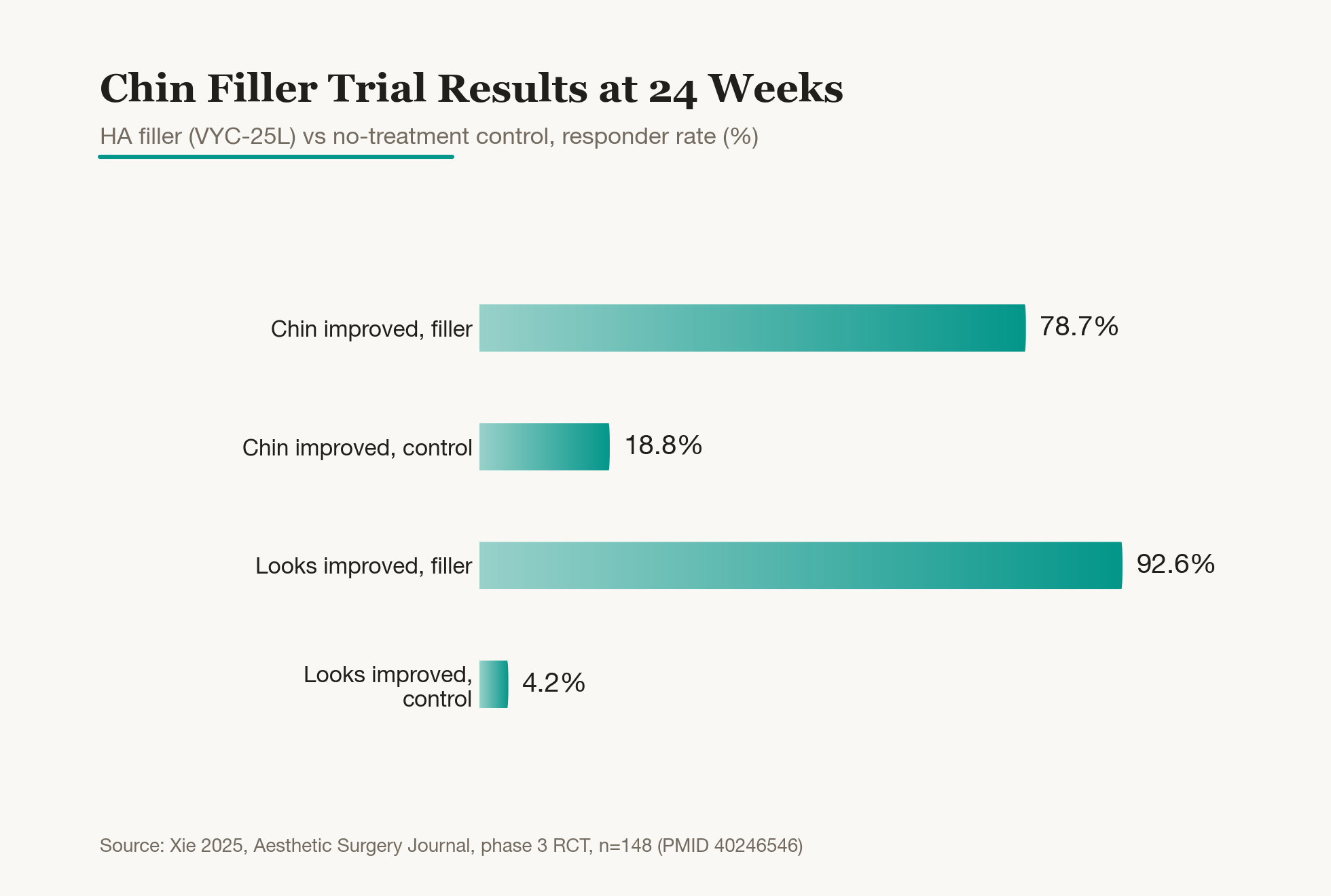
How does filler build up the chin?
Filler works by injecting a hyaluronic acid gel beneath the skin of the chin, just above the bone. Hyaluronic acid already exists naturally in our skin and joints, and it draws in water to create volume wherever it sits.
Using a fine needle or a blunt tipped cannula (a thin tube shaped injection instrument), the provider places the gel close to the thin membrane covering the jawbone, where it sits like a thin cushion over the front of the bone and makes the chin tip stand out. Think of it as layering material on top of the bone rather than touching the bone itself.
The firmness of the gel changes how the final result feels. A softer gel spreads more naturally but has less lifting power, while a firmer gel gives a more defined, projected chin tip. So the type of gel chosen depends on how much projection is wanted.
How is an implant fixed in place?
An implant places a solid material, typically silicone or porous polyethylene (a synthetic material with a dense network of tiny pores), directly in front of the jawbone. The provider makes an incision through skin and muscle to create a pocket that exposes the bone, then inserts a pre shaped implant into that space and secures it to the bone.
Silicone implants have a smooth surface, so they slide into place easily but do not bond tightly with the surrounding tissue. Porous polyethylene works differently. The body's tissue and blood vessels grow into its small pores, so over time the implant fuses with the bone and tissue almost as one piece. That gives it strong, stable positioning, but it also means repositioning or removing it later requires a more involved surgery.
Because an implant is a single solid piece sitting on the bone, it cannot be added little by little or fine tuned in specific spots the way filler can. In exchange, once it is in place, the shape holds without shifting.
How long do filler and implants last?
Filler eventually gets absorbed because of a property of hyaluronic acid itself. The body naturally contains enzymes that break hyaluronic acid down, and these enzymes gradually dissolve the injected gel, which then leaves the body along with water.
How firm the gel was and how deeply it was placed both affect how quickly this breakdown happens, but the volume eventually decreases over time regardless. That means a chin built with filler needs a touch up injection at some point to maintain its original shape.
Implants, whether silicone or porous polyethylene, are synthetic materials that the body's enzymes cannot break down. Since they are also secured to the bone with screws or sutures, the implant's own volume stays essentially unchanged even as surrounding tissue sags or ages. That is why implants are described as holding their shape for a long time once placed.
Comparing recovery time after treatment
Filler is injected with a needle or cannula, so it leaves only a tiny mark on the skin. Recovery tends to be quick, with swelling and light bruising often settling within a few days. Discomfort during the procedure is usually minimal thanks to topical numbing cream or anesthetic mixed directly into the gel.
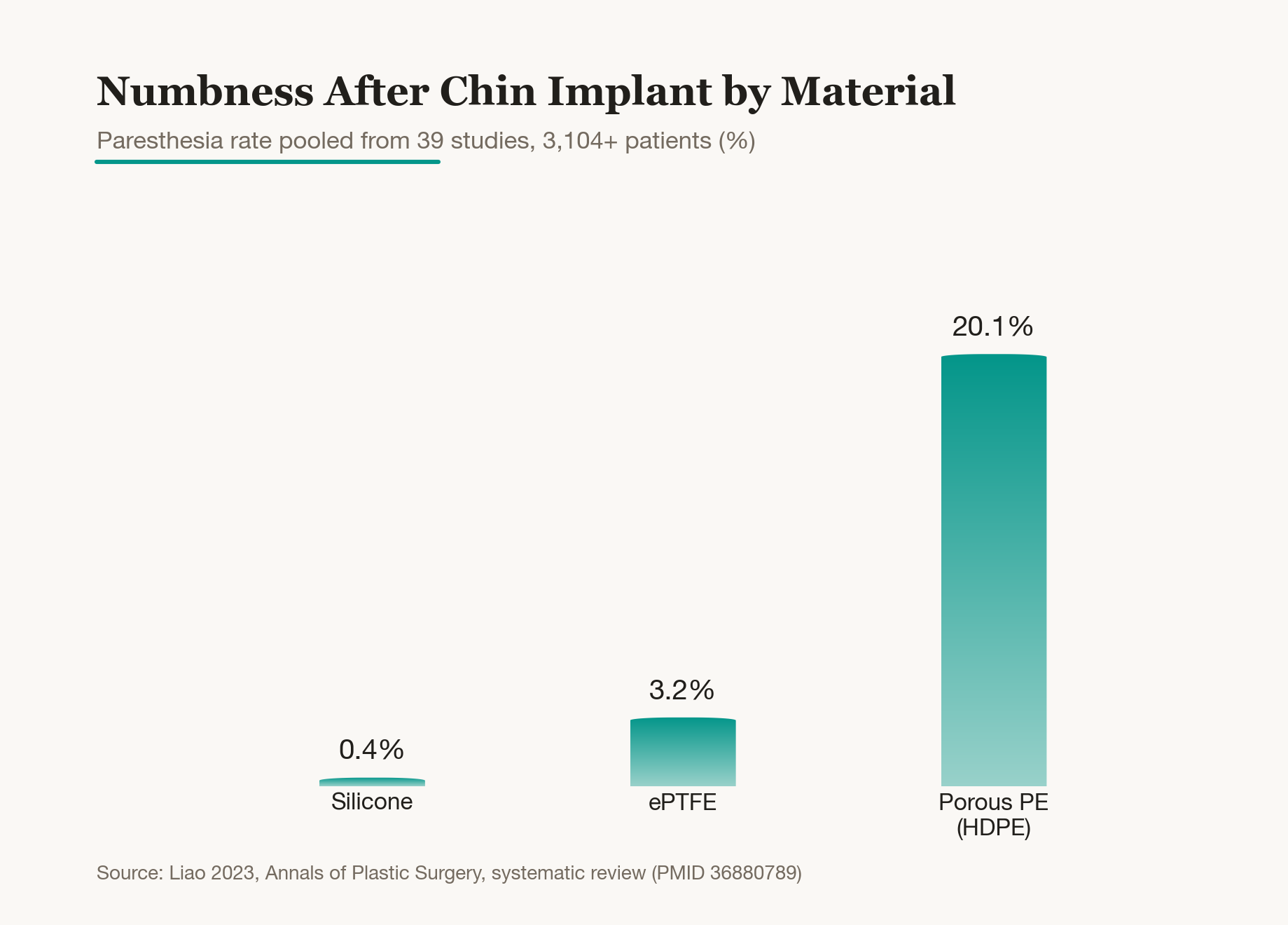
Implants are a different story, since they involve an incision and dissection (the process of separating tissue to create space). The provider incises either the inner lip or the skin under the chin and opens up tissue until the bone is exposed, so swelling and bruising last longer than with filler. The incision also takes time to heal, and a feeling of numbness can linger for several weeks.
Can you reverse it if you don't like it?
This is the biggest distinction between the two approaches. The hyaluronic acid used in filler can be dissolved relatively quickly with an injection of hyaluronidase, an enzyme. It works by artificially delivering the very enzyme that breaks down the gel, sharply speeding up its natural breakdown. So if the shape does not look right or a side effect develops, there is a relatively simple way to reverse it.
An implant cannot be removed that easily. Taking out the solid material requires going through incision and dissection surgery again, much like the original placement. Porous polyethylene in particular, since tissue has grown into it, can end up tightly fused with the bone and surrounding tissue, which can make removal surgery even more involved than the initial placement. That is why choosing an implant calls for a more careful decision from the start.
Criteria for choosing the method that fits your chin
How severe the recession is, your lifestyle, and how much room you want to leave for changing your mind can all help point you toward the right method.
- If the recession is mild: A small amount of added volume over the bone is often enough to smooth out the profile, which makes filler, a lower commitment option, a natural place to start. You can build it up gradually and see the result as you go.
- If the chin is noticeably recessed: Filling it in with filler alone may take several sessions and a large volume, so an implant can be the more efficient choice. A single solid piece can fill a significant gap in one procedure.
- If you do not have much time for recovery: Filler is the lighter option, since there is no incision and swelling settles at a different pace.
- If you want room to change or reverse the shape later: Filler has the advantage, since the ability to dissolve it with an enzyme means there is room to adjust course.
- If you want a shape that stays fixed and stable for a long time: An implant fits that goal better, since it is anchored to the bone and does not shift.
Before deciding, it helps to see a provider and get an accurate read on how much volume is actually needed, along with the condition of the bone and the thickness of the surrounding tissue. Even people with what looks like the same recessed chin can have different causes and degrees, and that diagnosis is what determines whether filler or an implant is the better fit.
References
Korean Dermatological Association, American Academy of Dermatology (AAD), and Ministry of Food and Drug Safety (MFDS).
Was this helpful?
About this article
Written by a practising aesthetic physician and intended for general education — not a substitute for individual medical advice.
Read next

Filler and Fat Grafting: Differences, Duration, and Reversibility Compared
Filler is made of hyaluronic acid that the body's own enzymes slowly break down, so it can be reversed with a dissolving injection if needed. A fat graft is different: the fat cells that survive settle in permanently, which means the result is much harder to undo once it takes. Here is the biology behind why these two treatments behave so differently under the skin.
By Dr. Lee

Sculptra and Juvelook Volume: Differences and Duration Compared
Sculptra and Juvelook Volume both get filed under collagen-stimulating injectables, but they differ in ingredient and mechanism, particle shape, and how much evidence has stacked up. Here is a calm, research-based look at when results appear, how long they last, and what to weigh when choosing.
By Dr. Kim

AHA and BHA Differences: Choosing by Skin Type and Comparing Effects
AHA and BHA are both acids that clear away dead skin cells, but where they actually work depends on one simple thing, whether they dissolve in water or in oil. AHA breaks down the bonds holding surface buildup together, while BHA rides through oil to reach the sebum sitting deep inside your pores. Here is how each one works, and which fits which skin type.
By Dr. Kim