Chemical Peel Types and Differences: BHA for Acne, AHA for Pigment
By Dr. Lee9 min read
You'll even find peels on drugstore shelves, but the ones used in dermatology clinics vary widely in reach and strength depending on the acid. AHAs like glycolic acid and lactic acid are water-soluble, so they work their way between the moisture-holding dead skin cells to smooth the surface. BHA, essentially just salicylic acid, is oil-soluble instead, letting it dig into pores clogged with sebum.
With trichloroacetic acid (TCA), how deep the peel strips the skin can be adjusted just by changing its concentration. Jessner solution and mandelic acid have carved out their own roles, one as a prep step for medium-depth procedures, the other as an option for sensitive skin. Different concerns, whether acne, pigmentation, or pores, call for different acids and depths, and the improvement rates and recovery times seen in actual clinical studies make that difference clear.
How do peeling acids differ?
How a chemical peel works, and how deep it goes, depends on the acid behind it. AHAs, like glycolic acid and lactic acid, are water-soluble. Think of how water rinses your face clean: these acids work the same way, loosening the bonds between dead skin cells to smooth the surface.
BHA is essentially just salicylic acid. Because it is oil-soluble, it penetrates pores packed with sebum the way an oil-based cleanser cuts through grease. That is why it is used so often for acne.
TCA, short for trichloroacetic acid, lets you dial in how deep the peel strips the skin simply by adjusting the concentration. Jessner solution is a combination of salicylic acid, lactic acid, and resorcinol. It can be used on its own, but it is also applied before TCA as a prep step, softening the stratum corneum, the thin layer of dead cells covering the skin's outermost surface. Mandelic acid has a larger molecule than other AHAs, so it absorbs into the skin more slowly. Because a larger molecule can't push in deeply all at once, it spreads more gradually, causing less irritation, which makes it a comparatively gentle option for sensitive skin or pigmentation concerns.
In practice, clinics often layer two or three acids in sequence, matching the combination to skin condition and concerns rather than relying on just one. For light surface exfoliation, AHA or BHA typically comes first, with mandelic acid layered in if pigmentation is also a concern. Whichever acid you choose, it is safest to start at a low concentration, check how the skin responds, and step up from there.
| Type | Main Ingredient | Properties | Main Use |
|---|---|---|---|
| AHA | Glycolic acid, lactic acid | Water-soluble, surface exfoliation | Texture, dark spots |
| BHA | Salicylic acid | Oil-soluble, penetrates pores | Acne, blackheads |
| TCA | Trichloroacetic acid | Depth adjustable by concentration | Pigmentation, scars |
| Jessner | Salicylic acid + lactic acid + resorcinol | Combination solution, prep step | Medium-depth prep |
| Mandelic | Mandelic acid | Larger molecule, less irritation | Sensitive skin, pigmentation |
Does a glycolic acid peel work on acne?
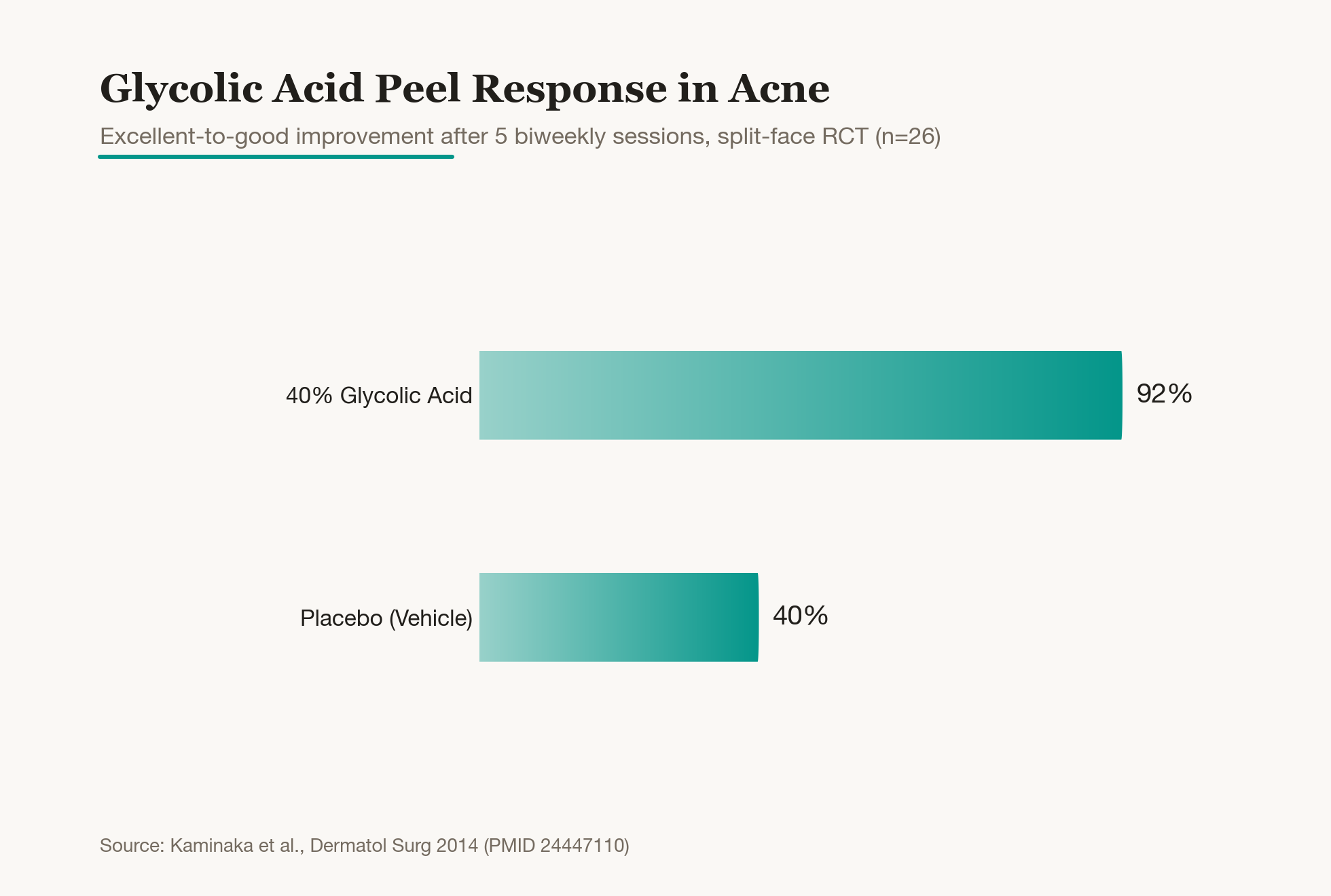
In a study of 26 patients with moderate acne, one side of the face received 40% glycolic acid (pH 2.0) and the other side a placebo, applied 5 times at 2-week intervals. The glycolic acid side showed excellent or good improvement in 92% of cases, versus 40% for the placebo side. The response was more pronounced for non-inflammatory comedonal lesions.
Glycolic acid has a relatively small molecule among acids, so it penetrates deep into the stratum corneum, the thin layer of dead cells covering the skin's outer surface. It loosens the bonds between dead skin cells and sheds the ones clogging the pores, and repeating this process keeps pores clear and leads to fewer new breakouts. Lactic acid, another AHA, works on a similar principle, but its molecule is somewhat larger and it has a moisturizing effect, making it a good alternative for skin that's sensitive to irritation.
For both acids, it is safest to start at a low concentration and raise it gradually as the skin adjusts. Some stinging and redness can show up early on, but it usually settles within a day or two.
How long is recovery by peel depth?
How well a peel works, and how long recovery takes, depends less on which acid is used and more on how deep it reaches. It helps to picture the skin as a layered cake. The stratum corneum sits on top, the epidermis below it, the papillary dermis further down, and the reticular dermis at the very bottom.
A superficial peel affects only the stratum corneum and the epidermal cell layers. In cake terms, it just skims off a bit of the top frosting. A medium-depth peel injures the entire epidermis and the papillary dermis, prompting them to rebuild. The deepest peel reaches the reticular dermis, essentially the bottom layer of the cake, and clinics handle this level with particular caution.
TCA is unique in that the same acid can produce all three depths just by changing its concentration. A 10–20% concentration stays within the epidermis and the upper papillary dermis, closer to a superficial peel. A 25–35% concentration reaches into the mid-papillary dermis and serves as the standard for medium-depth peels. Applying Jessner solution first to thin the stratum corneum, then layering TCA on top, a method known as the Jessner-TCA combination, can reliably produce a medium-depth effect without pushing the TCA concentration any higher.
High-concentration TCA above 40%, or phenol peels, are classified as deep peels that reach the reticular dermis. That said, because the scarring risk is considerable, these are reserved for limited situations rather than routine cosmetic use.
| Depth | Layer Reached | Representative Method | Recovery Time |
|---|---|---|---|
| Superficial peel | Stratum corneum, epidermis | AHA, BHA, TCA 10–20% | 1–7 days |
| Medium-depth peel | Full epidermis, papillary dermis | TCA 25–35%, Jessner combination | 7–14 days |
| Deep peel | Reticular dermis | High-concentration TCA, phenol | 14+ days |
Why is salicylic acid used first for acne?
Salicylic acid is oil-soluble. That lets it pass through the moisture-rich stratum corneum and reach the sebaceous gland deep inside a pore packed with sebum. There, it gently loosens dead skin cells and adds an anti-inflammatory effect on top, which makes it a particularly good fit for oily or acne-prone skin.
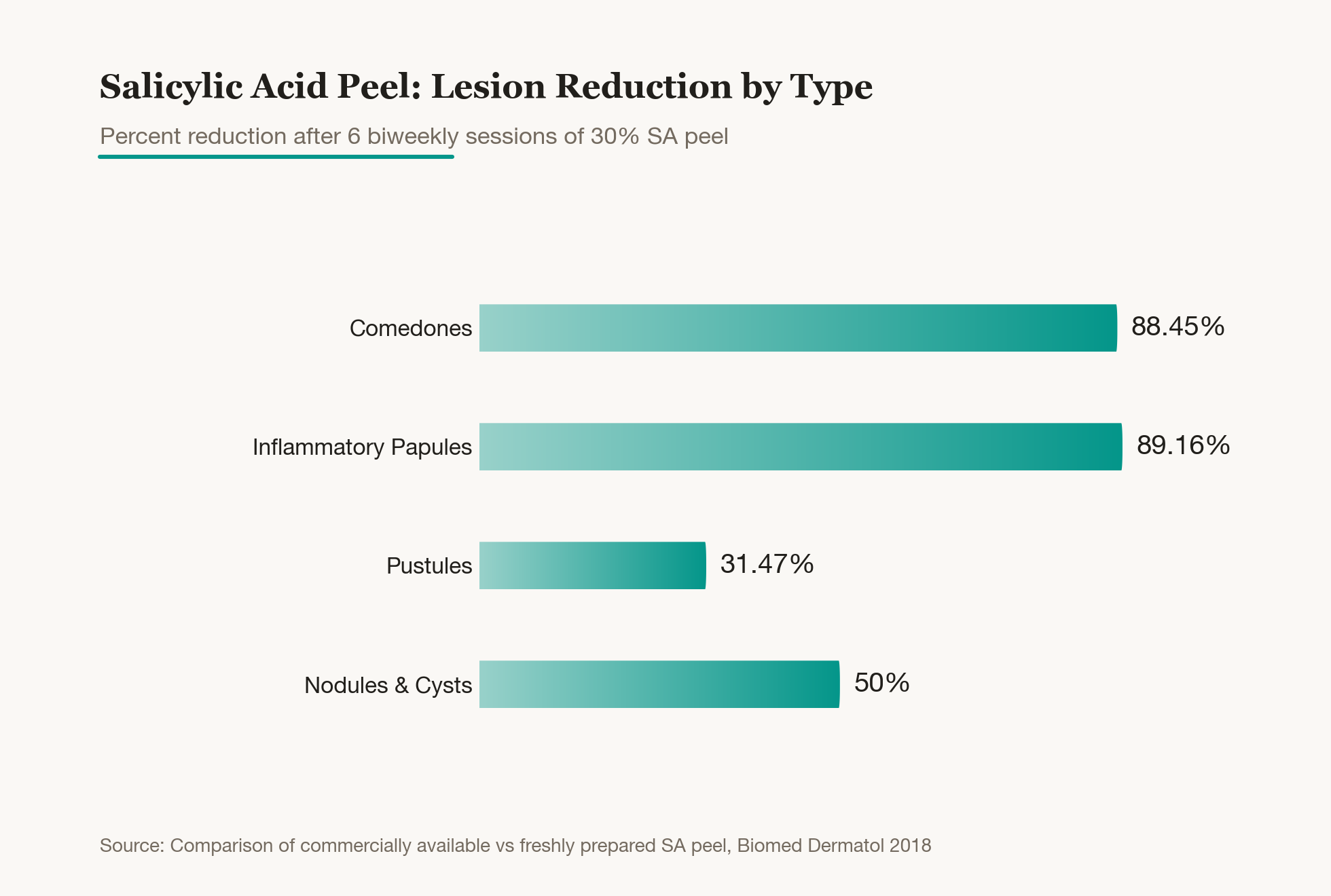
In a study of 30% salicylic acid peel given 6 times at 2-week intervals, non-inflammatory lesions like blackheads and whiteheads dropped 88.45%, and raised red inflammatory papules dropped 89.16%. Pustules, though, fell only 31.47%, and deeper lesions such as nodules and cysts fell just 50%. The shallower and more surface-level the lesion, the stronger the response.
A study comparing salicylic acid directly against glycolic acid found that salicylic acid tended to calm inflammatory lesions faster. In a comparison against 45% mandelic acid, overall improvement was similar between the two, but mandelic acid caused less irritation and burning, earning it a reputation as the gentler option.
Which peel suits pigment and pores?
Different concerns call for different peels. If acne is the main issue, an oil-soluble acid that reaches the pore, like salicylic acid, is the first recommendation. For brightening, melasma, or dark spots, acids that speed up skin cell turnover, like glycolic acid or mandelic acid, are typically the go-to choices.
In a study of melasma patients comparing 35% glycolic acid against a combined salicylic acid-mandelic acid peel, both methods showed similar improvement, with the combination peel causing less irritation. For enlarged pores and rough texture, a medium-depth TCA peel or Jessner combination helps by stimulating dermal collagen, the protein that keeps skin firm, to smooth out texture.
For localized problems like acne scars, there are methods that target just the specific spot rather than a full-face peel. When several concerns overlap, it is safer, and more likely to show results while limiting irritation, to prioritize the most noticeable concern first rather than trying to fix everything at once.
| Concern | First Recommendation | Evidence |
|---|---|---|
| Acne | BHA salicylic acid | Up to 89% reduction depending on lesion type |
| Pigmentation, melasma | AHA glycolic acid, mandelic acid | Similar improvement to combination peels |
| Pores, texture | TCA medium-depth, Jessner combination | Stimulates dermal collagen |
| Localized scars | TCA CROSS | Explained separately below |
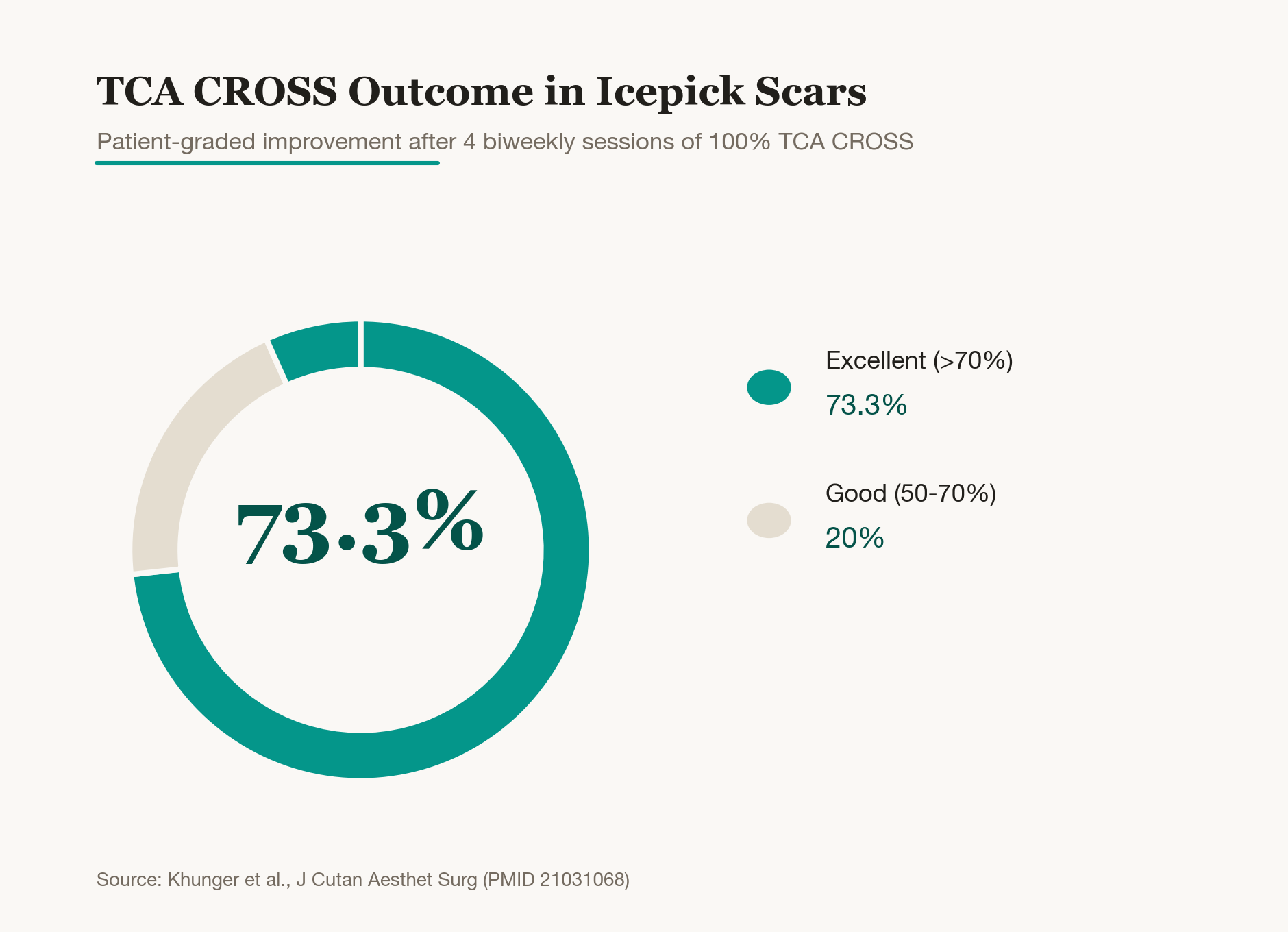
The TCA CROSS method for pitted scars
Narrow, deep pits like icepick scars are hard to reach at the bottom with a full-face peel alone. TCA CROSS, as the name suggests, chemically reconstructs scar tissue by targeting only the scar itself. A high concentration of 90–100% TCA is dabbed onto the tip of a toothpick and applied only inside the scar. It leaves the surrounding normal skin untouched and triggers localized inflammation only at the base of the scar, prompting new collagen to fill in that spot.
In a study using 100% TCA 4 times at 2-week intervals, 73.3% of patients showed marked improvement of more than 70%. Another 20% showed good improvement between 50% and 70%. Only a small minority saw no noticeable improvement.
Because it acts only locally, unlike a full-face peel, the risk of pigmentation spreading over a wide area is relatively low. That said, the concentration is very high, so precise technique is needed to apply just a small amount in exactly the right spot, and recovery involves about a week of scabbing before it clears.
Was this helpful?
About this article
Written by a practising aesthetic physician and intended for general education — not a substitute for individual medical advice.
Read next
Why Skin Peels After a Chemical Peel: Does It Work on Acne and Pigment Too?
A chemical peel isn't about acid burning your skin. It works by loosening the bonds holding dead cells that are already due to shed, speeding up turnover that was happening anyway. Here's the difference between AHA and BHA, and how recovery time changes with strength.
By Dr. Lee
Acne Scar Treatment by Scar Type: Effects, Downtime and Pigmentation
Acne scars respond differently to treatment depending on whether they are icepick, boxcar, or rolling type. Here is a rundown of the improvement rates and downtime for subcision, fractional CO2, microneedling RF, TCA CROSS, and HA filler, plus the pigmentation risk for Korean skin, backed by clinical research.
By Dr. Lee
TCA CROSS for Icepick Acne Scars: Effect and Pigmentation Care
What TCA CROSS is, why it outperforms laser on narrow deep icepick scars, how concentration affects outcomes, how proper prep slashes post-inflammatory hyperpigmentation risk, and how to combine it with other treatments, all backed by clinical study numbers.
By Dr. Lee