Acne Scar Treatment by Scar Type: Effects, Downtime and Pigmentation
By Dr. Lee10 min read
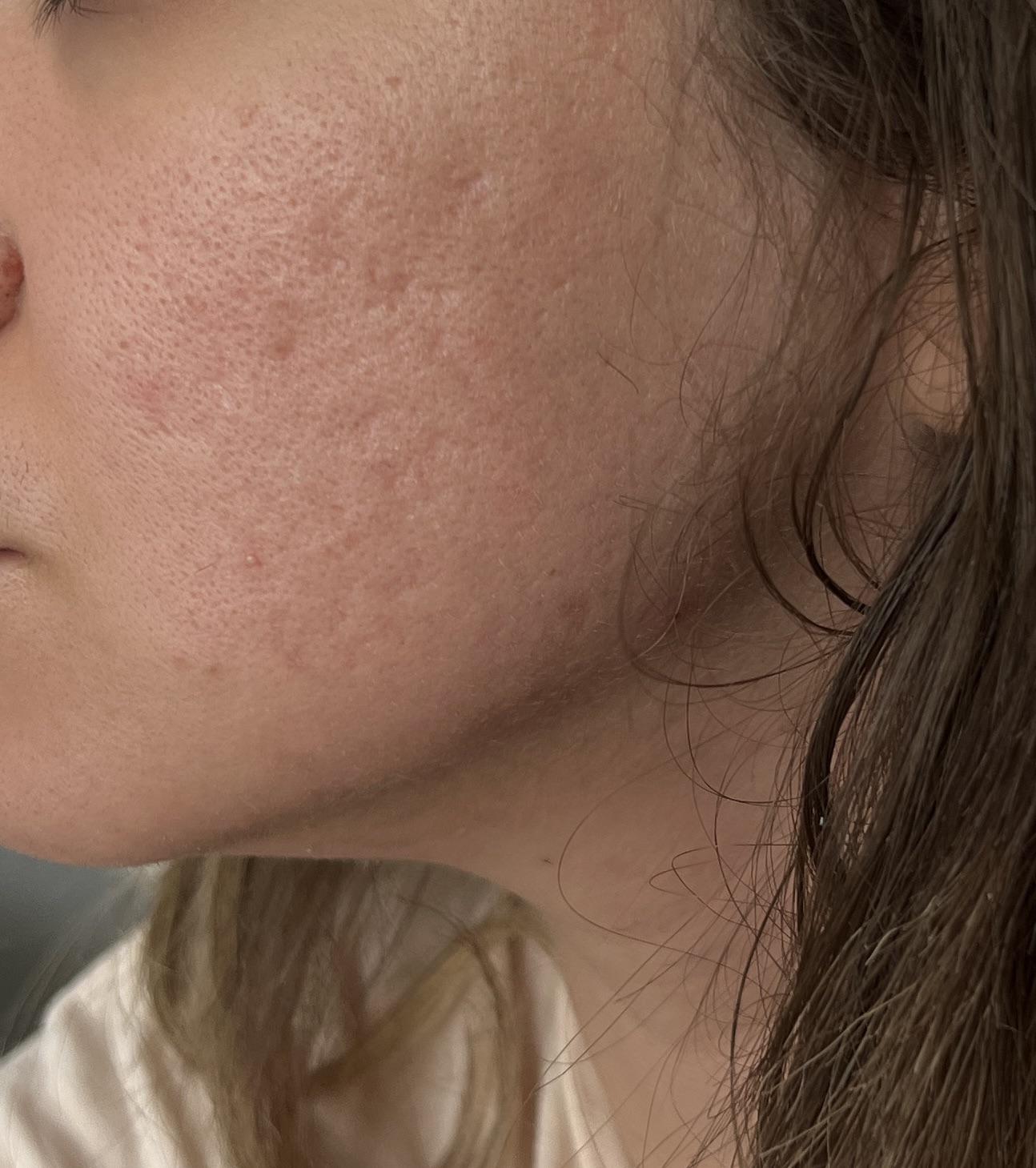
Scars left behind after acne clears up respond differently to treatment depending on their type. Narrow, deeply pitted marks and broad, gently sloping depressions form for different reasons, so even the same laser can produce very different results on each. That is why treating scars usually starts with identifying the type before choosing the right approach, rather than relying on a single procedure to handle everything. The main options are subcision, fractional CO2, microneedling RF, TCA CROSS, and HA filler, and each one is best suited to a particular kind of scar. This article breaks down the three scar types (icepick, boxcar, and rolling), and explains which treatment fits each one and why, along with the improvement rates and downtime backed by clinical research. It also covers the pigmentation risk that matters most for Korean skin.
| Scar Type | Key Feature | First-Line Treatment | Evidence | Downtime |
|---|---|---|---|---|
| Icepick | Narrow, deep pinpoint mark | TCA CROSS | 80% saw over 70% improvement after 4 sessions of 100% TCA | 5-7 days |
| Boxcar | Sharply defined, angular depression | Fractional CO2 / microneedling RF | Responds well to fractional thermal injury | RF 1-3 days, CO2 5-10 days |
| Rolling | Broad, gently undulating, caused by fibrous tethering | Subcision, then filler or energy device | 44.3% alone, 68.6% with CO2 combined | 3-7 days |
What types of acne scars are there?
Atrophic acne scars fall into three types based on shape: icepick, boxcar, and rolling. Most people have a mix of types on the same face, so in real-world practice, the standard approach is to identify each type present and combine treatments accordingly.
Icepick scars are narrow, under 2mm wide, and dip straight down deep into the dermis. Because the channel is so narrow and deep, surface resurfacing alone struggles to reach the bottom. Boxcar scars are depressions with sharply defined, angular edges that look like round or polygonal walls. Rolling scars have a broad, gentle wave-like shape, caused by fibrous bands that tether the scar downward.
| Type | Width and Depth | How to Spot It | Best-Fit Approach |
|---|---|---|---|
| Icepick | Under 2mm, deep and vertical | Looks like a narrow, pointed hole | Localized regeneration at the scar base |
| Boxcar | Shallow or deep, angular walls | Clearly defined edges | Even remodeling of walls and base |
| Rolling | Broad and gentle, tethered | Shows up as waviness under light | Releasing the tethering bands |
In practice, the difference in response between types is clear. A study using a non-ablative 1550nm fractional laser found improvement rates of 59.2% for boxcar scars, 40.6% for rolling, and only 19.1% for icepick. That means laser alone has real limits for icepick scars. When multiple types are mixed on the same face, the evidence supports a staged approach: release tethering first, remodel collagen next, and finish with surface and pigment correction.
Can subcision release rolling scars?
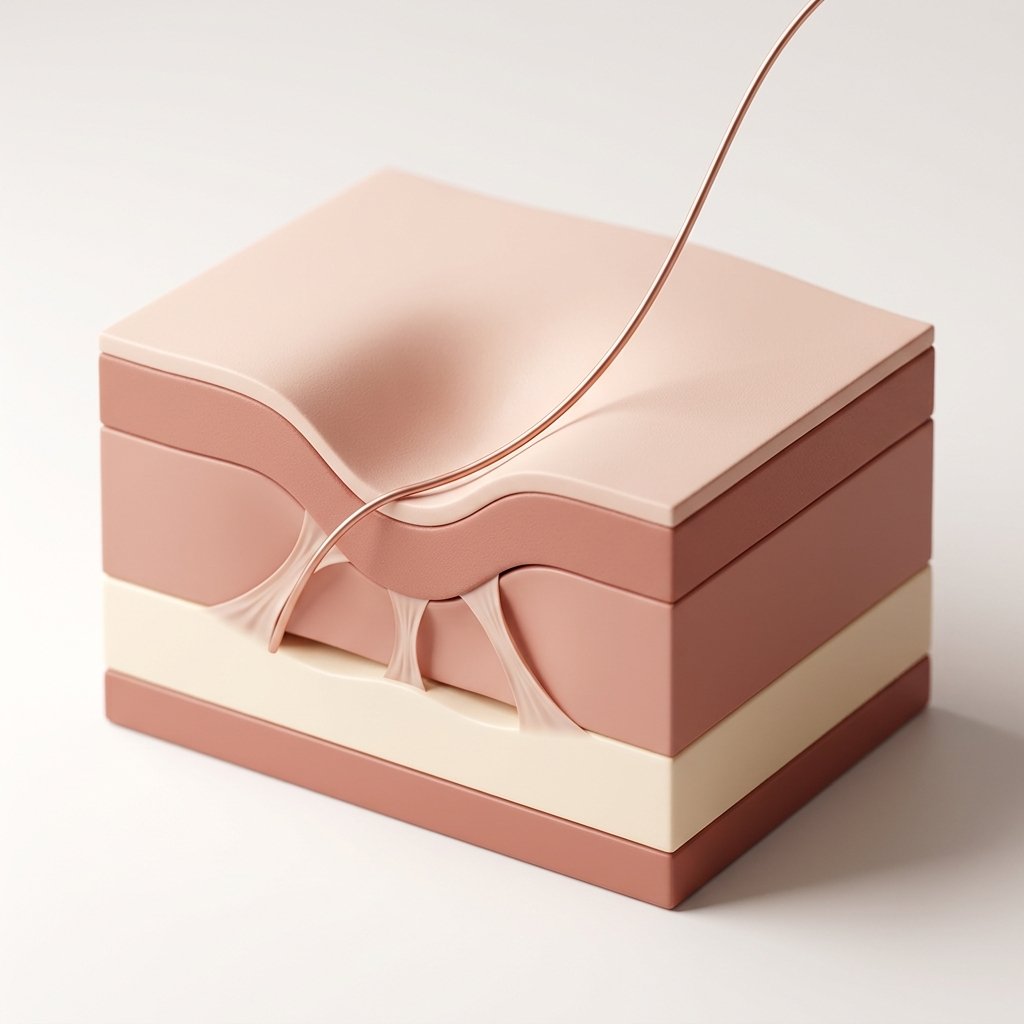
Rolling scars form when fibrous bands beneath the skin pull the scar downward. A laser that only works on the surface has a hard time releasing that pull. Subcision uses a fine needle or blunt cannula inserted below the dermis to directly cut these tethering bands. Once the tethering releases, the depression lifts, and the small hematoma that forms at the release site helps trigger new collagen production.
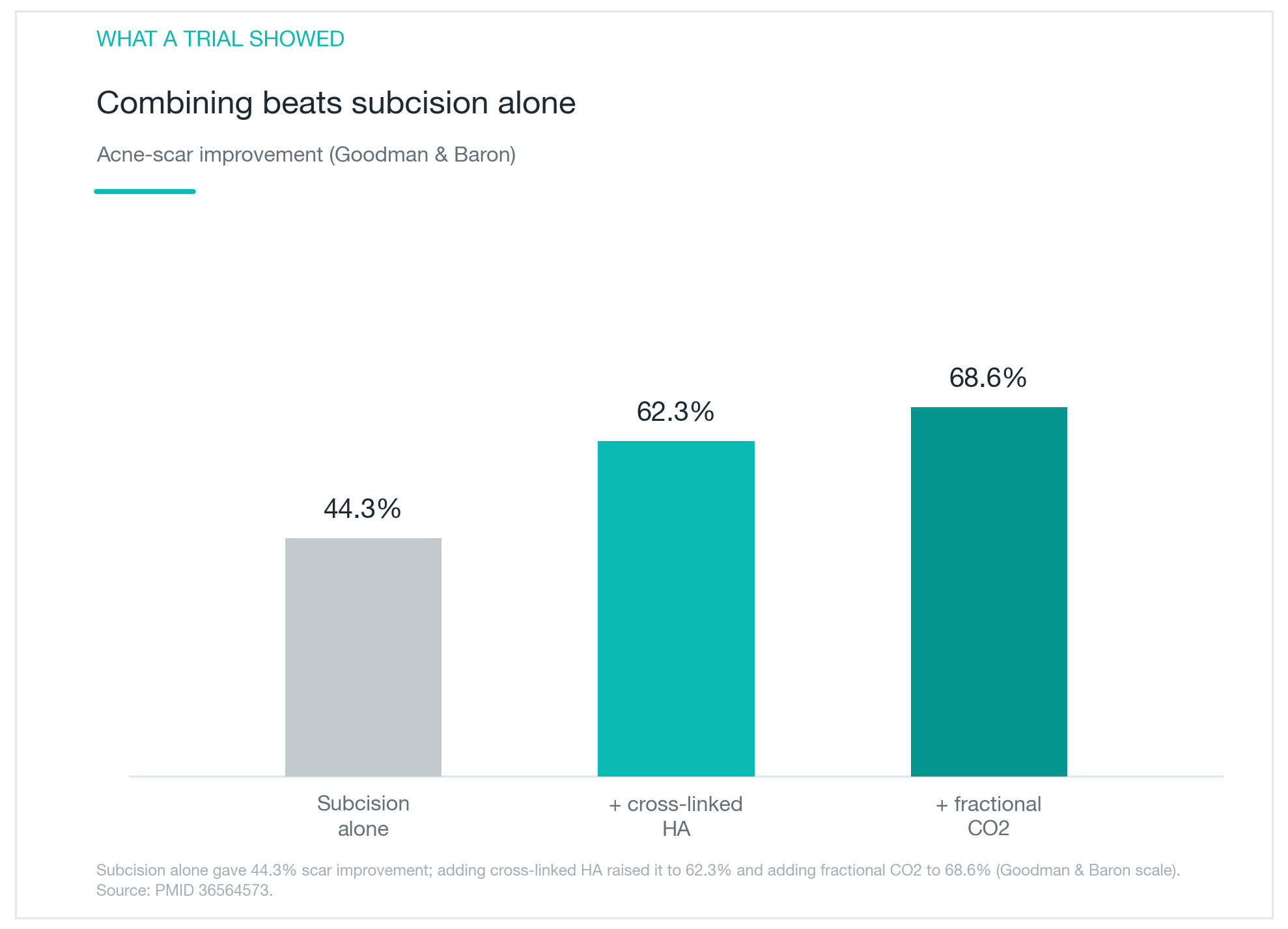
The effect has been confirmed with real numbers. In a study of 40 patients, subcision alone produced 44.3% improvement. Adding cross-linked HA raised that to 62.3%, and adding fractional CO2 raised it to 68.6%, with combination treatment clearly outperforming subcision alone. The share of patients rated as showing excellent improvement also rose, from 15% with subcision alone to 50% with CO2 combined.
That said, the effect of subcision alone is fairly modest, so it is unrealistic to expect it to erase a scar completely on its own. Sessions are usually spaced about a month apart, up to 3 times. Recovery typically takes 3 to 7 days, with bruising and hematoma being the most common side effects. Redness, swelling, and pain were all lowest when subcision was done alone.
Subcision, then, is the starting point for addressing the actual cause of rolling scars. Releasing the tethering first and then adding filler or an energy device is a well-supported way to boost improvement rates. If a broad, gently sloping depression is your main concern, it makes sense to start with subcision and discuss combination options from there.
Which treatment suits ice pick scars?
Icepick scars, narrow and deep, need a treatment that reaches the very bottom of the channel. TCA CROSS applies a high concentration, 90% to 100%, of trichloroacetic acid to the tip of a wooden toothpick and dabs it precisely onto the scar base only. This coagulates the protein inside the scar, and new epithelium and collagen then fill in the space to close the channel. Its advantage is that it leaves the surrounding normal skin untouched.
The supporting evidence is specific. In a study using 100% TCA in 4 sessions spaced 2 weeks apart, 8 out of 10 patients, or 80%, saw more than 70% improvement. The remaining 2 patients improved by 50% to 70%. For icepick scars, depth is generally reported to shrink by about half over 3 to 6 sessions.
| Item | Detail |
|---|---|
| Method | High-concentration TCA applied only to the scar base |
| Improvement Rate | 80% saw over 70% improvement after 4 sessions |
| Sessions | 3-6, spaced 2 weeks apart |
| Downtime | 5-7 days, localized scabbing |
Right after treatment, the applied spot shows a white, frost-like reaction and then scabs over, healing in about a week. In the study above, the only side effects were one case of temporary hypopigmentation and one of hyperpigmentation, with nothing more serious. Because the acid is applied only to a localized spot, the risk of pigmentation spreading over a wide area is relatively low, but given the high concentration, precise and careful application is essential.
Boxcar scars: CO2 or RF, which is better?
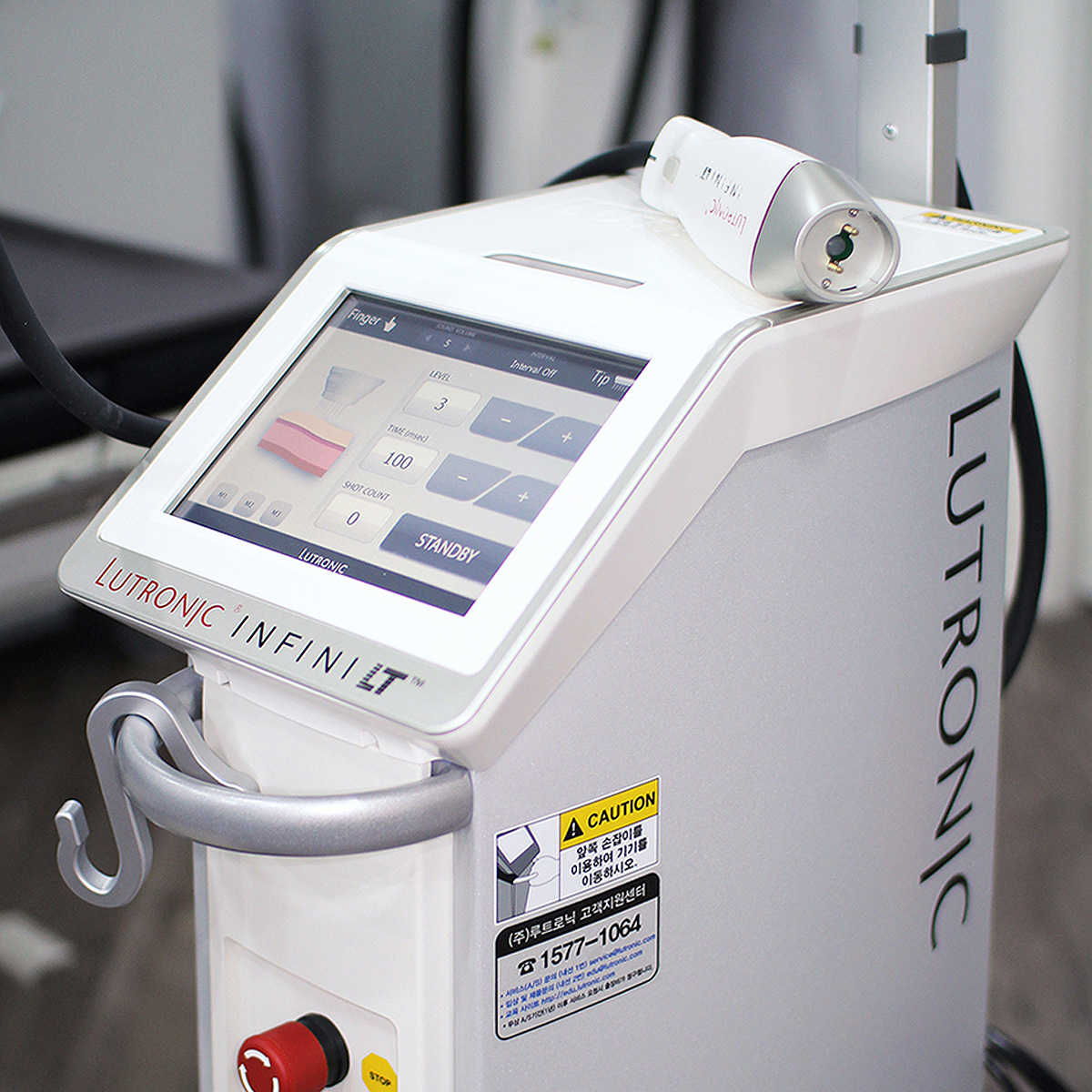
Depressions with walls and a floor, like boxcar scars, respond well to treatments that remodel the area evenly through fractional thermal injury. The two main options are fractional CO2 laser and microneedling RF. Results vary somewhat from study to study, so it is hard to call one definitively better than the other.
Fractional CO2 creates a grid of microscopic thermal columns that prompts surrounding tissue to weave new collagen. A meta-analysis pooling 8 randomized studies and 249 patients found CO2 came out slightly ahead in scar improvement. On the other hand, split-face studies comparing one side against the other found the two treatments produced essentially equal improvement, with microneedling RF showing faster recovery and fewer pigmentation side effects.
| Category | Fractional CO2 | Microneedling RF |
|---|---|---|
| Efficacy | Slightly ahead in meta-analysis | Equal in split-face studies |
| Pigmentation Risk | Relatively higher | Lower, spares the epidermis |
| Downtime | 5-10 days, prolonged redness | 1-3 days |
| Sessions | 1-3 | 3-4 |
Microneedling RF inserts insulated microneedles into the dermis and releases radiofrequency heat only from the needle tips. The key is that it heats only the deep dermis while sparing the epidermis, which is why its pigmentation risk stays low. In the end, CO2 suits people who want a strong effect in fewer sessions and can tolerate a longer recovery, while microneedling RF suits those who want faster recovery and prioritize pigment safety. There is no single best treatment; the evidence-based choice depends on your skin condition and how much recovery time you can allow.
Pigmentation risk to consider on Korean skin
When choosing a scar treatment, the biggest concern for Korean skin is pigmentation after the procedure. Many Korean patients have medium to darker skin types, and this kind of skin tends to hold onto brown pigment for a long time after strong thermal stimulation. If the scar fades but new pigmentation shows up in its place, satisfaction drops sharply.
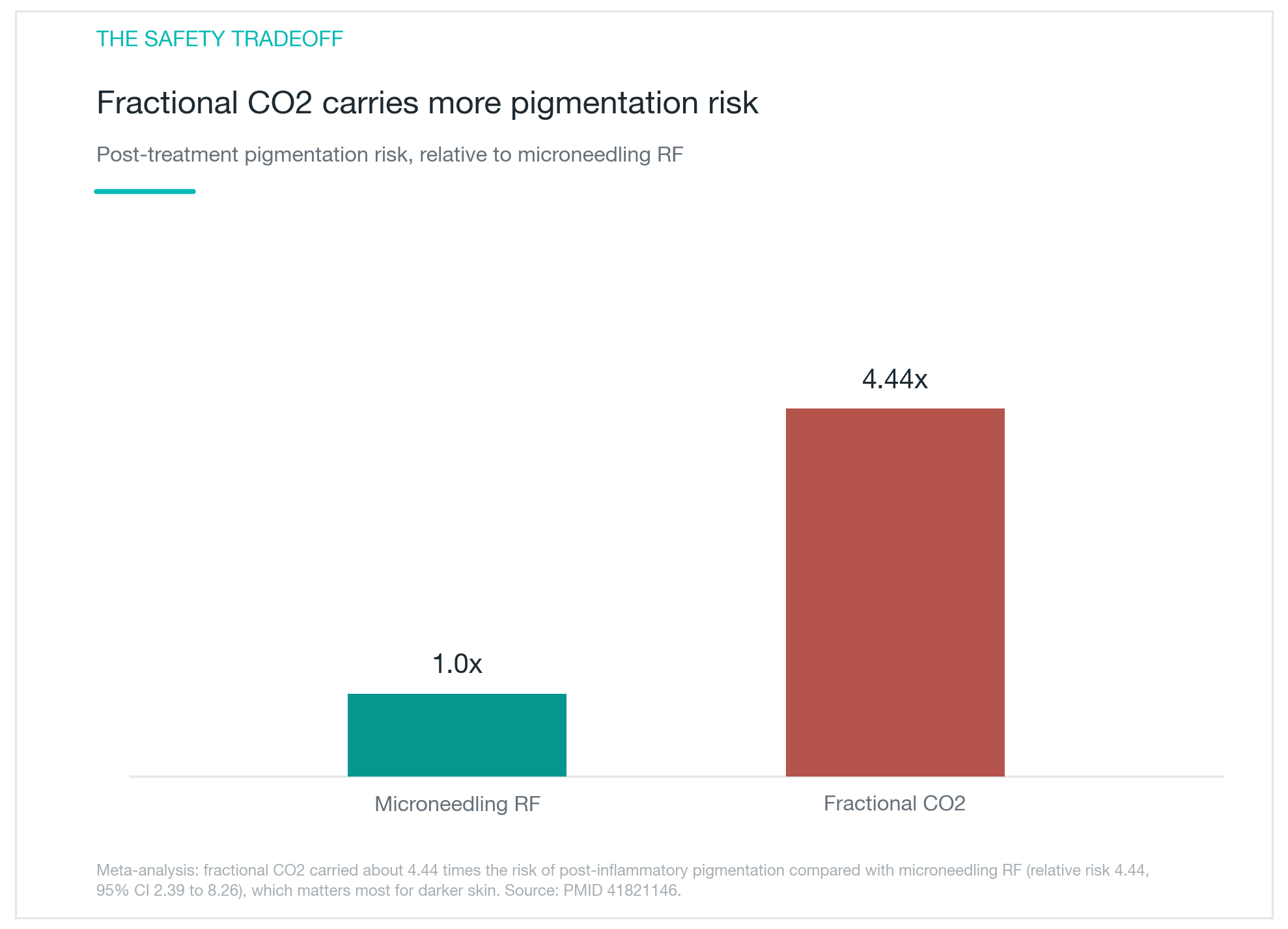
The numbers back this up clearly. Fractional CO2 carried a 4.44 times higher risk of pigmentation than microneedling RF. On darker skin, that difference is large enough to shape the outcome. The pigmentation rate for non-ablative fractional laser is also reported at around 17%, though narrowing the treatment area can help lower that risk.
For this reason, the relatively safer choices for darker skin are microneedling RF, which spares the epidermis, non-ablative laser, and TCA CROSS, which acts only on a localized spot. Subcision and filler involve little thermal stimulation, so their pigmentation risk is also low. Strong ablative lasers deliver bigger results, but it is worth remembering that pigmentation risk grows along with the effect.
Reducing pigmentation risk depends more on care before and after treatment than on the procedure itself. Strict sun protection is essential both before and after, and pretreatment to settle down existing pigment can help when needed. For darker skin in particular, spreading treatment across several gentler sessions rather than going all-in at once is a more realistic way to lower pigmentation risk while still improving the scar.
Filler effects and the order to combine treatments
Filler works by immediately filling the area beneath a depression to restore volume. It suits scars that can be filled directly, like broad rolling scars or shallow boxcar scars, but is not well suited to narrow, deep icepick scars. In a study of 15 patients treated with HA filler, 92% reported improvement, with a clear drop in scar severity and count, and the effect held up for up to 2 years. Large-scale placebo-controlled studies are still limited, though.
| Category | HA Filler | PMMA Bellafill |
|---|---|---|
| Reversible | Yes, dissolved with hyaluronidase | No, permanent |
| Duration | Evidence for up to 2 years | Permanent |
| Best-Fit Scars | Rolling, gentle boxcar | Moderate to severe atrophic |
Bellafill, a PMMA-based filler, has FDA approval for moderate to severe atrophic acne scars on the cheeks. Its particles remain in place and encourage the body's own collagen to build around them, which makes the effect permanent. HA filler, by contrast, can be dissolved with hyaluronidase if a problem arises, which makes it easier to manage risk than the irreversible PMMA option.
The most important thing to understand is that no single treatment erases a scar completely. In most studies, the goal is partial improvement, not total removal. Even a strong combination approach typically achieves about 60% to 70% quantitative improvement, and a single treatment on its own falls short of that. That is why multiple sessions and combined treatments are the standard.
In practice, the typical sequence is to release tethering with subcision first, remodel with fractional laser or microneedling RF, and then fill remaining depressions with filler while addressing pigment. Because collagen builds up gradually over weeks to months after treatment, the final result is best judged 3 to 6 months later. Identifying your scar type first, then combining safe treatments step by step, is the most evidence-based way to improve acne scars.
Was this helpful?
About this article
Written by a practising aesthetic physician and intended for general education — not a substitute for individual medical advice.
Read next

Fraxel for Acne Scars: Effects, Pigmentation, and Side Effects
How fractional lasers like Fraxel work on acne scars, why results differ so much by scar type, how real the PIH risk is on Asian skin, and what the research actually shows about how much improvement to expect: scars soften, they don't vanish.
By Dr. Kim

LaseMD Thulium Laser: Effects on Melasma and Dark Spots, and Recovery Time
LaseMD is a non-ablative fractional treatment that uses a 1927nm thulium laser to target only the skin's shallow epidermal layer. Here is a rundown of the clinical evidence behind its effects on melasma, pigmentation, pores, and tone, along with what the research actually shows about LaseMD Ultra's ampoule-absorption effect.
By Dr. Kim

TCA CROSS for Icepick Acne Scars: Effect and Pigmentation Care
What TCA CROSS is, why it outperforms laser on narrow deep icepick scars, how concentration affects outcomes, how proper prep slashes post-inflammatory hyperpigmentation risk, and how to combine it with other treatments, all backed by clinical study numbers.
By Dr. Lee