Carboxytherapy: Effects, How It Works, Number of Sessions and Precautions
By Dr. Kim8 min read

Deliberately injecting gas into the body sounds like an odd idea at first. Yet carboxytherapy actually traces back to French spa therapy and has since become an established treatment for managing fat and circulation. Using a fine needle, a small amount of medical-grade carbon dioxide is injected just under the skin, into the subcutaneous fat layer.
The key thing to understand is that carbon dioxide itself does not burn fat. Instead, it works as a signal that tells the body to circulate more aggressively. Following that signal, blood flow increases, and the extra blood carries more oxygen and nutrients to the area, creating conditions that favor fat breakdown and tissue repair. Here is how that chain of events unfolds and why it gets used where it does.
Why does injecting carbon dioxide widen blood vessels?
Blood vessels in the body constantly monitor local carbon dioxide levels. The more active the cells in an area, the more carbon dioxide they release, so the body reads a spike in carbon dioxide as a sign that oxygen is urgently needed there. In response, local vessels widen on their own to send more blood. It is similar to a construction site flagging a labor shortage and getting extra crew sent in right away.
Carboxytherapy triggers this same response on purpose. Injecting carbon dioxide into the subcutaneous fat causes local carbon dioxide levels to spike almost instantly. The body reads this as an emergency shortage of oxygen and widens the small vessels in that area to push more blood through. This is called vasodilation, which simply means the vessels act like pipes that have grown wider, letting more blood pass through.
The injected carbon dioxide does not linger in the body. It is carried off through the bloodstream and exhaled through the lungs, typically clearing within 10 to 20 minutes. But the boost in blood flow it triggers during that brief window keeps going for another two to three days after treatment. So the real starting point of carboxytherapy is not the gas itself, but the increase in circulation the gas sets off.
How does increased blood flow affect fat cells?
Fat tissue naturally has a sparser network of blood vessels than most other tissue. That means areas where fat has accumulated tend to have relatively sluggish circulation to begin with. When circulation is slow, the energy stored inside fat cells has a harder time getting out, and waste products build up more slowly too.
When carboxytherapy raises blood flow, that pattern shifts. With blood moving more actively, oxygen and nutrients reach the fat cells more frequently, and the byproducts of fat breakdown get cleared away faster. Picture opening a new channel through a stagnant pond. Water that keeps flowing is less likely to sit and stagnate, and the same logic applies here: better circulation keeps the environment around fat cells from turning stagnant.
On top of that, the physical stretching and pressure caused by the injected gas adds its own effect. This mechanical stimulation is reported to activate the enzymes inside fat cells that break down stored fat. In other words, a chemical signal and a physical nudge work together to create conditions that favor fat breakdown.
Why does more oxygen change fat breakdown?
The process of converting stored fat into usable energy is called lipolysis. It happens in several stages, and a good portion of those stages depend on oxygen. When oxygen is scarce, the whole process slows down.
When carboxytherapy increases blood flow, the amount of oxygen reaching the area rises along with it, effectively supplying more fuel for the lipolysis process. On top of that, carbon dioxide itself makes it easier for hemoglobin in the blood to release its oxygen into the tissue, a well-documented physiological effect. Hemoglobin normally acts as a courier that grabs oxygen and carries it along, but when the surrounding carbon dioxide level rises, it lets go of that oxygen more readily. It works a bit like a delivery driver dropping off packages faster once they get close to the destination.
Put together, the rise in blood flow and the rise in oxygen delivery combine to create favorable conditions for fat cells to break down and clear out their stored fat. That said, this shift rarely shows up after a single session. It tends to build up gradually over roughly 8 to 12 sessions.
Does it work on cellulite too?
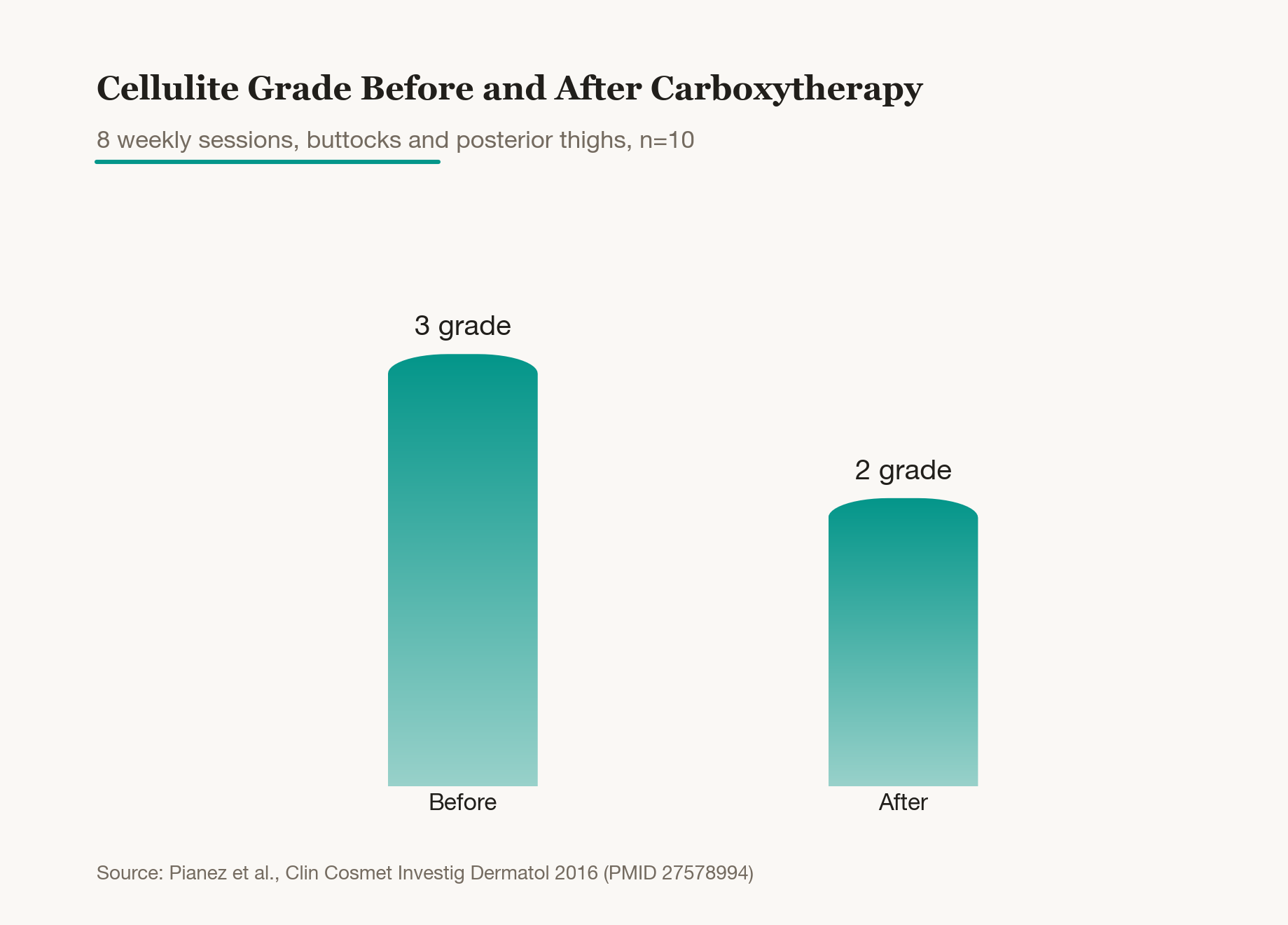
Cellulite refers to the dimpled, uneven texture that shows up on the skin surface, most often on the thighs and buttocks. There is no single cause, but slow circulation in the area combined with the way connective tissue structures push fat cells upward is thought to play a role. When circulation slows, fluid and waste tend to pool between tissues, and that buildup can make the surface look more uneven, similar to mild swelling.
Carboxytherapy targets exactly that stagnant circulation. As blood flow increases, the channels for pooled fluid and waste to drain properly widen, and reports suggest this can ease surface irregularities to some degree. Combined with the reduction in fat cell volume, this can help the surface look smoother.
Since cellulite has several overlapping causes, it is more realistic to see carboxytherapy as one piece of a broader management approach centered on improving circulation, rather than expecting it alone to make cellulite disappear entirely.
How does it target collagen for stretch marks?
Stretch marks form when the skin stretches rapidly over a short period and the collagen fibers in the dermis cannot keep up, eventually tearing. Collagen acts like a supporting pillar that keeps skin firm, and once that pillar breaks, the area fills in with thinner, weaker scar tissue. As a result, stretch mark areas tend to have fewer blood vessels and slower regeneration than the surrounding skin.
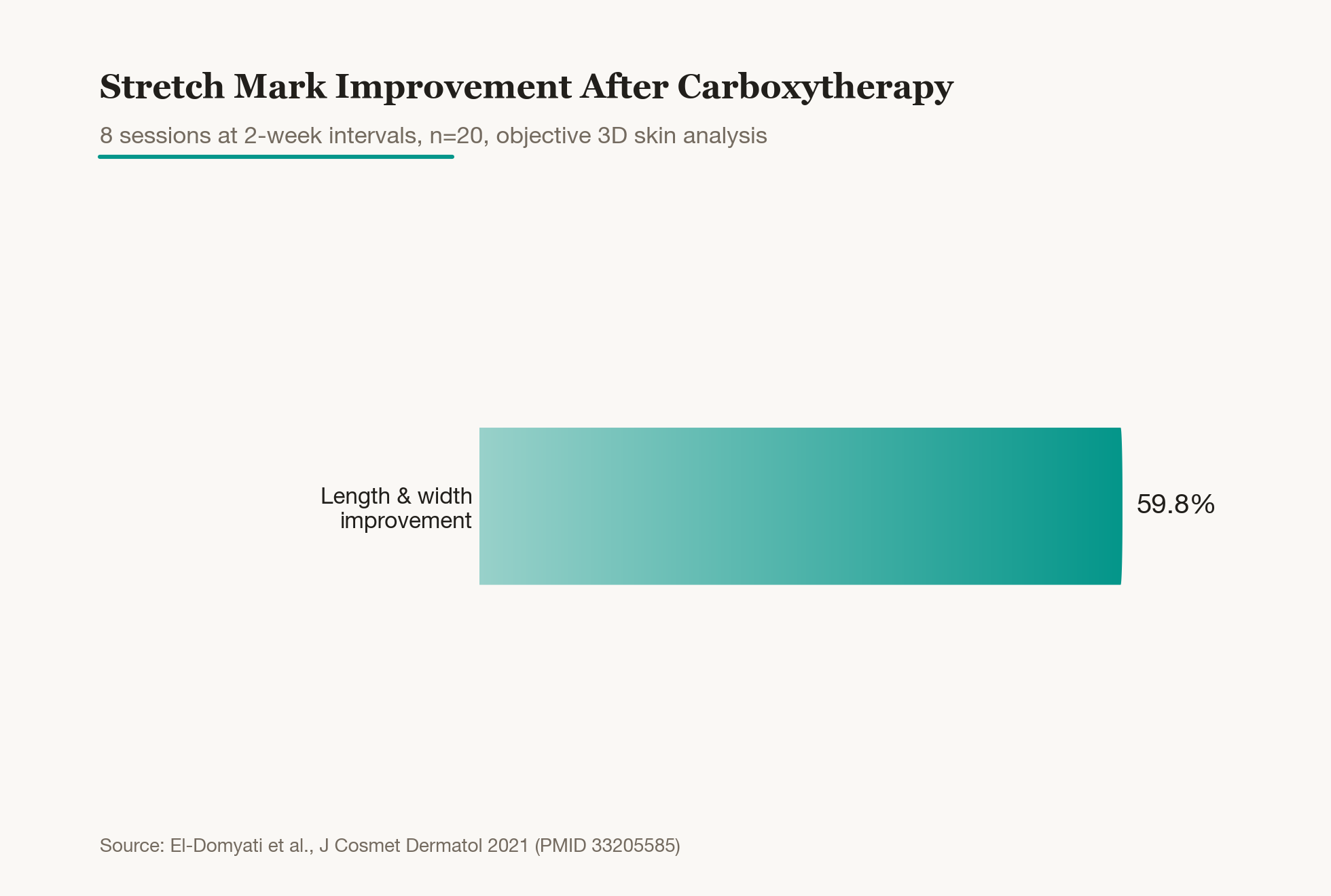
Carboxytherapy approaches this area the same way, by boosting circulation. As blood flow rises, fibroblasts, the cells responsible for producing new collagen, receive more oxygen and nutrients, and this stimulation is reported to encourage collagen production to some extent. Fibroblasts can be thought of as the workers directly weaving collagen, the skin's structural pillar. Give the workers more raw material and energy, and the work naturally speeds up.
As a result, the characteristically thin, sunken texture of stretch marks is reported to gradually fill in over 8 to 12 weeks, along with some fading in color. That said, the response tends to be stronger in stretch marks that are relatively recent and still reddish or purplish, rather than older marks that have already turned white and firm.
How do session counts differ by area?
Carboxytherapy is not applied the same way everywhere, since fat thickness, vessel density, and skin sensitivity vary by body area. Here are three reasons behind those differences.
- The abdomen and thighs have thicker fat layers, so the gas needs to reach a wider range, which means injecting at more points per area and typically needing more sessions, around 10 to 15. The thicker the fat layer, the longer it takes for the circulation boost to spread evenly.
- Areas with thinner fat layers, like the double chin or upper arms, tend to respond faster with a relatively smaller amount, since the target fat cells are packed more densely within the area the gas can reach.
- For surface-level concerns like cellulite or stretch marks, the injections go shallower and closer together, since the problem sits in the dermis and just below it, and matching that depth is what lets the circulation boost reach exactly the right spot.
The most common protocol is 8 to 12 sessions spaced one to two weeks apart. Since circulation improvement and fat breakdown are cumulative processes, repetition tends to matter more for the outcome than any single session.
What it feels like and who should be careful
The treatment involves injecting short bursts of gas at multiple points within the target area, spaced about 1 to 2cm apart, using a fine needle. Right after injection, the gas spreading through the tissue can cause mild pressure, a slight stinging sensation, or a puffy feeling in the area. This is a temporary effect from the carbon dioxide filling the spaces between tissue, and it typically settles within 10 to 30 minutes as the gas gets absorbed.
Some mild redness or bruising can show up afterward, a natural response to the widened vessels and the minor mechanical stimulation. Most of this is reported to resolve within two to five days. That said, anyone with a circulatory condition, certain lung conditions, or who is pregnant should discuss the treatment with a doctor beforehand.
Carboxytherapy is less about dramatically reducing fat in one go and more about supporting circulation on an ongoing basis. Results are reported to hold up more reliably when it is paired with lifestyle habits like diet and exercise.
References
Korean Dermatological Association, Ministry of Food and Drug Safety (MFDS), American Academy of Dermatology (AAD), and U.S. Food and Drug Administration (FDA).
Was this helpful?
About this article
Written by a practising aesthetic physician and intended for general education — not a substitute for individual medical advice.
Read next

Body Onda: Effects, Approach by Area, Number of Sessions and How Long It Lasts
Body Onda is a non-surgical body contouring treatment that uses microwave energy to selectively heat the fat layer beneath the skin, shrinking fat cells while tightening the skin above them. Here is why the heat targets fat rather than skin, why fat reduction and tightening happen together, how the approach differs for the abdomen, arms, and flanks, and how many sessions it takes to see lasting results.
By Dr. Kim
HPL Fat-Dissolving Injection: How It Works, Number of Sessions, and Swelling
A principle-first look at how HPL fat dissolving injections break down fat cell membranes and how the broken-down fat actually leaves the body. We also cover why dosing and session counts differ by treatment area, and how much swelling and downtime to expect.
By Dr. Lee
Tear Trough Filler Duration and Side Effects, Including Vessel Risks
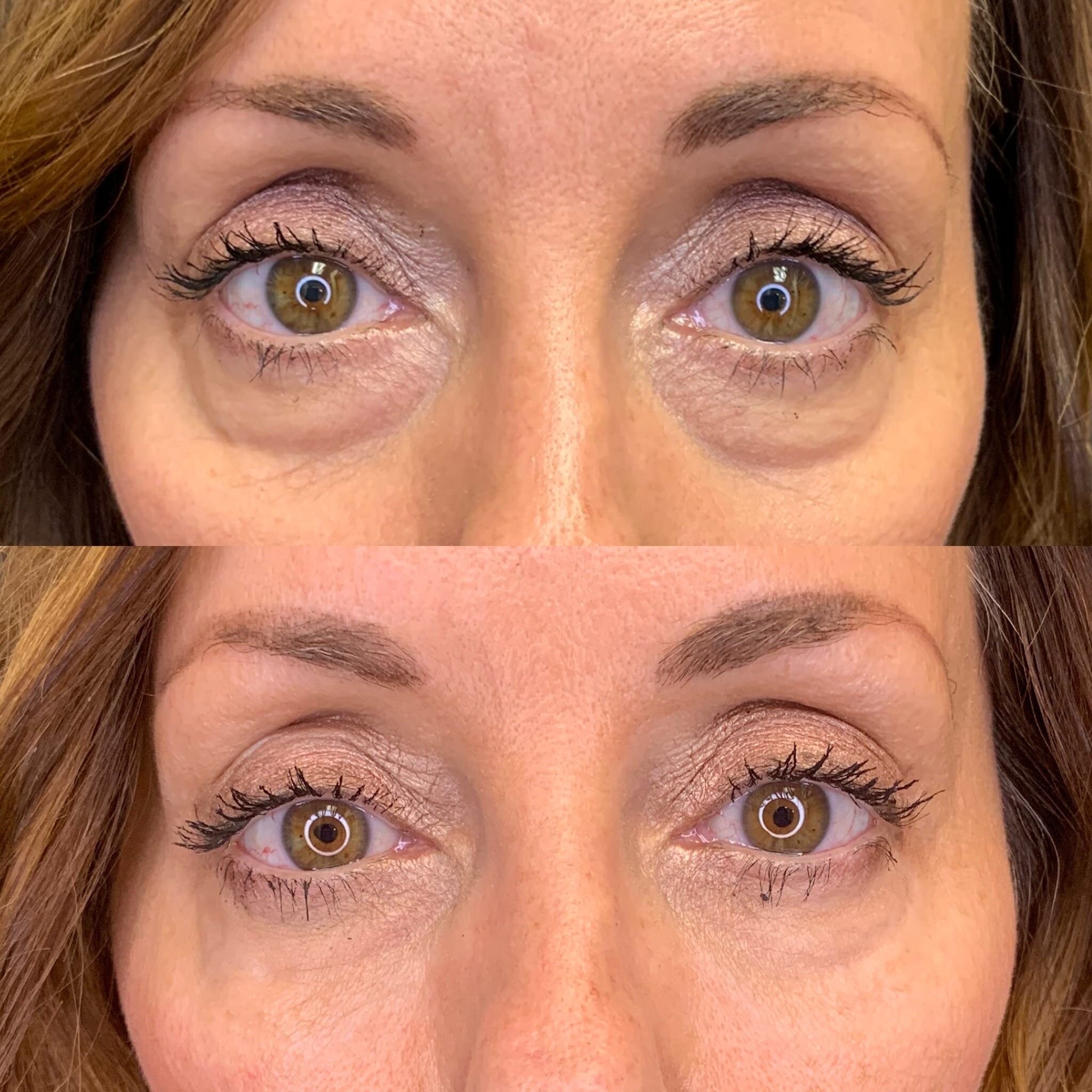
The hollow that forms just under the under-eye fat pad, the tear trough, improves when filler physically fills that empty space. But skin and blood vessels are thin in this area, so there are separate precautions around cannula technique and the Tyndall effect. Here is how the filling works, how long results last, and what recovery looks like.
By Dr. Kim