Black Carbon Peel: How It Works and Precautions After Treatment
By Dr. Lee8 min read

Carbon peel treatments involve applying a black carbon cream to the face, then passing a laser over it. Clinics usually call this the black peel or carbon peel, simply because the cream itself is jet black. It might look like nothing more than smearing charcoal powder on your face, but underneath that is a precise process where the laser targets each individual dark particle and burns it off.
The key is that carbon particles absorb the laser energy in place of your skin. That means the skin itself stays largely unharmed, while old dead skin cells, sebum, and blackheads trapped in your pores get carried away along with the carbon. Let's go through why carbon is the one doing this job, and how that heat ends up changing your skin texture too.
What kind of treatment is the black carbon peel?
The treatment happens in two stages. First, a black cream loaded with microscopic carbon particles gets spread thinly over the whole face. These particles are so small that to the eye it just looks like a smooth black film, but they're actually tiny enough to work their way into the pore openings.
Once the cream has had time to sink in, a Q-switched Nd:YAG laser (a specialized laser at a 1064nm wavelength) passes over the area in sections. Wherever the laser touches, the carbon instantly heats up and vaporizes, taking a layer of old surface buildup with it. By the end of the session, the black cream has completely vanished, and the skin feels smoother, almost like a layer has been peeled away.
How does carbon seep into the pores?
Carbon itself isn't an oily substance, but it's hydrophobic, meaning it mixes well with oil rather than water. That's why the cream carrying it is built on an oil base, which lets it slip naturally into pores that are already full of sebum. It's a bit like using an oil-based cleanser on a greasy dish. The oil in the cleanser blends right into the grease instead of fighting against it.
That's why the cream needs a few minutes to sit before the laser step. During that wait, the carbon particles quietly work their way into the sebum-heavy pore openings and blackhead sites. If the particles only stayed on the surface, the laser would only clean up the surface too. But once carbon has made it into the pore, it becomes a target that pulls the deeper debris out along with it. In the end, how deep the carbon manages to penetrate is what determines how far the treatment's effect actually reaches.
Why does the laser react only to carbon?
The most important concept behind this treatment is selective absorption. A laser doesn't react to every material the same way. It gets absorbed much more strongly by substances with a specific color and structure. Think of how black objects get noticeably hotter than lighter-colored ones under the sun. That's the same reason a black shirt feels warmer in summer: black absorbs far more light energy than other colors.
The 1064nm laser used here works the same way. It gets absorbed strongly by the deep black carbon particles, but reacts much more weakly to the lighter-toned skin tissue around them. So most of the laser's energy gets funneled toward the carbon, while the skin itself passes through with minimal irritation. Because that gap in absorption is so wide, the treatment can precisely strip away surface buildup and dead skin cells without much collateral effect.
Vaporized carbon also removes dead skin and sebum
Once a carbon particle absorbs the laser, its temperature spikes almost instantly and it turns into gas. This is called a photomechanical effect: as the heat rises, the area right around the particle gets a tiny burst of physical force that flings material outward. It's similar to what happens when a drop of water hits a hot pan and instantly sputters and jumps.
It's not just the carbon particle that disappears. The surface dead skin, leftover sebum, and shallow blackheads clinging to it get pulled away in the same burst. That's why, right after the session, pores tend to look noticeably clearer and the skin often looks a shade brighter. That said, this effect stays at the surface level. It's not going to erase deep wrinkles or larger pigmented lesions.
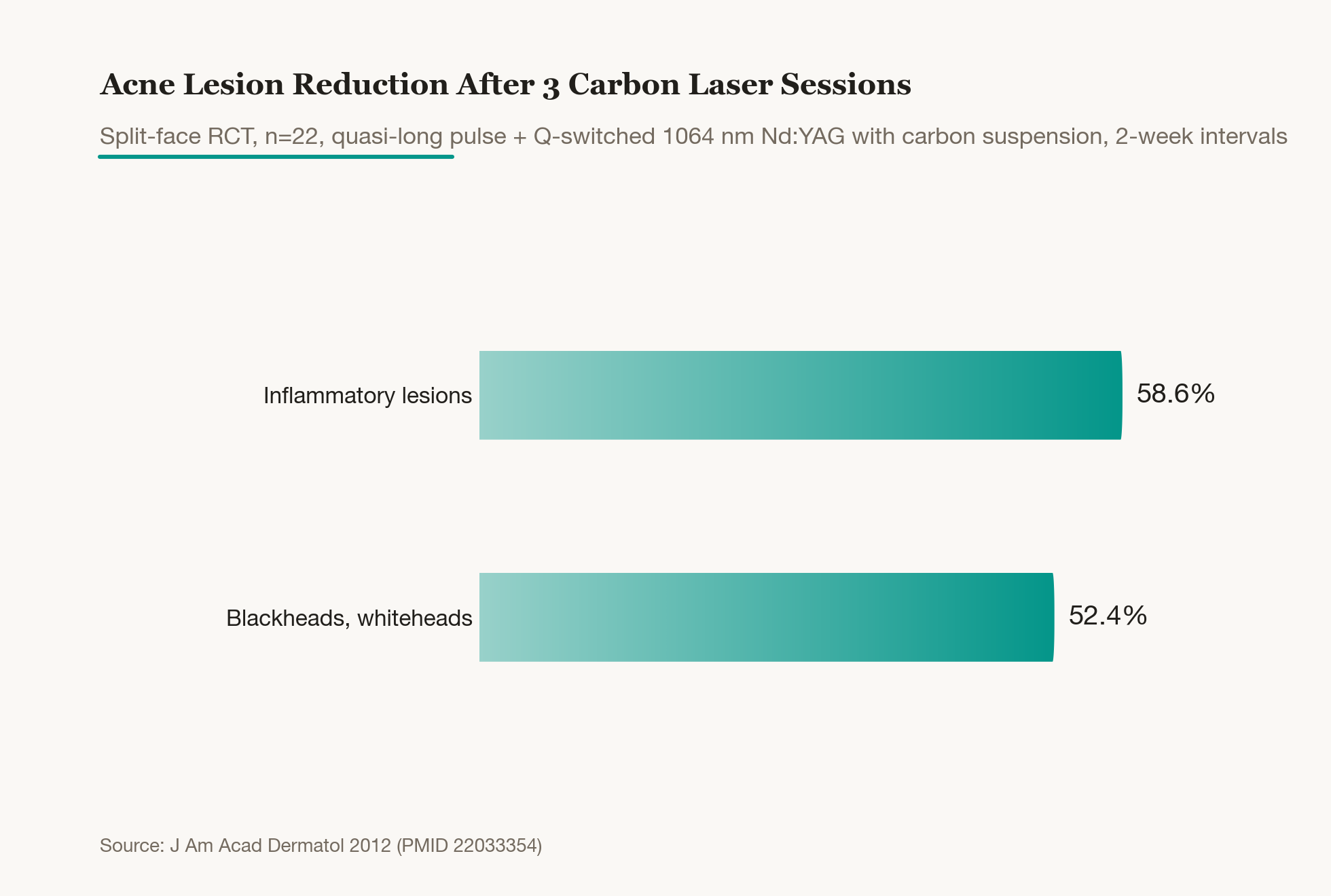
What happens when heat reaches the dermis?
Some of the energy used to burn off the carbon gets used up right at the surface, but a portion of it quietly travels down to the dermis underneath. In the brief moment the laser passes over, the whole area warms up slightly. It's not hot enough to cause a burn, but it is enough to nudge the cells into action.
When skin picks up a mild heat signal like this, it reads it as minor damage and switches on its repair response. The same way new skin grows over a wound, this stimulus gradually activates the cells that produce collagen. That's why people who repeat carbon peel sessions a few times report not just better pore and oil control, but smoother-feeling skin texture overall. That said, this heat stimulus is much gentler than what an ablative laser delivers, so the changes build up slowly rather than all at once.
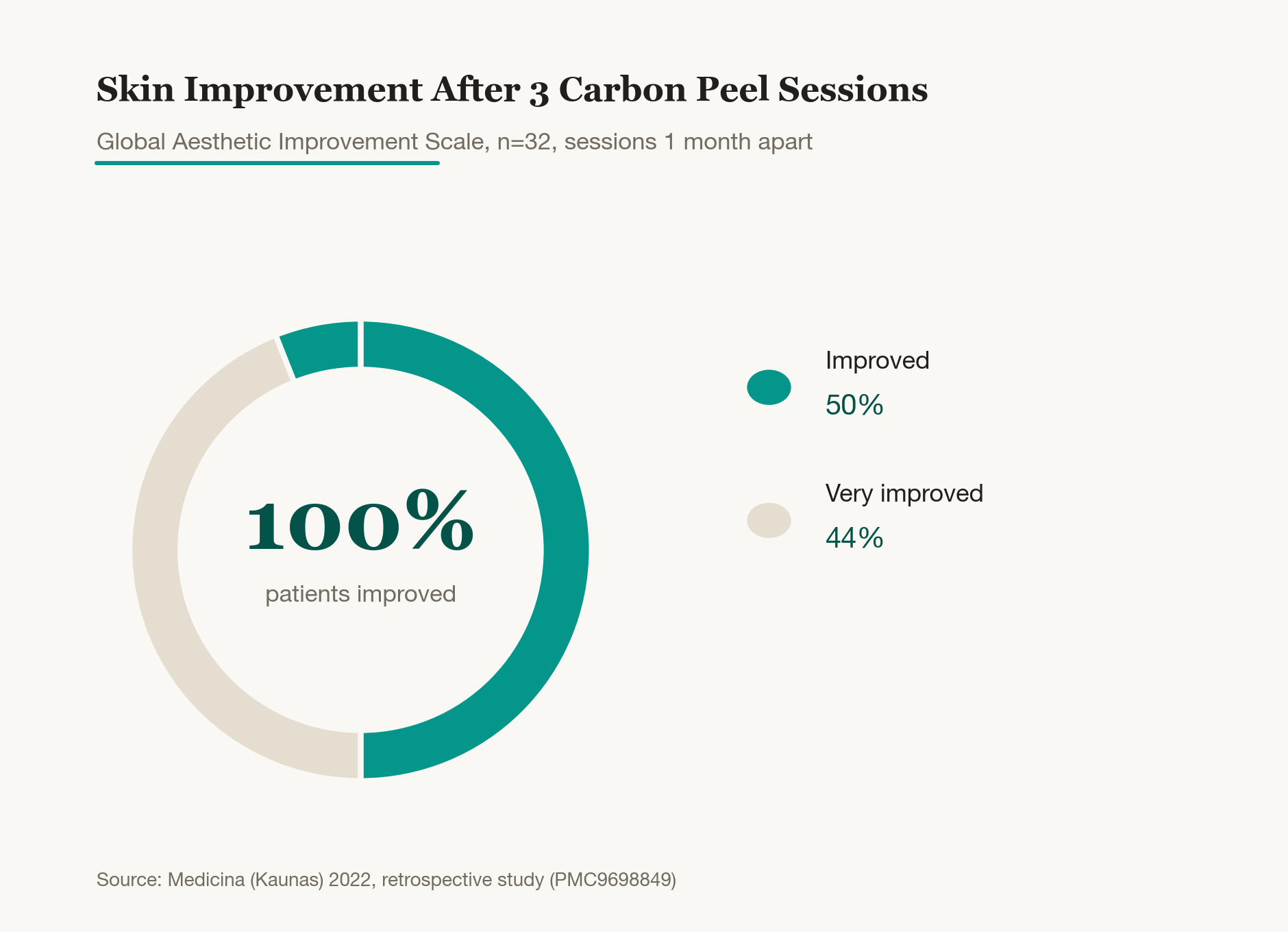
How long does it take and how much does it hurt?
Even counting the time it takes for the cream to absorb, the whole session tends to wrap up fairly quickly. Since the laser is only burning carbon at the surface, it's much gentler than treatments that penetrate deep into the tissue.
During the treatment, most people describe it less as stinging and more as a light snapping warmth passing over the skin. That's because each carbon particle vaporizing gives off a faint popping sound along with a brief flash of heat, and it's common to go through the whole thing without any numbing cream. Here are the reactions that typically show up before and after the session.
- Mild redness right after treatment: This shows up because clearing the surface dead skin leaves the skin temporarily more reactive. It usually settles within a few hours to a day.
- A bit of dryness: Since part of the outer dead skin layer comes off with the treatment, the skin barrier is briefly thinner than usual. That means it needs extra moisturizing for a while.
- A sense that pores look smaller: This comes from clearing debris out of the pores, which makes them look relatively smaller by comparison. The pore structure itself doesn't actually shrink, so they gradually return to their original size over time.
Aftercare and which skin types suit it
Since the surface dead skin layer is thinner right after treatment, aftercare should focus on cutting down irritation and rebuilding the barrier. Skin can stay a bit more reactive than usual for a few days.
- Sunscreen deserves extra attention. With the dead skin layer thinner, skin reacts more easily to UV exposure, which raises the risk of pigmentation building up.
- Skip exfoliants or high-strength acids for a few days after. The surface has already been cleared out, so adding more exfoliation on top of that can thin the barrier further.
- Layer on enough moisturizer to rebuild the barrier. Since the dead skin layer that normally holds onto moisture is temporarily thinner, outside hydration needs to fill that gap.
This treatment is considered an especially good fit for oily skin with a lot of sebum, blackheads, and enlarged pores, or for anyone hoping to brighten a dull complexion. On the other hand, if skin is very sensitive or inflammatory acne is actively flaring, it's safer to hold off, since it can add unwanted irritation during that window. For deeper concerns like significant scarring or larger pigmented lesions that sit deep in the dermis, carbon peel on its own has its limits, so it's often paired with other treatments instead.
Spacing between sessions matters too. It takes a certain amount of time for the surface dead skin layer to clear out and rebuild, so repeating the treatment too often before that recovery finishes can leave the barrier thinner for longer than it should be. That's why clinics usually adjust the timing of the next session based on how an individual's skin is recovering. Staying consistent while also giving the skin room to recover is really what makes this treatment sustainable over the long run.
References
Korean Dermatological Association, American Academy of Dermatology (AAD), and Ministry of Food and Drug Safety (MFDS).
Was this helpful?
About this article
Written by a practising aesthetic physician and intended for general education — not a substitute for individual medical advice.
Read next

Lara Peel Effects and Irritation, Including Treatment Interval and Suitable Skin
Lara Peel was developed for sensitive skin that finds stinging, peeling treatments too harsh. It combines LHA with an alkaline ingredient to gently smooth away dead skin cells. Using real research on LHA and other gentle peel ingredients, here is a look at how it works on texture and pores.
By Dr. Lee
Pigmentation After Laser Hair Removal: Why It Happens and How to Prevent It
Laser hair removal works by using heat to destroy melanin inside the follicle, but when that heat spreads into the epidermis, it can leave a burn that later turns into hyperpigmentation. Here is why burn risk changes with skin tone, wavelength choice, and cooling method, along with ways to reduce it beforehand.
By Dr. Lee

Body Onda: Effects, Approach by Area, Number of Sessions and How Long It Lasts
Body Onda is a non-surgical body contouring treatment that uses microwave energy to selectively heat the fat layer beneath the skin, shrinking fat cells while tightening the skin above them. Here is why the heat targets fat rather than skin, why fat reduction and tightening happen together, how the approach differs for the abdomen, arms, and flanks, and how many sessions it takes to see lasting results.
By Dr. Kim