Calf Botox: Effects, Duration and Precautions
By Dr. Lee7 min read
A lot of people steer clear of skinny jeans or short skirts because of a bulge on the back of the calf. The muscle tightens into a hard knot while walking or standing, and it doesn't fully release even when you try to relax it. Calf Botox comes up often as an answer to exactly this problem.
It works by deliberately weakening the muscle to soften the shape, yet most people never quite learn why that change happens, how long it takes, or whether it suits everyone. Below, we'll go through what actually happens inside the calf muscle, why the bulge shrinks, how a muscle-driven calf differs from a fat-driven one, and how long the results tend to last.
How does calf Botox reduce the bulge?
For a muscle to move, a command from the brain has to travel down a nerve and reach the muscle. The chemical that carries out the last step of that relay is acetylcholine. Think of it as a letter the nerve sends to the muscle that reads, contract now.
The point where the nerve meets the muscle to hand over that letter is called the neuromuscular junction, essentially a mailbox where the message gets dropped off. Botulinum toxin, better known as Botox, blocks the letter from ever leaving that mailbox. It stops acetylcholine from being released at the nerve ending in the first place.
So the nerve still generates the signal, but it never reaches the muscle. Botox doesn't destroy or damage the muscle cells directly, it simply cuts the line of communication on the way there. Without instructions, the muscle can't generate force, and as that continues, the muscle itself starts to shrink.
When does the effect start?
Cutting the nerve signal doesn't make the calf bulge disappear in 1 week. Thinning out a muscle simply takes time. Muscle strength typically weakens noticeably somewhere between 1 and 2 weeks after treatment, and an actual reduction in bulk is reported to become noticeable around the 3 to 4 week mark.
This process is called muscle atrophy, which simply means a muscle gradually shrinking because it isn't being used. If you've ever seen a leg that's been in a cast for a long stretch, the muscle underneath visibly thins out, and the principle here is similar. A cast blocks movement physically, while Botox blocks the nerve signal chemically, arriving at a similar result through a different route.
The gastrocnemius, the muscle on the back of the calf that forms the bulge, keeps getting used every time you walk or run, so it can atrophy a bit more slowly than muscles in the arm or face. That's why patients are usually told to wait about a month, rather than judge the outcome right after the injection, before evaluating the change in shape.
Are my calves muscular or fatty?
Calf Botox works well when muscle is the main reason for the bulge. If the calf looks thick mainly because of fat, reducing muscle strength won't meaningfully change the circumference. That's why identifying the actual cause before considering treatment is the first step that determines the outcome. A few things are commonly checked to sort this out.
- Rise up on your toes and check whether the calf tightens into a hard knot. A clear difference in thickness between relaxed and flexed points to muscle as the main driver, while little change either way suggests fat plays a bigger role.
- Sit down and let your leg hang loose, then check how much the tissue jiggles. A lot of jiggle when you shake it gently leans toward a fat-driven calf, while little jiggle and a firm feel leans toward a muscle-driven one.
- Pinch the calf with your hand to gauge how much soft tissue you can grab. If there's a thick layer you can pinch, fat likely makes up a larger share, and a treatment that reduces fat directly may suit you better than one that reduces muscle.
In practice, muscle and fat are often mixed together in the same calf. In that case, Botox alone may deliver limited change, so other body contouring options sometimes come up in consultation as well. It's worth checking which type your calf leans toward before deciding on treatment.
Which muscle and location are injected?
Most calf bulges come from the gastrocnemius. It's the muscle that rounds out on the back of the calf to form the bulge, and it contracts hard when you rise on your toes or walk. Underneath it sits the soleus, a deeper muscle that stays engaged just to hold you upright, so it's generally left alone.
Treatment selectively targets the superficial gastrocnemius because weakening the soleus too much can start to affect the way you walk. So the injection points and dose are planned around wherever the gastrocnemius bulges out the most.
Since the calf is a muscle that's constantly working to support your body weight and move you around, providers tend to be a bit more careful about strength loss here than in the arm or face. That's why starting with a low dose and adjusting based on whether walking or climbing stairs still feels comfortable is a commonly recommended approach.
How many months does the effect last?
The reduction in muscle strength from Botox isn't permanent. Over time, the nerve ending sprouts new branches that rebuild a pathway for the signal to reach the muscle, similar to a new route opening up next to a mailbox that was once blocked. Once that pathway reopens, the muscle gradually returns to its original size.
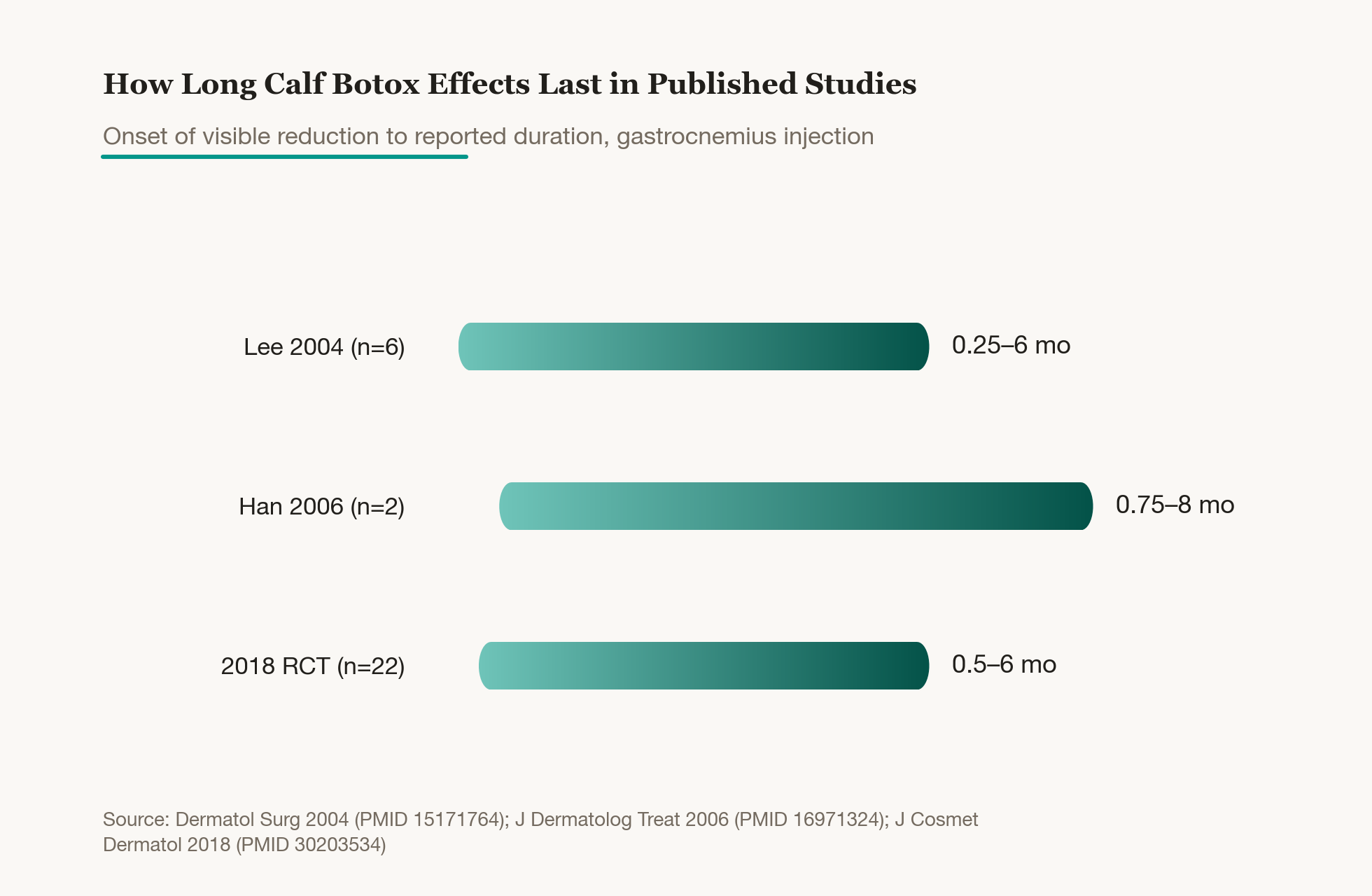
Results are generally reported to last somewhere between 4 and 6 months. That window varies from person to person depending on the dose used, how developed the muscle was to begin with, and how much someone walks or exercises. People who regularly do calf-heavy activities like walking or hiking are reported to see the muscle bounce back a bit sooner.
If you want to maintain the shape, you'll want to plan a follow-up session around the time the effect starts to fade. Rather than repeating the same dose every time, it's generally advised to check how much the muscle has recovered first and adjust the amount as needed. Some people are reported to keep the muscle smaller through repeated sessions, but this varies a great deal from person to person.
Precautions to know before treatment
There are a few things worth knowing ahead of time if you're considering calf Botox.
- There's no reversal agent. Once the effect sets in, you have to wait for it to wear off naturally over time, which is why starting with a low dose and watching how your walk changes is the safer approach.
- If you're very active or your job puts a lot of demand on your calves, it's worth mentioning during your consultation. The effect on strength can feel different from person to person, and knowing your activity level helps guide the right dose.
- If your calf is a mix of muscle and fat, it helps to set realistic expectations beforehand. If fat makes up a large share, Botox alone may not produce a dramatic change, and combining it with other approaches is something to discuss in consultation.
- A temporary feeling of weakness in the leg right after treatment is also worth expecting. This sensation is generally reported to ease as the muscle adjusts.
Knowing these points ahead of time helps close the gap between expectation and outcome. In the end, calf Botox comes down to this: when muscle is the actual cause of the bulge, it softens the shape by temporarily lowering that muscle's strength for about 4 to 6 months.
References
Korean Dermatological Association, Ministry of Food and Drug Safety (MFDS), American Academy of Dermatology (AAD), and U.S. Food and Drug Administration (FDA).
Was this helpful?
About this article
Written by a practising aesthetic physician and intended for general education — not a substitute for individual medical advice.
Read next
Arm Botox: Effects, Duration and Telling Muscle Bulge From Fat
Explains how injecting Botox into the muscles behind an arm bulge cuts the nerve signal so the muscle gradually slims down. Covers how to tell muscle type from fat type, when results start to show, and how long the effect lasts before a touch-up is needed.
By Dr. Lee

Masseter Botox: When Results Appear, How Long They Last, and Precautions
Masseter Botox is injected into the masseter, the muscle you use to chew, to reduce its strength. Here is an easy breakdown of why the muscle atrophies, why the slimmer jawline appears gradually, how long the effect lasts, and when a touch-up is needed.
By Dr. Lee

Body Onda: Effects, Approach by Area, Number of Sessions and How Long It Lasts
Body Onda is a non-surgical body contouring treatment that uses microwave energy to selectively heat the fat layer beneath the skin, shrinking fat cells while tightening the skin above them. Here is why the heat targets fat rather than skin, why fat reduction and tightening happen together, how the approach differs for the abdomen, arms, and flanks, and how many sessions it takes to see lasting results.
By Dr. Kim