Arm Botox: Effects, Duration and Telling Muscle Bulge From Fat
By Dr. Lee7 min read
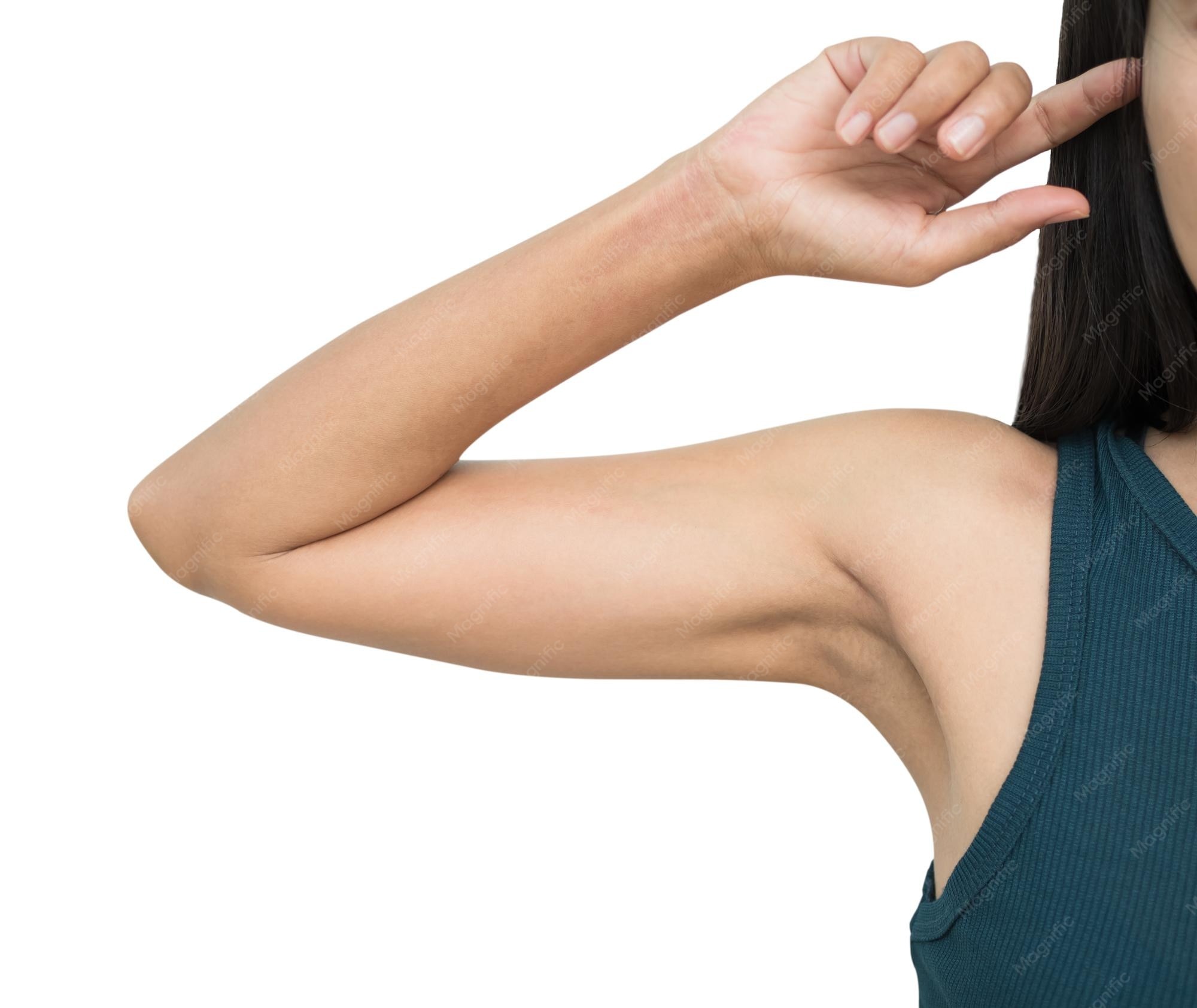
A lot of people notice that the inside or back of their upper arm sticks out more than they'd like once they put on a sleeveless top or a short-sleeve shirt. Bend the arm and there's a hard little bulge, straighten it and that same spot still stands out. This is where arm Botox gets brought up, as a way to soften the muscle's pull just enough to smooth the line.
The underlying idea is the same as calf Botox or jaw Botox, but arms are a different story because you use them constantly to lift and carry things, so the approach needs a bit more care. Below, we'll walk through what Botox actually does inside the muscle, why the bulge shrinks, how to tell a muscle-type arm from a fat-type arm, and how long the results tend to hold.
How cutting the nerve signal relaxes the muscle
For a muscle to move, a nerve has to send it a signal. The chemical that carries that signal is acetylcholine. Think of it as the message a nerve sends telling the muscle "contract now." The spot where nerve meets muscle is called the neuromuscular junction, and it works a lot like a mailbox where that message gets dropped off and picked up.
Botulinum toxin, better known as Botox, blocks the message from ever leaving that mailbox. It stops acetylcholine from being released at the nerve ending, so even though the nerve is still trying to send the signal, it never actually reaches the muscle. Botox isn't touching the muscle itself, it's cutting the instructions on their way there.
A muscle that stops getting instructions can't generate force. Flex your arm and it won't clench as hard as before, and over time the bulk itself starts to shrink. It's a similar idea to how an arm thins out after being in a cast for a long stretch, since a muscle that isn't being used naturally loses size. It's also why skipping the gym for 8 to 12 weeks makes an arm feel soft again. Muscle needs a steady stream of signals to keep its bulk, and Botox essentially slows that signal down enough that the muscle shrinks on its own.
How long until the bulge visibly shrinks?
Cutting the nerve signal doesn't make the bulge disappear overnight. Slimming down takes time. Muscle strength usually starts noticeably weakening around 1 to 2 weeks after treatment, and the drop in bulk becomes visible from around 3 to 4 weeks.
This process is called muscle atrophy, meaning the muscle gradually shrinks from disuse. It's the same thing that happens when you take 4 to 6 weeks off from working out and the muscle goes soft and thin, except Botox artificially blocks the nerve signal to speed that process along.
At this stage, the change tends to feel gentle rather than dramatic. Flexing produces less of a hard clench, and even at rest the muscle outline looks less defined. That said, how much change you'll see depends a lot on how much of the original bulge was actually muscle. If you regularly work out and have a well-built arm, the difference tends to be obvious, but if the arm never had much muscle mass to begin with, the change might just be a slight cleanup of the line. So rather than judging results off a handful of before-and-after photos, it helps to set expectations based on your own arm, which cuts down on disappointment.
Is my bulge muscle or fat?
Arm Botox works best when the bulge is actually caused by muscle. If the arm is thick because of fat, reducing muscle strength won't change the overall size much. That's why figuring out the cause before treatment matters so much for the outcome. Here are the checks commonly used to sort this out.
- Flex the arm and see if it hardens noticeably. A clear difference between flexed and relaxed points to muscle playing a big role, while an arm that stays soft even when flexed points to more fat.
- Let the arm hang and shake it to see how much the skin jiggles. A lot of movement suggests fat, while little movement suggests muscle.
- Pinch the skin with your hand to gauge thickness. If there's a thick pinch of tissue, fat is likely the bigger factor, and a fat-reduction approach may suit better than reducing muscle strength.
In reality, plenty of arms are a mix of both muscle and fat. In those cases, Botox alone may only offer limited change, so liposuction or another body procedure sometimes gets considered alongside it. Arms that look similar on the surface can be quite different underneath, some mostly muscle, some mostly fat, some a roughly even mix, and the right approach depends on which one you're actually dealing with. So the first step before deciding on treatment is figuring out which category your arm falls into.
Which muscle is injected?
The upper arm has two spots people typically identify as the "bulge." One is the biceps, which pops up on the front of the arm when you bend it, and the other is the triceps, which handles straightening the arm and is also tied to sagging on the back of the arm.
Even though it's called arm Botox either way, the injection site depends on which muscle is doing the bulking. If the front of the arm stands out when flexed, the biceps is the target, and if the back looks thicker, the triceps gets the focus. When both are noticeably developed, both can be addressed together.
Arms don't get as much daily use as calves do for walking and running, but they're still constantly used for lifting and pushing things. Carrying groceries or picking up a child both rely on these same muscles, so if strength is reduced too aggressively, everyday life can get uncomfortable. That's why the dose has to be set carefully, without cutting too far into strength, and it's typically adjusted per person based on original muscle size and how active that person's arms are day to day.
How long does it last, and when to repeat?
The reduction in muscle strength from Botox isn't permanent. Over time, new nerve branches grow out from the nerve ending and start delivering signals to the muscle again, similar to a blocked mailbox getting a new route opened up. Once the signal returns, the muscle gradually rebuilds back toward its original size.
Reports generally put the effect at somewhere between 3 and 6 months. That window varies from person to person depending on the dose used, how large the muscle was to begin with, and how much the arm gets used day to day. People who regularly do arm-heavy workouts tend to see the muscle bounce back faster, according to some reports.
If you want to keep the line for longer, a repeat treatment is usually timed to when the effect starts to fade. Rather than repeating the exact same dose every time, though, it's safer to check how much the muscle has recovered and adjust only as much as needed.
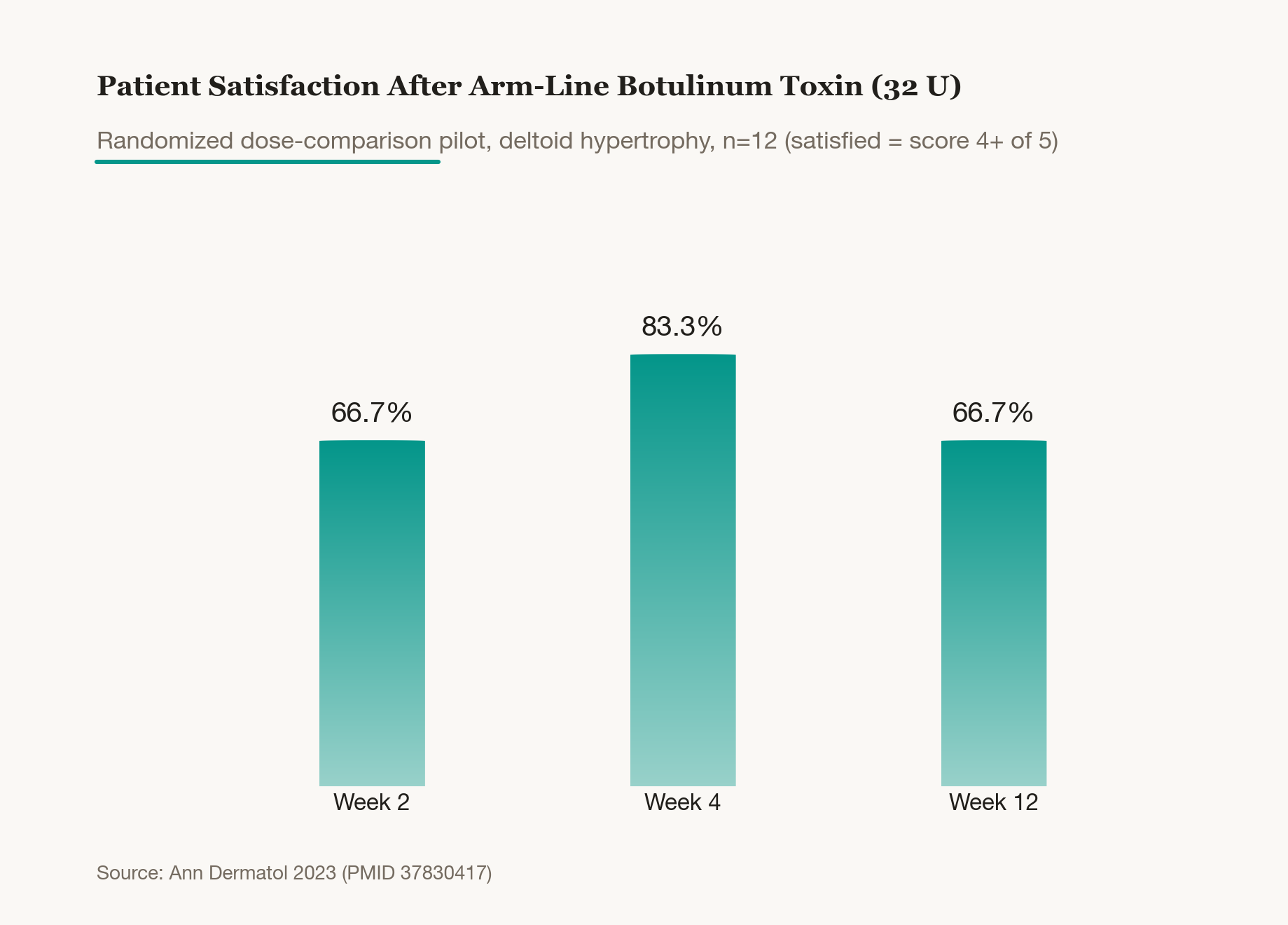
Precautions before and after treatment
There are a few things worth knowing before going in for this.
- There's no reversal agent for this one. Once the effect kicks in, you have to wait for it to wear off naturally, so starting with a lower dose and watching how your body responds is the safer route.
- If you regularly do sports or work that relies heavily on arm strength, it's worth mentioning during your consultation. How much strength loss feels noticeable varies from person to person, and knowing your activity level helps with dosing.
- If your arm is a mix of muscle and fat, it helps to set realistic expectations beforehand. If fat makes up a large share of the bulk, Botox alone may not create much change, and your consultation is a good place to discuss combining it with other options.
Knowing these points ahead of time helps narrow the gap between what you expect and what you actually see afterward. In the end, arm Botox comes down to this: when a bulge is caused by muscle, temporarily reducing that muscle's strength can soften the line.
References
Korean Dermatological Association, Ministry of Food and Drug Safety (MFDS), American Academy of Dermatology (AAD), and U.S. Food and Drug Administration (FDA).
Was this helpful?
About this article
Written by a practising aesthetic physician and intended for general education — not a substitute for individual medical advice.
Read next
Calf Botox: Effects, Duration and Precautions
Botox injected into the gastrocnemius, the muscle behind a bulky calf, cuts nerve signals so the muscle gradually thins. Here's how to tell a muscle-driven calf from a fat-driven one, how long it takes to see results, and how long the effect lasts before a touch-up is needed.
By Dr. Lee

Masseter Botox: When Results Appear, How Long They Last, and Precautions
Masseter Botox is injected into the masseter, the muscle you use to chew, to reduce its strength. Here is an easy breakdown of why the muscle atrophies, why the slimmer jawline appears gradually, how long the effect lasts, and when a touch-up is needed.
By Dr. Lee

Marionette Line Filler: Results, How Long It Lasts, and Combining With Botox
Marionette lines running from the corners of the mouth down toward the jaw form when the supporting ligaments loosen, the fat pad sags, and the muscle pulling down on the mouth corners adds to the strain. HA filler works by rebuilding this collapsed structure from the inside out, restoring lost volume layer by layer. Here's a look at recovery time, how long results last, and why Botox is often paired with it.
By Dr. Kim