Jaw, Trapezius and Calf Botox: Effects, Dose and Side Effects by Area
By Dr. Kim8 min read

Botox does more than smooth wrinkles. It is widely used to slim the jawline, lower the trapezius for a longer neck silhouette, and contour the calves. The shared idea is that it reshapes the body by reducing muscle, not bone, giving you refined lines without going under the knife.
These three areas involve much larger muscles than the small facial muscles treated for expression lines, which means higher doses and different considerations at each site. Effects, duration, and side effects all vary from area to area. Here is a look at how each site works, how much reduction to expect, and what to watch out for, based on actual research. Think of this as a different category from the small doses used for forehead lines.
How does Botox shrink a muscle?
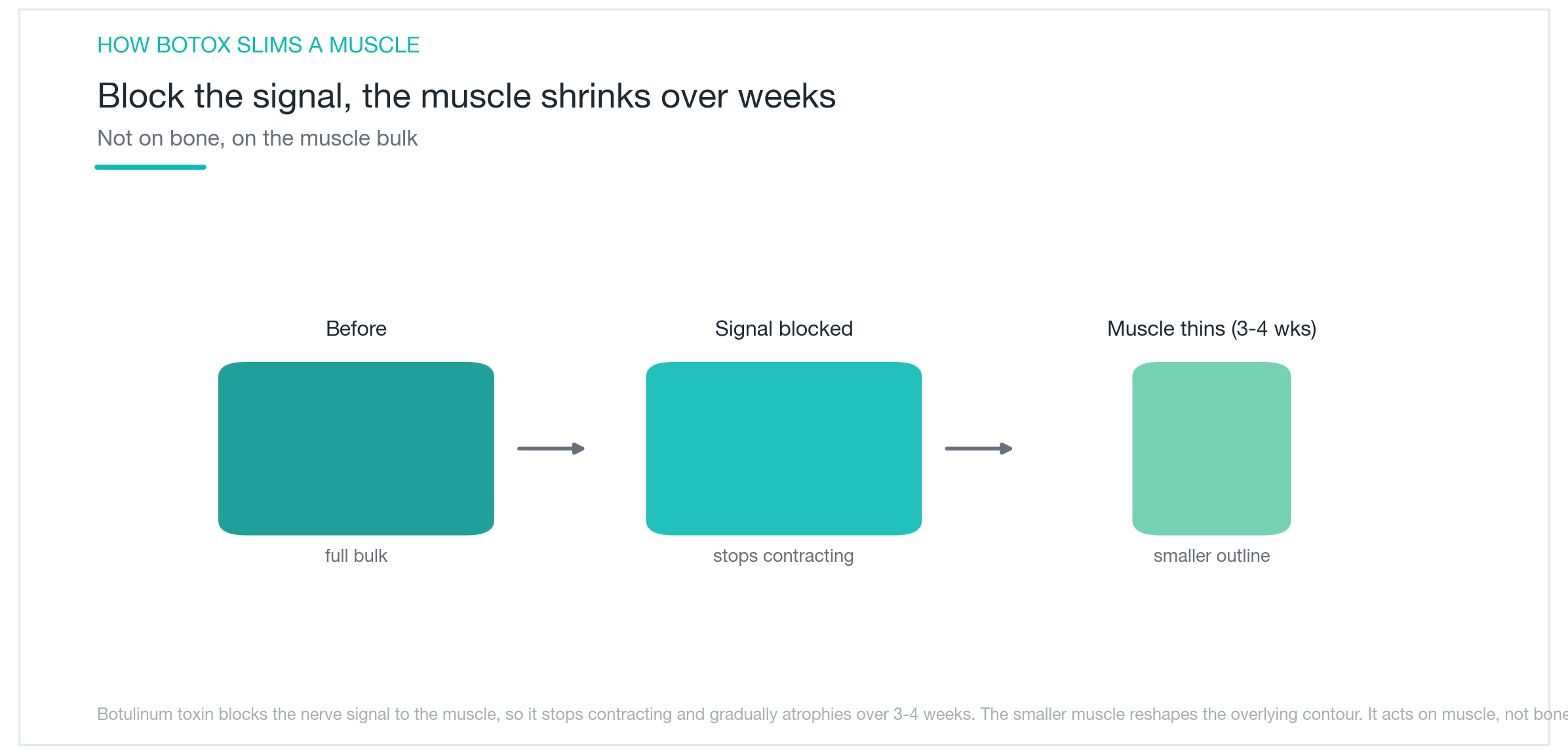
Botulinum toxin blocks the nerve signal that tells a muscle to contract. When the signal is cut off, the muscle loses strength and gradually becomes thinner over 3 to 4 weeks. It is the same principle as a muscle shrinking from disuse, and as the volume decreases, the contour above it smooths out.
The key is that it works on muscle, not bone. That is why it delivers strong results for concerns driven by muscle bulk: a square jaw from a large masseter, raised shoulders from a thick trapezius, or full calves from a prominent gastrocnemius. If jaw width comes from bone structure or calf size from fat rather than muscle, botox alone has its limits.
The effect is not permanent. When the nerve block fades after a few months, the muscle gradually returns, so periodic touch-ups are needed to maintain the shape. With repeated treatments, the muscle often settles into a slimmer baseline between sessions, and many people find they can go longer between visits over time. Results also do not appear overnight. The change settles in gradually over 2 to 4 weeks after injection, so give it about a month before evaluating the outcome. It performs best when muscle volume is the root cause, and for bone or fat concerns, complementary treatments are worth exploring.
How much does a square jaw slim down?
Jaw botox, or masseter botox, is the most commonly performed of the three areas and has the strongest evidence base. When the chewing muscle develops over time and makes the jaw look square, reducing that muscle creates a slimmer, more oval face shape.
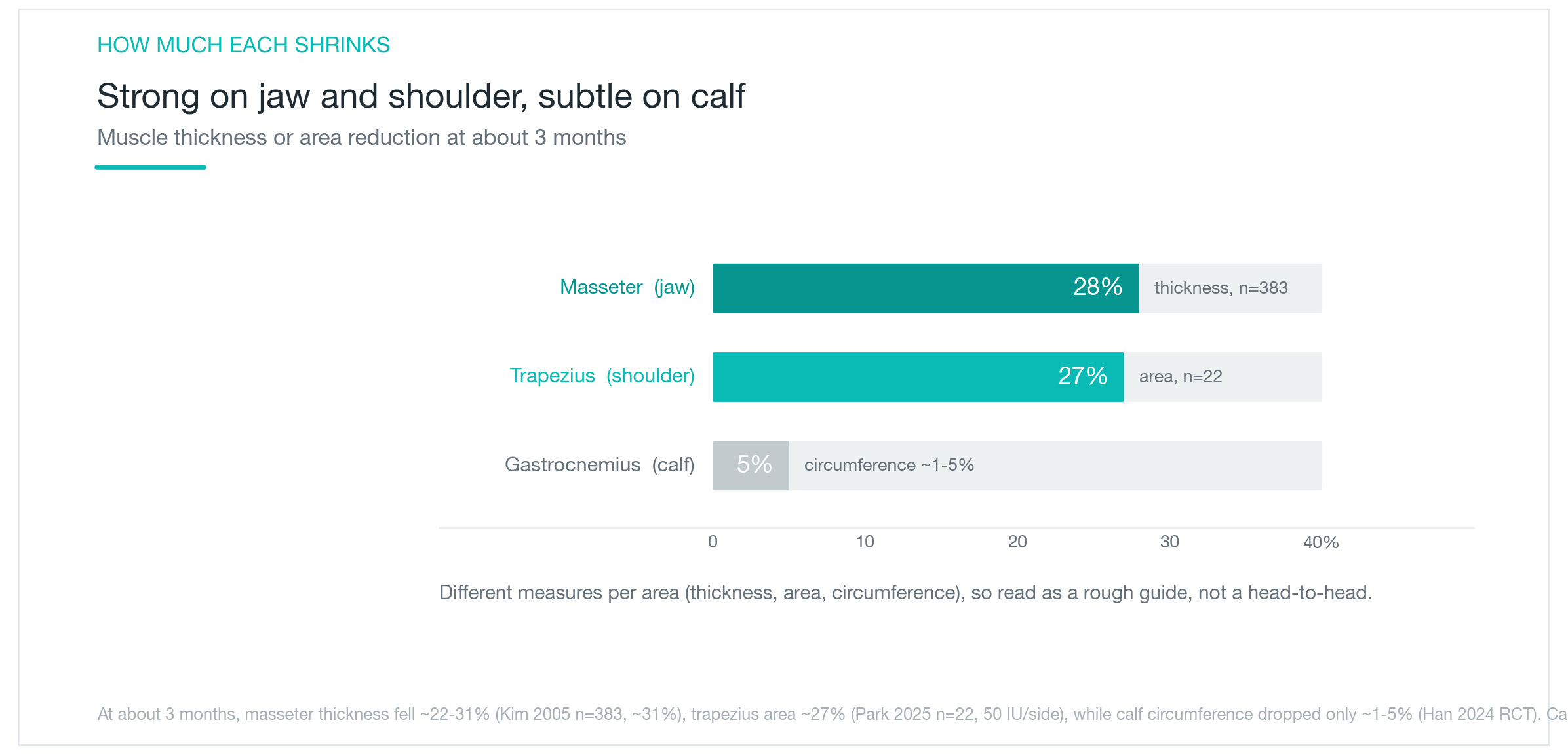
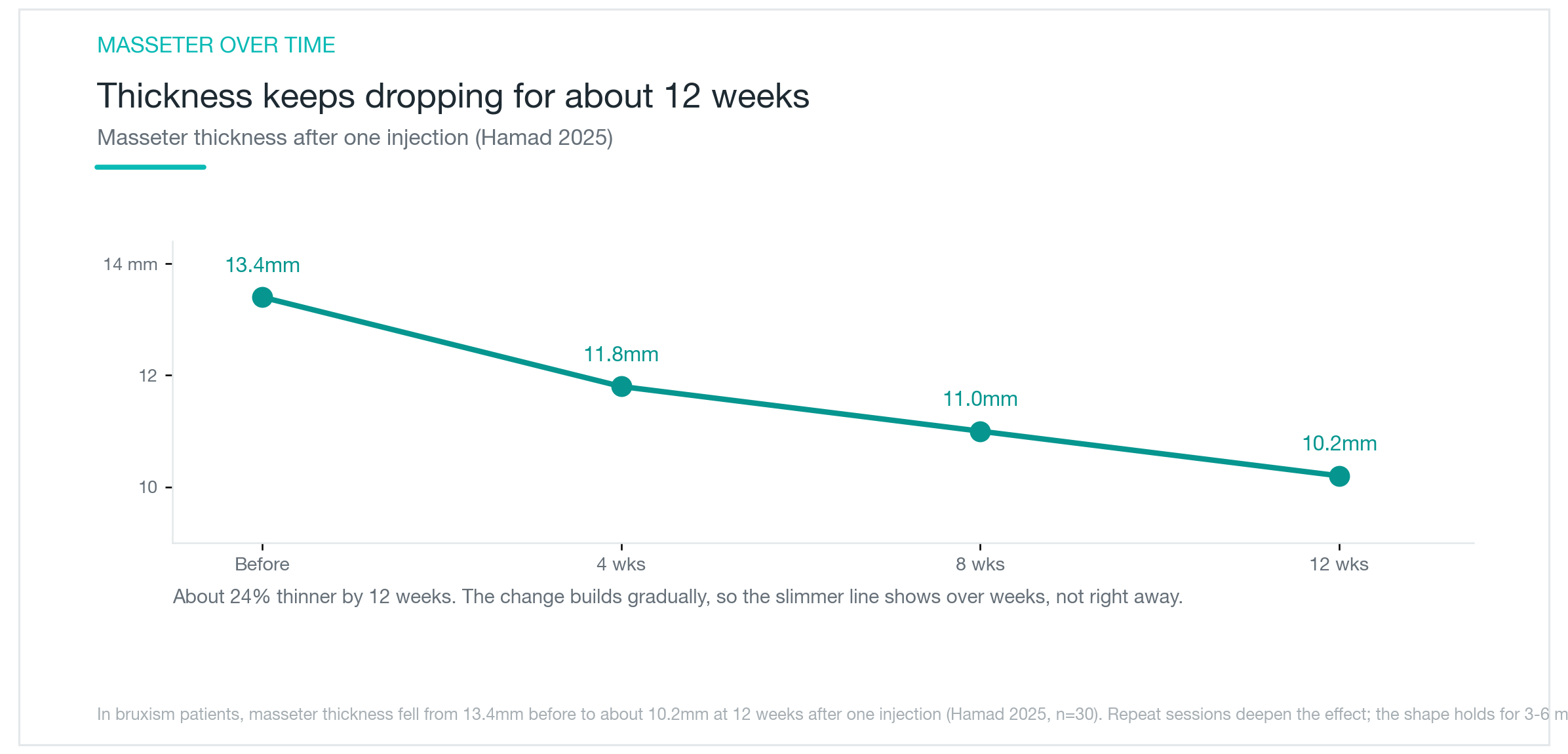
The numbers are encouraging. Pooled across multiple studies, masseter thickness decreases by roughly 22 to 31 percent at 3 months after a single treatment. One large analysis of 383 patients reported an average reduction of 31 percent, and a 12-week study in bruxism patients documented a thinning from 13.4 mm to 10.2 mm. Repeated sessions produce even greater reduction.
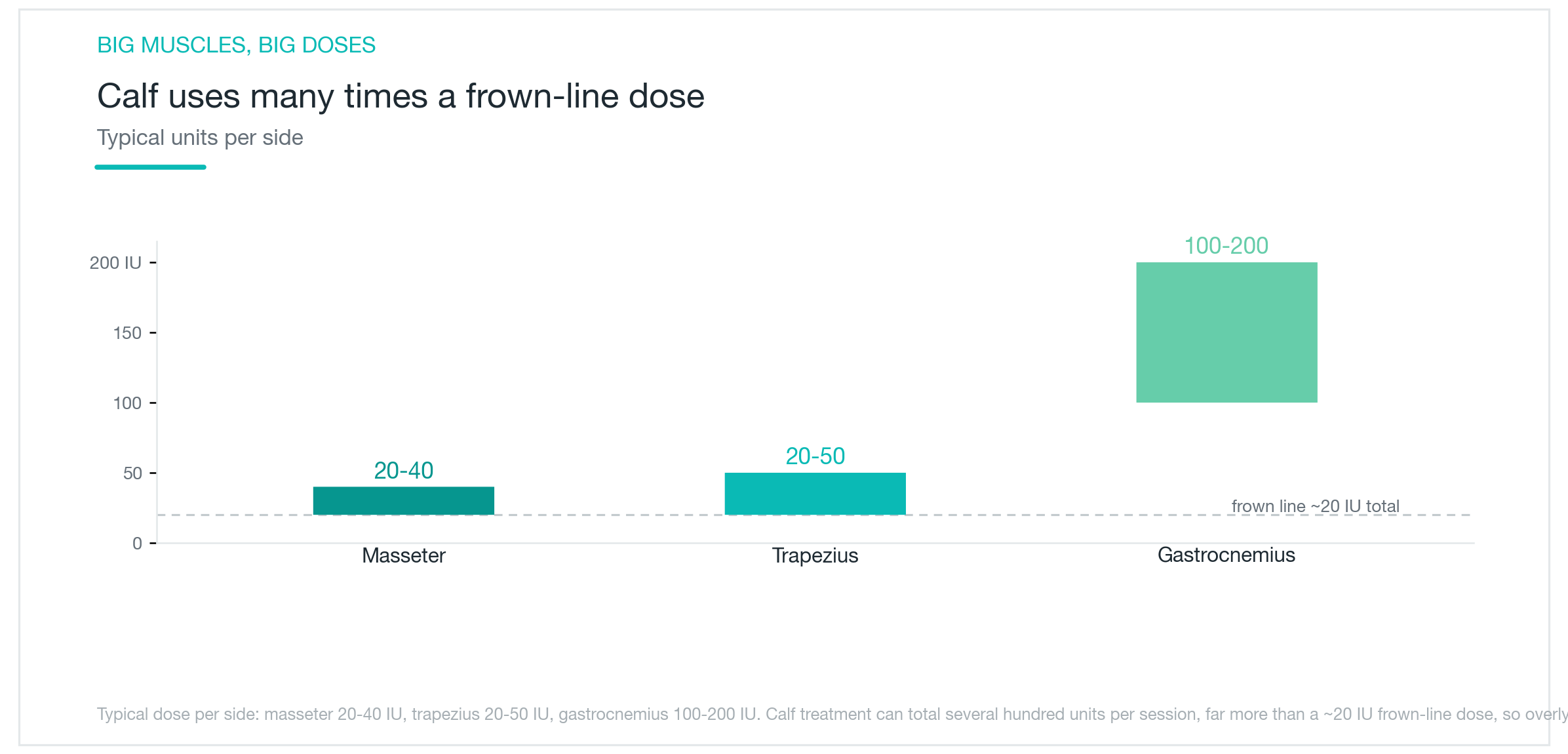
Chewing function holds up well. Studies using standard doses of 20 to 40 units per side consistently show no meaningful change in bite strength. One thing to watch is injection placement: if the needle goes too high on the masseter, the toxin can spread to muscles involved in smiling and cause a subtle asymmetry in expression. Accurate positioning makes all the difference. Effects last 3 to 6 months, and a typical maintenance schedule involves 2 to 4 sessions per year. Because masseter botox is so widely practiced, practitioners have accumulated extensive experience with it, making it one of the more reassuring procedures in this group.
Does trapezius Botox help with stiffness too?
The trapezius connects the neck and shoulders. When it is thick and elevated, the shoulders appear raised and the neck looks shorter. Trapezius botox relaxes this muscle to lower the shoulder line and visually lengthen the neck.
The evidence is smaller in scale than for the jaw but points clearly in the right direction. In a study of 22 participants treated with 50 units per side, the upper trapezius cross-sectional area decreased by about 27 percent at 3 months, and the neck-to-shoulder angle became more gradual. Many patients also report reduced shoulder tension and fewer tension headaches as an added bonus. Standard dosing is 20 to 50 units per side, and effects typically last 4 to 5 months.
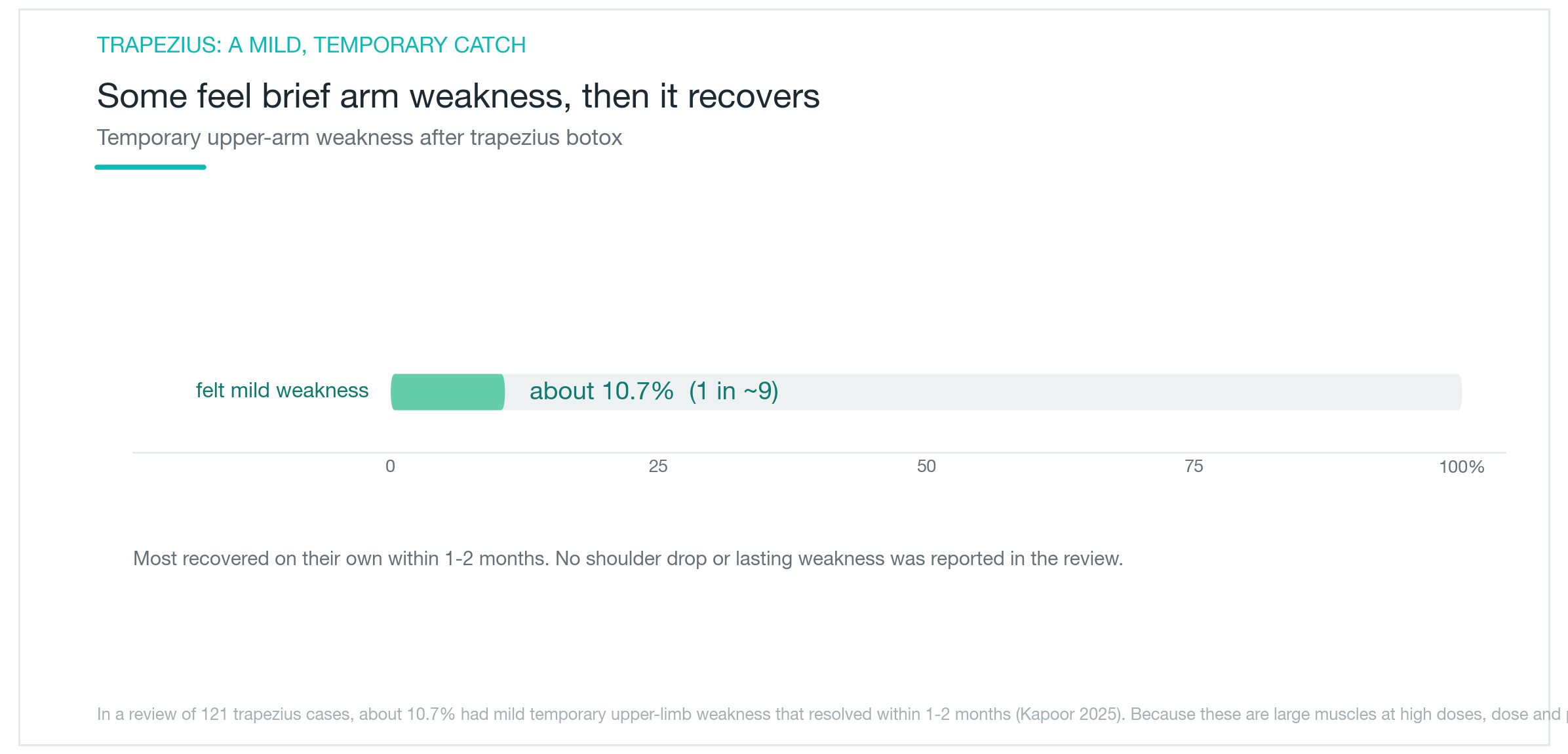
There is one side effect worth knowing in advance. The trapezius is also involved in lifting the arm and shrugging the shoulder, so mild upper-arm weakness can occur in the first month or two after treatment. One dataset found this in roughly 1 in 10 patients, and it resolved on its own within 1 to 2 months in the vast majority of cases. If you regularly do overhead lifting or heavy resistance training, bring this up at your consultation. For people hoping to address both shoulder shape and chronic tightness, trapezius botox can be particularly rewarding.
How much effect does calf Botox give?
Calf botox targets the gastrocnemius muscle in cases where muscle bulk is the main driver of the fullness. Of the three areas, this has the thinnest evidence base, so expectations should be set realistically.
In a randomized controlled study, calf circumference decreased by about 0.48 cm. That is more of a subtle, smoothed appearance than a dramatic visible change. Interestingly, increasing the dose did not produce a proportionally larger reduction, and the effect lasted 6 to 8 months, longer than the other two areas. Because the gastrocnemius is large, doses of 100 to 200 units per side are typical, meaning several hundred total units for both legs in a single session.
Current data show no meaningful change in walking function, which is reassuring. That said, the calves are essential for standing, walking, and running, and the doses involved are high, so if you are an active runner or hiker, a careful discussion beforehand is wise. A modest improvement in overall leg line is the most realistic goal, and starting with a lower dose to gauge your response is the safer approach. Confirming that the bulk is genuinely muscle-driven before committing is the best first step.
Side effects and precautions by area
The reason side effects vary across these three areas comes down to muscle size and function. Unlike facial botox, where small doses go into tiny expression muscles, these sites involve large muscles and much higher volumes.
A few things are worth keeping in mind. First, functional impact: the masseter is involved in chewing, the trapezius in lifting the arm, and the gastrocnemius in walking. At appropriate doses, most people notice no meaningful change, but excess doses or inaccurate placement can cause temporary weakness. Second, dosing scale and resistance: the calves can require several hundred units combined for both sides, more than 10 times the dose used for glabellar lines. Repeated high-dose treatments can, in rare cases, lead to antibody formation against the toxin, which gradually reduces effectiveness. Keeping treatments properly spaced and using only the dose that is needed helps avoid this.
Third, there is no dissolving injection for botox. Unlike hyaluronic acid filler, there is no antidote, so if you are unhappy with the outcome, you simply wait for it to wear off. Starting conservatively and adjusting upward over sessions is the sensible approach. All of these judgment calls depend heavily on area-specific experience, which is why choosing a practitioner who has worked extensively with each site matters most. Most side effects are temporary and self-resolving, and starting at the right dose from the beginning is the most reliable way to keep the experience smooth.
Which treatment fits a contour caused by muscle?
Area-specific botox works best for contour concerns driven by muscle volume. A square jaw caused by a large masseter, raised shoulders from a thick trapezius, and full calves from a prominent gastrocnemius are all strong indications.
Identifying the cause first is important. If jaw width comes from bone or calf size from fat rather than muscle, botox alone will not deliver full results. A consultation to confirm that muscle volume is the main factor is the right starting point. When muscle is the driver, consistent treatment at the right dose tends to produce high satisfaction over time.
Results last 3 to 8 months depending on the area, and maintenance sessions are needed to hold the change. The right approach is gradual, natural refinement rather than expecting a single dramatic transformation. Pairing that mindset with a practitioner experienced in area-specific dosing and placement leads to safe, satisfying outcomes. For high-dose areas like the calves, spacing sessions well rather than repeating too frequently is the smarter long-term strategy. Each area calls for its own dosing logic, and matching that logic to your specific concern is where good results begin.
Was this helpful?
About this article
Written by a practising aesthetic physician and intended for general education — not a substitute for individual medical advice.
Read next

Pebbled Chin Botox: Results, How Long It Lasts, Dosage, and Side Effects
Chin botox (mentalis botox) smooths out the pebbled, orange-peel texture that shows up on an overactive chin. Here's how relaxing the mentalis muscle evens out the skin, the typical dose and injection points, when results appear and how long they last, how this differs from a weak or protruding chin, and the side effects worth knowing about, all backed by real evidence.
By Dr. Kim
Crow's Feet Botox: Effects, Duration and Dose
A clear look at how crow's feet Botox works. It eases the orbicularis oculi muscle that creases the outer eye corner when you smile, softening the lines it leaves behind. This guide covers the standard 24-unit dose split across both sides, where the injections go, when results show up, the roughly four-month duration, the limits for deep static wrinkles, and side effects, all backed by real clinical study numbers.
By Dr. Kim
Under-Eye Hollow Filler: Effect and Side Effects, and the Tyndall Effect to Watch
The dark, sunken look under the eyes often comes less from pigment than from hollowing and the shadow it casts. Here's how the tear trough ligament and lost volume under the eye create that shadow, how a soft hyaluronic acid filler placed shallowly and sparingly smooths it out, why thin skin and the bluish Tyndall effect make this area tricky, and how long results actually last, all backed by real published numbers.
By Dr. Kim