Belotero Types and Differences: Under-Eye Filler Duration and Side Effects
By Dr. Kim11 min read

If you've been researching fillers, you've probably come across Belotero. What's confusing is the range of names that follow it: Soft, Balance, Intense, Volume. Each one sounds slightly different, and it's easy to wonder what any of them mean or which would actually apply to your concern. And then there's the claim that it can be used under the eyes, which raises the obvious question of whether that's really safe.
The short answer: Belotero is not a single product. It's a family of hyaluronic acid fillers made by the German company Merz, each formulated with different firmness and HA concentration for a different face zone. The defining feature of the entire family is a proprietary manufacturing method called CPM, which allows the gel to integrate smoothly into surrounding tissue rather than sitting as a discrete mass. That property is what makes it particularly relevant for thin, sensitive areas like the under-eye. Below is a breakdown of what Belotero is, how the product lines differ, why CPM matters, what to expect from treatment, and where the real safety considerations lie.
What kind of filler is Belotero?
Belotero is a hyaluronic acid filler made by German company Merz. Hyaluronic acid, commonly abbreviated HA, is a molecule that occurs naturally in the skin. It binds water and keeps tissue plump and hydrated. As we age, HA levels decline and skin loses volume, leading to lines and hollows. In filler form, HA is processed into a gel and injected directly into those areas to restore fullness right away. The result is visible the same day, which sets it apart from treatments like Sculptra or Radiesse that stimulate collagen over several months.
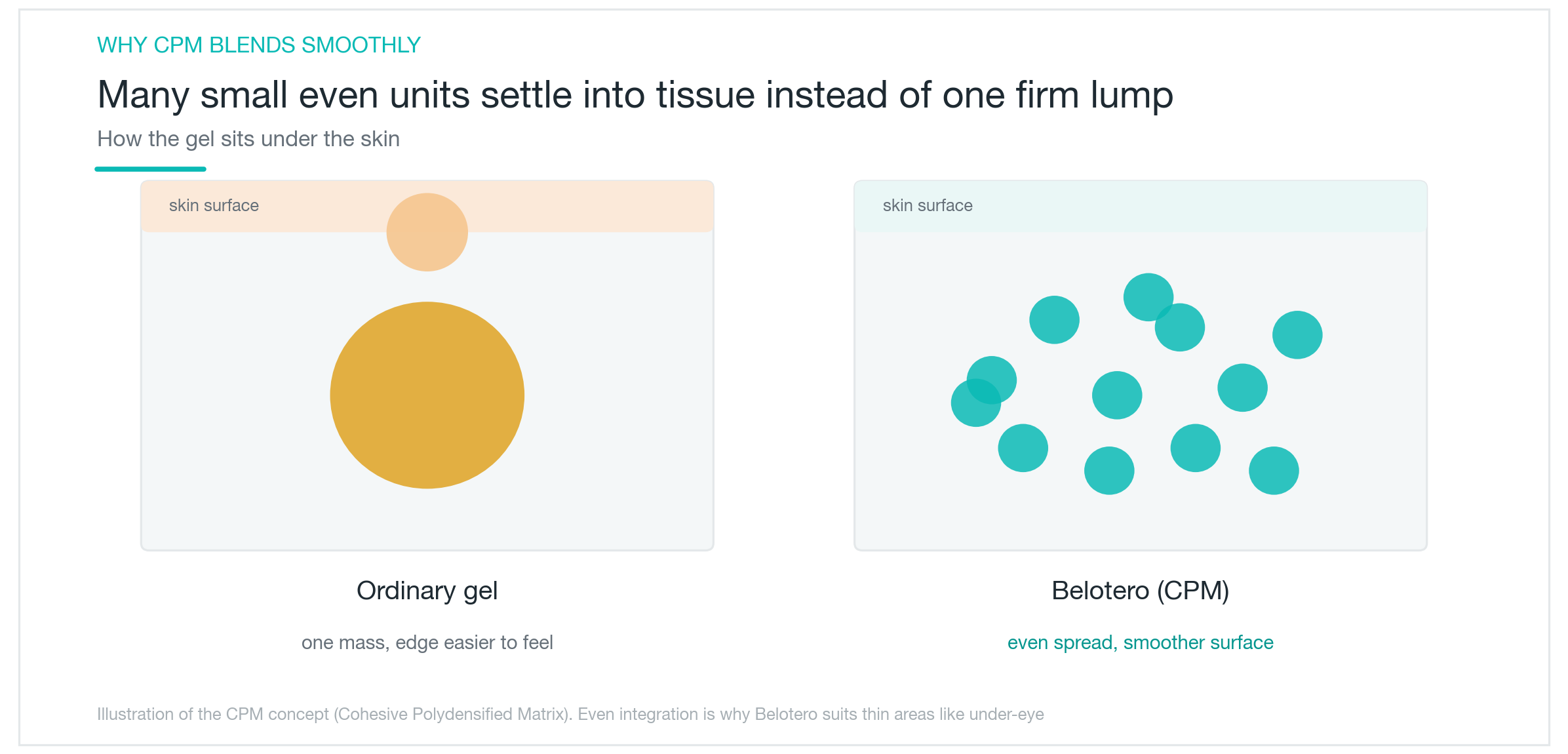
That part is similar to other HA fillers. What sets Belotero apart is how the gel is made. Pure HA breaks down quickly in the body, so the chains are cross-linked to make them last longer. Most fillers cross-link HA chains uniformly. Belotero uses a technology called CPM, Cohesive Polydensified Matrix, to create a gel in which densely cross-linked and loosely cross-linked regions coexist within the same matrix. The practical effect is that the gel does not behave as a single cohesive mass. Instead, it spreads and integrates into the surrounding tissue the way water absorbs into fabric. The result is smoother borders and less palpable texture under the skin.
One more point worth knowing: because Belotero is an HA filler, it is reversible. If the result is unwanted or a complication arises, a clinician can inject hyaluronidase, the enzyme that dissolves HA, to break the filler down. This reversibility is the core safety advantage that HA fillers hold over permanent or non-dissolvable alternatives.
How do the Belotero types differ?
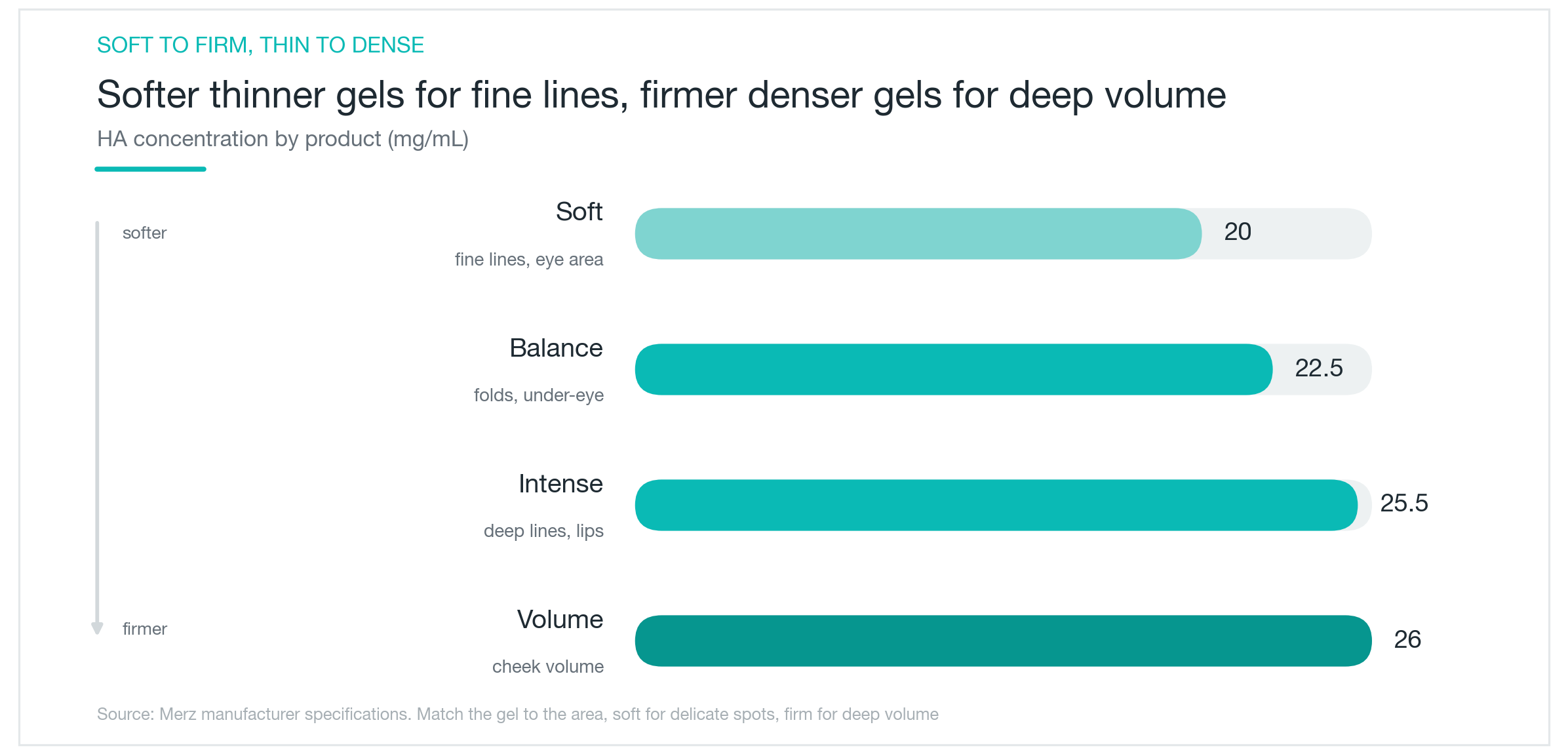
Different areas of the face require different properties. Fine, shallow lines need a soft, low-viscosity gel. Deep folds and volume loss need something firmer and denser. The Belotero family covers that range with four main products formulated specifically for different depths and applications.
The four most commonly used products, compared:
| Soft | Balance | Intense | Volume | |
|---|---|---|---|---|
| HA concentration | 20mg/mL | 22.5mg/mL | 25.5mg/mL | 26mg/mL |
| Firmness | Softest | Medium | Firm | Firmest |
| Injection depth | Superficial dermis | Mid dermis | Deep dermis | Deep, supraperiosteal |
| Primary areas | Fine lines, crow's feet | Nasolabial folds, under eye | Deep lines, lips | Cheeks, cheekbone volume |
As the table shows, HA concentration and firmness increase from Soft to Volume. Soft is designed for shallow, delicate work like crow's feet. Balance sits in the middle and handles nasolabial folds and under-eye hollows. Intense is appropriate for deeper lines and lips. Volume, the firmest product, is used for structural volume in the cheeks and cheekbones.
The principle is consistent: softer products go shallower for subtle refinement, firmer products go deeper for structural volume. Using a volume-grade product in a fine superficial line would feel hard and look unnatural. Using a soft product to fill sunken cheeks means it disappears quickly and provides little support. Getting the product-to-area match right is one of the primary variables that separates a natural-looking result from an off one, and it is a decision that rests entirely with the treating clinician.
A few more details are worth knowing. Lidocaine-formulated versions of each product are available for pain reduction during injection. These are generally labelled with "Lidocaine" or a plus sign on the product name. If you're sensitive to pain, it's worth asking in advance. Merz also makes skinbooster-type products under the Belotero brand, such as Hydro and Revive, which are intended for overall hydration and skin texture rather than volumizing or line correction. Those sit in a different category from the four filler products described above.
Can Belotero be used under the eyes?
The under-eye area is one of the most frequently cited uses for Belotero, particularly Balance. It's also one of the most technically demanding zones on the face. The skin there is very thin, the tissue beneath it is delicate, and blood vessels run close to the surface. In that context, the wrong filler or technique can produce visible lumping under the skin or, worse, the Tyndall effect: a bluish discoloration that appears when filler sits close enough to the surface for light to scatter through it. Once that happens, it's difficult to conceal with makeup and distracting at close range.
CPM is the reason Belotero is frequently selected for this area. Because the gel integrates into surrounding tissue rather than sitting as a mass, it tends to produce smoother contours with less visible border definition and lower Tyndall risk than conventional gels placed at the same depth. In the United States, Belotero Balance has received FDA clearance specifically for the treatment of under-eye hollows, a distinction that carries weight because few HA fillers have earned regulatory approval for that specific indication.
That said, a few honest caveats are worth keeping in mind. CPM makes Belotero comparatively well suited to the under eye; it does not make the under eye easy. Any filler in that zone carries real risk if placed in excessive quantity or at the wrong depth. Swelling and lumpiness can result from small volume errors. The area also has active vasculature, making vascular occlusion a genuine concern. Before treatment, it's worth establishing whether the hollow is actually a volume deficit that filler will address, or whether the appearance is driven by lower-lid fat prolapse, in which case adding volume beneath it can make the area look puffier rather than better. Under-eye treatment should be approached with small quantities and a conservative hand. The good news is that HA fillers can be dissolved with hyaluronidase if something goes wrong.
When do Belotero results appear?
The effect is real. Volume appears the same day as treatment. The final result settles in around 1 to 2 weeks once post-injection swelling resolves. When done well, the result looks like restored facial structure rather than something added on top, and CPM's smooth tissue integration contributes to that quality by reducing visible borders and palpable texture.
Whether it looks natural comes down primarily to how much product is used and where. Overfilling at any site results in an unnatural, overdone appearance. The safer approach is to start conservatively and assess. Adding more at a follow-up is straightforward. Dialing back a result that has too much product is considerably harder. Starting on the lower end of what seems necessary is a routine principle among experienced injectors for exactly this reason.
Product-to-area matching matters as much as volume calibration. A firm product like Volume placed in a high-movement area like the lips will feel unnatural and lumpy. A soft product like Soft placed in a sunken cheek will have minimal structural impact and absorb quickly. Even within the same family, using the wrong Belotero line for the wrong application produces a noticeably worse outcome.
One more point: filler restores volume. It does not lift sagging tissue. Attempting to address significant ptosis purely with filler tends to add bulk rather than elevation, which can look heavier rather than refreshed. For concerns that are more about laxity than volume, a lifting treatment is the more appropriate primary intervention. Filler and lifting often complement each other, but they address different problems.
Treatment time and how long it lasts
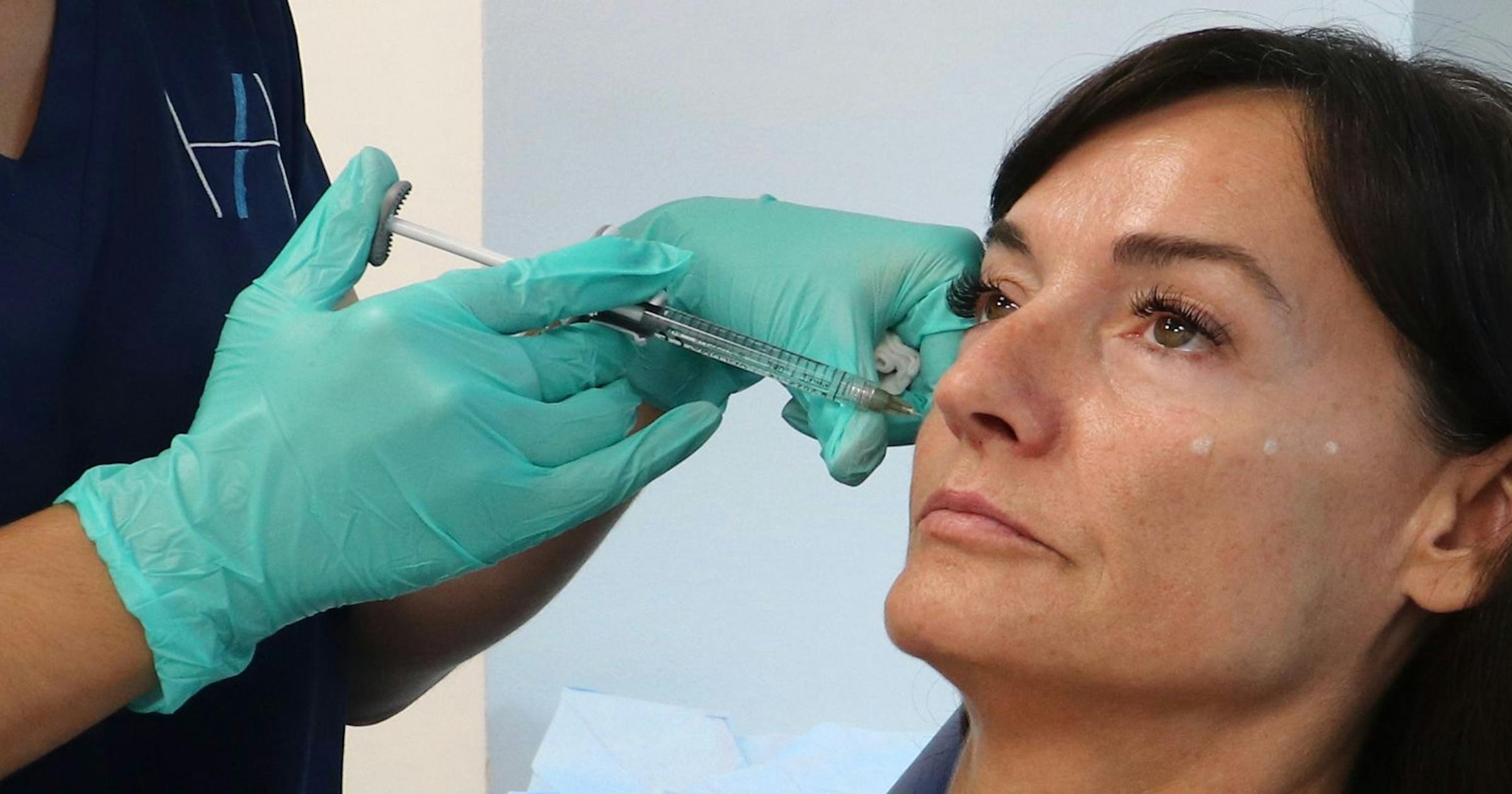
Treatment is typically brief. Topical anesthetic cream is applied first, or the lidocaine-containing version of the product is used directly to reduce discomfort. The filler is then placed using either a fine needle or a cannula, which is a blunt-tipped flexible tube. Needles allow precise, targeted placement. Cannulas enter through a single entry point and can distribute filler across a broader area with a single insertion, which tends to reduce bruising and lower the risk of vascular injury. The under-eye area and other vascular-dense zones are often treated with a cannula for that reason. The session itself typically takes 10 to 20 minutes depending on the area, and most patients return to normal activity immediately after.
Downtime is generally mild. Redness, swelling, and bruising are common immediately after injection and typically resolve within a few days to 2 weeks. If bruising is a concern, it's sensible to schedule treatment at least a week ahead of any important commitments.
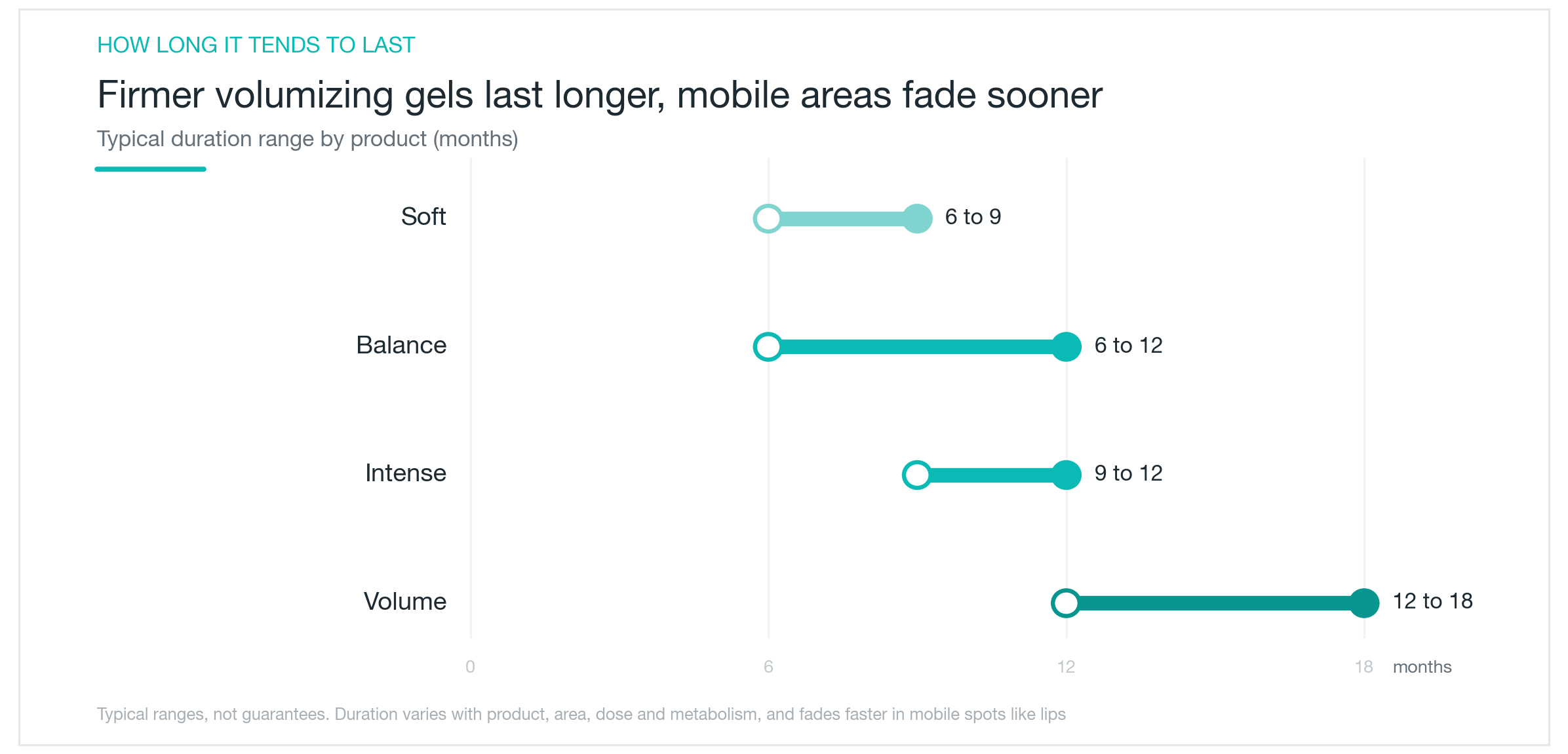
How long results last depends on the product and the area. Soft typically lasts around 6 to 9 months. Balance lasts approximately 6 to 12 months. Intense holds for roughly 9 to 12 months. Volume, the firmest product, generally lasts 12 to 18 months. These figures represent typical averages rather than guaranteed minimums. High-movement areas like the lips wear down faster than structural zones like the cheeks. Individuals with higher metabolic rates or lower body fat often absorb filler more quickly as well.
The implication is that Belotero is a maintenance treatment, not a one-time correction. It helps to think of it as a repeating cycle of 6 to 18 months, depending on the product and area, rather than expecting permanence. When estimating cost, factor in the frequency of upkeep over time rather than just the initial session.
Side effects and who should avoid it
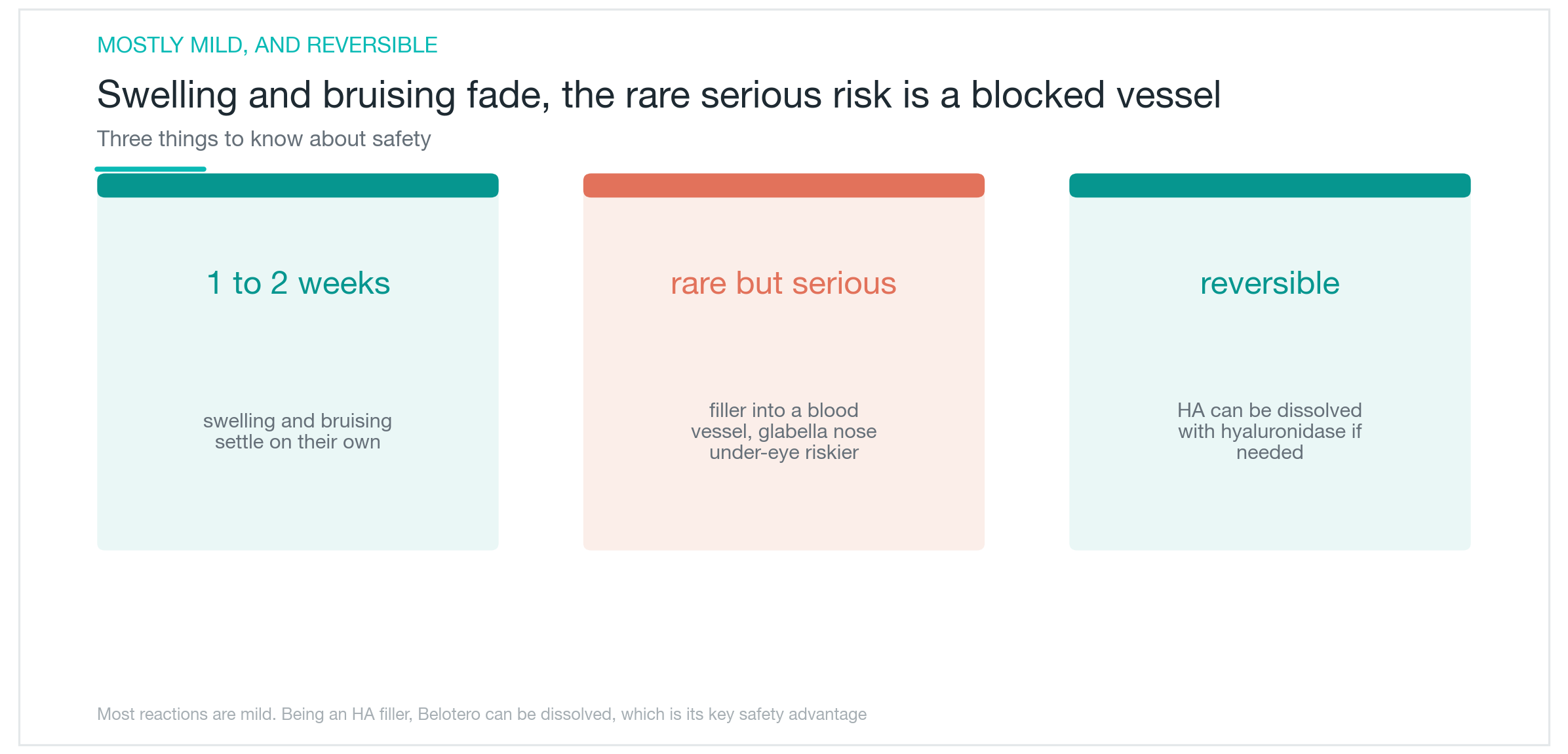
Most side effects are minor. Swelling, bruising, and firmness at the injection site in the days following treatment are expected and typically resolve within 1 to 2 weeks. Occasionally a small nodule forms at the injection point; most of these resolve on their own over time or respond to gentle massage. In rare cases, delayed nodules can appear weeks to months after treatment, sometimes triggered by immune activation from illness or other procedures. These generally respond to treatment.
The serious risk, though rare, is vascular occlusion: filler accidentally injected into or compressing a blood vessel, cutting off local circulation. In severe cases this leads to skin necrosis. In extremely rare cases it can affect vision. Areas with more complex vascular anatomy, including the glabella, nose, and under eye, carry higher risk and require a more technically cautious approach.
Two things follow from that risk. First, treatment should be performed by a clinician with thorough knowledge of facial vascular anatomy. Second, hyaluronidase should be immediately on hand at the clinic so that a vascular event can be addressed in real time. The dissolvability of HA fillers is not just a cosmetic convenience; it is the core safety mechanism that allows rapid intervention if something goes wrong.
Belotero is not appropriate during pregnancy or breastfeeding, for anyone with a known sensitivity to hyaluronic acid, or if there is active inflammation or infection in the treatment area. Anyone with autoimmune conditions or a history of persistent nodule formation should discuss their history with the clinician before proceeding.
To summarize: Belotero is an HA filler family that uses CPM technology to integrate smoothly into tissue, making it a particularly considered option for thin or delicate areas like the under eye. It covers a range from fine superficial lines to deep structural volume depending on which product is selected. Results are visible the same day, reversible if needed, and most natural when the right product is placed in the right area in conservative amounts by a clinician who knows the anatomy.
Was this helpful?
About this article
Written by a practising aesthetic physician and intended for general education — not a substitute for individual medical advice.
Read next
Restylane Types and Results: How Long They Last and Side Effects
A clear breakdown of what Restylane is, how NASHA and OBT technology differ, which products go where across Lyft, Defyne, Refyne, Kysse, and Contour, and what the honest safety picture looks like, including how to reverse it with hyaluronidase.
By Dr. Lee
Juvederm Filler Types Compared: Voluma and Volbella Duration
A clear breakdown of what Juvederm is, why there are so many lines (Voluma, Volux, Volbella, Volift, and more), which product goes where, how long each one lasts, and what the real safety picture looks like, including how to reverse it if something goes wrong.
By Dr. Lee

Juvelook and Sculptra Differences: When Effects Appear and Lump Side Effects Compared
Juvelook is a collagen-stimulating filler that combines PDLLA with HA, while Sculptra is made purely of PLLA. Here is a verified breakdown of how they differ in immediate volume, collagen-stimulating mechanism, duration, and evidence level.
By Dr. Lee