Bakuchiol: Effects, Differences From Retinol, Irritation and How to Use It
By Dr. Kim7 min read
Bakuchiol has been showing up on ingredient lists a lot more often in the past few years. It is usually marketed as a "natural retinol," but bakuchiol is actually a completely different molecule from retinol, structurally speaking. And yet, in skin, it produces changes that move in a strikingly similar direction. That contradiction is exactly what makes bakuchiol worth a closer look.
A different structure producing a similar effect sounds like it shouldn't work. But from the perspective of a skin cell, it's not that strange. Think of it like two differently shaped keys that both end up opening the same lock, just through different mechanisms. Here's a closer look at how bakuchiol reaches retinol-like results, and why it's known to be milder on skin.
What kind of ingredient is bakuchiol?
Bakuchiol is extracted from the seeds and leaves of Psoralea corylifolia, a legume plant known in Korean as gaeamhul. This plant has long been used as a medicinal herb in India and China, so bakuchiol itself started out as a substance studied in traditional medicine rather than modern skincare.
Its rise as a cosmetic ingredient is fairly recent. While researchers were running large-scale comparisons of how various plant extracts affect skin gene activity, they noticed that skin cells treated with bakuchiol showed a response pattern that overlapped remarkably with cells treated with retinol. In other words, bakuchiol was essentially discovered by accident, as a retinol lookalike.
It's structurally different from retinol, so are the effects similar?
Retinol belongs to the vitamin A family. Chemically, it falls under a group called retinoids, and bakuchiol has no structural relationship to that group at all. It belongs instead to a class called meroterpenes. In simple terms, the two ingredients come from entirely different chemical families, with no shared ancestry whatsoever.
Even so, when you examine skin cells treated with each ingredient, a large portion of the genes that get switched on or off overlap. In particular, both ingredients were found to similarly increase the genes responsible for producing type 1 and type 4 collagen, the proteins that support the skin's structure. It is as if they took two entirely different roads and still arrived at the same destination.
How does it work without going through the receptor?
Retinol itself doesn't bind directly to a receptor. Inside skin cells, it first has to convert into retinaldehyde, then into retinoic acid, before it can attach to a protein called the retinoic acid receptor (RAR) and start regulating gene expression. Think of the receptor as a lock, and the retinoic acid that retinol eventually becomes as the key that happens to fit it.
Bakuchiol, on the other hand, doesn't go through this conversion process, and it is known not to bind directly to that receptor either. Yet the final outcome inside the cell, the signal to produce more collagen and the signal to clear out damaged tissue, ends up looking similar to what happens with retinol. It's less like using the same key on the lock and more like taking a detour through a completely different route to reach the same room. That's the reasoning behind calling bakuchiol a "retinol-like" ingredient.
Is it really less irritating than retinol?
Retinol's tendency to irritate skin is largely tied to this receptor-binding mechanism. When retinoic acid, the converted form of retinol, binds tightly to the receptor, it speeds up skin cell turnover, meaning old dead skin cells shed faster and new cells rise to the surface more quickly. When that speed increases too abruptly, the skin barrier doesn't have time to adjust, and redness or flaking can follow.
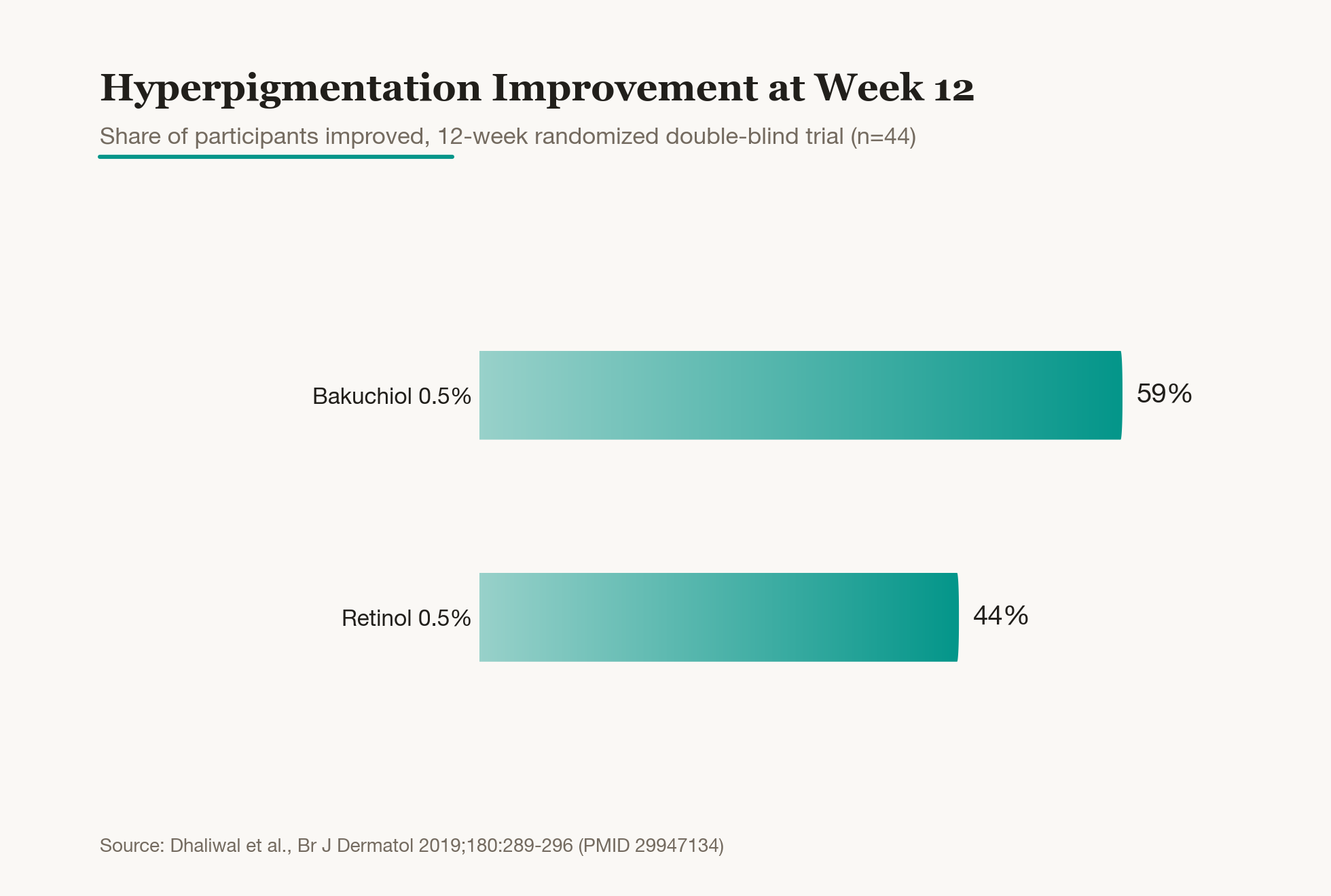
Because bakuchiol doesn't rely on this receptor-binding route, the acceleration in turnover tends to be milder than what retinol produces. That's reported to translate into noticeably less redness, flaking, and stinging. In a randomized comparative clinical trial published in 2019, participants applied bakuchiol twice daily and retinol once daily for 12 weeks. The improvement in wrinkles and pigmentation ended up fairly similar between the two, while flaking and stinging were reported more often in the retinol group.
That doesn't mean bakuchiol is completely without irritation, though. Any new ingredient applied to skin for the first time can cause mild reactions in some people, so it's a good idea to start with a small amount when trying it for the first time. And milder irritation doesn't mean weaker results. If anything, because it's easier on the skin, more people end up sticking with it consistently, and that consistency is often what drives the outcome.
When do collagen and wrinkles change?
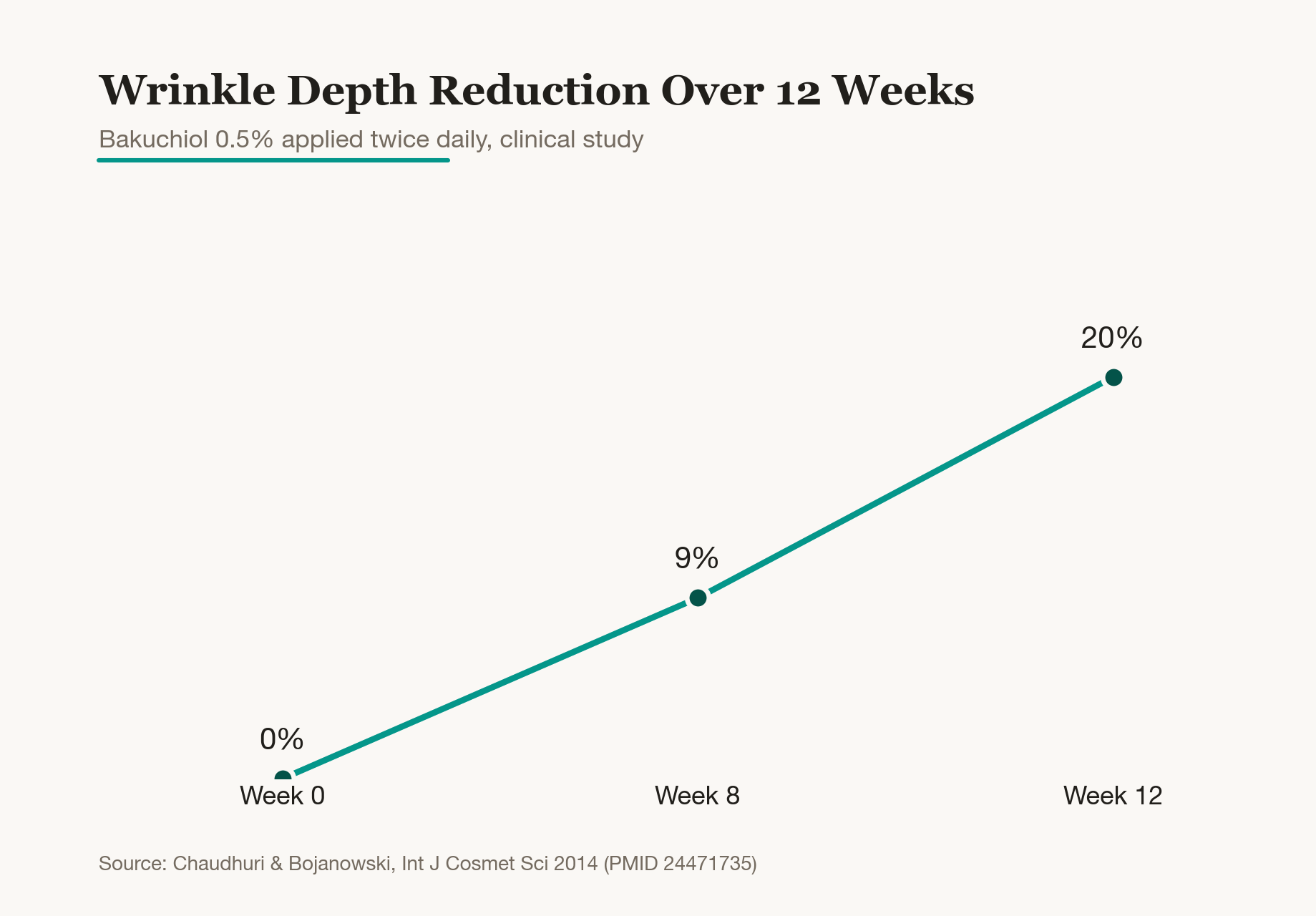
Collagen is like a pillar that supports the skin from underneath. As we age, that pillar gradually shrinks, and the skin thins and develops wrinkles. Bakuchiol stimulates fibroblasts, the cells inside the skin responsible for producing collagen, prompting them to weave new collagen fibers.
At the same time, it's known to also regulate the activity of enzymes that break down old or UV-damaged collagen. For the skin's texture to actually smooth out, the pace of clearing out the old structure and the pace of building new structure need to move together. It's a bit like stripping old wallpaper while putting up new wallpaper at the same time, rather than doing one after the other.
The improvement in pigmentation is explained through a similar mechanism. As cell turnover picks up moderately, melanin pigment that had built up in the epidermis gets cleared out along with it, which is reported to gradually fade spots and discoloration. That said, this effect takes time to show up. Consistent use for roughly 8 to 12 weeks is generally needed before a noticeable change appears.
How to use bakuchiol and what to watch for
Because bakuchiol tends to cause less irritation, many products are formulated for twice-daily use, morning and night. Retinol, by contrast, is usually recommended for evening use only, and even then starting at a low concentration and building up gradually. That difference alone says a lot about how the two ingredients compare in terms of irritation.
A few practical points worth keeping in mind:
- Sunscreen is essential during the day, no exceptions. Ingredients that speed up turnover can leave freshly surfaced skin more sensitive to UV exposure, so sunscreen in the morning is a must.
- Be careful about layering it with other exfoliating ingredients. Combining it with exfoliants like AHA or BHA can add up to more irritation, so it's safer to start by alternating days rather than using both every day.
- Pairing with niacinamide tends to work well. Niacinamide is known for reinforcing the skin barrier, and it can help ease any mild irritation that might come up while using bakuchiol.
- Give it at least 8 weeks before judging the results. Since it takes time for new collagen to settle in, it's more accurate to stick with it for two to three months rather than deciding after just a few days that it isn't working.
Can it fully replace retinol?
Bakuchiol produces effects in a similar direction to retinol, but the two aren't identical on every front. Retinol has decades of accumulated research and real-world use behind it, while bakuchiol's research history is comparatively short. That's why retinol still tends to be the more widely used option for cases that call for a stronger effect, like very deep wrinkles or severe photoaging.
That said, for anyone whose skin turns red and flaky every time they try retinol, bakuchiol can be a reasonable alternative. It offers a way to keep working toward more collagen while dialing down the irritation. In the end, whichever one you choose, the same principle holds. Using it consistently, alongside daily sunscreen, is the single most important factor that determines results with either ingredient.
References
Korean Dermatological Association, American Academy of Dermatology (AAD), and Ministry of Food and Drug Safety (MFDS).
Was this helpful?
About this article
Written by a practising aesthetic physician and intended for general education — not a substitute for individual medical advice.
Read next

Pink Peel: Results, How It Works, Aftercare, and Number of Sessions
Pink Peel is a low-irritation peel that uses isoflavones from fermented kudzu extract to refine texture while encouraging collagen renewal deep in the skin. Because it relies on mild plant-based compounds rather than harsh acids, even sensitive skin can generally tolerate it. Here is how the ingredient actually works, how it differs from a typical peel, and how to care for skin afterward.
By Dr. Kim
CELLREDM and Re2O: Differences and How Long Their Effects Last
CELLREDM delivers human-derived extracellular matrix directly into the dermis rather than waiting on collagen stimulation. An honest clinical breakdown of its ECM composition, the phADM split-face trial data (Lee YI et al., IJMS 2026), how it compares to Re2O, and who is genuinely a good candidate.
By Dr. Lee
Acrief Acne Cream: Effects, Early Irritation and Back Acne Use
A clear look at what Acrief is, how trifarotene 0.005% cream differs from Differin, whether it genuinely works on trunk acne as well as the face, what the clinical trials show about timeline and irritation, and how to apply it correctly.
By Dr. Lee