Aquapeel: Effects, Pain and How Often to Treat Pore Oil
By Dr. Kim8 min read
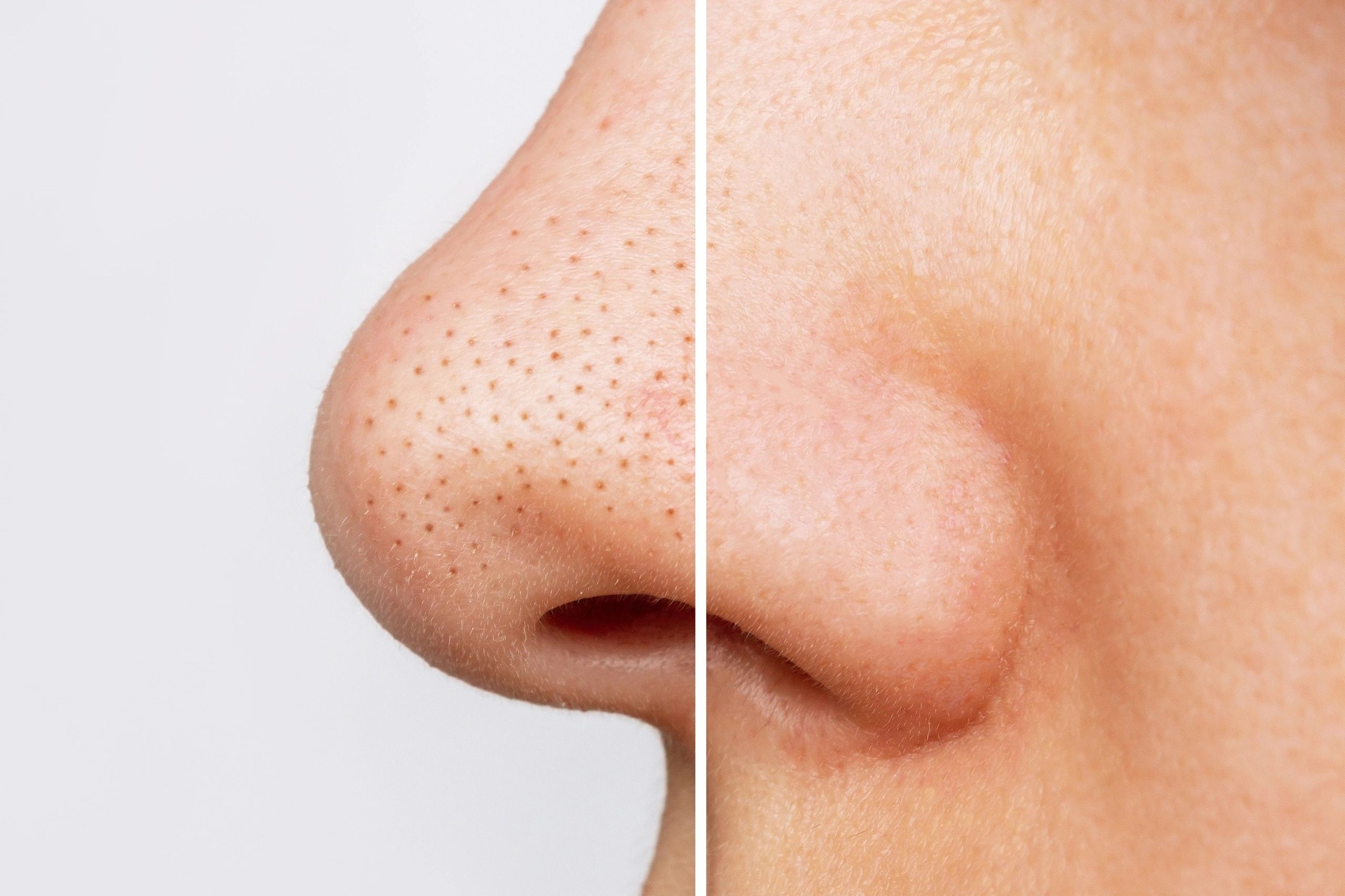
Lean in close to the mirror and sometimes you'll spot small dark dots packed into your nose or cheeks. Squeezing them out by hand risks leaving a mark, and scrubbing with a rough exfoliant feels like it might just sting your skin. The area around the nose is especially bad about this since the oil glands cluster there, so no matter how carefully you wash your face, a dull, congested look creeps back before long. This is exactly the problem aquapeel is built to solve.
True to its name, aquapeel relies on the power of water to clear away dead skin and sebum. There's no squeezing by hand and no scraping with a blade, just water and vacuum suction working together to draw debris out of the pores. So what exactly happens during the process that makes this kind of cleanout possible without irritation? Let's walk through it step by step.
It helps to start with why pores clog in the first place. Oil glands produce sebum all day long, and as that oil tangles together with old dead skin cells, the pore opening gradually narrows. Add in dust and leftover makeup, and the mix hardens into the visible dark dot known as a blackhead.
Why does water-softened dead skin come off easily?
Dead skin cells naturally clump together and sit firmly on the skin's surface. Scrape that off by force and you'll likely take healthy skin along with it, which is exactly what triggers irritation.
Water changes things completely. Think about how your fingertips turn pale and wrinkly after soaking in the bathtub for a while. Dead skin cells work the same way. Once they soak up water, they swell, and the bonds holding them together weaken.
This is the exact principle an aquapeel device relies on. A mildly acidic solution flows continuously from the tip onto the skin's surface, gradually softening the dead skin. Once the stiff, tightly packed dead skin has soaked up water and turned pliable, it's primed to lift away far more easily in the next step.
Comparing a dry sponge to one soaked in water makes the idea click. Pull at a dry sponge and it crumbles apart, tearing the surrounding fibers with it. A soaked sponge, though, comes apart smoothly along its natural grain with barely any force. That's also why the solution is mildly acidic rather than plain water: it loosens the bonds between dead skin cells more efficiently than water alone, so the dead skin can soften enough within the short span of a single session.
How does vacuum pull out sebum?
Softening the dead skin doesn't make it disappear on its own. That's where vacuum, in other words suction, comes in.
Picture drinking through a straw. Lower the pressure inside the straw and the liquid outside gets pushed up to fill that pressure difference. An aquapeel tip works exactly the same way. It creates low pressure, or negative pressure, at its opening, and the sebum and just-softened dead skin sitting inside the pore get drawn along that pressure difference into the tip.
Sebum in particular is an oily substance, so it doesn't rinse away easily with water alone. That's precisely why the softening step and the suction step work together. Water loosens the dead skin, and through that opening, the vacuum's pull drags the sebum out along with it. It's something neither water alone nor suction alone can fully accomplish, but the two forces working together can.
Throughout this process, the tip moves slowly across areas where pores tend to be larger, like the sides of the nose or the forehead. Because it keeps moving instead of lingering in one spot while it suctions, pressure never concentrates too heavily anywhere in particular, and debris gets drawn out evenly.
The contrast with manual extraction makes this even clearer. Pressing a pore out by hand concentrates force at a single point instantly, which compresses the surrounding tissue too, sometimes leaving redness or, in worse cases, scarring. A device, on the other hand, spreads a lower level of pressure evenly across a wider area. The force itself is gentler than manual extraction, but because it's applied steadily over time, it can still pull debris out without ever delivering a sudden burst of pressure.
Why does it sting less than lasers or peels?
Laser treatments and chemical peels apply direct stimulation to the skin's surface, whether through heat or acid. Aquapeel takes a fundamentally different approach.
It doesn't burn the skin or dissolve it chemically. It softens dead skin with water first, then relies purely on physical suction to draw debris out, so it barely touches healthy skin tissue. Because it's selectively pulling out dead skin that's already primed to come loose along with debris sitting in the pores, people are known to feel more of a cooling sensation during treatment than any sting.
That said, depending on your skin type, you might notice a bit of tightness or slight redness. This is a mild physical response from the suction itself, and it's reported to fade quickly right after the session.
Can sensitive skin have it?
Lasers and stronger peels can be a lot for sensitive skin to take on, since heat or acidic ingredients tend to trigger a bigger reactive response.
Aquapeel is known to be a relatively gentle approach by comparison. Both the water temperature and the suction strength can be adjusted, leaving room to dial down the intensity based on how the skin is doing. That said, this only holds true when the practitioner accurately reads the skin's condition and adjusts the settings accordingly. If you deal with frequent redness or a noticeably weakened skin barrier, it's safer to have your skin properly assessed before booking.
How are nutrients delivered while debris is removed?
Another distinctive feature of aquapeel is that it delivers nutrients at the very same time it clears debris out. As the tip suctions impurities out, it sends a solution containing water-soluble ingredients like hyaluronic acid or vitamins through the opposite channel.
The logic is simple. A pore that had just been clogged with dead skin and sebum becomes, the moment cleaning finishes, a briefly open channel. Sending the nutrient solution through during that narrow window lets the ingredients soak into the skin's upper layers without any obstruction. The idea is that delivering hydration straight into a channel that was just cleared works more efficiently than treating cleansing and hydration as two separate steps.
How many weeks apart should you repeat it?
A single session often leaves pores looking noticeably tighter and skin tone visibly brighter. But that's mostly the result of clearing out debris that had been building up all at once, in that one moment.
The catch is that dead skin and sebum keep regenerating. Skin never stops producing new dead cells, and oil glands never stop secreting sebum. So even after a single thorough cleaning, debris starts building back up in the pores again after 2 to 4 weeks. It's a bit like a drain you use often: clean it once, and hair and grime still build back up over time.
The skin's outermost layer is known to renew itself on roughly a monthly cycle, with new cells forming while older ones shed away naturally. Aquapeel can't stop or slow down that cycle itself. What it can do is clear away the dead skin and sebum that build up along the way, before they get the chance to harden into stubborn blockages inside the pores.
This is why sessions every 2 to 4 weeks tend to be recommended. People with noticeably oilier skin might do better with a slightly shorter interval, while those on the drier side can space sessions a bit further apart. With consistent repetition, debris has less time to sit and harden inside the pores, and reports suggest pores tend to stay more refined the longer this routine continues.
Aftercare on the day of treatment
Right after treatment, the outer skin layer is a bit thinner and the pores are still open. How you handle your skin during this window can affect how long the results last.
- Skip heavy sun exposure on treatment day: With the outer layer thinner than usual, skin can react more sensitively to UV rays. It's worth applying sunscreen more diligently than usual.
- Hold off on strong exfoliating ingredients that same day: Layering on retinol or high-concentration acids can add extra irritation to skin that's already thinned out. It's safer to stick to gentle hydration on the day of treatment.
- Keep your skin well hydrated: The suction process can pull some surface moisture out along with the debris. Following up with a moisturizing cream or a calming mask is known to help redness settle faster.
- Stick to the recommended interval between sessions: Repeating treatments too soon keeps re-irritating skin that's still recovering. Sticking to the recommended interval helps protect the skin barrier while still letting results build up.
- Keep same-day cleansing light, with lukewarm water: Hot water or a harsh cleanser can further irritate a thinned-out outer layer. A brief rinse with lukewarm water is plenty.
Pores aren't a structure that shrinks permanently from a single treatment. But applying the simple physical forces of water and vacuum on a regular, repeated basis lets the pace of clearing outrun the pace of buildup, which is ultimately what keeps pores looking refined for longer.
References
Korean Dermatological Association, Ministry of Food and Drug Safety (MFDS), American Academy of Dermatology (AAD), and U.S. Food and Drug Administration (FDA).
Was this helpful?
About this article
Written by a practising aesthetic physician and intended for general education — not a substitute for individual medical advice.
Read next
Pore Scaling: How It Works and How It Differs From Home Care
Pore scaling clears out the sebum and dead skin packed inside pores using a combination of chemical and physical steps. Here is why pores look enlarged in the first place, and how the process brings them back to looking tighter.
By Dr. Lee
Scalp Scaling: Effect, How Often, and Changes in Odor and Itching
Scalp scaling lifts away the oil and built-up dead skin clogging your pores, helping restore balance underneath. Here's why blocked pores lead to odor and itching, what scaling actually removes, and how often you can safely get it done.
By Dr. Kim

Acne and Diet: Effects of Milk and Sugar, Plus Diet Management
Diet and acne keep coming up together, and two things get singled out most: foods that spike blood sugar fast, and dairy. Here is how the chain from blood sugar to insulin to IGF-1 actually reaches the oil glands and pores, why skim milk gets named more often than whole milk, and what to check first in your own diet.
By Dr. Kim