Acne and Diet: Effects of Milk and Sugar, Plus Diet Management
By Dr. Kim7 min read

Chocolate and milk are usually the first things people blame when a breakout shows up. That used to be dismissed as an old wives' tale, but newer research keeps finding that certain foods really do feed into the pathway that produces acne. Two categories come up again and again: foods that spike blood sugar quickly, and dairy. Here is why those two keep getting singled out, and what is actually happening inside the body.
Does food really affect acne?
Acne is a skin condition where the oil glands get clogged and then inflamed. For a long time, dermatology treated diet and acne as basically unrelated. Lately, though, evidence has been piling up that diets high on the glycemic index, a measure of how fast and how much a food raises blood sugar, and dairy intake are tied to acne showing up or getting worse.
That said, this is not a clean one-cause, one-effect relationship like smoking and lung cancer. Food acts more like a nudge to hormonal signals already running in the body. Once you see how that signal actually reaches the oil glands and pores, it becomes much easier to understand why certain foods keep getting pointed to.
Why does high blood sugar increase oil production?
White rice, white bread, and sugary drinks digest fast and push blood sugar up quickly, which is why they are called high-glycemic foods. Eating them sends blood sugar climbing, and the body releases more insulin than usual to bring it back down.
More insulin means more IGF-1 too. IGF-1 (a growth signal closely related to insulin that tells cells to grow and multiply) stimulates the oil-producing cells, ramps up sebum production, and pushes the cells lining the pore to build up more than they should. Once a pore is narrowed by oil and dead skin cells, it becomes an easy place for acne bacteria to thrive.
On top of that, insulin and IGF-1 also help androgens, the male hormones, act more strongly inside the oil glands. Androgens already boost sebum production on their own, and when insulin signaling overlaps with that, the effect gets amplified further. That is one reason why two people with the same androgen levels can end up producing very different amounts of oil, depending on how often their blood sugar spikes.
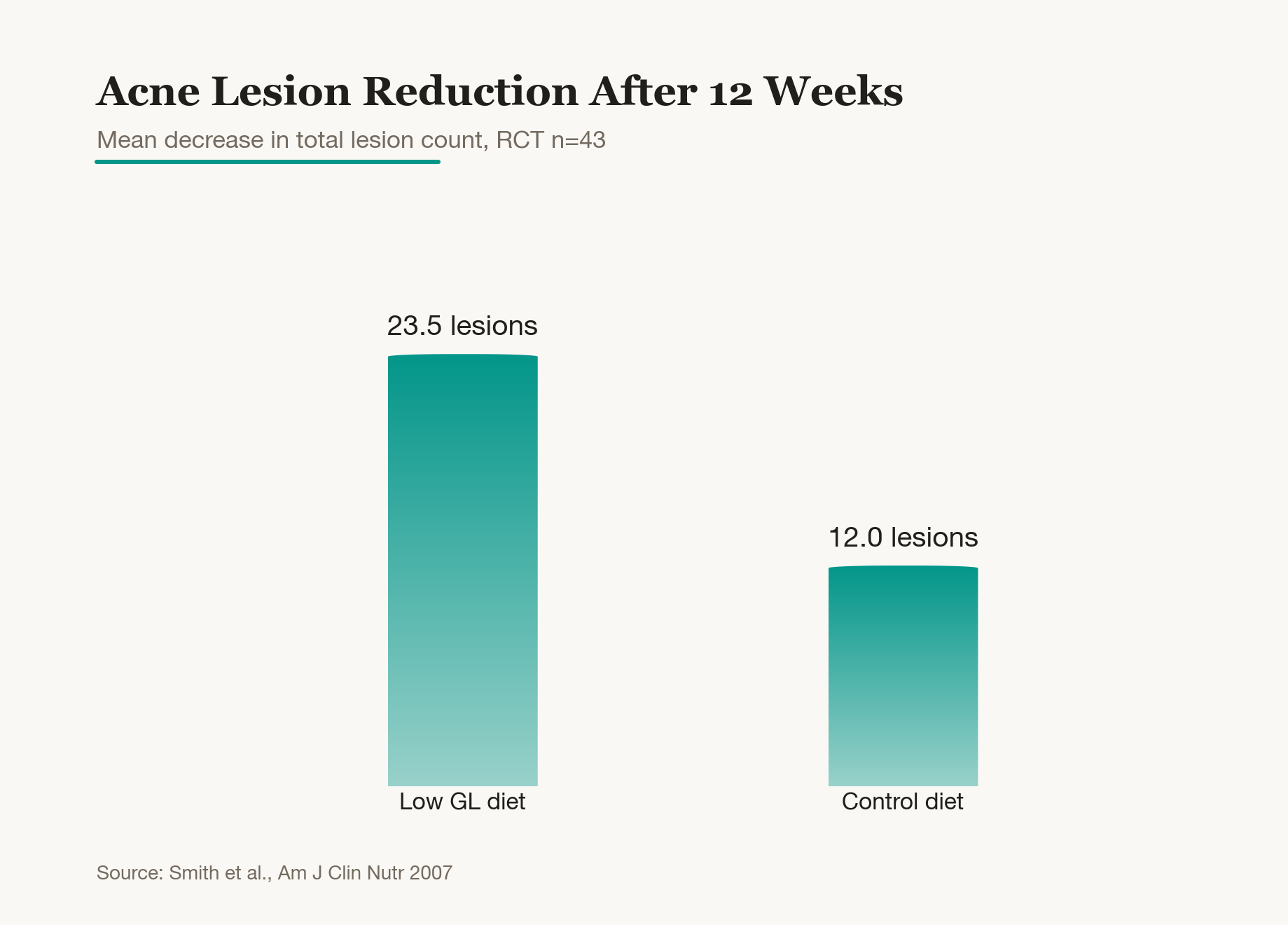
Switching toward foods that raise blood sugar more slowly, like whole grains and vegetables, takes some of the edge off this signal. Some studies that had people follow a low-glycemic diet for a few weeks reported fewer acne lesions afterward.
Why is milk linked to acne?
Milk itself is not a high-glycemic food. It does not spike blood sugar the way white rice or soda does. Still, dairy shows up repeatedly in acne research, and there is a separate reason for that. Milk naturally contains hormone traces, and its proteins, casein and whey, both have the ability to stimulate insulin and IGF-1 on their own.
In other words, the issue is not blood sugar here. It is the protein itself. Whey protein is the same ingredient used in most gym supplements, and it drives up insulin and IGF-1 signaling through the same pathway that helps build muscle. That signal reaches all the way to the oil glands and stimulates the acne pathway right along with it.
Milk also carries trace amounts of hormones produced while a cow is pregnant. The amount a person actually consumes is tiny, but these hormones are still thought to interact with androgen-related signaling in the body, which can push oil glands in the same stimulating direction. A single glass of milk, in other words, carries several overlapping triggers at once.
Why is skim milk named more often?
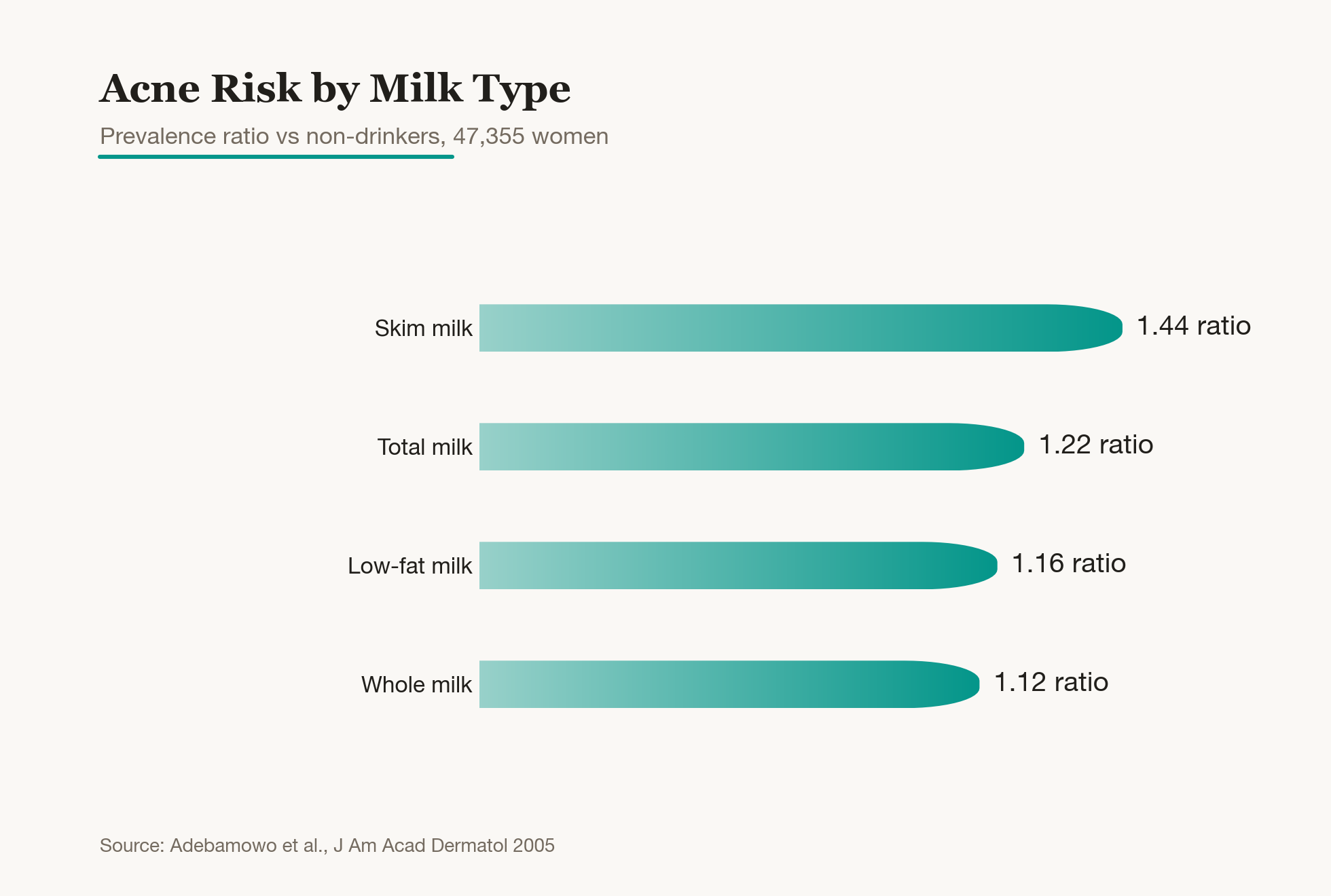
Several studies have found a stronger link between acne and skim milk than between acne and full-fat whole milk. On paper that seems backwards, since skim milk has had the fat removed.
One hypothesis: the process of stripping fat out of milk shifts the balance of fat-soluble components, and whey protein and hormone components end up making up a relatively larger share of what is left. That is thought to make the insulin and IGF-1 stimulating effect even stronger, not weaker.
This is still a hypothesis, though, and not everyone reacts the same way. Researchers are still working out why some people are sensitive to dairy and others drink the same amount with no visible effect at all.
Processed dairy like yogurt and cheese tends to show a weaker association in the data. That is likely because fermentation and processing change the form of the stimulating components, though there simply is not as much research on solid dairy as there is on liquid milk. Rather than lumping all dairy into one bucket, it makes more sense to look at the specific form and how often it is eaten.
How does sugar affect sebum?
Sugary foods eventually loop back into the same blood sugar and insulin pathway. Refined sugar digests especially fast, which makes it especially quick to spike blood sugar.
When blood sugar swings up and down often, the body gets used to releasing large amounts of insulin repeatedly. Over time, this is reported to push the oil glands to produce more sebum, and the fatty acid makeup of that sebum gradually shifts toward a composition that is more likely to trigger inflammation. The oil itself changes in quality, not just quantity.
Add in the tendency for dead skin cells inside the pore to clump together rather than shed cleanly, and oil plus dead skin together create the exact conditions a pore needs to get blocked.
Refined sugar adds inflammation to this process as well. Repeated blood sugar swings are known to increase inflammatory signaling molecules throughout the body. Since acne itself is a condition where bacteria multiply inside a clogged pore and spread into inflammation, even a small rise in overall inflammatory tendency can speed up how fast an already blocked pore turns into a red, painful breakout.
What to check first in your diet
Rather than overhauling your entire diet at once, it is more realistic to work through the following in order.
- Sugary drinks and desserts: these raise blood sugar fastest, which means the insulin response is biggest too.
- Refined carbs like white rice and white bread: they digest faster than whole grains and spike blood sugar through the same mechanism.
- Dairy, including skim milk: separate from blood sugar entirely, it can stimulate IGF-1 signaling directly.
- Whey protein supplements: even if you are taking it for training, it is worth checking your intake during a bad breakout period.
Cutting something out completely is not necessary. Reducing the amount and watching how your skin responds directly is lower pressure and easier to stick with.
Can diet alone clear acne?
Evidence that diet changes can help manage acne keeps building, but it is unlikely that diet alone will clear acne completely. Acne comes from hormones, genetics, the skin's own inflammatory response, bacteria, and how skin cells shed, all tangled together.
Because of that, it makes more sense to treat diet changes as a supporting tool rather than a standalone fix. If you already have a prescribed treatment or skincare routine, keeping that going while also trying a slower blood-sugar diet and cutting back on dairy is a balanced approach.
What works varies from person to person, so it takes a few weeks of changed habits and honest observation of how your skin actually responds. And if diet changes alone are not moving the needle, it is usually faster to see a dermatologist and combine other treatment options rather than gritting it out on your own for much longer.
References
Korean Dermatological Association, American Academy of Dermatology (AAD), and Ministry of Food and Drug Safety (MFDS).
Was this helpful?
About this article
Written by a practising aesthetic physician and intended for general education — not a substitute for individual medical advice.
Read next

Hormonal Acne Causes: Why It Keeps Returning on the Chin and Around the Mouth
Breakouts that keep returning to the jaw and mouth in adulthood follow a different pattern than teenage acne. Here is a look at how hormones like androgens keep stimulating the oil glands and hair follicles, plus how the menstrual cycle and stress fit into the picture.
By Dr. Kim

Teen Acne: Causes, Care and When to See a Clinic
Teen acne starts when androgen hormones ramp up oil production, then moves through a few predictable stages that end in clogged pores and inflammation. Here is why this stage of life hits so hard, what actually helps at home, and when it is time to see a dermatologist.
By Dr. Lee
Exosome Treatment Effects: How Are They Different From Stem Cells?
Exosomes are tiny signal packets that cells release into their surroundings, delivering only the messages a stem cell creates rather than the stem cell itself to the skin. Here is a plain look at how exosomes carry regeneration and calming signals, why clinics so often pair them with laser treatments, and how much evidence has actually built up so far.
By Dr. Kim