Apogee Plus Hair Removal: Effects, Sessions and Precautions by Skin Tone
By Dr. Lee7 min read

Start looking into laser hair removal and you'll quickly hit a wall of jargon: alexandrite, diode, Nd:YAG. Among those options, Apogee+ comes up often as one of the leading alexandrite systems. You're probably wondering whether it actually delivers long-term reduction, and whether it's safe for your skin tone.
Apogee+ is a 755nm alexandrite laser made by Cynosure. The wavelength is absorbed strongly by melanin in hair, generating enough heat to damage the follicle and prevent regrowth. That same melanin-targeting ability also makes it useful for shallow pigmented spots. The flip side: because it reacts so well to pigment, skin tone matters. Here's a straight look at how it works, what the clinical evidence shows, how many sessions are realistic, when it can treat pigmentation, and where its limits lie.
The wavelength and device Apogee Plus uses
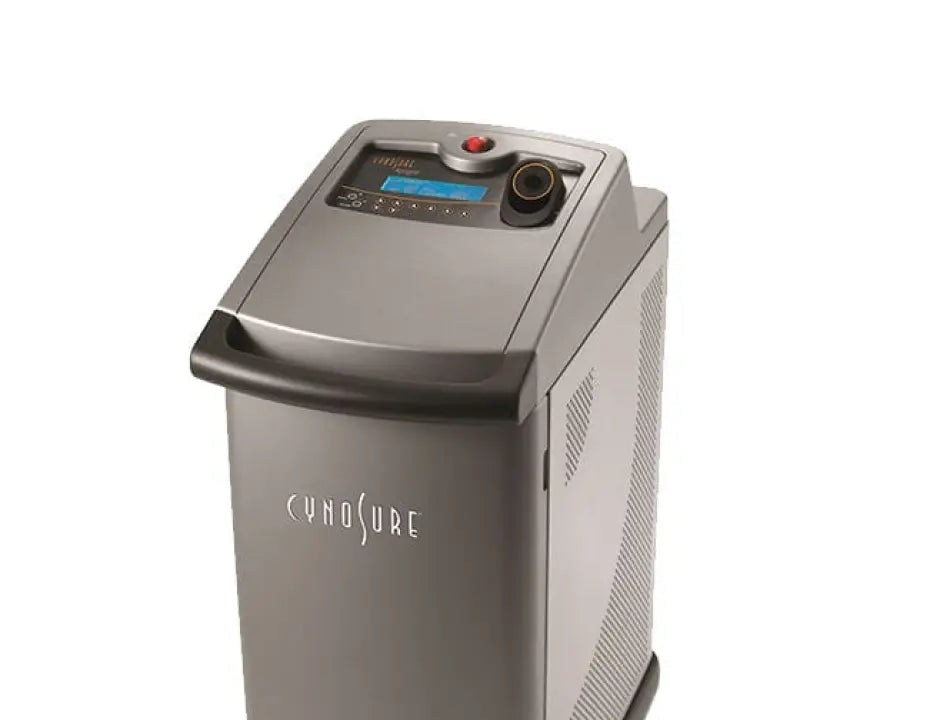
Apogee+ is an alexandrite laser operating at 755nm. Different wavelengths target different chromophores: 755nm happens to be absorbed very efficiently by melanin. The dark pigment in hair absorbs that light, converts it to heat, and that heat damages the follicle responsible for regrowth.
It's manufactured by Cynosure. The alexandrite wavelength has been a benchmark for laser hair removal for decades, largely because its high melanin absorption translates into efficient follicle destruction. Apogee+ pairs that with a built-in cooling system that chills the skin surface during delivery, protecting the epidermis while heat reaches the follicle.
Add the 1064nm Nd:YAG head and it becomes the Elite+, the upgraded dual-wavelength configuration. The 1064nm wavelength penetrates deeper and is absorbed less by superficial melanin, making it considerably safer on darker or tanned skin. Apogee+ can run solo on 755nm or operate as part of a dual-wavelength setup that covers a wider range of skin tones. It's not the newest platform on the market, but it's a proven, well-established system with a long track record in alexandrite-based hair removal.
How does a hair removal laser remove hair?
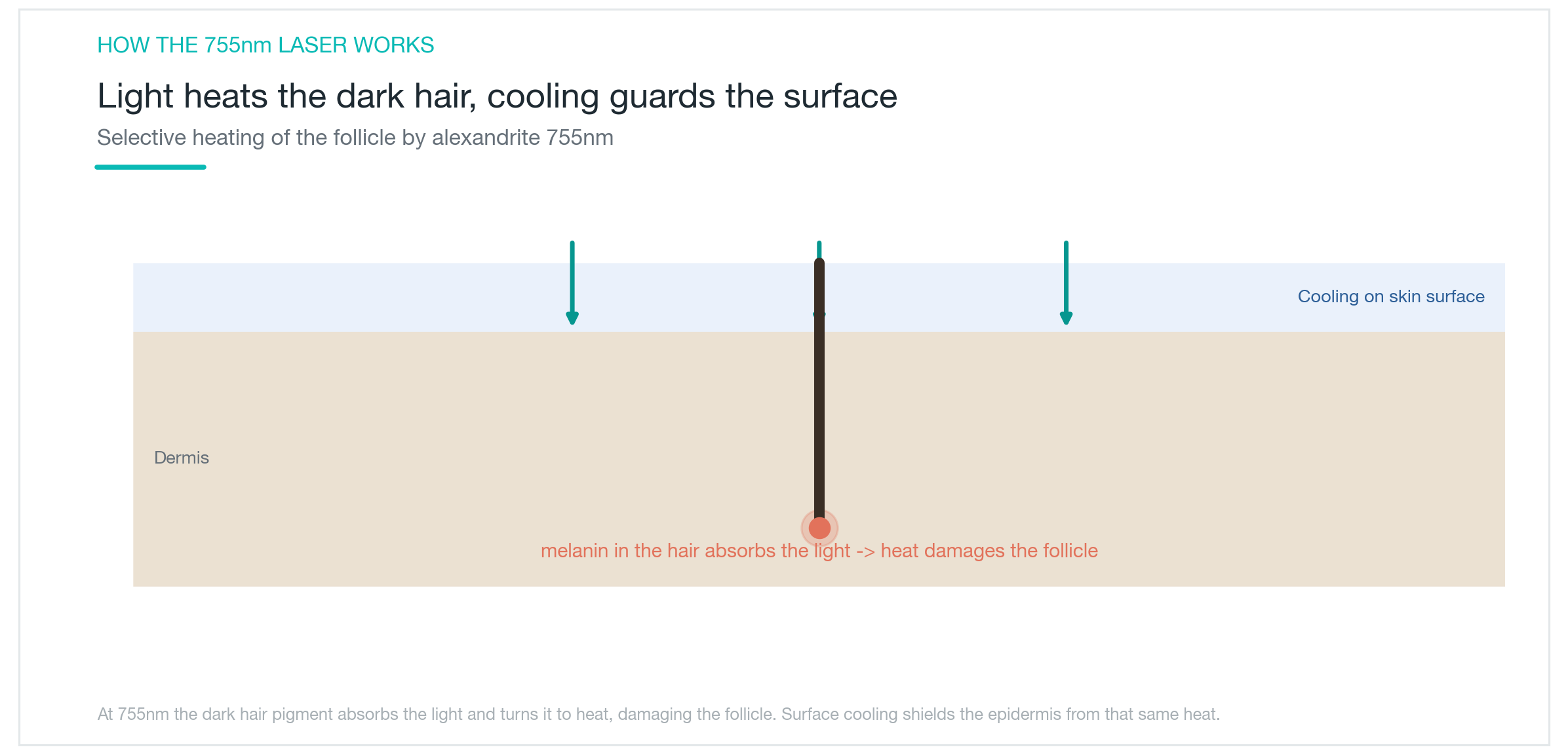
The principle is selective heating, targeting pigment without damaging everything around it. Hair contains high concentrations of melanin, and 755nm light is absorbed by melanin with particular efficiency. That absorbed energy becomes heat, which conducts through the hair shaft into the follicle, damaging the cells responsible for new growth. Surrounding skin, with far less melanin, absorbs much less energy.
That contrast between dark hair and lighter skin is exactly what makes laser hair removal work well, or not at all. Dark, coarse hair on lighter skin gives the best results. Fine, lightly pigmented hair, or white and gray hair, lacks the melanin needed to absorb the laser and doesn't respond. That's why no laser removes every hair type equally.
Cooling matters here. Because 755nm is also absorbed by melanin in the skin itself, leaving the surface unprotected means the epidermis heats up right alongside the hair, raising the risk of burns and post-inflammatory pigmentation. Apogee+ cools the skin at the moment of delivery to protect the surface while directing thermal energy down to the follicle. Ultimately, the balance of fluence and cooling comes down to the treating provider's judgment. The same device can be quite safe or problematic depending on how it's set up, which is why assessing both hair color and skin tone together before dialing in parameters is essential.
How far is the hair removal effect confirmed in clinical studies?
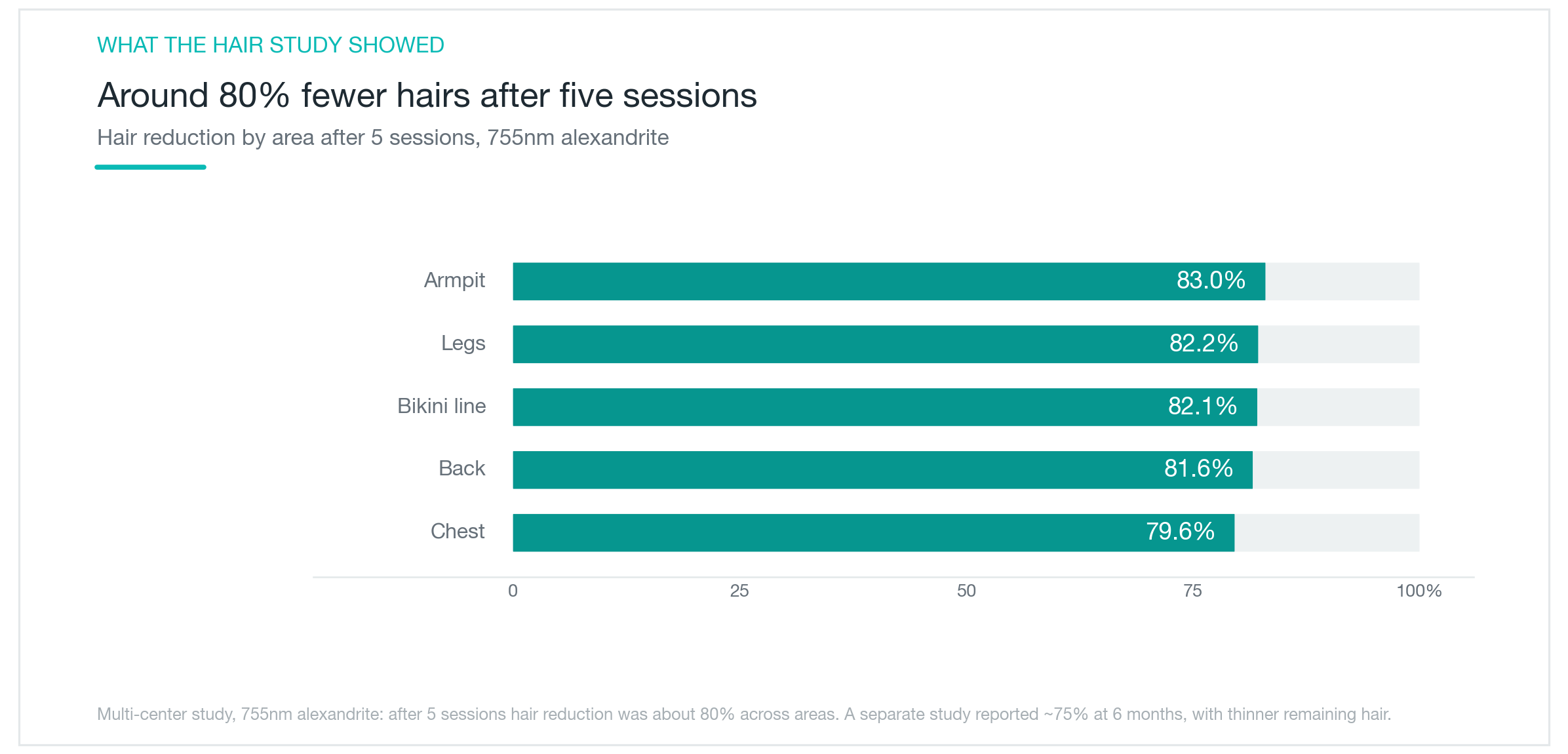
The evidence is solid. The 755nm alexandrite wavelength has long been cited as a benchmark for permanent hair reduction. In one multicenter clinical trial, hair reduction after 5 sessions came in around 80% across multiple body areas: 83.0% for underarms, 82.2% for legs, 82.1% for the bikini line, 81.6% for the back, and 79.6% for the chest.
In a separate study, hair reduction at 6 months post-treatment was approximately 75%, with remaining hairs becoming finer and more vellus-like over time. Alexandrite laser removal isn't about wiping everything out at once; it's a gradual reduction in both count and coarseness across multiple sessions. One thing consistently reported: the better the contrast between dark hair and lighter skin, the stronger the results.
One thing worth clarifying: "permanent hair removal" doesn't mean every hair is gone forever. The medical definition covers a significant, lasting reduction in regrowth, not total eradication. Some hairs may return over time, and maintenance sessions are common. A realistic expectation is that a full course will dramatically reduce the majority of hair, not eliminate it completely.

How many sessions, and at what interval?
Multiple sessions are necessary because of the hair growth cycle. Hair alternates between active growth (anagen), resting (telogen), and shedding (catagen) phases. Laser only works effectively on hairs in the active growth phase (those have the most melanin and the strongest connection to the follicle). One treatment catches the hairs growing at that moment; follicles that were resting will cycle back and emerge later.
The standard protocol is sessions spaced 4–6 weeks apart, with a minimum of 3 sessions. Clinically, the average runs closer to 5.6 total treatments. Each round catches hairs newly in their active growth phase, progressively reducing count and coarseness. The number needed varies by area and hair characteristics.
Even after completing the initial course, periodic maintenance is common. Hormonally sensitive areas or coarse-hair zones may need additional sessions. This isn't a one-or-two-and-done treatment; results build up with consistent, well-timed sessions. Space them too close and you don't give enough new growth to catch; too far apart and regrowth accumulates between visits. Getting the interval right for each area and hair cycle is what drives efficiency.
Why is it also used for pigment like age spots?
Because 755nm is strongly absorbed by melanin, it can address more than just hair. Epidermal brown pigment (solar lentigines, age spots, freckles) absorbs the wavelength and fades in response. On lighter skin with well-defined brown spots, it can be quite effective.
That said, treating pigmentation is more skin-tone-dependent than hair removal. The alexandrite reacts to the skin's own melanin too, so if you're tanned or naturally darker, the epidermis absorbs excess energy, raising the risk of burns or paradoxical darkening. For pigmentation treatment, a careful assessment of skin tone and lesion depth is essential before proceeding.
It's also not a universal fix for all pigmentation types. Melasma (inflammation-sensitive and sitting deeper in the skin) can actually worsen with alexandrite treatment. Apogee+ suits superficial, well-demarcated lesions like lentigines and freckles, but applying the same laser indiscriminately across different pigment types can cause problems. Identifying what you're actually dealing with comes first. Even within the same lesion type, raised or thicker spots may respond better to a different modality, and the approach depends on lesion morphology.

Is it safe on darker skin?
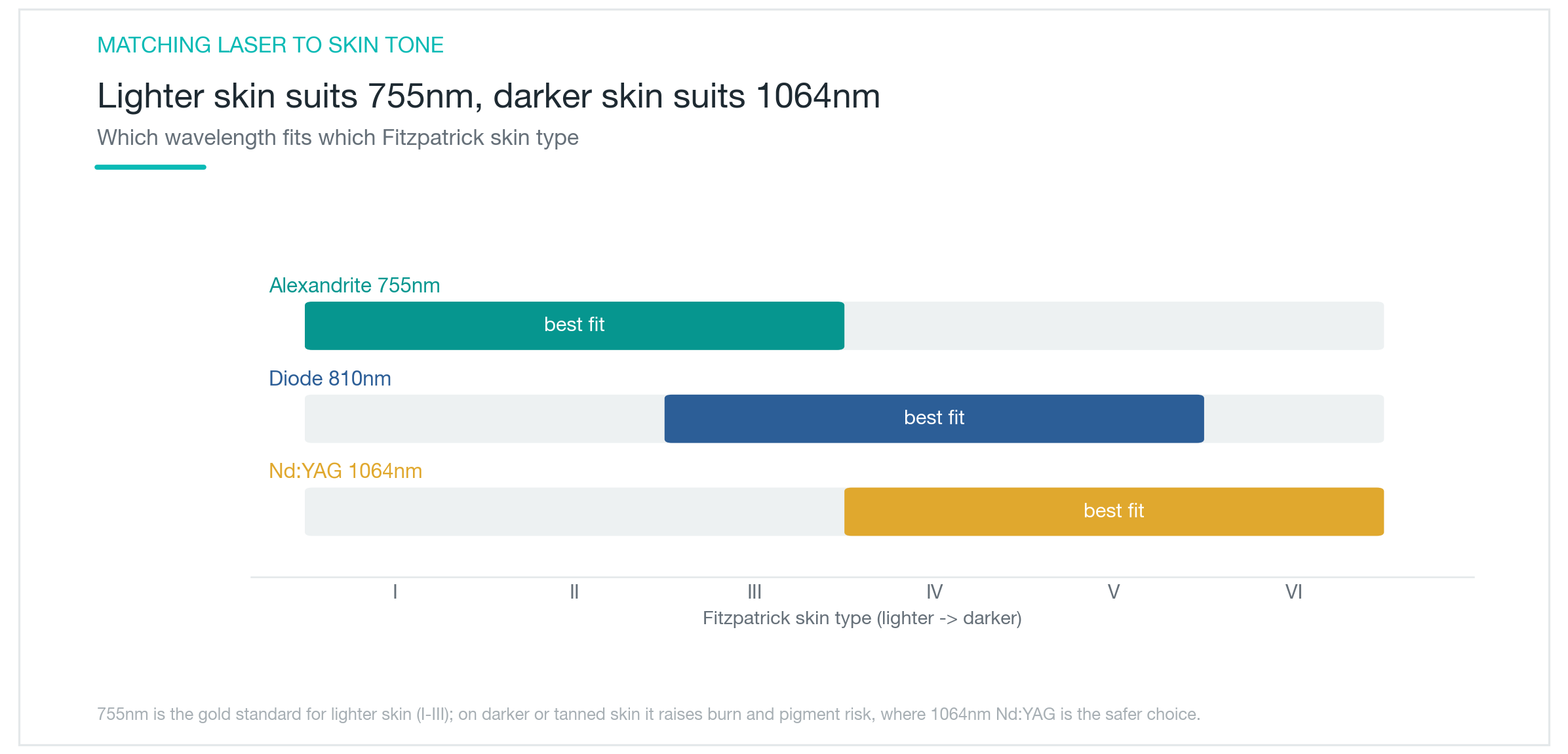
Skin tone is the most important variable to understand. Alexandrite 755nm works best (and is safest) on lighter Fitzpatrick types (I–III). As skin tone deepens, epidermal melanin absorbs more of the laser energy, pushing the risk of burns and post-inflammatory hyperpigmentation higher. It can still be used on medium skin tones (Fitzpatrick III–IV) with careful parameter selection, but for darker skin types (Fitzpatrick IV–VI) or actively tanned skin, 1064nm Nd:YAG is the safer alternative. The longer wavelength penetrates deeper, is absorbed less by surface melanin, and has a well-established safety profile on deeper complexions.
Pre- and post-care matters. Avoid tanning and prolonged sun exposure for several weeks before treatment; apply sunscreen diligently afterward to minimize pigmentation side effects. Post-session redness and mild stinging are normal and typically resolve within a few days. More than anything, finding a provider who properly adjusts fluence, cooling, and wavelength to your skin tone is the real safety factor.
Who is the ideal candidate? Dark, coarse hair on lighter skin is the sweet spot. It's particularly well-suited for areas where you shave or wax repeatedly, or where folliculitis is a recurring problem. On the flip side, fine or lightly pigmented hair and white or gray hair won't respond meaningfully: there simply isn't enough melanin for the laser to work with. For deeper skin tones, a Nd:YAG-based approach will be safer. The best outcome comes from going in with realistic expectations: significant reduction across multiple sessions, not a single permanent fix, and from having the settings properly matched to your skin type.
Was this helpful?
About this article
Written by a practising aesthetic physician and intended for general education — not a substitute for individual medical advice.
Read next
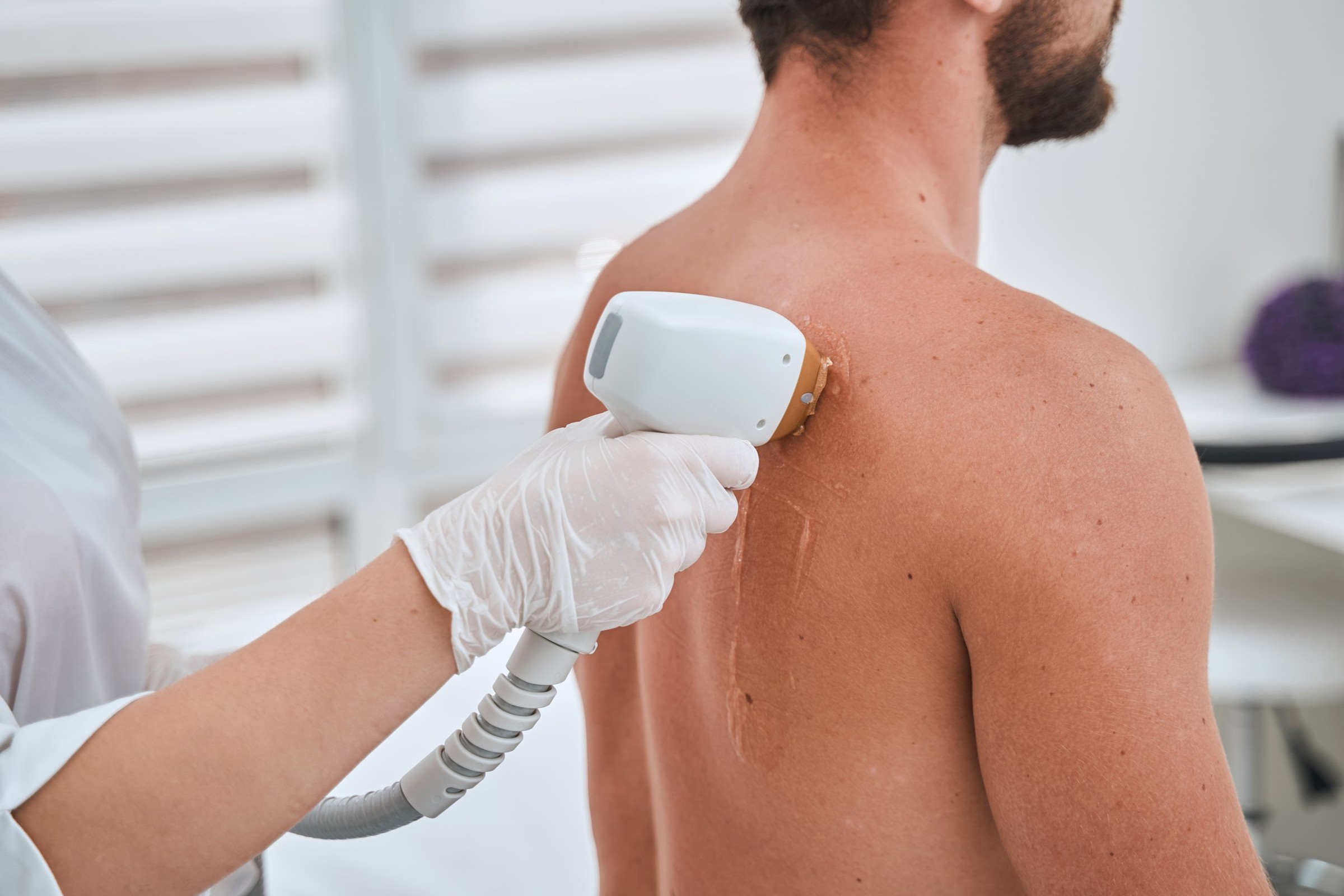
Pigmentation After Laser Hair Removal: Why It Happens and How to Prevent It
Laser hair removal works by using heat to destroy melanin inside the follicle, but when that heat spreads into the epidermis, it can leave a burn that later turns into hyperpigmentation. Here is why burn risk changes with skin tone, wavelength choice, and cooling method, along with ways to reduce it beforehand.
By Dr. Lee
Reepot Laser Results: Can One or Two Sessions Clear Lentigines That Toning Couldn't?
How Reepot's 532nm wavelength achieves roughly 11x higher melanin absorption than the 1064nm used in laser toning, why VSLS pre-cooling reduces the risk of post-inflammatory hyperpigmentation on Asian skin, what the clinical evidence shows for efficacy on solar lentigines, how to manage the scabbing process, and an honest look at PIH rates and who benefits most.
By Dr. Lee
Titanium Lifting Effect and Limits, and How It Differs From Ultherapy and Thermage
What Soprano Titanium's triple-wavelength diode laser actually does for skin laxity, texture, and tone, with a clear-eyed look at the clinical evidence and its real limitations.
By Dr. Lee