Air Subcision and Needle Subcision: Differences and Pain Compared
By Dr. Kim8 min read
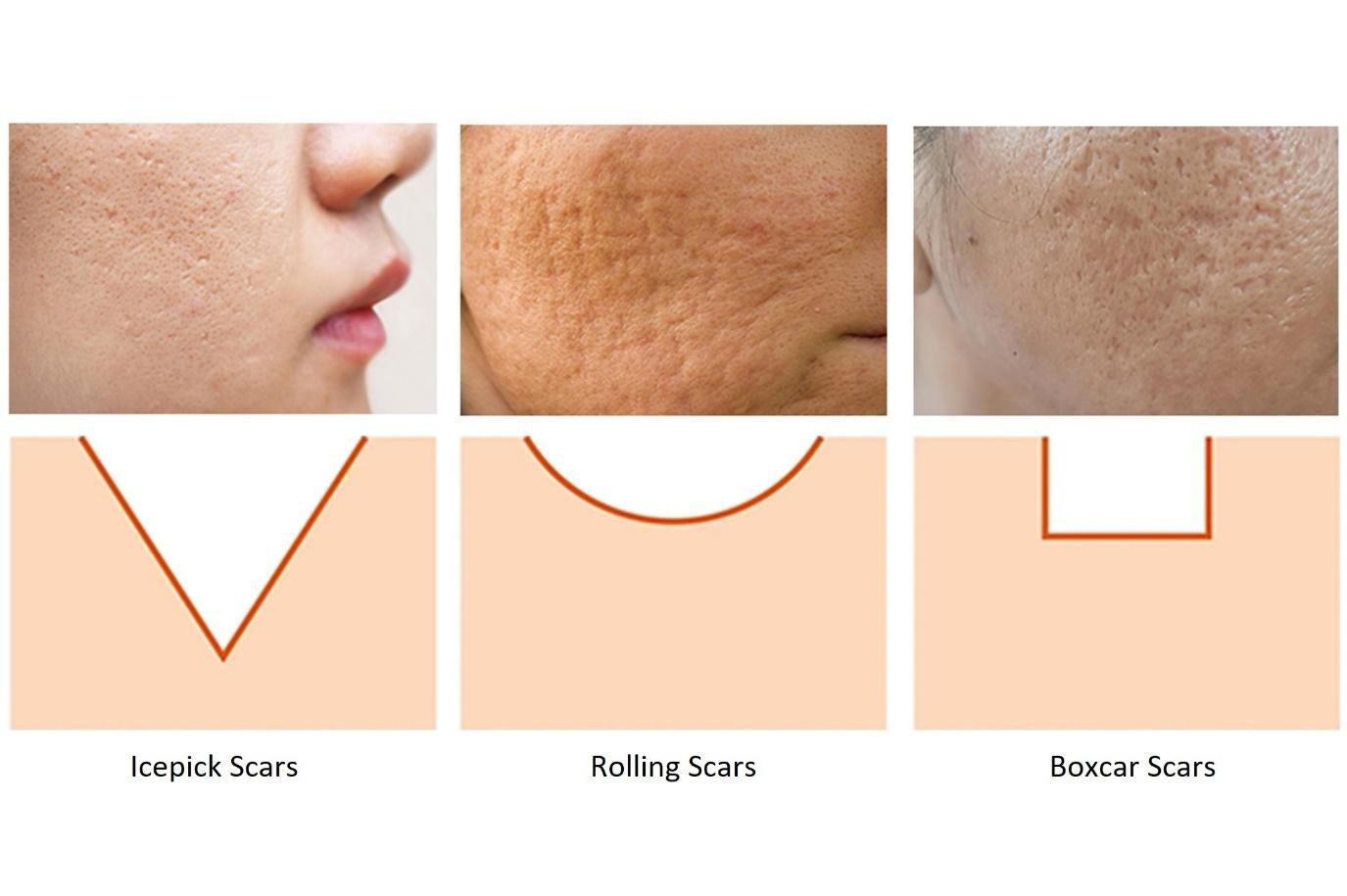
Some acne scars look far deeper than the tissue loss underneath would suggest. Run a finger over one and the surface feels smooth, but just under it something feels pulled tight. That tug is exactly what subcision is designed to release. Lately, more clinics are doing this release with a burst of compressed air instead of a hand-guided needle.
Needle subcision and air subcision share the same goal. Both aim to cut through the fibrous bands stuck beneath a scar so the skin has room to lift back up. What differs is how the force gets there. With one, a doctor pushes a needle in by hand. With the other, compressed air blasts out from the tip of a cannula and that pressure does the work of pushing the tissue apart.
Why do scars that pull from within look deeper?
When acne inflammation runs deep, the collagen that regenerates afterward does not always come back smooth. Sometimes it clumps into thin, tough, thread-like strands instead. These strands anchor the dermis to the fascia layer underneath it, and that anchoring is what dermatologists call tethering.
Picture a tent staked to the ground. The stakes pull the fabric down, so that one spot sinks lower than the rest of the tent even though nothing is actually missing there. A tethered scar works the same way. The fibrous strands under the skin are pulling the dermis downward, which makes the scar look deeper than the actual tissue loss would account for.
This is exactly why lasers and peels, which only work on the skin's surface, tend to disappoint on this type of scar. No matter how much you resurface the top layer, the pull from underneath stays in place. Only cutting that pull loose gives the scar any real chance to flatten out.
How does needle subcision cut the scar?
Needle subcision involves inserting a fine needle beside the scar and sweeping the tip back and forth in a fan pattern to sever the fibrous bands underneath. The doctor feels the resistance at the needle tip and uses that feedback to judge whether the tissue has actually let go, adjusting direction as they go.
The strength of this approach is exactly that fingertip feedback. When the doctor feels tissue holding firm, they can push harder or change the angle right there, treating a stubborn spot differently from a looser one within the same area.
The tradeoff is that a single spot often needs several passes before the fibrous strands give way fully, and each extra pass raises the odds of the needle grazing a small vessel underneath. Hand strength also varies slightly from moment to moment and from one clinician to another, so the force applied is never perfectly uniform across the treated area.
How is air subcision different from needle?
Air subcision uses a device that channels compressed gas through a cannula with a blunt tip instead of a needle. A single entry point is made in the skin, and once the cannula is guided under the tethered area, high-pressure air bursts out from its tip in short pulses.
Rather than a needle scraping through tissue directly, think of the burst of air pressure itself as the tool that pushes the fibrous strands apart and separates them. The doctor's job is to guide the cannula, adjusting direction and depth, while each burst of high-pressure air does the actual work of releasing and severing the tethered bands.
There is also a reason for swapping the needle for a blunt-tipped cannula. A rounded tip tends to push small vessels aside rather than pierce them the way a sharp needle can, which is described as helping reduce tissue trauma while working through fibrous bands in several directions from just one entry point.
How air pressure breaks fibrous tissue
Air subcision releases fibrous tissue through a different mechanism than needles do. A needle is mechanical cutting, the tip physically strikes and slices through tissue. Air subcision instead relies on the burst of high-pressure air itself pushing apart and separating the tethered bands. As the compressed gas expands suddenly, the pressure it generates becomes the force that peels the fibrous tissue away from between the dermis and the fascia.
What stands out about this approach is how consistent that force stays. Compressed gas is released at a fixed pressure, so there is almost none of the moment-to-moment variation you get when a hand is pushing a needle. That means the strength of the air pressure hitting each point stays roughly the same from the first pass to the last.
This consistency is what lets multiple tethered points get treated evenly in a short amount of time. A hand fatigues slightly with every repetition and its grip wavers, but air pressure does not tire. The pressure stays the same no matter how many times it fires.
Is there really less bruising and pain?
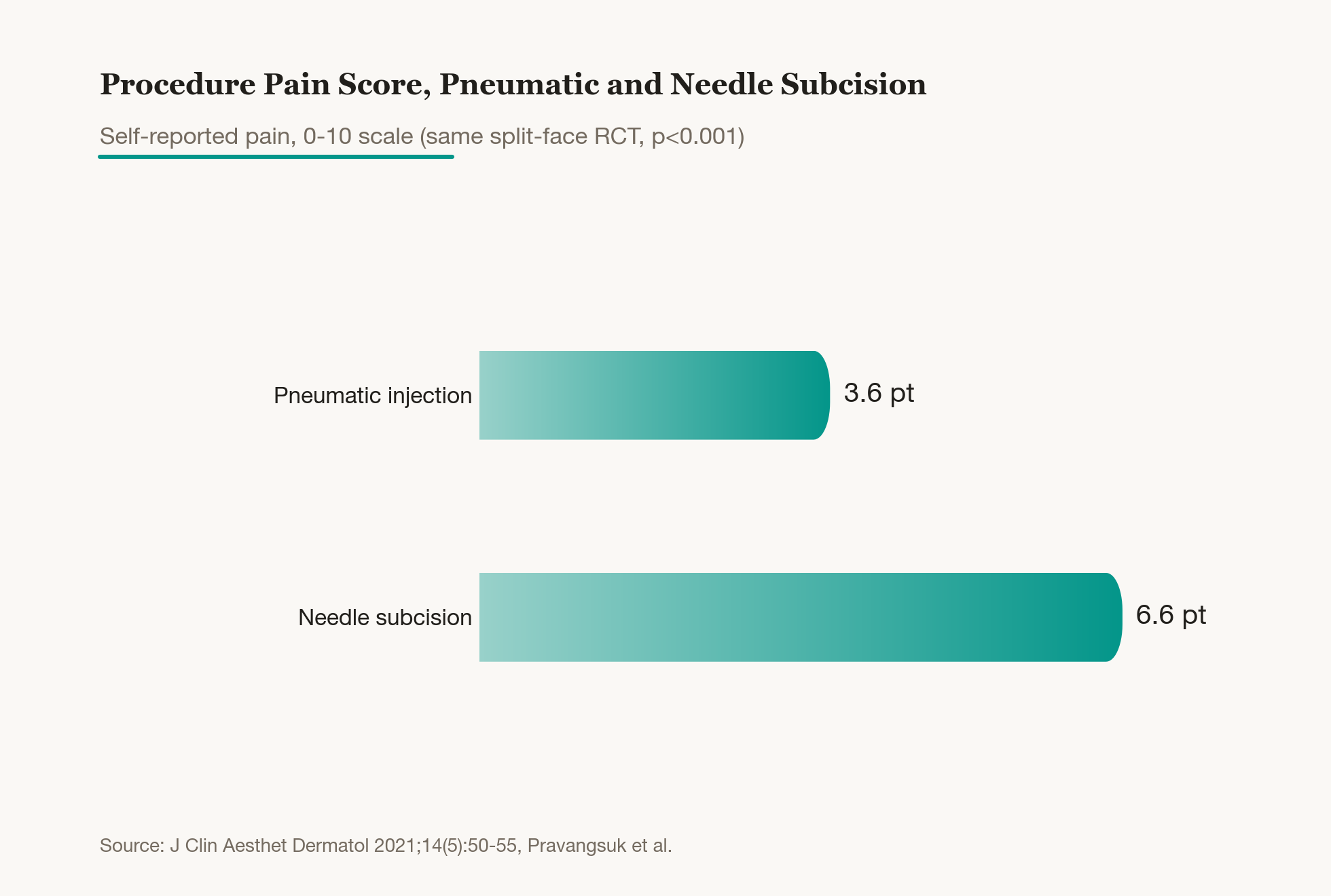
People who have had air subcision often report less bruising and less pain compared to the needle method. There are a few physical reasons this tends to hold true.
- Blunt cannula tip: Unlike a sharp needle, the rounded tip tends to push small vessels along its path aside rather than cut through them. That means less vascular damage even when covering the same area.
- Single entry point: Needle subcision usually requires re-entering the skin at multiple spots, while air subcision goes in once and fans out in several directions from that same point. Fewer punctures on the surface follow naturally from that.
- Steady pressure: Hand pressure can spike in an instant, but air pressure only ever operates at its preset strength. That structurally lowers the chance of excess force concentrating on any single spot.
Of course, how much bruising or pain shows up still depends on how deep the scar is, how widespread the tethering is, and each person's skin and vessels. These points describe a physical difference between the two methods, not a guaranteed outcome for everyone.
When is needle subcision better?
Air subcision does not replace needle subcision on every front. The biggest gap is that fingertip feedback. With a needle, the doctor feels resistance in real time and can adjust force and angle on the spot. Air subcision fires at a fixed pressure, so that kind of fine, moment-to-moment adjustment is harder to achieve.
The blunt cannula tip cuts both ways, too. What makes it gentler on vessels can work against it on old, densely hardened fibrous tissue, where a sharp needle can often sever the band more efficiently and precisely. A blunt tip handles thin, pliable strands well, but tough, thickened tissue may need several extra passes before it gives way.
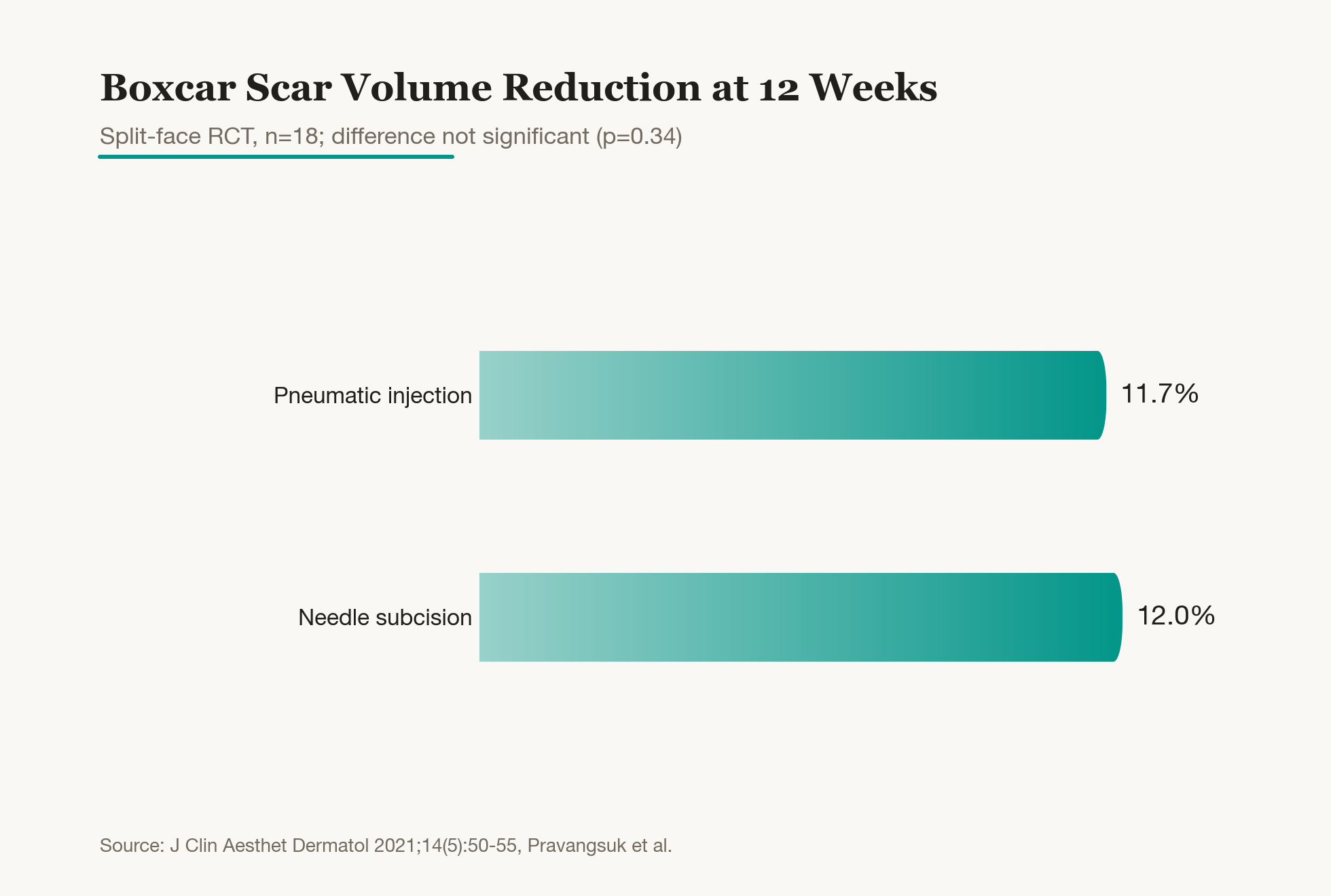
In practice, many clinics combine both methods depending on what a scar looks like, or choose differently area by area. A wide, shallow patch of tethering might get treated quickly and evenly with air subcision, while one or two old, deeply hardened spots get finished off with a needle. Neither method is simply superior across the board; it comes down to matching the tool to how deep and how hardened the scar actually is.
Swelling and recovery care after treatment
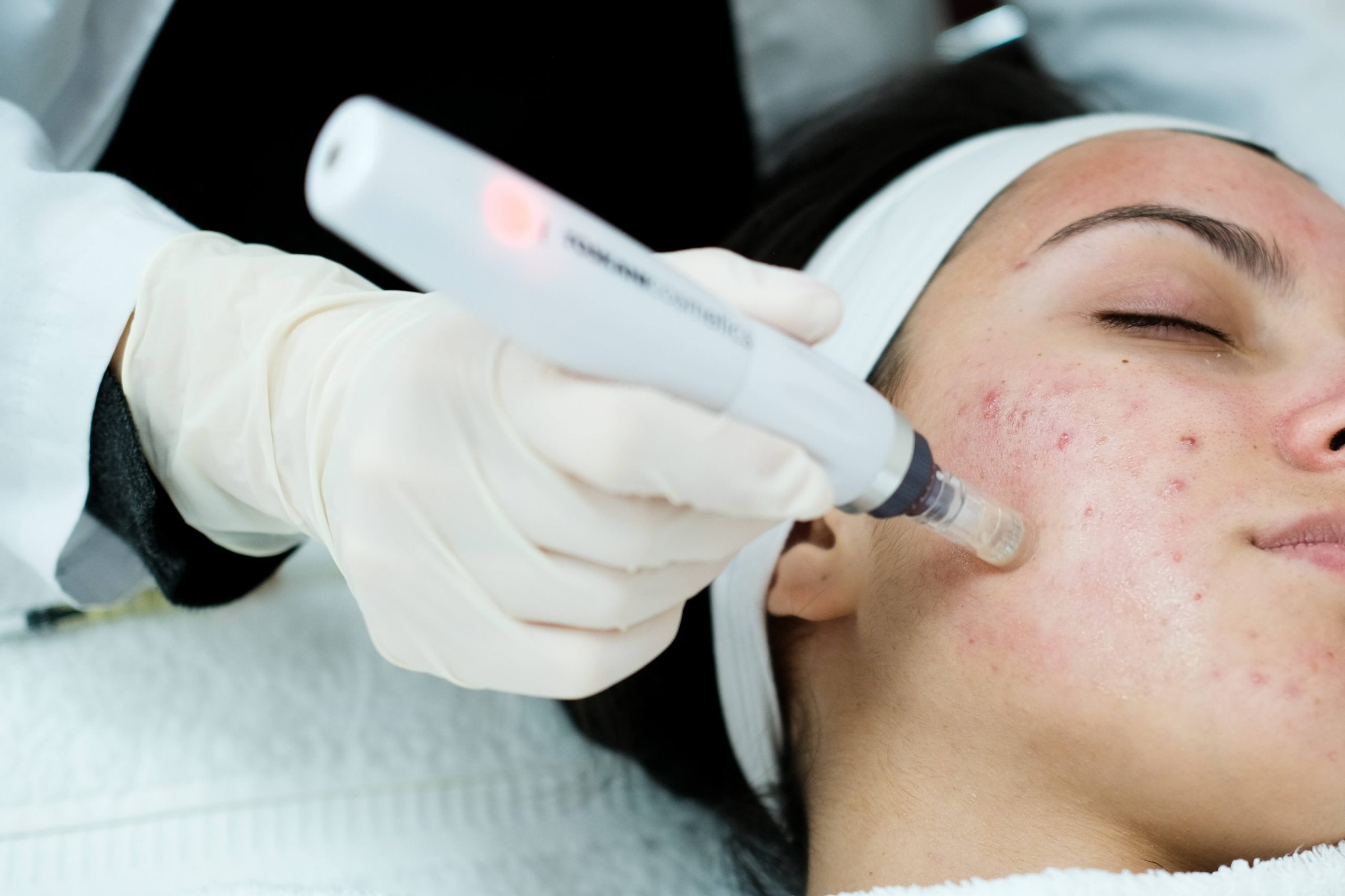
Swelling and bruising right after subcision are common. Cutting through fibrous tissue inevitably irritates the small vessels running alongside it, and both are described as settling naturally over the following days.
Where the fibrous band used to be, an empty space opens up. Blood initially fills that space, and as it gradually gets reabsorbed, fresh collagen moves in to take its place. The scar flattens out gradually over the same stretch of time this healing response takes to run its course.
For the first few days after treatment, pressing or rubbing the area firmly is best avoided. Tissue that has not settled into place yet can get pushed back together if pressure lands on it, undoing some of the release. The treated area may also be more sensitive to UV exposure for a while, so keeping up with sun protection helps.
A single session of air subcision does not always release everything at once. When the fibrous tissue is spread over a wide area or has hardened over a long time, the same spot may be treated again a few weeks later to work through what remains, step by step. Watching how quickly collagen fills in typically guides when that next session should happen.
References
Korean Dermatological Association, American Academy of Dermatology (AAD), and Ministry of Food and Drug Safety (MFDS).
Was this helpful?
About this article
Written by a practising aesthetic physician and intended for general education — not a substitute for individual medical advice.
Read next
Subcision for Sunken Scars: How Many Sessions Until They Lift?
Subcision is a procedure that uses a needle to cut the fibrous tissue under the skin that is pulling a scar downward. Here is why scars sink in, how the needle releases that pull, and why treatment usually takes 3 to 6 sessions.
By Dr. Lee
Blackheads: Causes, Care and Is It Okay to Squeeze Them by Hand?
Blackheads aren't trapped dirt. They're a plug of sebum and dead skin cells inside the pore that turns dark through oxidation. Here's why extracting them often leaves marks, and which ingredients actually help, explained through the science behind it.
By Dr. Kim

Exfoliation Methods: Physical Versus Chemical Exfoliation Compared
Exfoliation falls into two broad camps: physically buffing away dead skin and chemically dissolving it. Scrubs and brushes lift flakes off through friction, while acid ingredients loosen the bonds between skin cells so they release on their own. Here is how each method actually works on the skin, and which one fits which skin type.
By Dr. Kim