Acne Scar Types and Treatments: TCA CROSS and Subcision Included
By Dr. Lee8 min read
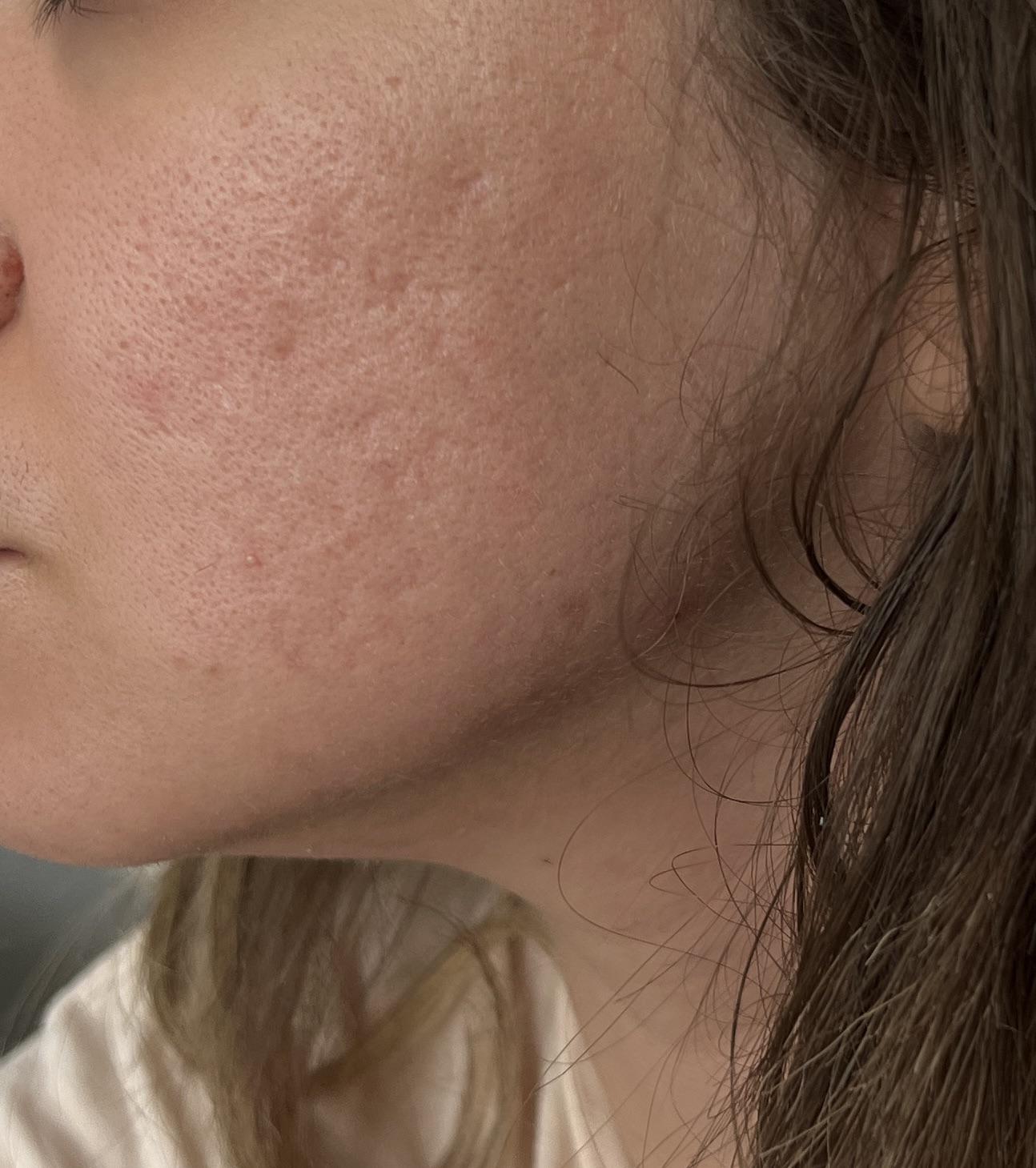
Even after every breakout has cleared, sunken marks often remain on the skin. Look closely and you will notice they are not all the same shape. Some look like a tiny puncture, narrow and deep. Others sit like a small square basin, wide and flat. And some create a gentle, wave-like dip across the surface.
There is a reason behind each of these different shapes. And because the shapes differ, what actually happened underneath the skin differs too, which is why the treatments that work best are not the same either.
Why do scars differ in shape from the same acne?
Acne scars form where inflammation has festered deeply. The longer and deeper the inflammation runs, the more collagen gets damaged underneath. Collagen is the protein that acts like a supporting pillar for the skin. When inflammation flares up, the body releases enzymes called MMPs (matrix metalloproteinases) that break down this pillar. The name sounds technical, but the job is simple: think of MMPs as scissors that snip away at collagen.
If the body cannot fully rebuild the collagen it lost by the time the inflammation settles, the spot stays sunken. But the direction and depth the inflammation spreads is different for everyone, and even different from spot to spot on the same face. Whether it burrowed narrow and deep, spread wide and shallow, or left behind cord-like fibrous bands tugging at the tissue below all determine the final shape of the scar. That is exactly why treatment has to start by identifying the scar's shape rather than lumping every scar together.
How many types of acne scars are there?
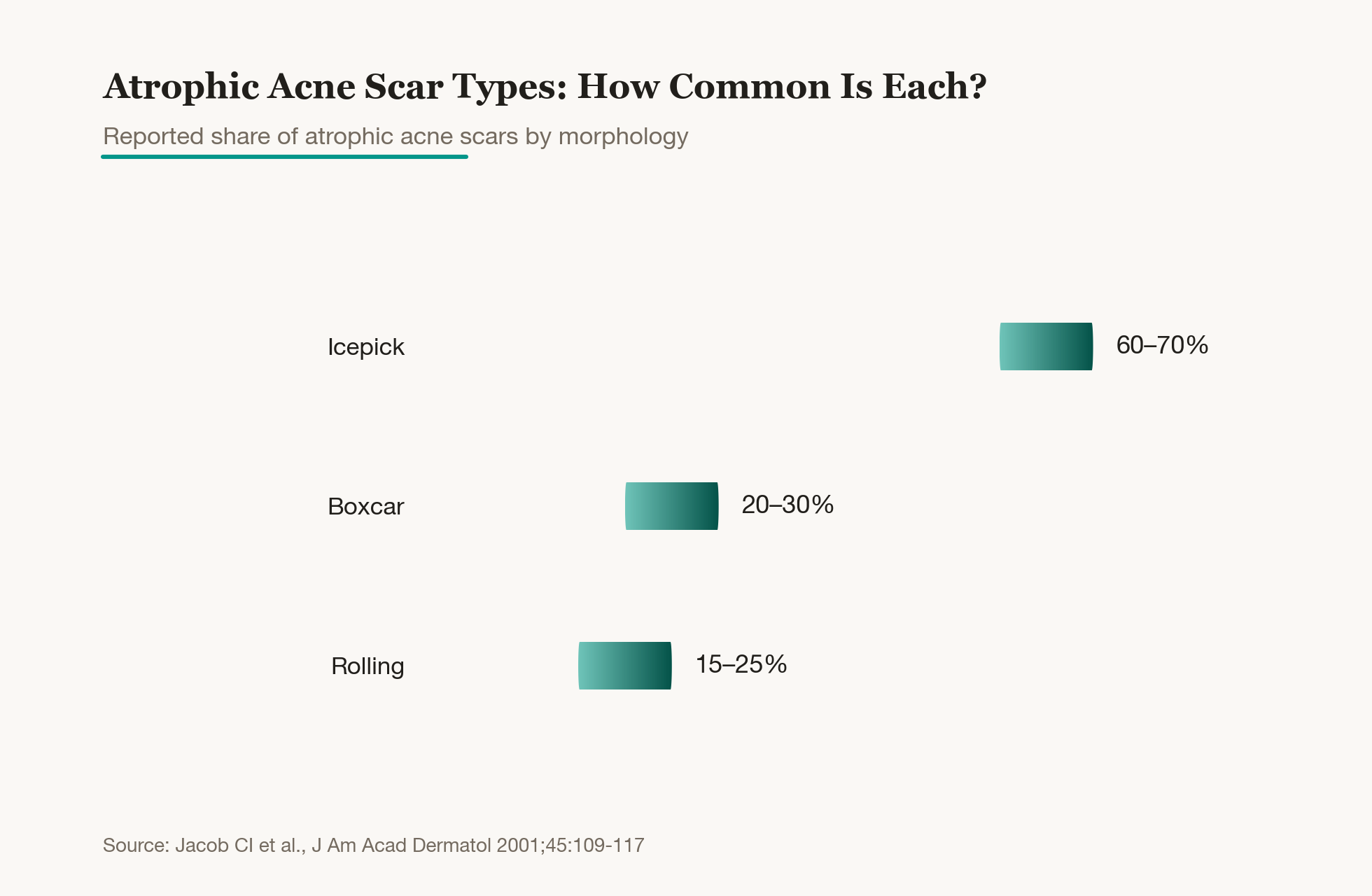
Dermatologists broadly classify atrophic acne scars, meaning scars caused by tissue loss, into three types: ice pick scars, boxcar scars, and rolling scars.
Ice pick scars form when inflammation burrows narrow and straight along a pore, going deep. They are often so narrow, like a well, that they measure less than 2mm across. Boxcar scars form when inflammation spreads a bit wider sideways and eats away at collagen evenly down to a certain depth, leaving sharp, well-defined edges and a flat, basin-like bottom. Rolling scars, on the other hand, are not caused by inflammation itself but by fibrous bands, thin cord-like tissue that forms between the dermis and the fat layer beneath it during healing. These bands pull the skin downward, creating the soft, wave-like undulation on the surface.
Because each type forms through a different route, reversing them requires a different approach too. A scar with a narrow, deep tunnel to fill, a scar with wide walls and a floor that need smoothing, and a scar with a cord pulling from below each call for their own strategy.
Why don't lasers work well on ice pick scars?
Ice pick scars look exactly like their name suggests, as if someone poked the skin with a sharp point. Inflammation burrows straight down around a single pore, damaging only the narrow column of collagen surrounding that tunnel. The width stays narrow, but the depth can reach deep into the dermis, and in more severe cases even close to the fat layer beneath it.
Because of this structure, treatments that only smooth the surface have their limits. Lasers or peels that shave off a thin layer of the surface simply cannot reach the bottom of such a narrow, deep tunnel. It is a bit like widening the mouth of a narrow well while leaving the bottom untouched. That is why ice pick scars need a method that stimulates all the way down inside the tunnel so new tissue can rebuild from the floor up.
How does CROSS fill the bottom of a scar?
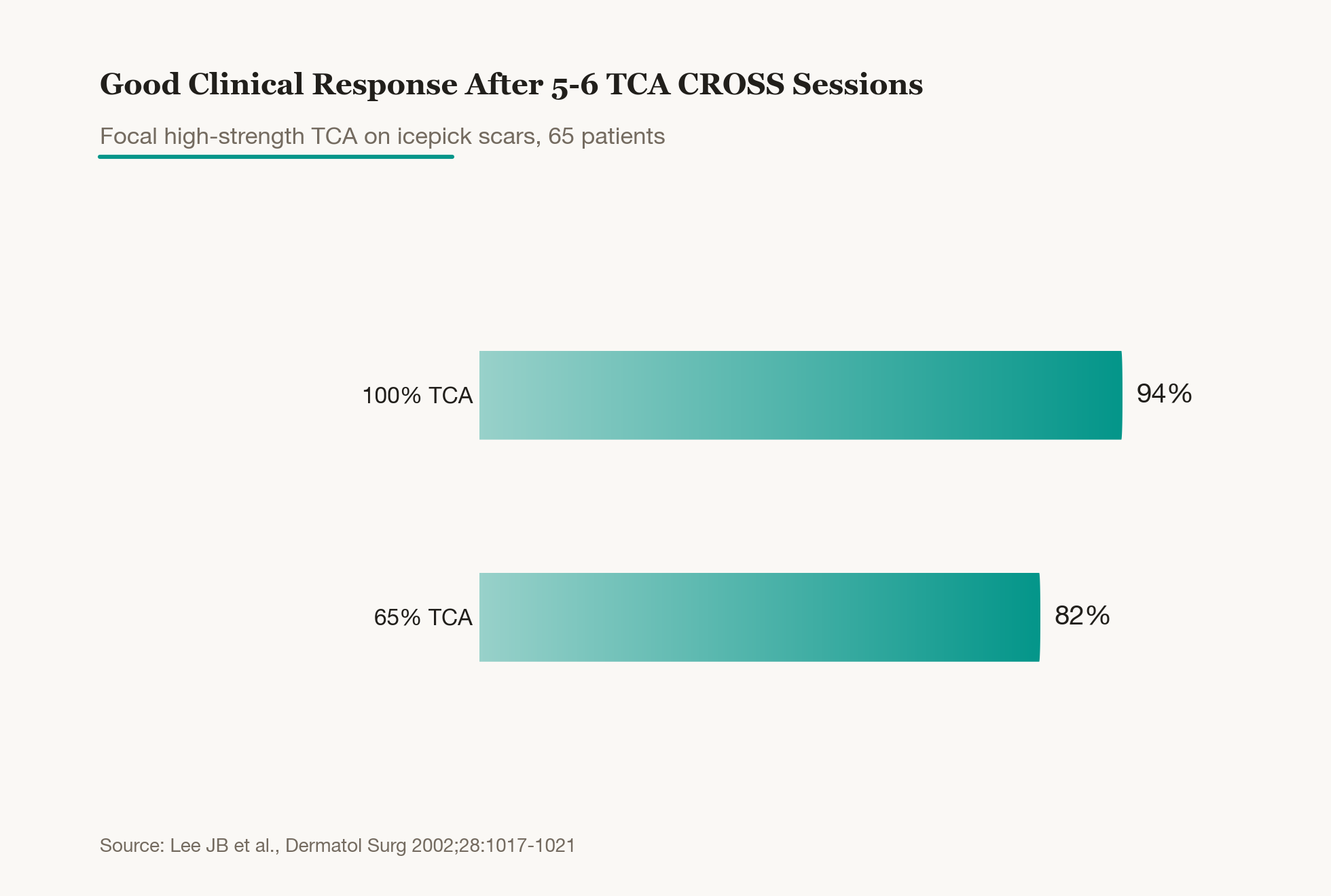
TCA CROSS is a chemical resurfacing technique applied locally and repeated over time. A highly concentrated solution of trichloroacetic acid, at 90 to 100%, is dabbed onto a toothpick or a thin cotton swab tip and pressed directly onto the floor of the scar. Unlike a regular peel that spreads the acid broadly across the skin, the key here is applying it to one narrow point at a time.
Applied this way, a strong chemical injury occurs only within that narrow tunnel, while the surrounding healthy skin is barely touched. As the body heals the damaged spot, new collagen gradually fills in from the bottom of the tunnel, and the scar shallows out over time. Because it can precisely reach deep inside a narrow tunnel, it fits the underlying mechanism of ice pick scars better than a laser that only resurfaces the top. It is typically repeated 3 to 6 times at 2 to 4 week intervals, with the depth gradually reducing session by session.
Boxcar scar features and treatment direction
Viewed from above, boxcar scars stand out for their sharp, well-defined edges. It looks almost as if a small square basin were stamped into the skin, with vertical walls and a flat floor. This shape forms because the inflammation spreads a bit wider sideways than in ice pick scars, eating away at collagen evenly down to a set depth.
They are also further split into shallow and deep boxcar scars depending on depth. Shallow ones can improve noticeably with a treatment that simply resurfaces the skin evenly. Deep ones need the walls and floor addressed together to rebuild collagen, so treatments that use heat or fine needles to stimulate deeper skin layers are usually added. Because the entire area needs to be stimulated evenly, the approach is completely different from ice pick scars, which only need one narrow point treated.
How rolling scars and subcision work
Rolling scars have an entirely different cause from the other two types. Ice pick and boxcar scars form because inflammation directly eats away at collagen on the spot, but rolling scars form when fibrous bands, thin, tough cord-like tissue, develop between the dermis and the fat layer beneath during the healing process. Because these bands keep pulling the skin downward, they create a broad, gentle, wave-like dip on the surface.
For this kind of scar, treatments that only resurface the skin do not help much, since the real cause lies beneath the surface, in the band pulling downward. That is why subcision is used instead. Subcision involves inserting a blunt-tipped needle or a thin cannula under the skin and directly cutting through the fibrous band that is pulling the tissue down. Once the band is released, the depressed skin lifts slightly, and the minor bleeding and healing response triggered in the process stimulates new collagen to fill that spot.
Because it removes the actual cause of the pulling, subcision plays a role in treating rolling scars that is hard to replace with any other procedure. That said, cutting the band alone rarely finishes the job, so it is commonly reported to be followed by volume filling or surface resurfacing treatments as well.
What is the treatment order for mixed scars?
In practice, most faces show all three types mixed together rather than just one. That is why treatment is generally recommended as a combination sequenced around the cause of each scar, rather than a single procedure.
- If rolling scars with fibrous bands are present, subcision is usually considered first. The pulling band underneath needs to be released before resurfacing, so later treatments can actually take effect.
- If boxcar scars with distinct walls and floors are present, treatments using heat or fine needles to stimulate collagen deeper in the skin are added. Evening out a wide area is what softens the scar's edges.
- If narrow, deep ice pick scars remain, TCA CROSS is used to finish that tunnel specifically. It is the method that can reach a narrow, deep floor that other treatments simply cannot touch.
- If actual volume loss remains, filler may be added at the end to restore that volume. Filling after the fibrous bands and surface have already been addressed is known to keep the results more stable.
New collagen takes anywhere from 4 weeks to 6 months to settle in. So rather than judging results after a single session, it makes more sense to plan 3 to 5 sessions spaced 4 to 8 weeks apart. Above all, the first step is to look in the mirror, get a sense of which type your scars are closest to, and consult a specialist familiar with these treatments to plan the right sequence.
References
Korean Dermatological Association, Ministry of Food and Drug Safety (MFDS), American Academy of Dermatology (AAD), and U.S. Food and Drug Administration (FDA).
Was this helpful?
About this article
Written by a practising aesthetic physician and intended for general education — not a substitute for individual medical advice.
Read next
Epidermal Cyst Causes and Symptoms: Why It Refills After Squeezing
If a lump under your skin keeps refilling no matter how many times you squeeze it like a pimple, it may be an epidermal cyst. Here's an easy breakdown of how these cysts form, how they differ from acne, and why the cyst wall itself has to come out to keep it from coming back.
By Dr. Lee

Fraxel for Acne Scars: Effects, Pigmentation, and Side Effects
How fractional lasers like Fraxel work on acne scars, why results differ so much by scar type, how real the PIH risk is on Asian skin, and what the research actually shows about how much improvement to expect: scars soften, they don't vanish.
By Dr. Kim
Acne Scar Treatment by Scar Type: Effects, Downtime and Pigmentation
Acne scars respond differently to treatment depending on whether they are icepick, boxcar, or rolling type. Here is a rundown of the improvement rates and downtime for subcision, fractional CO2, microneedling RF, TCA CROSS, and HA filler, plus the pigmentation risk for Korean skin, backed by clinical research.
By Dr. Lee