Ice Pick Scars: TCA CROSS Effect, Session Interval and Recovery Time
By Dr. Lee7 min read

Even after acne has fully healed, some people are left with a mark on the cheek that looks like it was made with a needle. This kind of scar is called an ice pick scar, and the name fits: narrow on the surface, but surprisingly deep underneath. Patients often notice that these particular scars are much more stubborn than other acne scars, and in practice, common treatments like lasers or fillers rarely fill them in as much as expected. So it's worth understanding why that happens, and which treatments actually reach deep enough to make a difference. Once you understand why the scar ends up so narrow and deep in the first place, it becomes much clearer why some treatments can reach the bottom of it and others simply can't.
Why are ice pick scars narrow and deep?
An ice pick scar is less than 2mm wide, but it tunnels down through the dermis and into the fat layer underneath. At a glance it can look like an enlarged pore, but running a finger over it tells a different story. It feels like a narrow channel punched straight down into the skin, as if something sharp had poked through and left a clean, vertical hole behind.
This shape forms because inflammation burrows deep into the dermis and breaks down the collagen and supporting tissue along the way. Once the inflammation settles, if that collapsed tissue never gets rebuilt, the scar keeps the shape of that narrow tunnel. These scars show up most often on the cheeks, particularly near the nose or along the jaw.
Structural difference from boxcar and rolling scars
Boxcar scars have flat, sharply defined bases, like the bottom of a box. Rolling scars have wide, gently undulating bases. An ice pick scar is structurally different from both: the depth is far greater than the width, so it looks more like a narrow tunnel than a shallow dip.
That structural difference is exactly what determines how hard each scar is to treat. Boxcar and rolling scars have wide enough bases that resurfacing the surface or lifting the tissue underneath is often enough on its own. An ice pick scar is a different story: the channel is too narrow and too deep for a surface-level approach to reach the bottom. It's a bit like trying to fix the inner wall of a well by only smoothing over the opening. From the outside the scars can look similar, but what each one actually needs is completely different.
Why lasers and fillers don't fill them well
Fractional lasers create many tiny zones of controlled damage across the skin's surface to trigger renewal, working mainly on the epidermis and the upper dermis. That's enough to smooth the texture around the rim of the scar, but the energy simply doesn't reach far enough to affect the floor of a deep, narrow channel.
Filler runs into a similar problem. Because it's a soft gel, injecting it into a narrow, deep channel often means it doesn't hold its shape and instead disperses into the surrounding tissue. Subcision, which uses a needle to release the fibrous bands tethering the skin from underneath, works well for rolling scars precisely because those scars are caused by a band pulling the skin down. An ice pick scar usually isn't caused by a pulling band at all. It's just a narrow hole, so there's often nothing to release in the first place. That's why all three of these common approaches tend to underdeliver against ice pick scars specifically.
How does TCA CROSS fill the scar?
TCA CROSS stands for chemical reconstruction of skin scars using trichloroacetic acid, which is exactly what it sounds like: using a chemical to rebuild the tissue inside the scar itself. The technique itself is fairly simple. A fine, toothpick-like applicator is dipped in a high concentration of TCA, usually somewhere between 65% and 100%, and pressed directly into the base of the scarred channel.
The key detail is precision: the acid is applied only inside that narrow opening, barely touching the healthy skin around it. Wherever the high-concentration acid lands, the skin turns white, a reaction called frosting, which signals that controlled damage has reached that depth of tissue.
The body reads this as an injury and switches on its repair response. Fibroblasts, the cells in the skin responsible for producing collagen, migrate down to the floor of the channel and start laying down new collagen, and over time that sunken floor is gradually pushed back up. The narrowness of the opening is actually the whole point here, since it lets the acid stay contained exactly where it's needed.
Think of it like refilling a narrow flowerpot with soil. If the opening is wide, poured soil just spreads out sideways and thins out. If the opening is narrow, whatever you pour in stays stacked up inside. TCA behaves the same way: because the reaction is confined to that narrow channel, it can trigger repair at the base of the scar without spreading damage across the surrounding healthy skin.
How many weeks apart are sessions?
The treatment is done scar by scar, with the applicator tip touched down like a dot on each one individually. So the total session length depends mostly on how many scars are being treated, though no single spot takes very long.
One session usually isn't enough to fill the channel completely. Building new collagen takes time, and a single round of stimulation rarely closes the full depth on its own. That's why sessions are typically spaced 4 to 6 weeks apart and repeated several times.
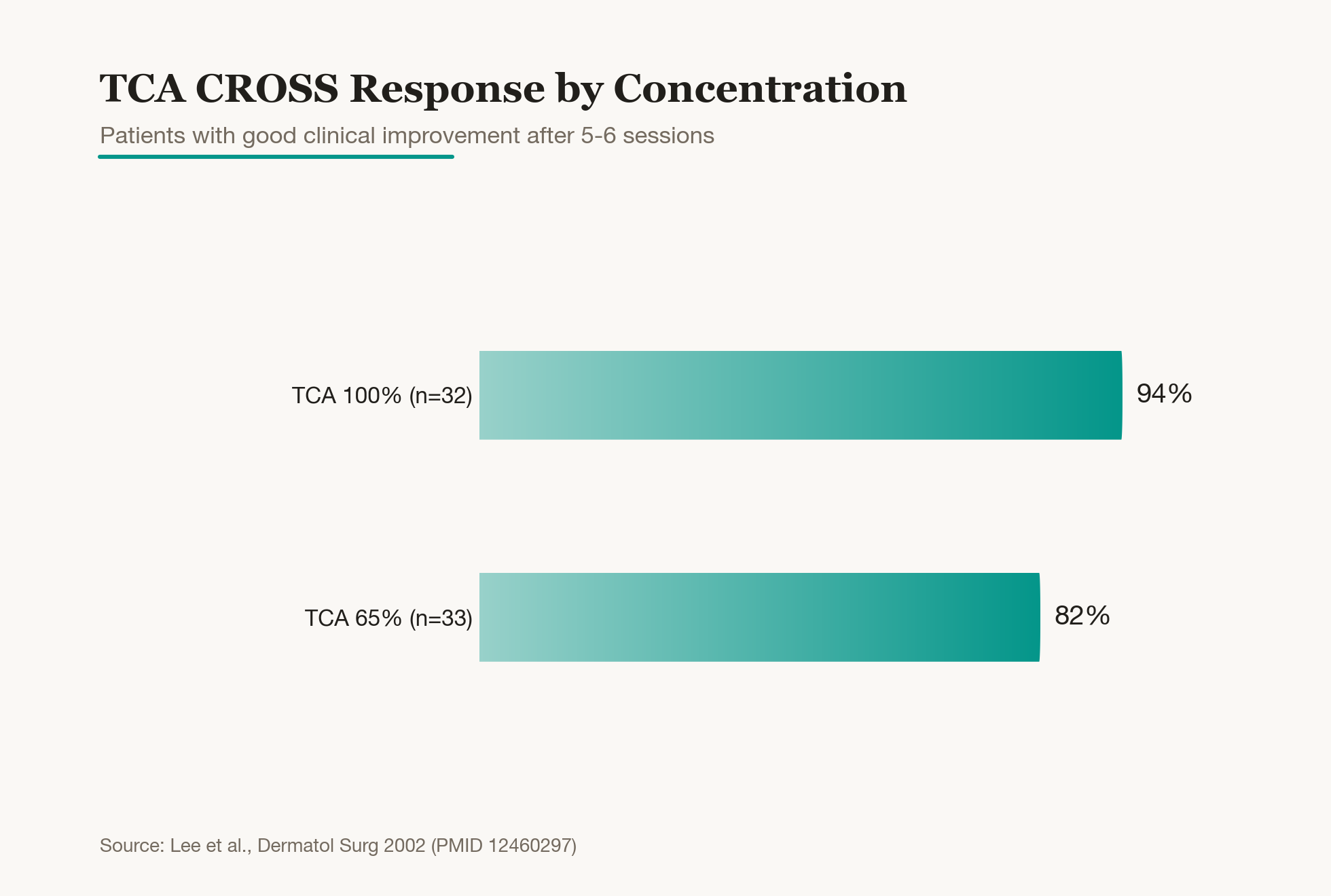
In one study, noticeable improvement was reported in about 82% of patients treated at a 65% concentration, and about 94% at 100% concentration. A pooled analysis of multiple studies found that a large share of patients saw more than 70% improvement in scarring after completing 4 sessions. These figures do vary from person to person depending on scar depth, number of scars, and overall skin condition.
Scabbing and recovery time after treatment
Right after treatment, a small scab forms over each spot that was treated. These scabs typically fall away naturally within 5 to 7 days. During that window, it's important not to pick at them. New tissue is still settling in underneath, and forcing a scab off early can disrupt that process.
Once the scab clears, the area can stay pink or brown for a while, and this discoloration tends to linger longer in people with darker skin tones. That's why diligent sun protection matters more than usual in the weeks after treatment.
Visible improvement doesn't stop once the scab falls off. Because collagen builds up slowly, the gradual rise of the channel floor typically shows up over 4 to 12 weeks. And even after the full treatment course wraps up, many patients continue to see gradual improvement for another 6 to 12 months.
What if you have mixed scar types?
If ice pick scars are the only concern, TCA CROSS alone can be enough. In practice, though, most faces have more than one type of scar at once, so it's often paired with other techniques depending on the situation.
- Combined with fractional laser: the laser handles overall skin texture and shallower scarring, while TCA CROSS focuses on the deep ice pick scars, letting each technique cover the other's weak spot.
- Combined with subcision: if there's also a fibrous band pulling the skin down, as with rolling scars, it's typically released first, and TCA CROSS is then applied to whatever narrow channel remains.
- Combined with punch techniques: for scars where the channel is unusually wide and deep, a small punch elevation or excision may be done first, with TCA CROSS reserved for the remaining narrower scars.
Sorting scars this way, and matching the treatment to the type, tends to produce a more even overall result than relying on a single technique across the board. That said, which combination makes sense really comes down to examining the scars directly.
References
Korean Dermatological Association, American Academy of Dermatology (AAD), and Ministry of Food and Drug Safety (MFDS).
Was this helpful?
About this article
Written by a practising aesthetic physician and intended for general education — not a substitute for individual medical advice.
Read next

TCA CROSS Effect: How Many Sessions for Icepick Scars?
TCA CROSS places high-concentration acid precisely at the base of narrow, deep ice pick scars to trigger fresh collagen growth right where it's needed. Here's why this method works so well for narrow scars, how the scar gradually fills in, and why it takes multiple sessions to see results.
By Dr. Kim

TCA CROSS for Icepick Acne Scars: Effect and Pigmentation Care
What TCA CROSS is, why it outperforms laser on narrow deep icepick scars, how concentration affects outcomes, how proper prep slashes post-inflammatory hyperpigmentation risk, and how to combine it with other treatments, all backed by clinical study numbers.
By Dr. Lee

Filorga NCTF 135 Ingredients and the Difference From Water-Glow Injections, Including Sessions and Interval
Filorga NCTF 135 is a mesotherapy treatment that delivers vitamins, amino acids, minerals, and hyaluronic acid, dozens of ingredients in a single syringe, straight into the dermis. Here's a principle-first look at why so many ingredients are mixed together, what each one actually does in the skin, and how this differs from a classic skin booster.
By Dr. Kim