Warts on Hands and Feet and Corns: How to Tell Them Apart and Treat Them
By Dr. Kim8 min read
If a bumpy growth on your hand or foot won't go away and keeps getting bigger, you should suspect a wart. It's easy to mistake for a callus or corn and just leave it alone, but a wart starts from a completely different place than simple thickened skin. A virus gets into the keratin-forming cells on the skin's surface, sets up shop there, and hijacks those cells to copy itself. That's the lesion you're seeing.
That's also why rubbing or shaving it down doesn't make it disappear. The thick, visible layer of skin is just the byproduct the virus leaves behind. As long as the infected cells underneath are still there, the growth comes right back. Let's walk through why warts show up on hands and feet, why they're so often confused with corns, and what actually helps.
How Does the Wart Virus Get In?
The virus that causes warts is the human papillomavirus, better known as HPV. As the name suggests, it only grows in human skin cells, and the strains that cause hand and foot warts are different from the ones that show up elsewhere on the body. Different strain, different favorite location, different look.
This virus can't punch through intact skin. It needs a tiny opening you'd barely notice, like a micro-crack in the calluses from walking barefoot, or a hangnail near the nail bed. Think of it like a lock that's just slightly loose letting someone slip through. Once inside, the virus burrows into cells in the basal layer, the deepest layer of the skin.
Basal layer cells normally have one job: keep churning out new skin cells. The virus hijacks that replication machinery and forces the cell to copy the virus's own genetic material right along with itself. The cell isn't dividing for its own sake anymore, it's dividing to serve the virus. The infected cells multiply at an abnormal rate, and the result is a raised bump pushing up from the skin: a wart.
Why Are Warts Hard Like a Callus?
Hand and foot warts tend to look unusually hard and thick because the infected spot is already an area where skin naturally builds up keratin. Palms and soles carry body weight and absorb constant friction, so the outer layer is thicker there to begin with. Add a virus pushing cell growth into overdrive, and that layer piles up even more.
On the sole, body weight also keeps the wart from rising outward, so it gets pressed inward instead. Keratin keeps forming over the pressed-down lesion, and the surface ends up looking like a hard callus, even though an actively multiplying viral lesion is still sitting underneath. If you mistake it for a plain callus and put off treatment, the infection can quietly spread sideways under the surface.
How fast the keratin builds up also varies from person to person. If your skin naturally thickens easily, or the spot rubs constantly against a shoe, the buildup happens faster and denser. That's why the same type of wart can feel noticeably harder on a pressure point like the heel than elsewhere.
How Do You Tell a Corn From a Wart?
Calluses, corns, and warts on the sole can look similar at a glance, but their causes and growth patterns are not the same. A corn forms from repeated friction and pressure compacting the skin, and has nothing to do with a virus. A wart, on the other hand, comes from a viral infection, which is exactly why it can spread to nearby skin.
Here are a few clues worth checking for:
- Tiny black dots on the surface: Shave the surface of a wart down slightly and you'll often see several small black specks. These are traces of tiny blood vessels that have clotted off inside the lesion, something you won't find in a corn, which has no blood supply of its own.
- Direction of skin lines: A wart grows in a way that interrupts the natural pattern of surrounding skin, since the infected cells multiply in a different direction and at a different speed than normal skin. A corn simply follows the existing skin lines.
- Pain when pressed from the sides: Squeezing a wart gently from both sides often triggers pain, because the tissue inside the lesion gets irritated under that pressure. A corn, by contrast, tends to hurt when pressed straight down from above, right at its center.
- Number and spreading pattern: Warts commonly multiply over time, with small new ones popping up around the original. That's the virus reaching tiny breaks in nearby skin and starting fresh lesions. Corns usually stay solitary at whatever spot takes the most pressure.
Why Do Some Clear on Their Own While Others Linger?
The single biggest factor in whether a wart clears up or sticks around is the body's immune response. Recognizing and clearing out virus-infected cells is ultimately the immune system's job. Once immune cells fully recognize the infected site, the wart gradually shrinks and disappears.
This is also why children get warts often and tend to clear them relatively well. Growing bodies are actively building immune responses to new viruses, so the body more often ends up recognizing and clearing the infection over time. On the flip side, conditions that suppress immune function, like diabetes, chronic illness, or immunosuppressant medication, slow down that clearing process, making warts more likely to linger or multiply.
For the same reason, hand and foot warts often don't disappear for good in one go and can come back. Removing the visible lesion doesn't help much if virus already established in the surrounding skin is still there, since it can resurface as a new lesion later. Treatment, then, works on two fronts at once: clearing the visible growth while helping the body's own immune response finish off the infected cells.
How Each Treatment Works
There are several treatments for hand and foot warts used in clinics, and each works a little differently. Here are the common ones and the logic behind them.
- Salicylic acid: Salicylic acid dissolves keratin. Applied daily, it gradually strips away the thickened outer layer while slowly irritating the infected cells underneath enough to draw out an immune response. Results build up with consistent, repeated use.
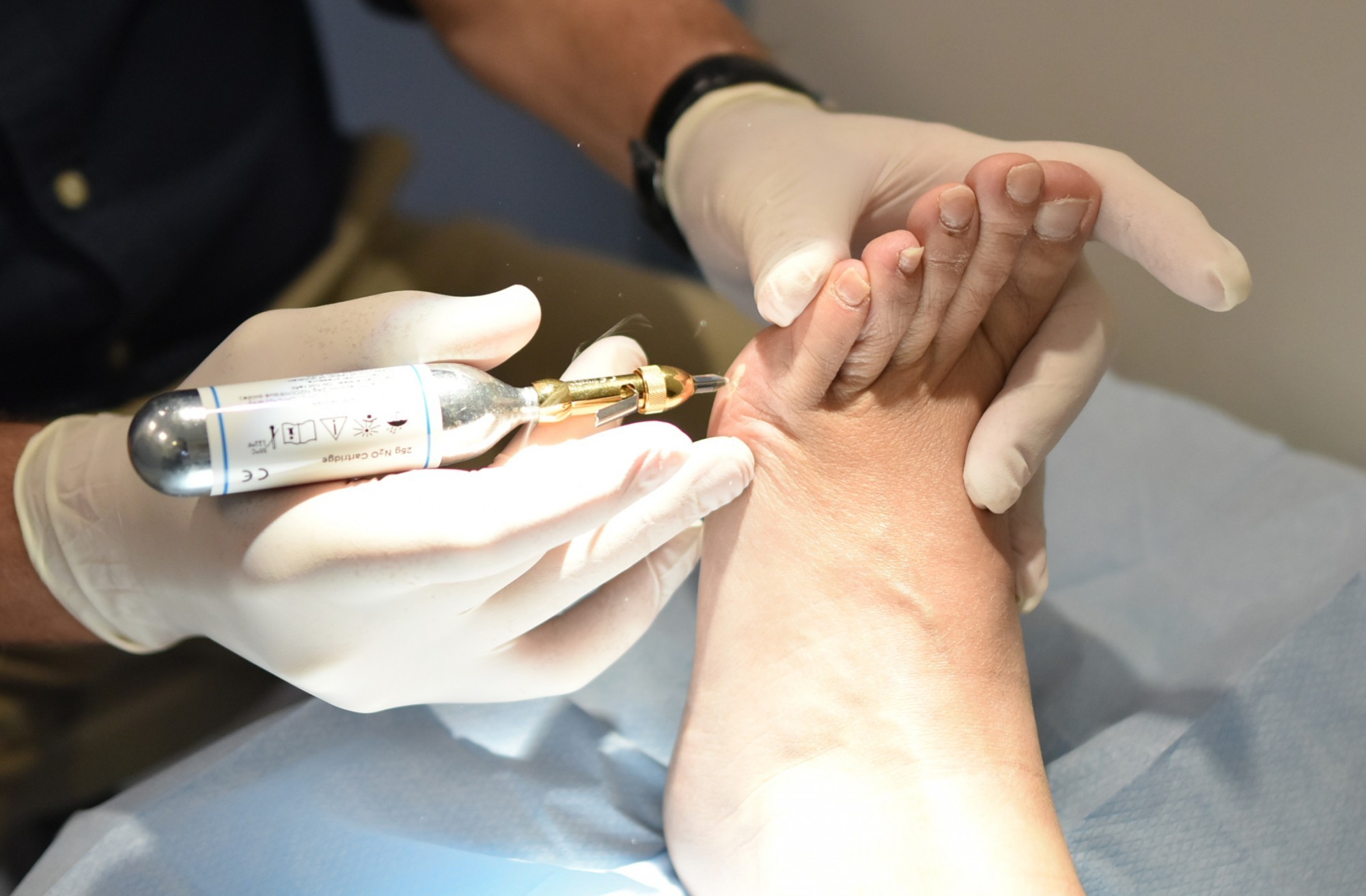
- Cryotherapy: Liquid nitrogen freezes the lesion instantly. As the tissue freezes and thaws, infected cells get damaged, a blister forms at the site, and the lesion sloughs off along with it. Clearing out the damaged tissue also stirs up an immune response.
- Electrocautery or laser ablation: This physically removes the lesion by burning or vaporizing the tissue. It's a direct and reliable way to eliminate infected tissue, but given the recovery time and scarring risk, it's usually reserved for when other methods haven't worked.
- Immunotherapy targeting the local immune response: A substance is applied to or injected into the lesion to artificially rev up the immune response right at that spot. The idea is to make the body strongly recognize the area as foreign material, prompting it to hunt down and clear the infected cells on its own.
Whichever method is used, it usually takes several sessions rather than one. Infected cells sit deep within the skin, so clearing them out has to happen step by step from the surface inward.
How Can You Prevent Warts?
Hand and foot warts spread more easily than a lot of other skin conditions. The virus can survive for a fair stretch of time on skin surfaces, especially in damp, keratin-rich areas. Places like pool decks or shared shower floors, where a lot of people walk barefoot, are exactly the kind of environment where the virus travels easily between people.
A few habits go a long way for prevention:
- Limit bare feet in shared spaces: Wear sandals at pools, saunas, and public showers. The longer bare feet sit on a wet floor, the more chances there are to come into contact with the virus.
- Keep personal items to yourself: Avoid sharing nail clippers, towels, socks, and shoes with others, since the virus can cling to surfaces and transfer that way.
- Don't scratch or pick at the lesion: Picking at a wart with your fingers or cutting into it with a sharp tool can push the virus into surrounding skin or onto other fingers through the fresh wound. Every new micro-cut is just another entry point for the virus.
- Keep feet dry: Damp, softened skin is easier for the virus to penetrate. Changing socks often and drying your feet thoroughly can lower infection risk on its own.
If someone in your household has a hand or foot wart, it also helps to avoid sharing bath mats or slippers. Kids in particular tend to pass it along through casual contact while playing, so it's worth being extra mindful of these habits while a lesion is active.
References
Korean Dermatological Association, American Academy of Dermatology (AAD), and Ministry of Food and Drug Safety (MFDS).
Was this helpful?
About this article
Written by a practising aesthetic physician and intended for general education — not a substitute for individual medical advice.
Read next

Tiny Facial Bumps: How to Tell Flat Warts, Milia and Skin Tags Apart, and How to Treat Them
The small bumps that show up on the face can look alike, but flat warts, milia, and skin tags have different causes and different treatments. Here is how to tell the three apart at a glance, the right CO2 and Er:YAG laser or electrocautery approach for each, how common they are, how they tend to recur, and real evidence on why removing them at home is risky.
By Dr. Lee
Stretch Mark Treatment: Does Starting While They're Red Work Better?
Stretch marks form when skin stretches too fast for the collagen pillars in the dermis to keep up, and they tear. Here is why red marks fade into white ones over time, and why treatment response changes depending on when you start.
By Dr. Kim

Flat Wart Causes and Symptoms: Why They Spread When Squeezed, and Treatment
Flat warts are a viral skin condition, so picking or scratching at them doesn't clear them up, it spreads them further. Here's why that happens, how to tell them apart from moles or acne, and the logic behind removal and preventing recurrence.
By Dr. Kim