Samurai Brows After Forehead Botox: Causes, Correction and Prevention
By Dr. Lee9 min read

Sometimes you get forehead Botox, look in the mirror, and notice that while the inner brow sits normally, the outer tip has shot up into a sharp point, giving you an angry expression. This is commonly called samurai brow. In English it's also known as Spock brow, after the pointed eyebrows of the Star Trek character.
It can be unsettling to see, but in most cases nothing went wrong with the treatment. It's simply a common shape change that shows up as the Botox takes effect. Once you understand the mechanics, it's easy to see why only the outer brow rises, how a small touch-up corrects it, and how to prevent it in the first place. Left alone, it often resolves on its own as the Botox wears off. Here's what's actually behind the odd brow shape that can follow forehead Botox, and how to fix it, based on real clinical literature.
What Are Samurai Brows?
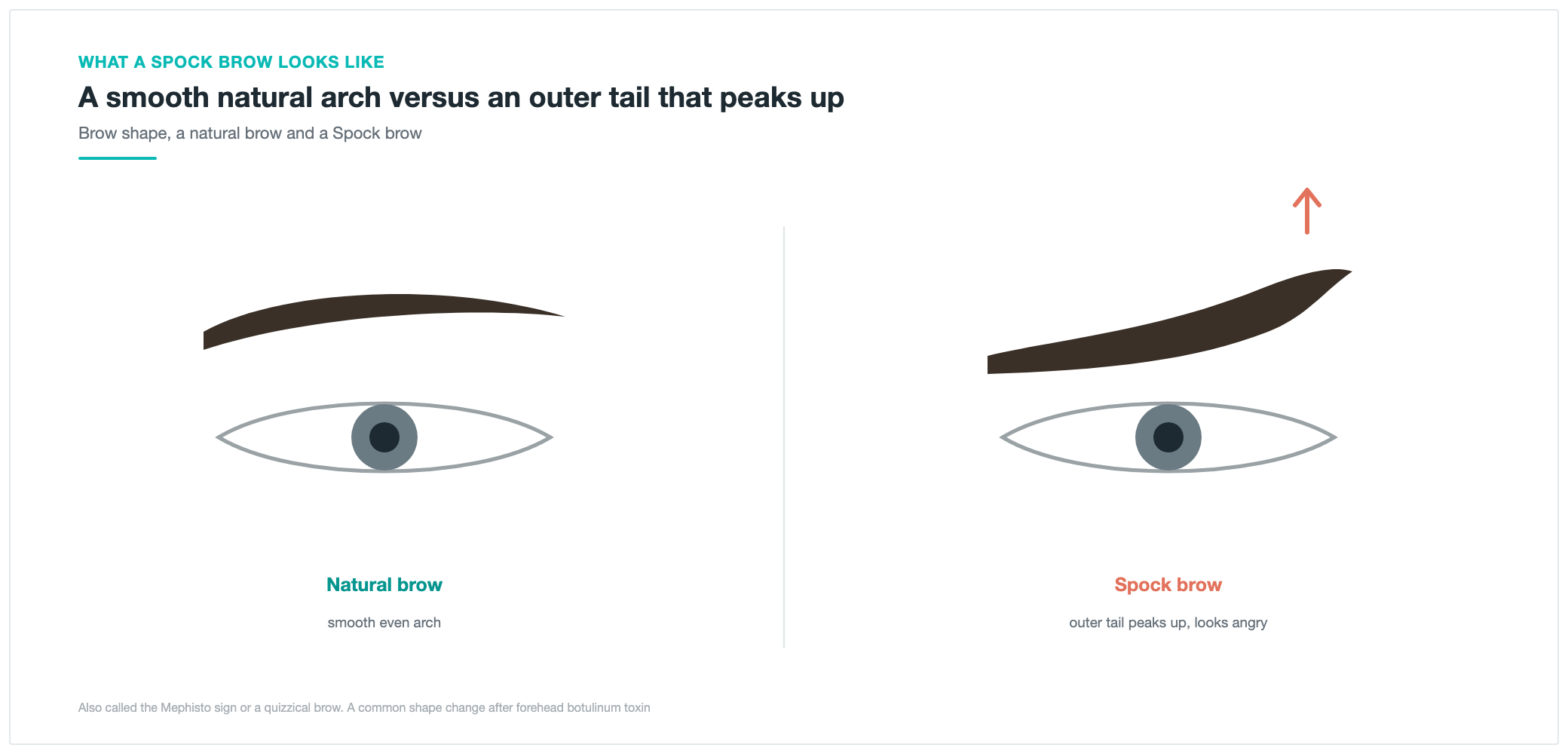
Samurai brow refers to the outer end of the eyebrow rising higher than the inner end after forehead Botox. The brow bends upward like a hook, creating an angry or suspicious expression, and sometimes even a slightly sinister one. It's one of the most recognizable shape changes that can follow forehead Botox.
English speakers use several names for it: Spock brow, after the pointed brows of the Star Trek character, and the Mephisto sign, a nod to the devil in the opera Faust, both describe the same thing. It's also called quizzical brow or surprised brow. Having so many names is itself a sign of just how common it is.
The important thing to understand is that this isn't a medical problem, just a temporary imbalance in muscle strength. Most of the time it clears up quickly with a small touch-up, and even without treatment it resolves on its own as the Botox wears off. So rather than panicking in front of the mirror, it helps to understand why the shape shows up in the first place. If it's your first time getting forehead Botox, this look can show up briefly while the effect settles over the first two weeks, and knowing that ahead of time makes it much less alarming. Here's the mechanism behind it.
Why Does Only the Outer Brow Lift?
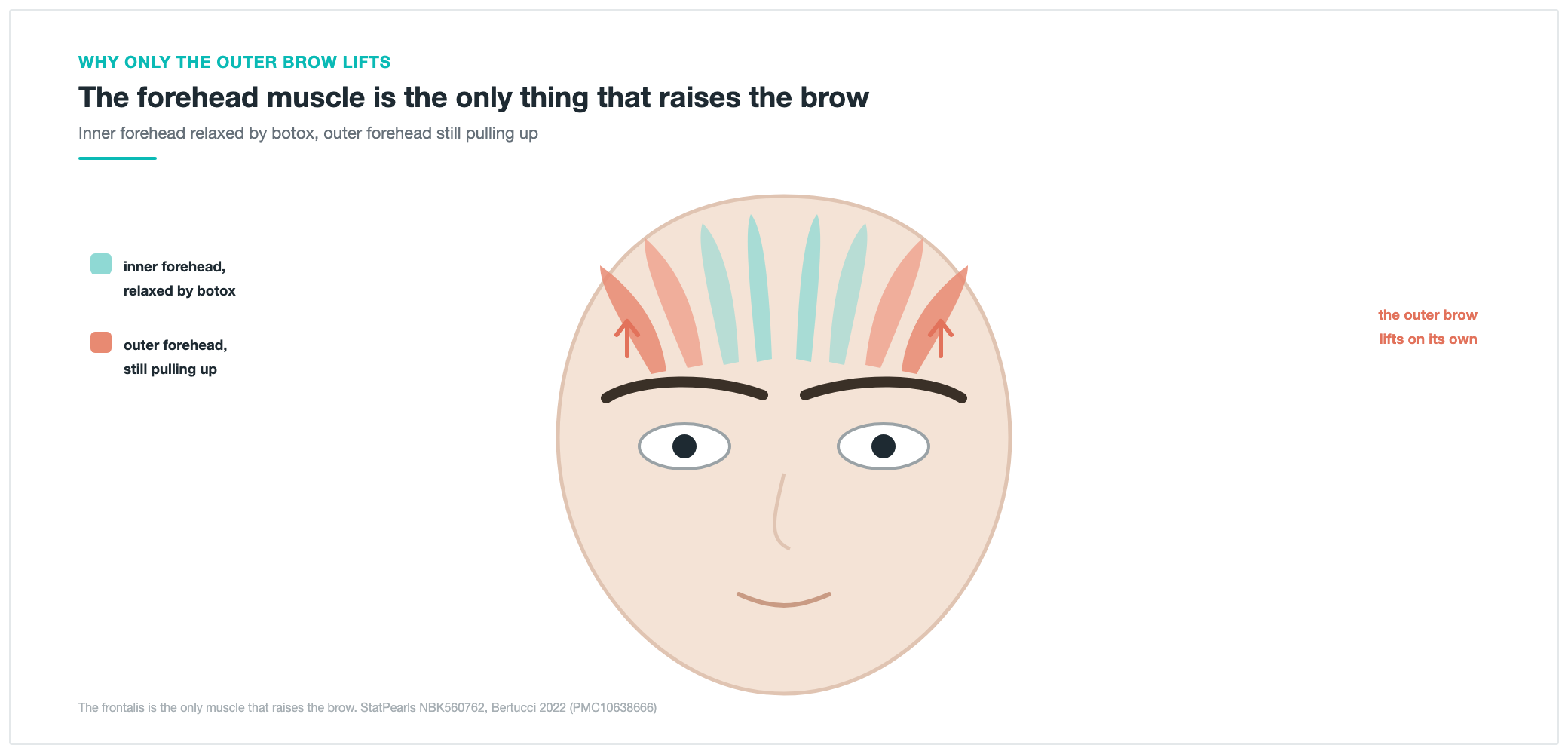
Only one muscle lifts the eyebrows: the frontalis, which covers the entire forehead. The muscles that pull the brow down, on the other hand, are numerous and sit around the glabella and the eyes. Where your brow ends up sitting is simply a matter of balance between that single lifting force and all those downward forces.
Forehead Botox works by relaxing the frontalis to smooth horizontal forehead lines. But sometimes the central, inner part of the forehead receives a strong enough dose to relax fully while the outer portion of the muscle gets relatively less. When that happens, the inner brow loses tone and drops, while the outer frontalis keeps working and pulls the outer brow up on its own. That's what samurai brow really is.
The root cause is an imbalance: too much relaxation on the inside and too little on the outside. It tends to happen when injection points don't reach far enough toward the outer forehead, or when that area gets skipped entirely. Anatomy plays a role too, since frontalis muscle shape varies from person to person. Someone whose frontalis splits into two separate bellies down the middle is more prone to brow sagging or an uneven shape, and it helps if the injector factors that variation into where they place the doses. Once you understand that the cause is an imbalance, it makes sense that the fix is about restoring balance too.
How Is an Over-Lifted Brow Corrected?
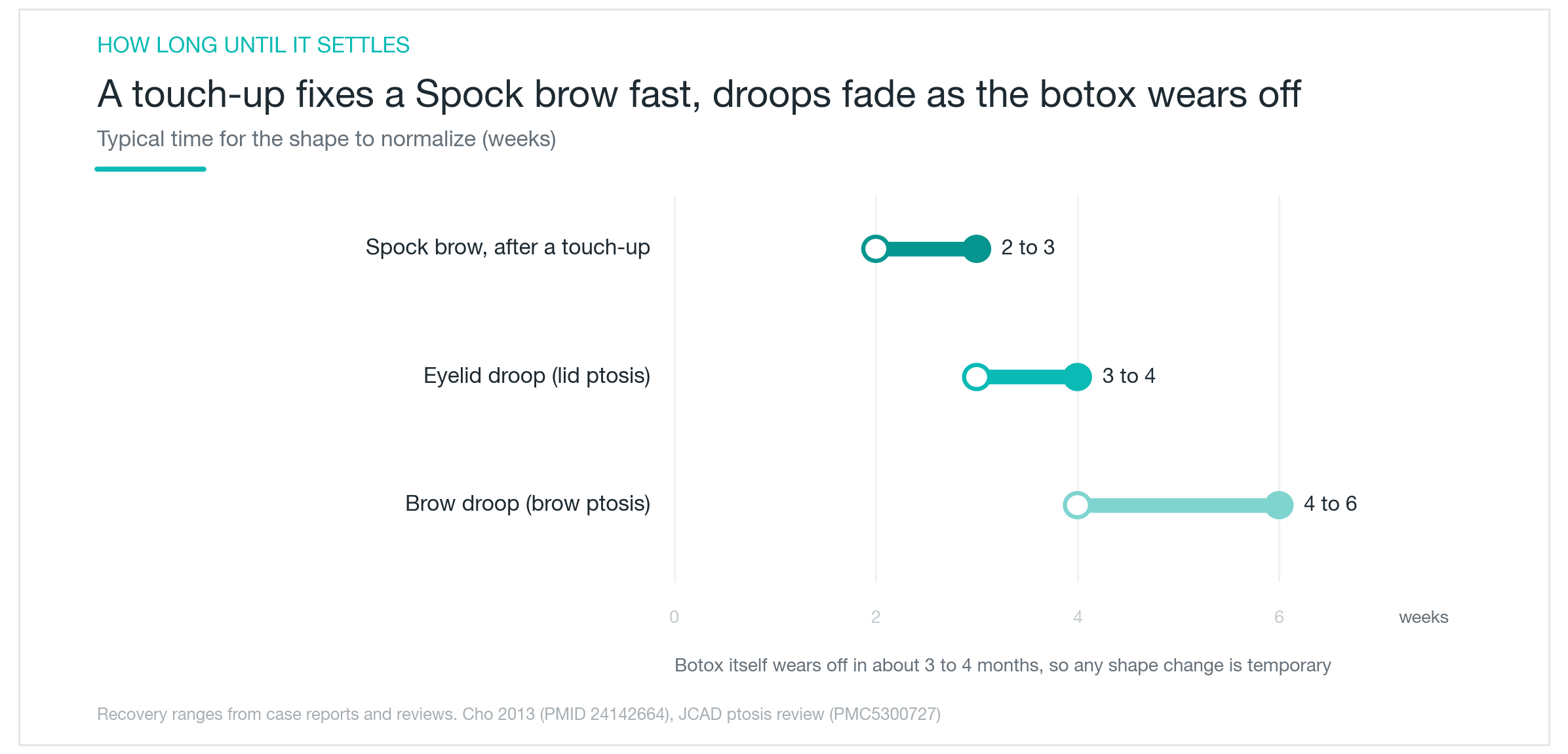
The fix is simpler than it sounds. You just add a small amount of Botox above the raised outer brow, right into the outer frontalis that's still working overtime. In documented cases, adding a small dose (around 2 to 4 units on each side at the outermost forehead point) brought the brow shape back to normal within two to three weeks. Since the inner forehead is already well relaxed, this is really just a small correction on the outside.
Timing matters here. Botox takes time to reach its full effect, so rather than rushing to correct things based on how it looks right after the appointment, the standard approach is to wait around two weeks until the final shape has settled, then add just what's needed. Overcorrecting too quickly with too much can flip the problem the other way and cause the brow to droop instead.
If sagging has already happened, there's no medication that reverses it. But since Botox wears off over time, it usually resolves on its own within a few weeks. So samurai brow is, in most cases, correctable with a small touch-up, and even in the worst case, it's a problem that time takes care of. One more practical note: it's best to get that touch-up from wherever you got the original treatment, since knowing exactly what was injected and where makes it much easier to correct the balance without overdoing it.
Injection Techniques That Prevent Samurai Brows
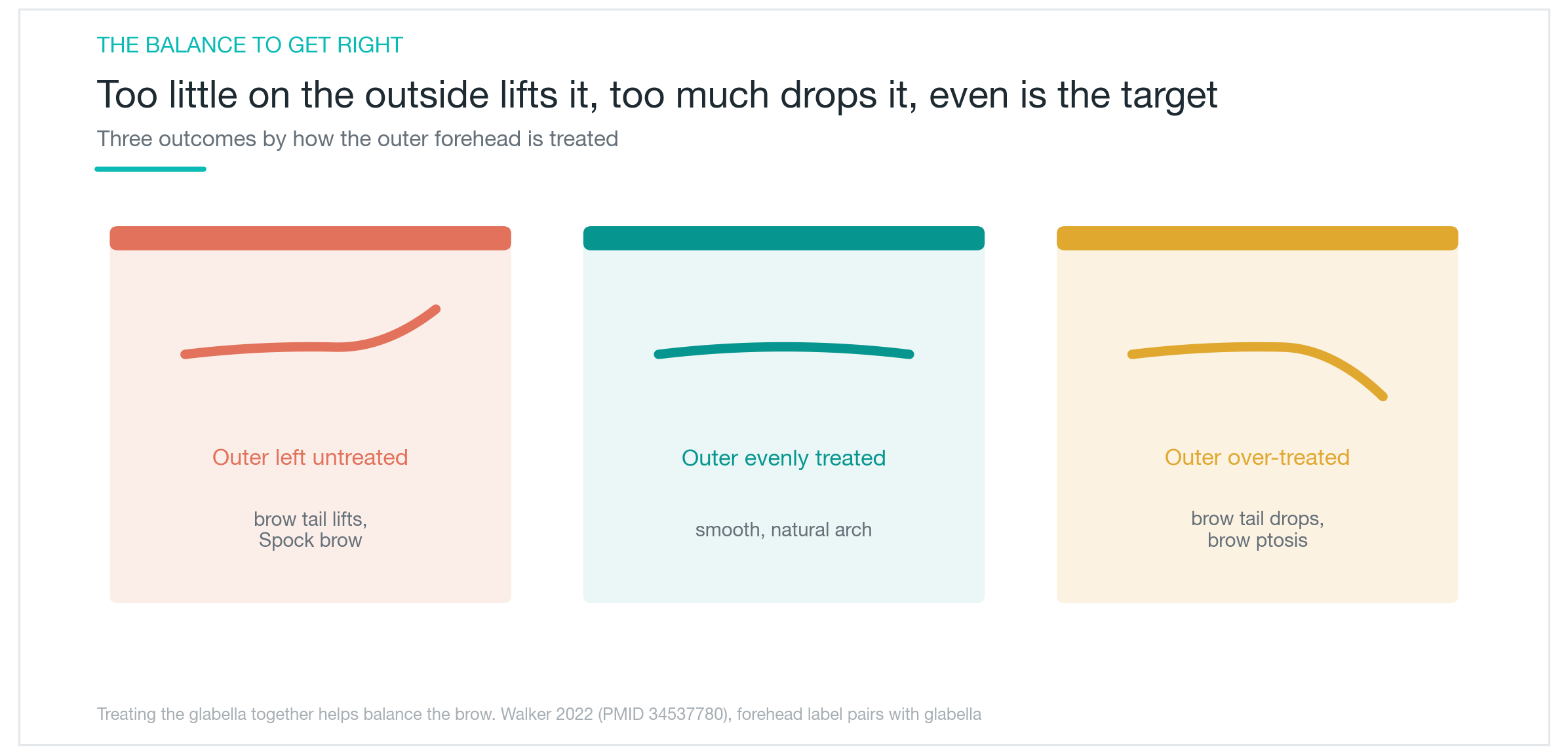
The key to prevention is treating the outer frontalis just as evenly as the rest of the forehead, in the right amount, right from the start. Extending the injection points far enough toward the outer edge of the forehead to relax the inner and outer muscle together keeps the outer brow from compensating by rising on its own.
There's a balance to strike here. Too little relaxation on the outside causes samurai brow, while too much Botox on the outside, or placement too low, causes the outer brow to droop instead. So the goal isn't simply injecting more; it's injecting just the right amount, evenly. Finding that balance point is really where an injector's skill shows.
Another practical tip is to treat the glabella along with the forehead rather than the forehead alone. Balancing the downward-pulling glabellar muscles against the upward-pulling frontalis lowers the risk of brow droop. In fact, forehead Botox is approved on the premise that the glabella is treated at the same time. This balance matters even more with age. Someone who's been relying on the frontalis to help hold up their eyelids can end up with heavy-feeling eyes if the forehead alone is strongly relaxed, so a lower dose combined with glabella treatment is the safer approach.
How Is Brow Droop Different From Eyelid Droop?
There are two distinct kinds of droop after Botox, and it's worth telling them apart. One is brow ptosis, where the eyebrow itself sits lower than its original position because the lifting frontalis has been weakened. The other is eyelid ptosis, where the upper eyelid drops and the eyes look smaller, caused by Botox spreading into the muscle that lifts the eyelid. This mostly happens when glabella injections go in too close to the midline or too deep.
There's a simple way to tell them apart. Gently lift the eyebrow up with your finger. If the droopy-looking eyelid improves, it's brow ptosis. If the eyelid still looks droopy, it's true eyelid ptosis.
Neither condition has a true antidote, but both resolve over time as the Botox wears off. Eyelid ptosis usually clears up within a few weeks, while brow ptosis tends to take a bit longer. If eyelid ptosis is bad enough to be bothersome, eye drops that temporarily assist the eyelid muscle are sometimes used, though most cases simply improve on their own with time. Samurai brow, unlike either of these, isn't a droop at all; it's the outer brow rising too much, and a small touch-up dose is enough to bring it back into balance.
Here's a quick side-by-side of all three.
| Condition | What It Looks Like | Cause | Fix | Recovery Time |
|---|---|---|---|---|
| Samurai brow | Only the outer brow tip rises | Outer frontalis under-relaxed | Add 2 to 4 units outside | 2 to 3 weeks after touch-up |
| Brow ptosis | Entire brow drops | Frontalis over-relaxed | Wait it out | About 6 weeks |
| Eyelid ptosis | Upper eyelid drops | Botox spread into eyelid muscle | Wait it out, drops if needed | 3 to 4 weeks |
Will It Go Back to Normal on Its Own Over Time?
In most cases, it simply resolves on its own with time. Botox effects typically begin to show within 3 to 5 days, peak around the two-week mark, and gradually wear off over 3 to 4 months. Even if samurai brow shows up, leaving it alone lets the effect fade and the muscle balance return to normal on its own.
So there are really two ways to handle it. If you want it corrected quickly, wait about two weeks until the shape settles, then add a small touch-up dose outside to rebalance things. If you're not in a hurry, waiting a few months lets it resolve naturally. Either way, it's not a permanent problem. And next time you get the same area treated, having the outer forehead dosed evenly makes it less likely to happen again.
If samurai brow is a concern, the things to remember are simple: get the outer forehead treated evenly from the start, treat the glabella at the same time, and follow up around two weeks later for a small correction if needed. It's a common shape change, but almost always an easy fix, so it's better to understand the mechanics than to worry about it. Mentioning the brow shape you're going for at your initial appointment lets the injector plan the placement accordingly. And if your brows end up looking off, the most reliable move is simply to go back to wherever you had the treatment done and have it looked at.
Was this helpful?
About this article
Written by a practising aesthetic physician and intended for general education — not a substitute for individual medical advice.
Read next

Trapezius Botox Effect and Duration, Including Side Effects and Who It Suits
Trapezius Botox, known as Bobby Botox, relaxes the muscle at the top of the shoulders to make the neck look longer and the shoulder line smoother. Here is an easy, research backed look at how it slims the shoulders, how long results last, whether shoulder weakness or other side effects show up, and who makes the best candidate.
By Dr. Kim
Crow's Feet Botox: Effects, Duration and Dose
A clear look at how crow's feet Botox works. It eases the orbicularis oculi muscle that creases the outer eye corner when you smile, softening the lines it leaves behind. This guide covers the standard 24-unit dose split across both sides, where the injections go, when results show up, the roughly four-month duration, the limits for deep static wrinkles, and side effects, all backed by real clinical study numbers.
By Dr. Kim

Tyndall Effect From Under-Eye Filler: Causes of the Blue Cast and How to Fix It
Some people notice a bluish tint under their eyes at certain angles after getting filler. This happens because of the Tyndall effect, light scattering off filler particles. Here is why it shows up so often under the eyes, and how to prevent or reverse it.
By Dr. Kim