Skincare Ingredients in Your 30s: How Do Retinol and Niacinamide Differ?
By Dr. Lee6 min read

Ask around and you will hear the same story from a lot of people in their 30s. One day they look in the mirror and their skin just looks different. Fine lines show up around the eyes, the overall tone looks duller, and makeup does not sit the way it used to.
But skin does not change overnight. What is really happening is that very slow changes have been building since your 20s, and they only cross into visible territory now, which is why it feels sudden. Understanding 30s skincare starts with understanding that lag. Why does the damage start early while the awareness comes late? Let's walk through the mechanism step by step.
Why Does Skin Suddenly Change in Your 30s?
Skin aging is not a switch that flips on one day. It starts with turnover, the time it takes for new epidermal cells to form and shed as dead skin, gradually getting slower as we age.
In your 20s, this cycle is short enough that damaged cells get replaced quickly. From your 30s on, that replacement slows down, so cells damaged by UV or irritation stay on the skin longer than before. It is a bit like a factory where quality control starts working more slowly, so defective parts start piling up in the warehouse.
Layer on top of that the sun exposure and lifestyle habits that accumulated through your 20s. Once that invisible buildup of damage outpaces your skin's own repair capacity, the changes finally become visible. So what shows up in your 30s is less something new and more something that was already underway, finally coming to the surface.
Why Does Collagen Decrease?
Collagen, the protein that gives skin its firmness, is continuously produced by fibroblasts (the collagen-making cells in the dermis) while MMPs (matrix metalloproteinases, enzymes that break down old collagen) clear out worn-out collagen at the same time. In your 20s these two processes stay in balance, so total collagen does not drop much.
The problem is that as you age, fibroblasts slow down on making new collagen, while MMP activity does not slow down nearly as much. Production slows, cleanup stays the same, and the scale tips toward a gradual net loss of collagen.
Think of a construction site where new bricks are being laid more slowly while old bricks are still being torn down at the same pace. The wall gets thinner because building cannot keep up with demolition. Elastin, the fiber responsible for skin's snap-back, declines through a similar process, which is why skin feels less bouncy and takes longer to return to shape after being pressed.
Why Sun Exposure in Your 20s Shows Up in Your 30s
UV exposure plays a bigger role in 30s skin changes than most people expect. UV rays penetrate deep into the skin and generate free radicals (unstable oxygen molecules that damage cells), and those free radicals in turn activate MMPs, speeding up collagen breakdown.
The tricky part is that this happens a little at a time, every day, without any visible damage like a sunburn. UVA passes through cloud cover and window glass, so it reaches your skin even on overcast days or indoors. No visible symptoms does not mean no damage.
That daily, low-level buildup stays invisible for a while, then shows up all at once as pigmentation or fine lines. In your 20s, repair capacity outpaces the damage. From your 30s on, that balance starts to slip, so the same amount of UV exposure leaves a more visible mark than it used to.
How Does Retinol Act on Collagen?
Retinol (a vitamin A derivative) comes up constantly in 30s-plus skincare because it works on collagen from two directions at once. First, it speeds up epidermal turnover, helping damaged skin cells get replaced faster.
At the same time, in the dermis, it is known to stimulate fibroblasts to produce more collagen while suppressing the MMP activity described above. In other words, it nudges that collagen scale back toward balance.
That said, retinol commonly causes some early irritation the first time you use it, a feeling of thinness, redness, flaking. This initial reaction is your skin adjusting to a new stimulus, and it typically settles down somewhere between 4 and 12 weeks. That is why the standard advice is to start with a small amount and slowly build up frequency. Because it increases photosensitivity, pairing it with sunscreen every morning matters.
How Is Niacinamide Different From Retinol?
Niacinamide (a vitamin B3 derivative) is often mentioned alongside retinol, but it plays a different role. If retinol leans toward building new collagen, niacinamide leans toward strengthening the skin barrier.
Niacinamide is known to support ceramide (the lipid that makes up the skin barrier) synthesis and to slow the rate at which moisture escapes through the skin. A stronger barrier means less sensitivity to outside irritants, and studies have reported that it can also ease some of the irritation that comes with using retinol.
Niacinamide is also known to interfere with how melanin gets transferred to epidermal cells, which can help soften pigmentation caused by cumulative UV exposure. Having a collagen-building ingredient and a barrier-supporting ingredient working together keeps a routine from becoming lopsided.
Why Do You Need Moisture and Barrier Care?
No matter how good an active ingredient is, if the skin barrier is compromised, irritation shows up before any benefit does. The skin barrier is the structure formed by cells and lipids in the stratum corneum, stacked tightly like bricks and mortar, that blocks moisture loss and keeps outside irritants from getting in.
From your 30s on, the lipids that make up that barrier also tend to gradually decline, so the same conditions that used to feel fine can now trigger more dryness and sensitivity. Moisturizing ingredients like ceramides, panthenol, and hyaluronic acid work by refilling that barrier structure.
So moisturizing is not just about making skin feel soft, it is closer to laying the groundwork that lets active ingredients like retinol and niacinamide keep doing their job consistently. Active ingredients work best without irritation when they are applied on top of a stable barrier.
Precautions for Skincare in Your 30s
A 30s routine benefits more from following a few core principles than from stacking as many ingredients as possible. Here are the ones worth checking first.
- Retinoids are best avoided during pregnancy and breastfeeding. Reports suggest they may affect fetal or infant development, so it is worth confirming this before use during that time.
- Introduce new ingredients one at a time rather than several at once. If irritation shows up, it becomes much harder to identify the cause when multiple new products were added together.
- Sunscreen is worth applying daily, even on cloudy days or indoors. UVA passes through clouds and window glass and reaches deep into the skin regardless.
- Keep exfoliation to about once or twice a week. Over-exfoliating thins the barrier and leaves skin more vulnerable to irritation.
Stick to these principles while gradually building up retinol, niacinamide, and moisturizing ingredients, and skin stays in a stable, well-managed state over the long run, without needing dramatic changes.
References
Korean Dermatological Association, American Academy of Dermatology (AAD), and Ministry of Food and Drug Safety (MFDS).
Was this helpful?
About this article
Written by a practising aesthetic physician and intended for general education — not a substitute for individual medical advice.
Read next
Skincare in Your 20s: How to Use Sunscreen and Retinol
Skin in your 20s looks resilient, but the ability to produce collagen already starts slowing down around this time. Basic habits like cleansing, moisturizing, and sun protection shape how your skin looks decades from now. Here is a breakdown of when and how to start using retinol and niacinamide, and why.
By Dr. Kim
Loss of Skin Elasticity and Volume in Your 40s: Sagging Versus Hollowing
The way your face changes in your 40s comes from two problems layering on top of each other: sagging skin and lost volume. Here is why skin elasticity and the volume beneath it fade on different tracks, and what home care and in-office treatments can each actually restore.
By Dr. Kim
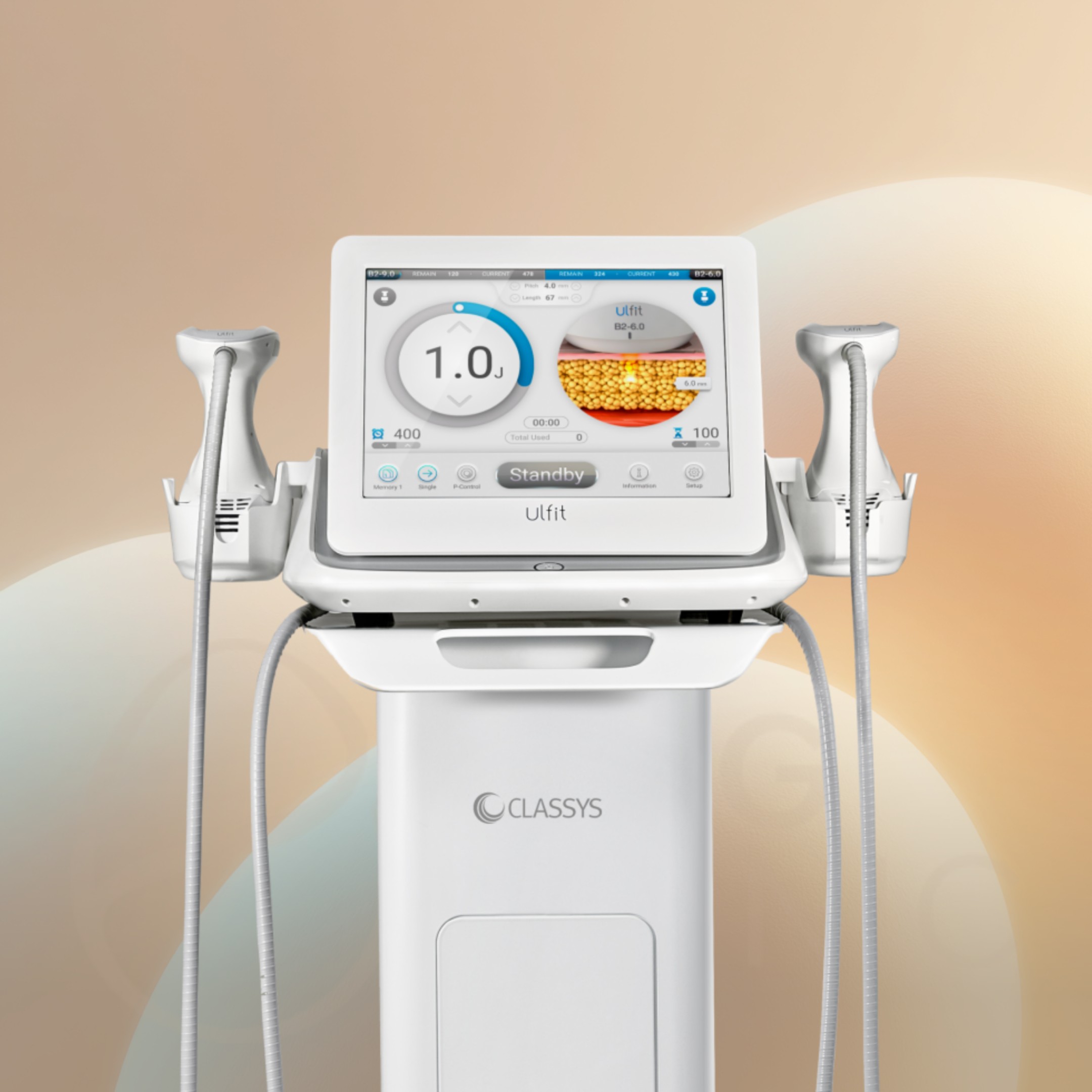
Ulfit Body HIFU Fat Reduction Effect: How Many Sessions Do You Need?
Ulfit Body HIFU is a non-surgical body contouring treatment that focuses ultrasound energy on the fat layer beneath the skin, gradually shrinking fat cells with heat. Here is a principle-first look at why the ultrasound heats only fat and nothing else, how that destroyed fat actually leaves your body, why the settings differ from facial HIFU, and roughly how many sessions and how much maintenance you can expect.
By Dr. Kim