Ruby Laser 694nm: Effect on Age Spots and Nevus of Ota
By Dr. Kim9 min read
Stubborn pigment like age spots or Ota's nevus can sit there through round after round of toning without fading much, which gets frustrating fast. But there is a laser built from the ground up to target pigmented lesions like these. That is the ruby laser, running at a 694nm wavelength.
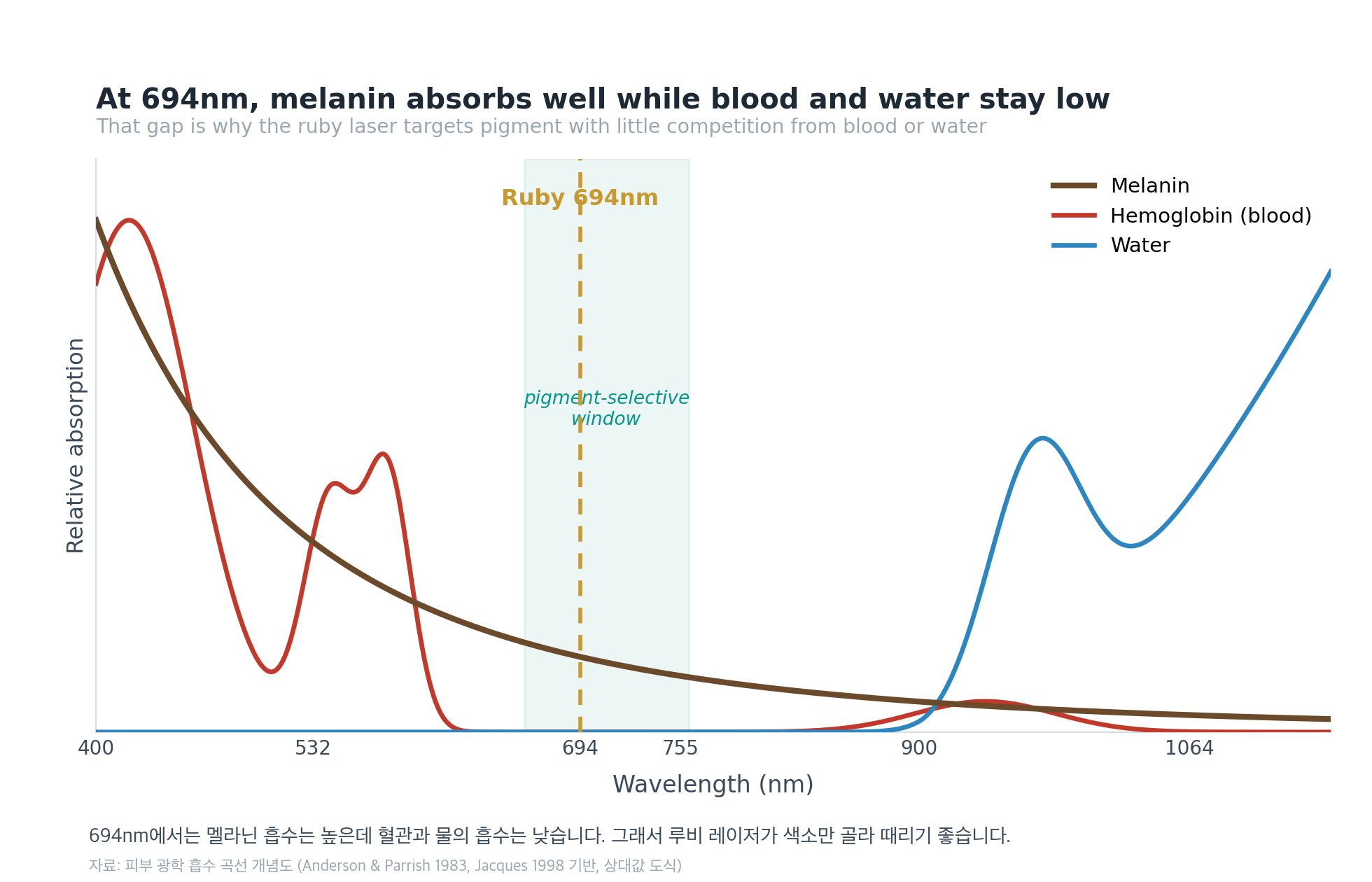
The ruby laser is a Q-switched pigment laser designed to break up pigment hard. The key is that 694nm wavelength: it absorbs strongly into melanin while barely touching blood vessels or water, so the energy lands almost entirely on pigment. That is why it has been the go-to device for age spots, sun spots, Ota's nevus, and tattoos for decades. Below, we walk through why 694nm specifically, using the melanin absorption curve and real study numbers, and we also look honestly at the pigmentation risk that matters for Asian skin.
Why Does the Ruby Laser Use 694nm?
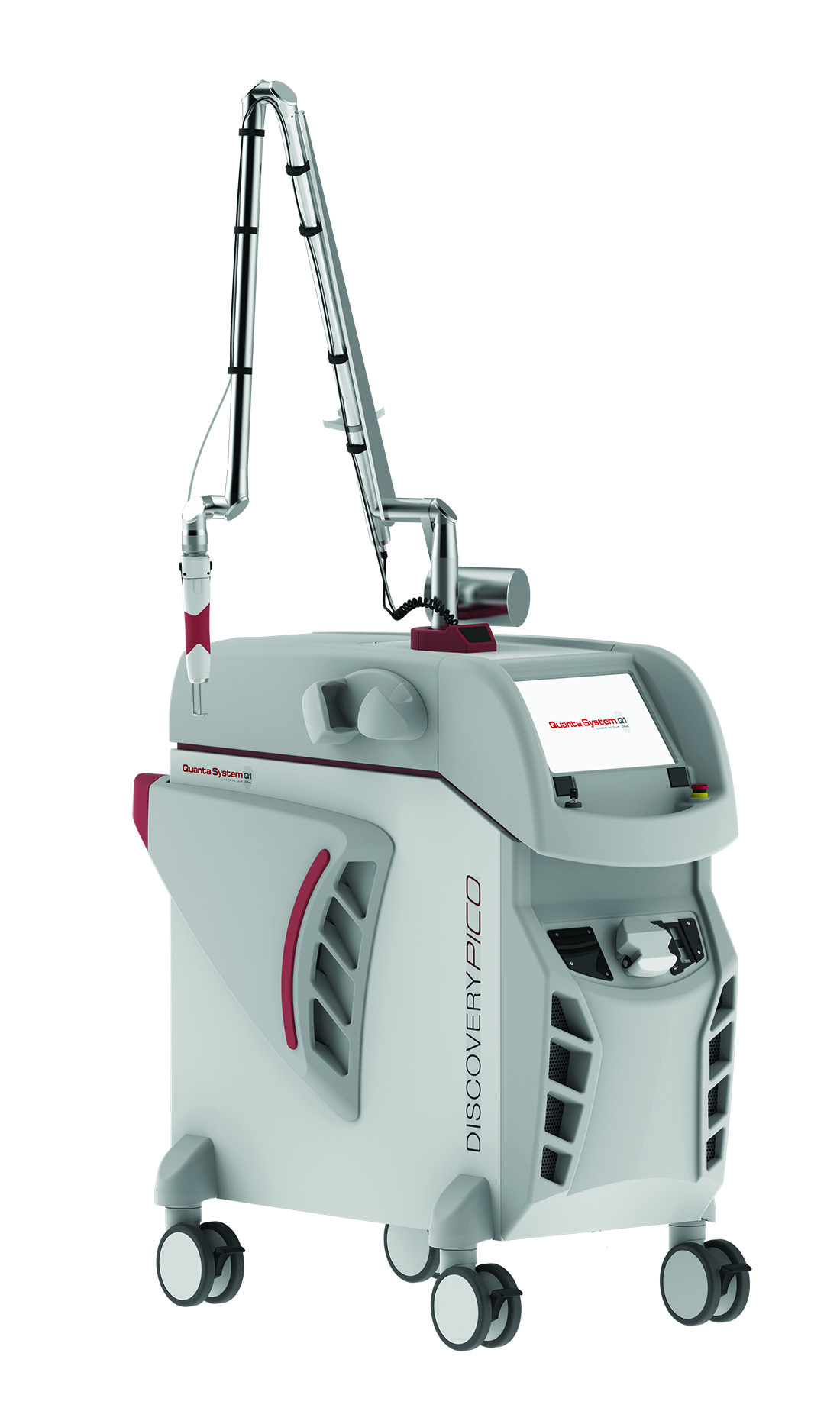
The ruby laser is named for the ruby crystal it uses as its lasing medium. Ruby actually holds a bit of laser history too: it was the very first material to produce a laser beam, back in 1960. In dermatology, this crystal emits a red 694nm light that gets fired in extremely short bursts to treat pigment.
That short burst is what Q-switching means. Q-switching compresses energy down to tens of nanoseconds, billionths of a second, and releases it all at once. When a pigment particle takes a hit like that, it shatters before the heat has time to spread into the surrounding tissue. Think of it like cracking ice with one sharp hammer strike instead of slowly melting it: the pigment breaks apart while the skin around it stays cooler.
That brings us to why 694nm matters so much. Melanin absorbs more strongly at shorter wavelengths, and 694nm sits in a sweet spot where melanin absorption is still high, while absorption by hemoglobin in blood vessels and water in the skin drops off. So the energy concentrates on pigment and spares the surrounding tissue, which is close to an ideal pigment-only wavelength. This is exactly why the ruby laser became one of the earliest go-to devices for clearing tattoos and pigmented lesions.
Choosing a Wavelength From the Absorption Curve
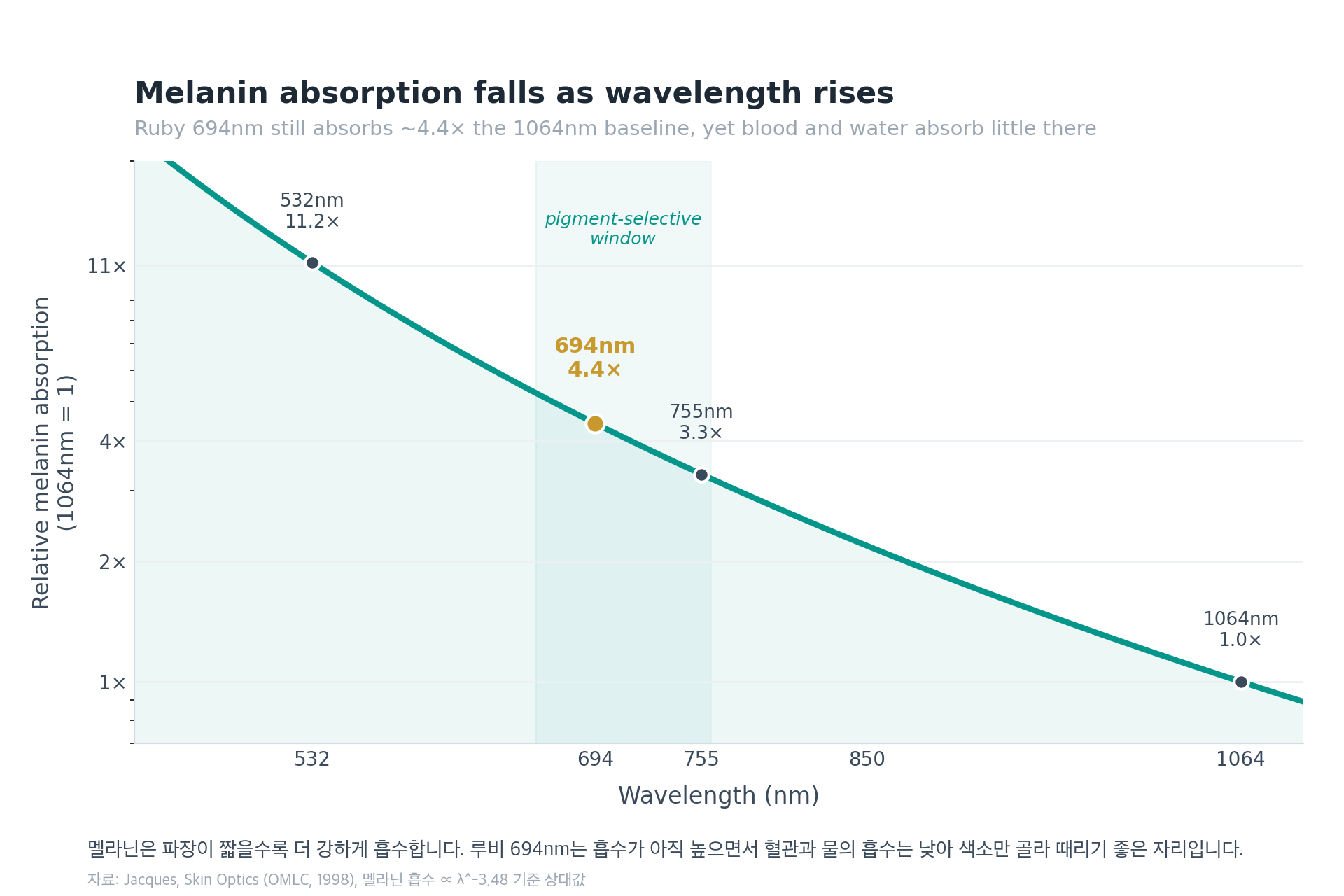
For a laser to clear pigment, its light needs to be well absorbed by melanin. The absorption curve plots how strongly melanin soaks up light at each wavelength, and the curve climbs steeply as wavelength shortens. That is why green-toned light around 532nm shows the strongest melanin absorption, with absorption tapering off as wavelength increases.
The catch is that stronger absorption is not automatically better. 532nm gets absorbed heavily by hemoglobin in blood vessels as well as melanin, so treating pigment at that wavelength tends to irritate nearby vessels too, leading to redness or bruising. Shorter wavelengths also do not penetrate very deep, so they only reach surface-level pigment. On the other end, 1064nm, the wavelength used in toning, penetrates deeper but absorbs into melanin more weakly, making it harder to break pigment apart forcefully in one pass.
694nm strikes a good balance between the two. Melanin absorption sits at about 4.4 times that of 1064nm, still plenty high, while absorption by hemoglobin and water stays low, which lets it target pigment selectively. Looking at selectivity between pigment and blood vessels, 532nm only reaches a melanin-to-blood absorption ratio of about 2.4 to 1, which is why vessel damage shows up fairly often at that wavelength. Slightly longer wavelengths like 694nm tilt much more clearly toward melanin. The table below lines up the wavelengths side by side.
| Wavelength | Melanin absorption | Penetration depth | Best suited for |
|---|---|---|---|
| 532nm | Strongest | Shallow | Surface spots, along with vessels |
| 694nm | High | Medium | Age spots, Ota's nevus |
| 755nm | Moderate | Medium to deep | Dermal pigment, tattoos |
| 1064nm | Weak | Deep | Toning, deep pigment |
Which Pigments Respond Best to the Ruby Laser?
The ruby laser does best on pigment that sits densely close to the surface. The classic example is age spots caused by long-term sun exposure, also called solar lentigines. In one study, 91 age spot lesions across patients with skin types II to IV were treated with a ruby laser, and every single one cleared completely. Freckles, which are also surface-level pigment, generally respond just as well.
Ota's nevus is a different story. Its pigment sits deep in the dermis with a bluish tone rather than at the surface, so it does not clear in one pass; it fades gradually over multiple sessions. Still, the ruby laser has long been a standard treatment for Ota's nevus, and repeated sessions bring noticeable lightening. Children who start treatment young tend to see even better clearance rates.
Tattoos are another area where the ruby laser has a long track record. 694nm absorbs well into black and dark blue ink, and in one study, a large share of black-blue tattoos cleared by more than 75%. Red and yellow ink, though, do not respond as well to 694nm and need other wavelengths. Since response varies by pigment type, here is a quick side-by-side.
| Pigmented condition | Response | Sessions |
|---|---|---|
| Age spots, solar lentigines | Usually clears completely | Few sessions |
| Freckles | Responds well | Few sessions |
| Ota's nevus | Fades gradually over time | Multiple sessions |
| Black-blue tattoos | Often over 75% cleared | Multiple sessions |
How Much Did Nevus of Ota Improve in Studies?
Looking at the numbers, response varies quite a bit by pigment type. Surface pigment like age spots clears almost completely in most cases, as noted above, while Ota's nevus, sitting deep in the dermis, calls for a different set of expectations.
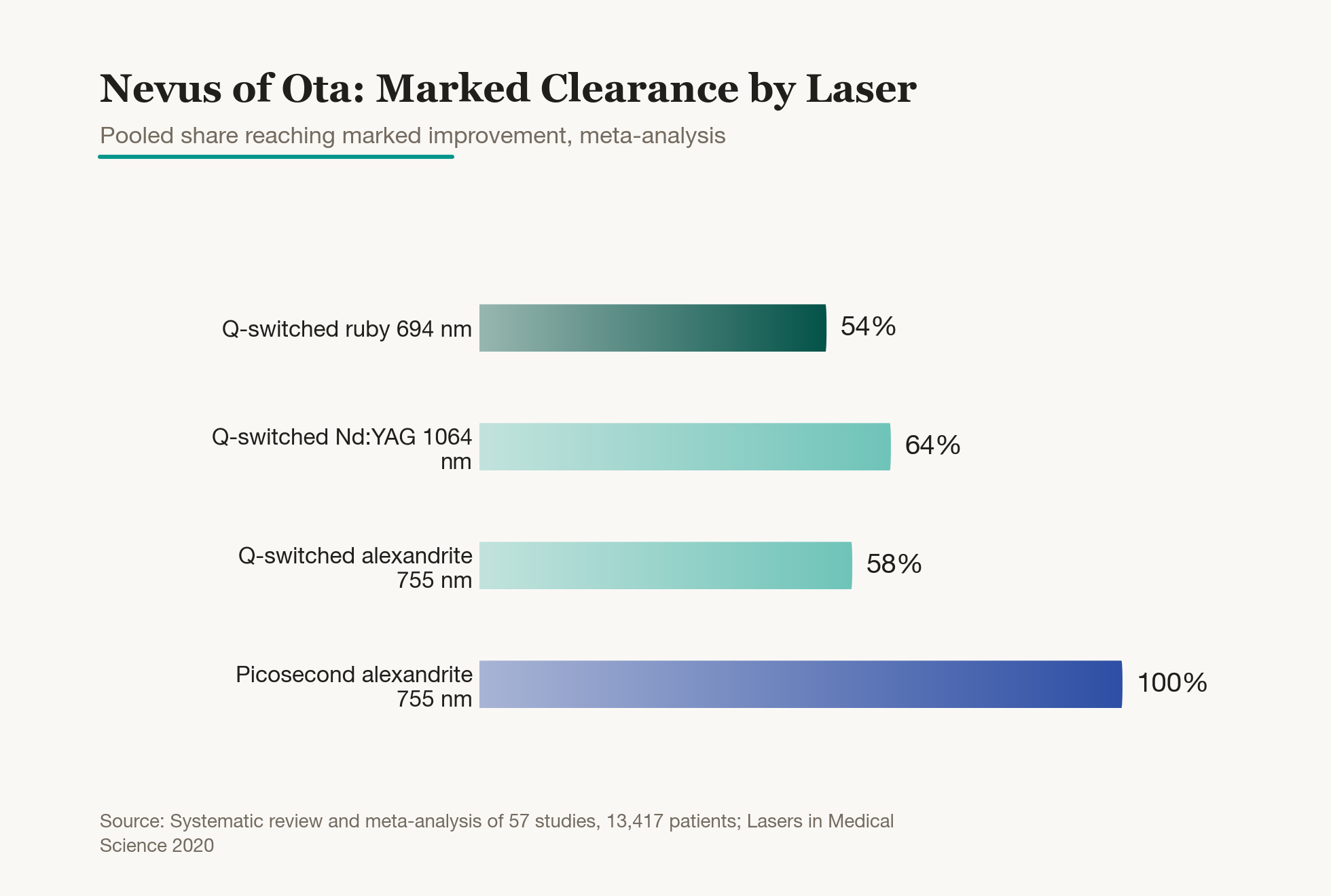
A pooled analysis brought together multiple studies on Ota's nevus, covering 57 studies and roughly 13,000 patients. Treatment with a Q-switched ruby laser produced marked improvement in about 54% of cases. Nd:YAG at 1064nm, another Q-switched laser, came in at 64%, and alexandrite at 755nm at 58%, all fairly close in range. Ruby laser treatment is typically spread over two to three sessions, with pigment fading further as sessions add up.
The newer picosecond laser showed a response close to 100%, considerably stronger. But it also came with a higher side effect rate, reported at 44%, so effectiveness and safety need to be weighed together. The ruby laser, as a well-established pigment laser with a long safety track record, sits at around 14% for side effects, a manageable range that keeps it a reliable option. In the end, the right device depends on which pigment you are treating, so getting the depth of your pigment properly assessed before treatment matters most.
The Procedure and Scab Healing Time
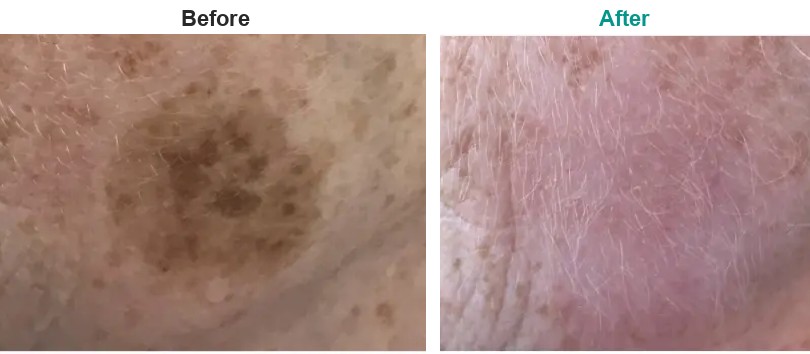
The procedure itself is fairly simple. After numbing cream is applied and given time to take effect, the laser is fired in quick pulses over the pigmented area. A single age spot can be treated in just a few minutes, and each pulse feels like a quick snap, similar to a rubber band flicking the skin. When pigment absorbs the energy, the spot whitens and puffs up instantly, a reaction called frosting, which signals that the pigment responded well.
Recovery follows the pattern of pigment crusting over and then shedding. Right after treatment, the area darkens or forms a fine scab, and new skin usually forms underneath and the scab falls away naturally over one to two weeks. The most important thing is not to pick at the scab. Removing it before new skin has fully formed underneath raises the risk of scarring or leftover pigmentation.
Age spots or freckles often only need one or two rounds of this cycle, while deeper pigment like Ota's nevus is treated repeatedly over several months. Skin right after the scab falls off is pink and delicate and sensitive to UV light, so diligent sun protection during this window matters a lot for keeping new pigment from forming. In other words, aftercare matters just as much as the procedure itself for the final result.
How to Reduce Pigmentation on Asian Skin
The most honest thing to say about pigment lasers is that pigmentation is the real risk to watch. Asian skin, including Korean skin, tends to carry more melanin, so if the laser stimulus runs too strong, it can trigger new dark pigmentation instead of clearing the original spot. This risk is not unique to the ruby laser; it comes with any strong pigment laser.
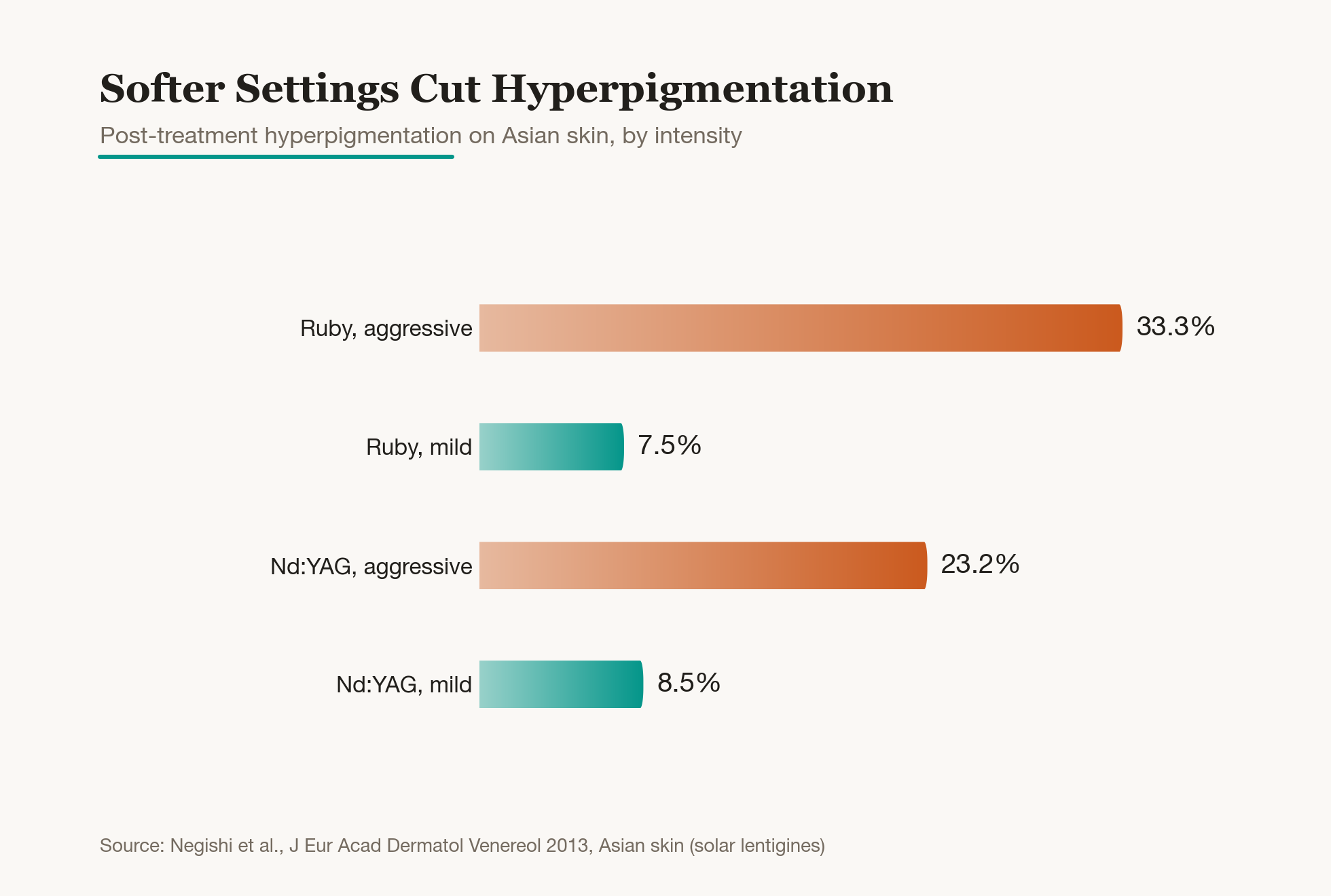
The good news is that the size of this risk shifts a lot depending on how the treatment is done. In a study on Asian skin, firing the ruby laser at high energy led to pigmentation in about 33% of cases, but gently lowering the output brought that down to around 7%. So rather than pushing hard to clear everything in one go, adjusting the output to skin type and spreading treatment across multiple sessions is the safer approach. This is exactly why the practitioner's experience shapes the outcome so much.
The newer picosecond laser tends to report fewer pigmentation cases for the same pigment, so it is worth considering alongside the ruby laser if pigmentation risk is a particular concern. That said, the ruby laser can still be used quite safely as long as the output is dialed in properly. If you have active melasma alongside your pigment, are taking light-sensitizing medication, have recently gotten a lot of sun, or are pregnant, it is worth discussing beforehand. For anyone who can stay consistent with sun protection afterward, even stubborn pigment that never budged with toning can be cleared distinctly with the ruby laser.
Was this helpful?
About this article
Written by a practising aesthetic physician and intended for general education — not a substitute for individual medical advice.
Read next
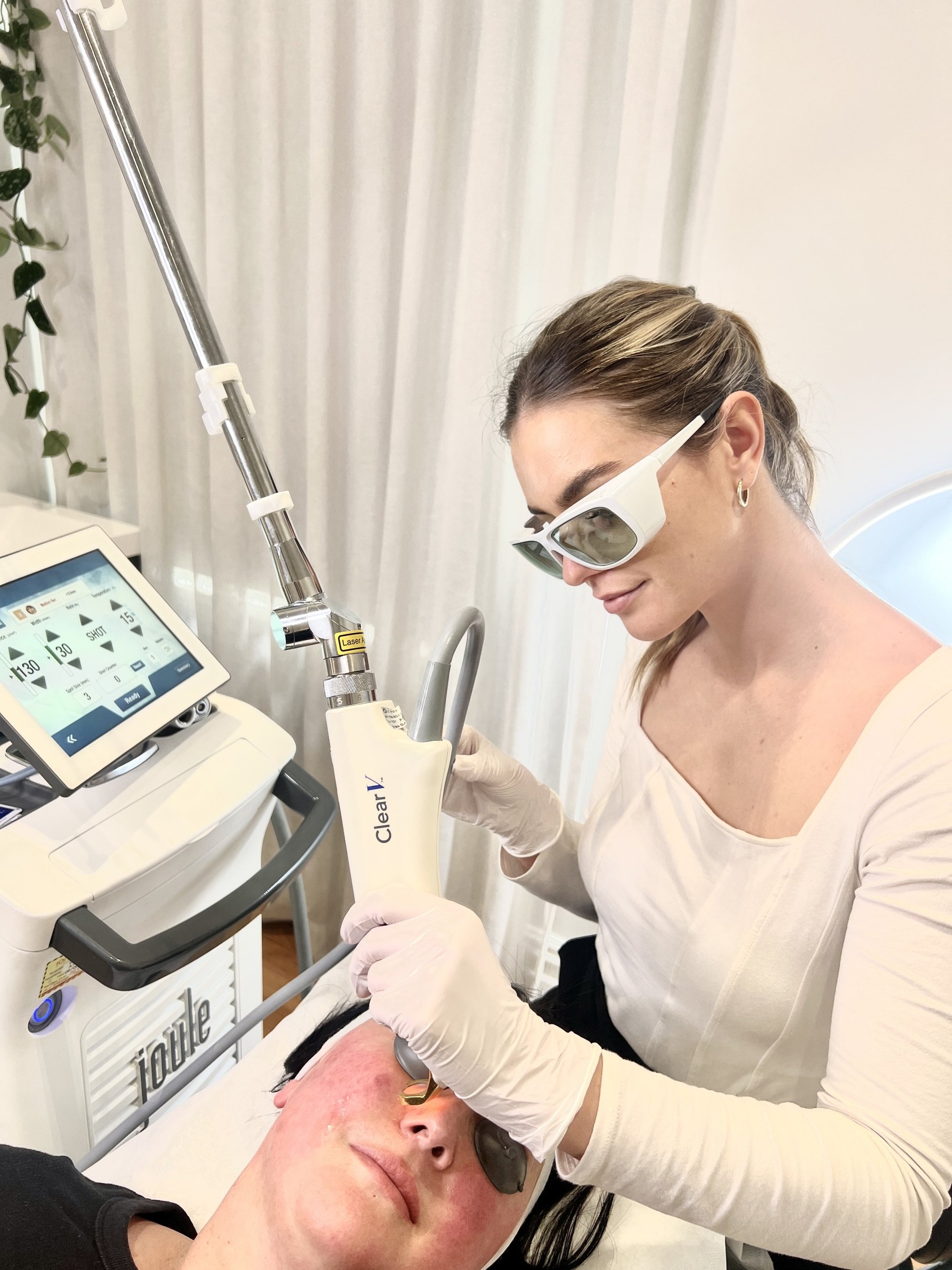
Nevus of Ota Treatment: Q-Switched Laser Sessions and Intervals
Nevus of Ota sits deep in the dermis rather than on the skin's surface, which is exactly why no amount of concealer can hide it. Here is a mechanism-focused look at why only a laser with a specific wavelength can reach that depth, and why treatment is spread across 6 to 10 sessions at 6 to 8 week intervals instead of being done all at once.
By Dr. Lee
Cherry Angioma: Causes, Symptoms and Laser Treatment
Cherry angiomas, the small red spots that multiply on the skin with age, come down to changes in blood vessel structure. Here is how vascular laser targets hemoglobin to clear them, plus what recovery and recurrence really look like.
By Dr. Kim
Reepot Laser Results: Can One or Two Sessions Clear Lentigines That Toning Couldn't?
How Reepot's 532nm wavelength achieves roughly 11x higher melanin absorption than the 1064nm used in laser toning, why VSLS pre-cooling reduces the risk of post-inflammatory hyperpigmentation on Asian skin, what the clinical evidence shows for efficacy on solar lentigines, how to manage the scabbing process, and an honest look at PIH rates and who benefits most.
By Dr. Lee