Laser Hair Removal Sessions and Intervals: How Many Are Needed to Finish?
By Dr. Kim8 min read

One of the most common misconceptions people have when first looking into laser hair removal is that one or two sessions will finish the job. In reality, most people need 5–8 sessions spaced weeks apart. You're probably wondering why so many sessions are needed, and why even after all of that, it still isn't called complete permanent removal.
The answer lies in the hair growth cycle. A laser can only remove hair that is actively growing right now, and the hair on our body grows and rests on different schedules depending on the area. That means no single session can catch every hair at once, so treatment has to be repeated at different points in time. Below, we'll look at how many sessions each area typically needs and at what interval, along with how the alexandrite and Nd:YAG wavelengths differ.
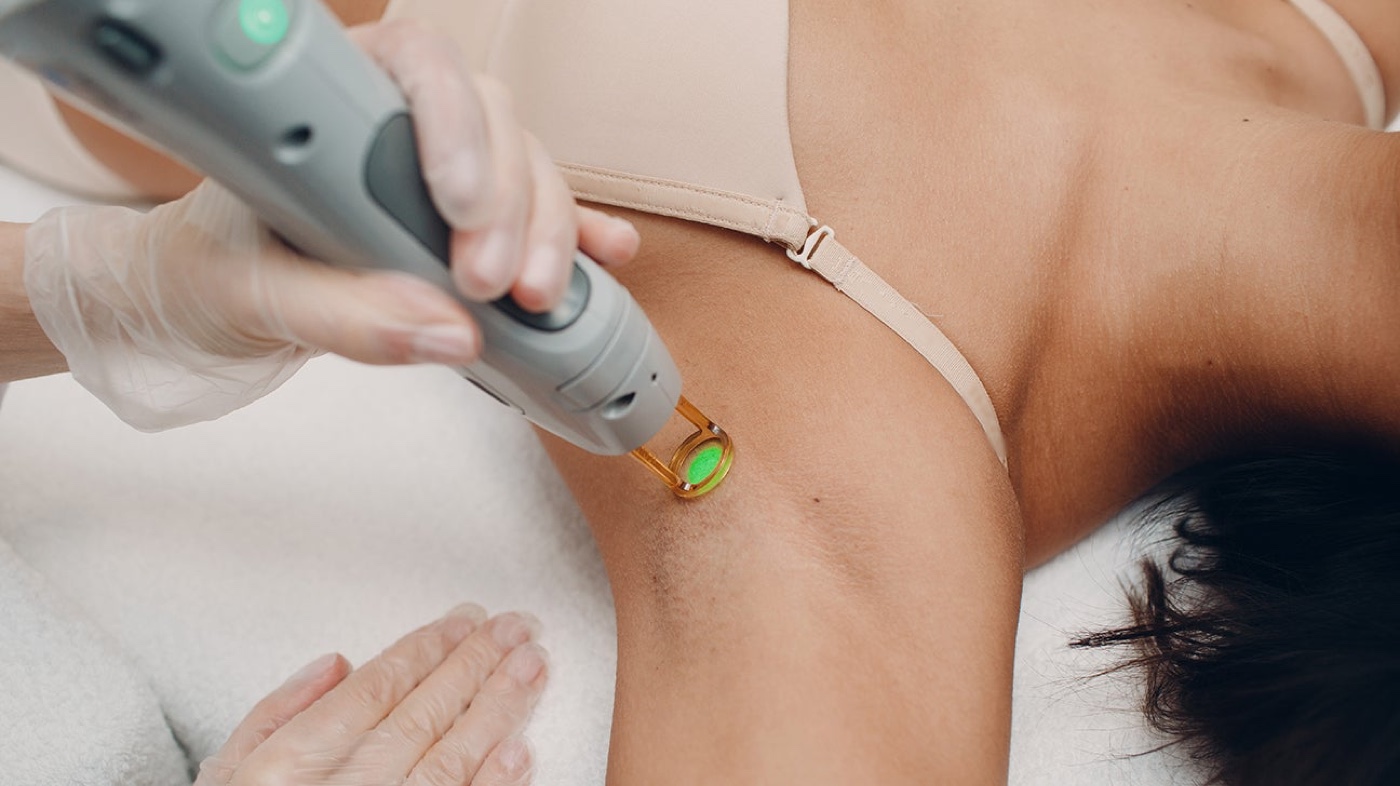
Why are multiple laser hair removal sessions needed?
Hair doesn't grow continuously in one spot. It cycles through growth and rest. Broadly speaking, there are three phases: the anagen phase, when hair actively grows, the catagen phase, when growth stops and the root is pushed upward, and the telogen phase, when the hair rests completely and prepares to shed.
Laser hair removal works by having melanin pigment inside the hair absorb light, and the resulting heat destroys the follicle. The problem is that this pigment is only concentrated in hair that's in the anagen phase. Hair in the telogen, or resting, phase has much less pigment, so there's no clear target for the laser, and firing at the same spot has little effect. In the end, a laser can only remove hair that happens to be in its growth phase at that moment.
This is exactly why multiple sessions are needed. No area has all of its hair in the growth phase at the same time. Even within a single area, some hairs are growing while others are resting, so only a portion gets caught in any one session. A few weeks later, hair that was resting moves into its growth phase, and that's when it gets targeted and removed. Spacing sessions several weeks apart and working through different points in time is what it takes to clear everything out. That spacing exists so resting hairs have time to shift into the growth phase, which is also why cramming sessions closer together doesn't get you done any faster.
Sessions and intervals by area
The general rule is similar across areas: an initial course of 4–6 sessions spaced 4–6 weeks apart is the baseline, with a few more sessions added depending on the condition of the area. That said, the cycle itself varies by body part, so the exact number of sessions and the spacing between them shift a bit.
Areas where hair cycles faster need shorter intervals, and areas where it cycles more slowly need longer ones. Areas with short cycles, like the face, are treated roughly every 4 weeks, while areas with long cycles, like the legs, are spaced out 8–10 weeks. Timing sessions to match the shift into the growth phase keeps treatments from being wasted. The numbers below are general guidelines, and clinics adjust them based on hair thickness, color, and skin type.
| Area | Typical sessions | Interval |
|---|---|---|
| Face (upper lip, chin) | 6–10 sessions | About 4 weeks |
| Underarms | 5–8 sessions | 4–6 weeks |
| Arms | 6–8 sessions | 6–8 weeks |
| Legs | 6–8 sessions | 8–10 weeks |
| Bikini line | 6–8 sessions | 4–6 weeks |
As the numbers show, the face tends to need more sessions even though the interval is shorter. That's because it's an area heavily influenced by hormones, which makes it harder to manage. It's also worth knowing that finishing the standard course isn't necessarily the end, since touch-up sessions can be added afterward depending on how much hair remains.
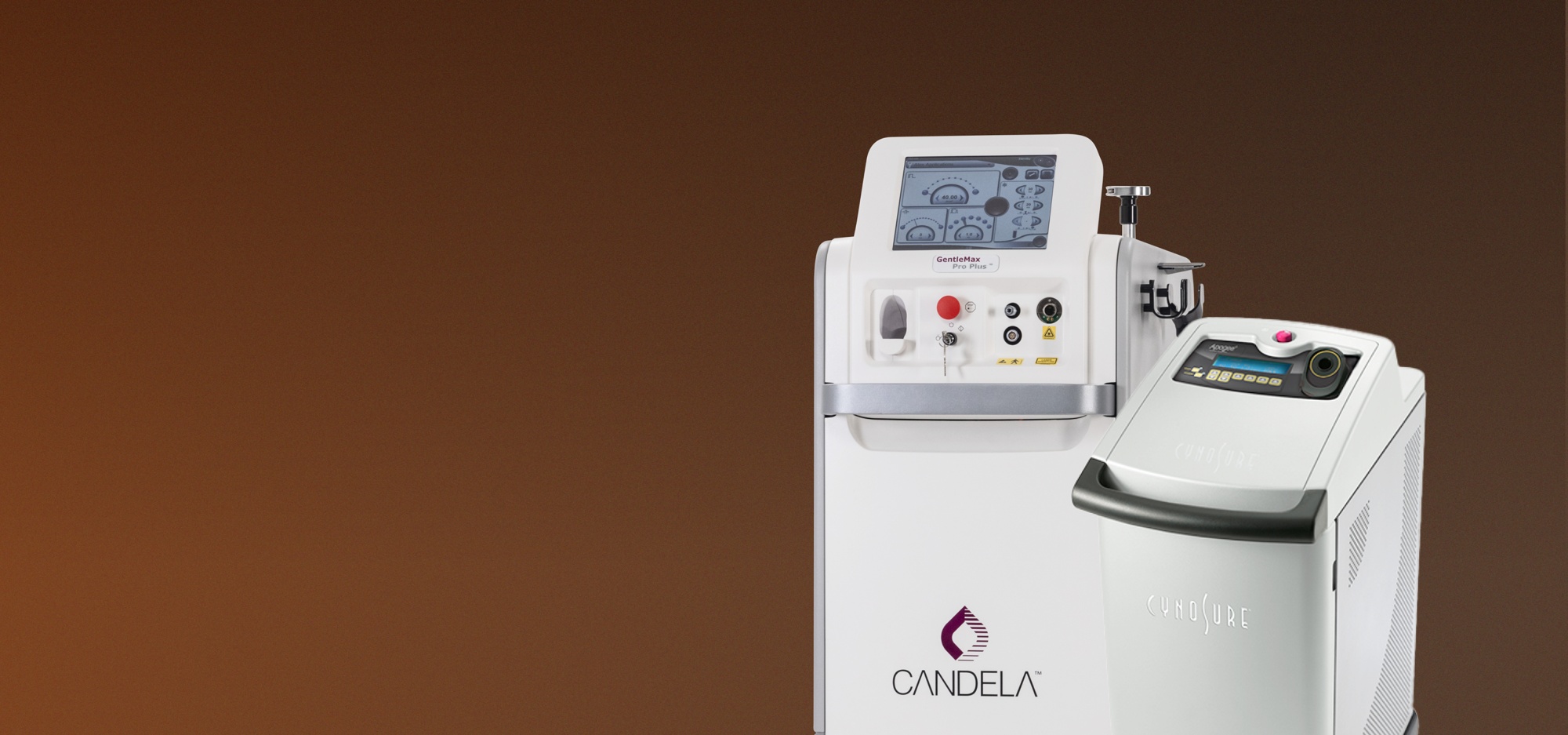
Alexandrite or Nd:YAG: which one suits you?
Hair removal lasers differ mainly by wavelength. The two most widely used are the 755nm alexandrite and the 1064nm Nd:YAG. The difference between them comes down to how well they're absorbed by melanin and how deeply they penetrate the skin.
The 755nm alexandrite has strong melanin absorption. That makes it effective at removing hair, even fine, light-colored hair on fair skin. But strong absorption also means pigment within the skin itself reacts to the light, so using it at high settings on darker skin raises the risk of burns or hyperpigmentation. The 1064nm Nd:YAG, on the other hand, has lower melanin absorption and penetrates more deeply. Because it interacts less with pigment in the epidermis, it can be used relatively safely on darker skin. The tradeoff is that it has less power against lighter hair.
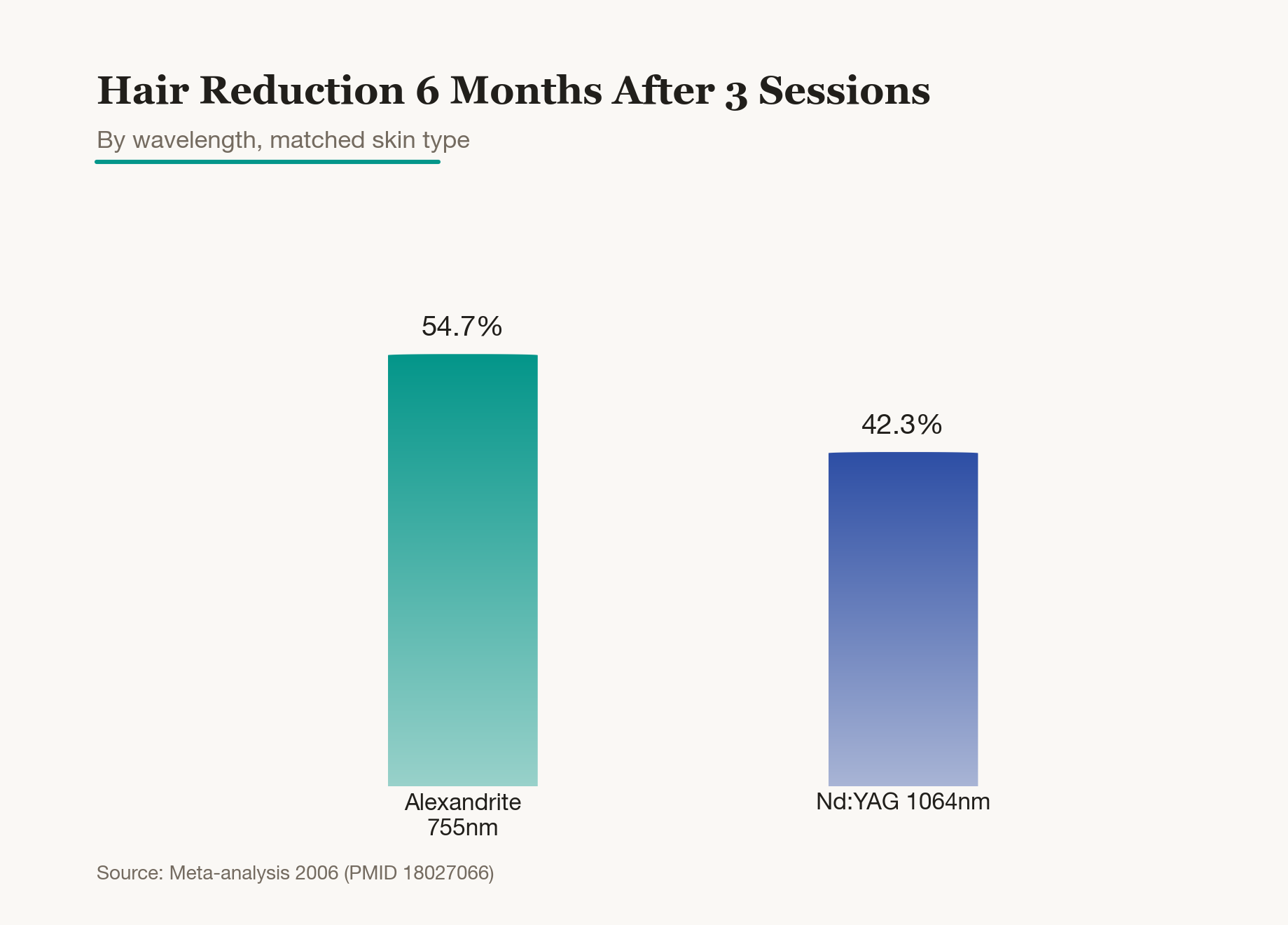
In practice, the wavelength is chosen based on skin tone and hair color. Alexandrite works well for dark hair on fair skin, while Nd:YAG is the safer choice for darker skin. Many devices today combine both wavelengths, aiming to capture the strengths of each for both efficiency and safety. In terms of raw effectiveness, alexandrite has a slight edge. One meta-analysis found that hair reduction rates 6 months after 3 sessions came in at 54.7% for alexandrite versus 42.3% for Nd:YAG. That gap only applies when skin tone is a good match for the wavelength, though, and for darker skin, safety comes first.
Is laser hair removal really permanent?
Laser hair removal is commonly called permanent hair removal, but medically, the correct term is permanent hair reduction, not permanent removal. The two phrases sound similar, but they mean different things. Permanent reduction means the number of hairs that grow back after treatment is significantly and durably reduced, not that no hair grows back at all.
The reason comes back to the growth cycle. There are always some follicles that were in the resting phase during treatment and survived unaffected, and follicles that weren't fully destroyed can grow fine hair back over time. That's why, even after completing a full course, a small amount of thin, light hair often remains.
Hormonal changes can compound this, sometimes reviving follicles that had gone dormant. During periods of major hormonal shift, such as pregnancy, menopause, or polycystic ovary syndrome, dormant follicles can wake up and produce new hair. For this reason, many people follow up their initial course with maintenance sessions every 6–12 months. This doesn't mean the hair can never be fully removed. It's more accurate to think of it as reducing most of the hair for a long time while managing the small remainder. How much this reduction varies by area becomes clearer when you look at the actual numbers.
Which area responds better, the face or the legs?
Even with the same device and the same number of sessions, results vary by area. The key factor is how long that area's hair cycle is. Areas with longer cycles have a relatively higher proportion of hair in the growth phase at any given time, so each session catches more, and the long-term reduction rate ends up higher.
According to a systematic review, long-term hair reduction rates range widely: 35–84% for alexandrite, 30–74% for Nd:YAG, and 33–69% for diode lasers. A major factor behind this wide range was the treatment area. Across all three devices, the highest reduction rates were seen on the legs, which have a long, roughly 1-year cycle, and the lowest were seen on the face, which has a short, roughly 6-month cycle. This is part of why facial hair removal takes more sessions and finishes more slowly.
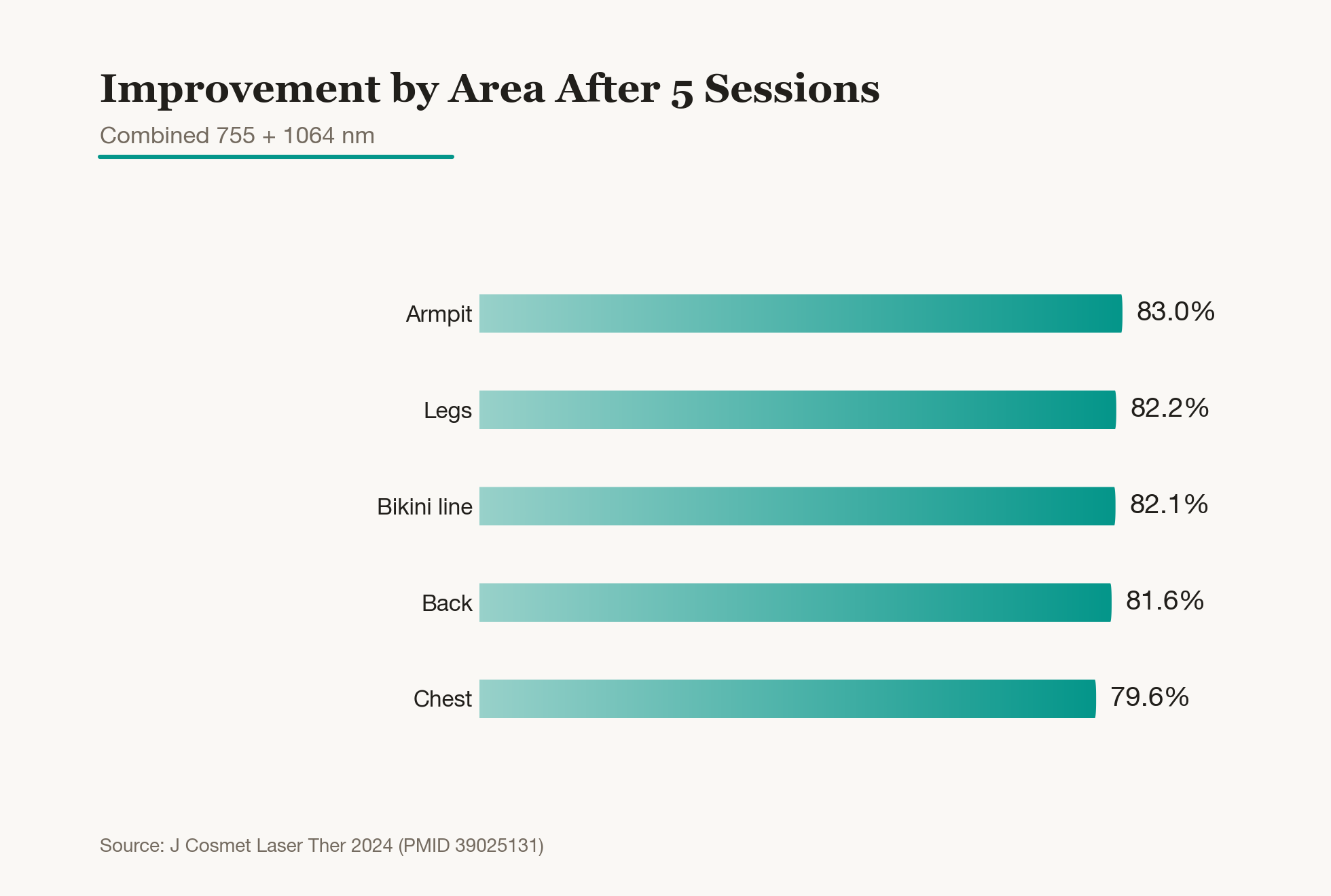
A study using a combined dual-wavelength laser found improvement rates after 5 sessions of 83.0% for the underarms, 82.1% for the bikini line, 82.2% for the legs, 79.6% for the chest, and 81.6% for the back. Broad areas with coarse hair, like the torso and limbs, generally showed strong results. Legs and underarms can expect good results with relatively little effort, while the face realistically calls for a few more sessions with more consistent follow-through. It's worth setting your expectations and session count based on which area you're targeting.
Care and precautions between sessions
What you do between sessions matters just as much as the sessions themselves. The most basic rule is not to pull hair out at the root if you have a session coming up. Waxing or plucking removes the very follicle the laser needs to target, which reduces that session's effectiveness. If you need to tidy up between sessions, shaving is the right call, since it leaves the root in place.
Sun protection also affects your results. If your skin tans before or after treatment, pigment in the epidermis increases, which raises the risk of burns and hyperpigmentation. So it's safer to avoid tanning and stay diligent about sunscreen. The table below summarizes what to keep in mind at each stage.
| Stage | What to keep in mind |
|---|---|
| Before treatment | No waxing or plucking, avoid tanning starting 4 weeks out |
| Right after treatment | Soothe with cold compresses, strict sun protection |
| Between sessions | Shaving only, no plucking or waxing |
| After the full course | Consider maintenance sessions every 6–12 months |
Following this routine lets you get the most out of your scheduled sessions, and any remaining hair can be managed without much trouble through maintenance visits. Laser hair removal isn't a one-time fix. It's a process of timing sessions to the growth cycle and finishing with proper care. Understanding this makes it much clearer why multiple sessions are needed and what you can realistically expect.
Was this helpful?
About this article
Written by a practising aesthetic physician and intended for general education — not a substitute for individual medical advice.
Read next

Laser Hair Removal Sessions: Why Split Into 3 to 7 Treatments?
A plain-language look at how laser hair removal zeroes in on dark melanin pigment, and why it only works on hair caught in its growth phase. We walk through the hair cycle behind the 3-to-7-session protocol, and why the number of sessions and the wait between them varies so much from one body area to another.
By Dr. Lee

Laser Hair Removal Sessions and Intervals: Why Are Multiple Sessions Needed?
Laser hair removal only reacts to follicles that are actively growing right now. Because follicles in the same area are cycling out of sync with each other, it takes several sessions to catch them all. Here is the biology behind why the spacing between sessions matters and why some areas need more rounds than others.
By Dr. Kim
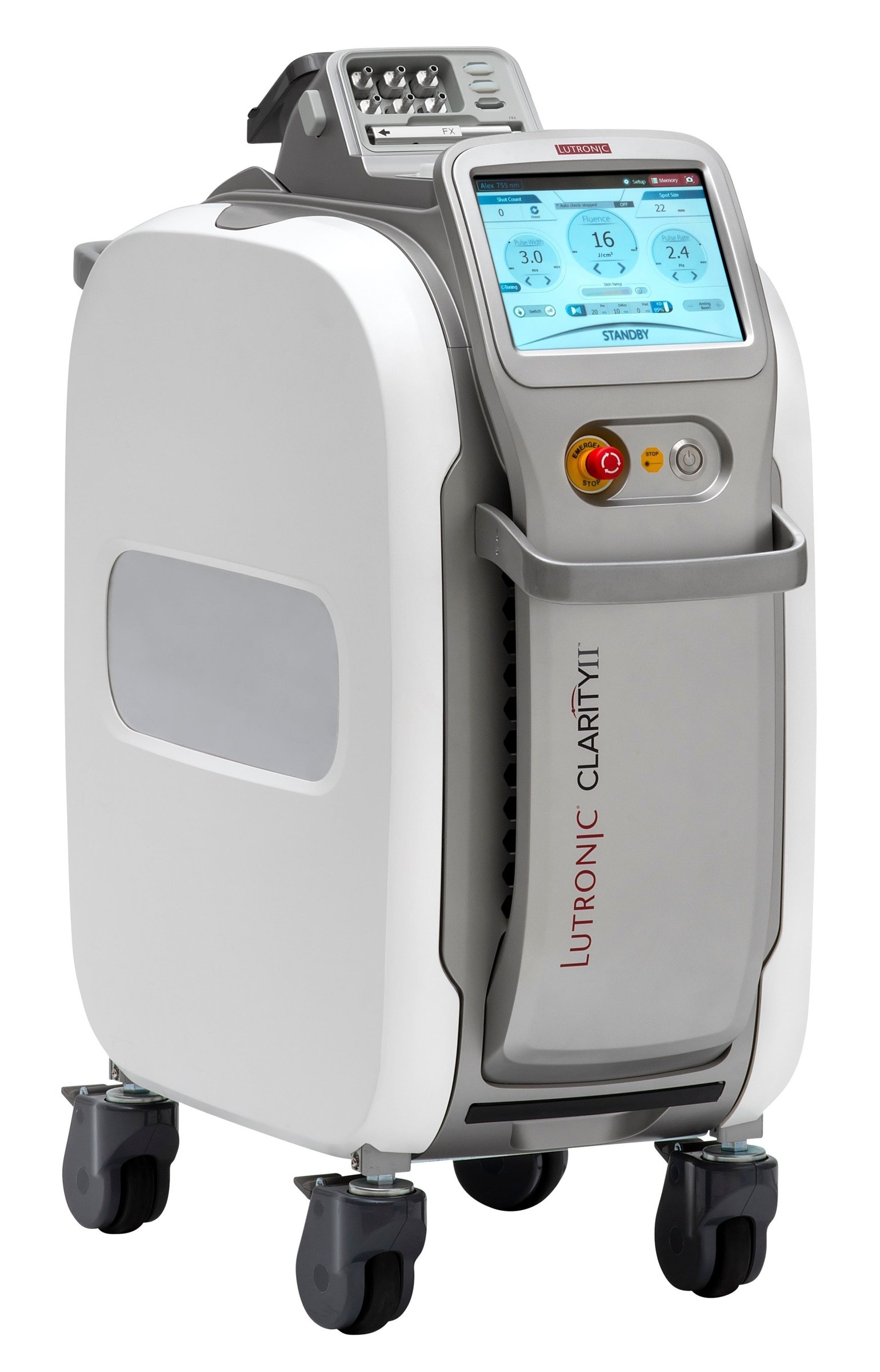
Clarity II Toning: Effects, How It Works and the Difference Between 755 and 1064 Nanometers
Clarity II toning pairs an alexandrite laser with an Nd:YAG laser in a single device, treating shallow spots and deeper melasma with two different approaches. Here is why two wavelengths are needed and how toning differs from a procedure that removes a mole.
By Dr. Kim