Dark Circle Types and Causes: Vascular, Pigmented and Structural Differences
By Dr. Kim8 min read

Some people catch a shadow under their eyes every time they look in the mirror, no matter how much sleep they get or how rested they feel. That's because dark circles rarely come from just one cause.
They generally split into three types: vascular, pigmented, and structural. Each one darkens the under-eye area through a completely different mechanism. Treat the wrong type and you can spend real time and money without seeing any change. Here's a closer look at why each type happens and why the treatments diverge so much.
Why is the skin under the eyes so thin?
Under-eye skin is among the thinnest on the face, running around 0.5 millimeters, roughly half the thickness of skin on your cheeks or forehead.
It's thin because this area has almost no fat layer underneath and a lower density of collagen in the dermis compared to elsewhere. Think of cheek skin as several sheets of paper pressed together, while under-eye skin is closer to a single sheet of tissue paper.
Thin skin lets whatever sits beneath it show through more easily, the same way a shadow shows through a sheer curtain. Under the surface of your under-eye skin are layers of blood vessels, muscle, fat, and bone, and it's this layered structure that sets up all three types of dark circles.
Why do vascular dark circles look blue?
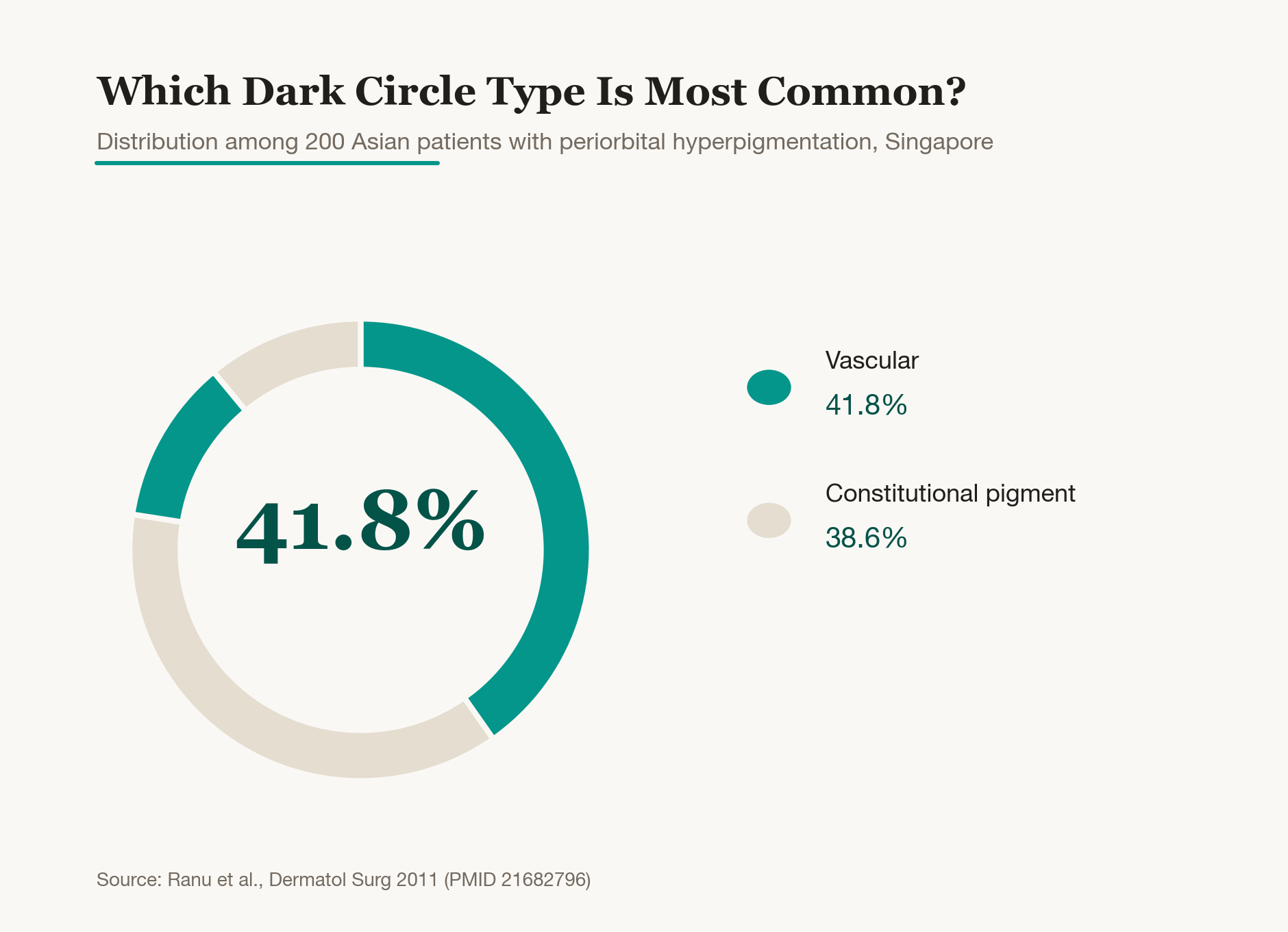
Vascular dark circles happen when the veins running beneath the under-eye skin show through. Veins carry deoxygenated blood, which is darker in color, and that hue shows through thin skin as blue, purple, or sometimes deep brown.
Here's the interesting part: blood inside a vein isn't actually blue, it's a dark reddish brown. The reason it appears blue to the eye comes down to how light travels through skin. Red wavelengths penetrate deep and mostly get absorbed, while blue wavelengths reflect back from shallower depths and reach your eye more easily. So the blue or purple tone you see has little to do with the blood's actual color, it's an optical effect, similar to how seawater looks clear up close but blue as it gets deeper.
This is also why the vascular type gets noticeably worse with lack of sleep, overwork, or a stuffy nose. When circulation slows down, blood pools in the veins, making them more prominent and darker in color, which is why the shadows often fade again once you've rested.
Vascular dark circles show up even in younger people. Thinner skin and veins sitting closer to the surface both make the vessels more visible, so genetics plays a real role here too. If under-eye shadows run in your family, it's likely because skin thickness and vein placement tend to be inherited traits.
Why do pigmented dark circles form?
Pigmented dark circles come from melanin building up in the under-eye skin. Melanin is the brown pigment your skin produces to protect against UV exposure, and areas that get frequent irritation, like under the eyes, tend to accumulate more of it.
Rubbing your eyes, chronic itching from atopic dermatitis or allergic conjunctivitis, and sun exposure are the usual triggers. When skin gets irritated repeatedly, your body reads it as damage and ramps up melanin production as a defense. Over time, that pigment becomes visibly noticeable. It's the same mechanism that leaves brown marks after acne or a wound heals, known as post-inflammatory hyperpigmentation, and because under-eye skin is so thin, those marks tend to show up darker and last longer.
Genetics matters a lot here too. If you have naturally darker skin, or if your parents also dealt with dark under-eyes, you may have inherited melanocytes, the cells that produce melanin, that respond more actively than average.
Unlike the vascular type, pigmented dark circles don't fade with better sleep or a good day. Since the pigment is already sitting in the skin, treatment needs to target breaking it down or reducing it directly.
Why do structural dark circles look like shadows?
Structural dark circles aren't about pigment or blood vessels at all, they're actually a shadow cast by the three-dimensional shape of the under-eye area. As we age, under-eye fat can bulge forward, or the area can hollow out into a sunken groove.
This creates something like a small hill next to a valley. When light hits from above, it naturally casts a shadow into that valley, and that shadow reads as a dark circle.
Dig a little deeper and the cause is that the thin membrane holding under-eye fat in place (the orbital septum) and the ligament connecting it to bone (the tear trough ligament) both loosen with age. In your younger years, that membrane and ligament keep the fat firmly in place, but as they lose elasticity, the fat pushes forward and forms that bulge. Meanwhile, the spot where the ligament anchors to bone stays fixed and sunken, creating a valley right beneath the bulge. One telltale sign of this type: unlike morning puffiness, pressing gently on the skin doesn't change its shape much.
Because structural dark circles have nothing to do with pigment or circulation, no amount of brightening product tends to help. Without changing the underlying shape that's casting the shadow, there's not much room for improvement.
Why do they get worse with age?
All three types tend to worsen with age, but for different reasons.
Vascular circles worsen because collagen and elastic fibers decline over time, thinning the skin further and making veins even more visible. Pigmented circles build up as decades of sun exposure accumulate, layering pigmentation over time. And structural circles typically start once the tissue holding fat in place begins to loosen, usually from the mid-thirties onward.
So it's common to see mostly vascular shadows in your twenties, with pigmented and structural factors layering in as you get older, turning the issue increasingly complex.
What if all three types overlap?
It's not unusual for one person to have all three types at the same time. Someone might start with naturally thin skin prone to the vascular type, add pigment from years of eye rubbing, and then develop structural changes as fat shifts with age.
In cases like this, it's hard to pin down a single type just by looking. If gently stretching the skin lightens the shadow, structural factors likely play a bigger role. If pressing on the skin fades the color, vascular factors are probably more dominant. For an accurate read, a dermatology visit to sort out which type (or combination) you're dealing with can be genuinely useful.
How are dark circles treated by type?
Since the underlying causes differ, so does the treatment approach for each type.
- Vascular type is generally addressed by targeting the visible veins directly. Vascular lasers or circulation-focused care may help, and since poor circulation plays a role, lifestyle measures like adequate sleep and cold compresses are typically recommended alongside treatment.
- Pigmented type centers on fading the melanin that's already built up. Brightening ingredients or pigment-targeting lasers are commonly used, aiming to break down existing pigment while suppressing new pigment formation.
- Structural type calls for adjusting the actual three-dimensional shape, whether that's the bulge or the hollow. Filler to fill in the sunken area, or procedures to address protruding fat, may be considered, since the goal is to smooth out the contour that's casting the shadow in the first place.
- Combination type often needs several approaches designed together. Since fixing just one cause tends to leave shadows from the other types behind, working out the right priorities with a dermatologist is usually the practical path.
How far can self-care improve them?
Lifestyle habits alone won't make dark circles disappear entirely, but how much they help depends on the type.
- Getting enough sleep is known to help particularly with the vascular type, since lack of sleep lets blood pool in the veins, deepening the color.
- Sleeping with your head slightly elevated can also help the vascular type, since the shift in gravity reduces how much blood collects in the veins around the eyes.
- Sun protection helps keep the pigmented type from worsening. UV exposure is a major trigger for melanin production, so applying sunscreen around the eye area is generally recommended.
- Cutting back on eye rubbing matters a lot for preventing the pigmented type, since repeated friction itself is what triggers the pigmentation.
- The structural type tends to see limited improvement from lifestyle changes alone. Once the three-dimensional shape has formed, it usually calls for a procedural approach rather than daily habits.
References
Korean Dermatological Association, Ministry of Food and Drug Safety (MFDS), American Academy of Dermatology (AAD), and U.S. Food and Drug Administration (FDA).
Was this helpful?
About this article
Written by a practising aesthetic physician and intended for general education — not a substitute for individual medical advice.
Read next
Dark Circle Treatment: Pigmented or Structural, Which Type Is Mine?
How to check at home whether your dark circles are pigmented, vascular, or structural, which cosmetic treatments work for each type, what clinical studies actually show about results, the real risks of under-eye filler, and why treating the wrong type means little to no improvement.
By Dr. Kim

Cafe-au-Lait Spots Returning After Laser: Causes, Number of Sessions and Expectations
A café au lait spot forms because the pigment-making cells in that one patch of skin are locally overactive. Laser treatment breaks up the pigment that has already built up, but it doesn't switch off those cells, which is why the color so often returns. Here's the biology behind it, why results differ so much from person to person, and what a realistic treatment timeline actually looks like.
By Dr. Kim

Milia Under the Eyes: Causes and Removal, and Why Squeezing Doesn't Work
Milia are the small white bumps that show up around the eyes and just won't budge no matter how you squeeze them. Here's an easy breakdown of how milia actually form, how they differ from acne, and why doctors remove them with a needle or laser instead.
By Dr. Lee