Corns and Calluses: Differences and How to Tell Them From Warts
By Dr. Kim8 min read

If you notice hardened skin on top of a toe or on the sole of your foot, with a sharp, poking pain every time you step on it, a corn or callus could be the cause. Both are a thickening of the stratum corneum that happens when skin takes repeated friction and pressure, but they look and hurt in slightly different ways. They are sometimes mistaken for warts, which leads to the wrong treatment, so it helps to tell them apart correctly first. Here is an evidence-based rundown covering how friction and pressure cause corns and calluses, how to distinguish them from warts, how well treatments like salicylic acid patches and lasers actually work, and how the right shoes and padding can prevent them from coming back.
Why do corns and calluses form in the same spot?
Both corns and calluses are a stratum corneum response to repeated friction or pressure on the skin. When irritation continues, the skin thickens the outer layer in that area to protect itself. When this happens over a small, concentrated point, it becomes a corn, and when it spreads across a wider area, it becomes a callus.
Shoes are the cause in most cases. Narrow or high-heeled shoes concentrate pressure between the toes or on the front of the sole. If bone prominences are involved, such as with bunions or hammertoes, pressure builds up even more over the skin covering them, making corns more likely to form. Surveys report that corns are common, affecting anywhere from 14% to 48% of the population.
Where they show up also differs. Hard corns tend to form on the side or top of the little toe, while soft corns tend to form between the fourth and fifth toes, where sweat tends to build up. Calluses spread across wider, weight-bearing areas, such as the ball of the foot or the heel.
| Category | Corn | Callus |
|---|---|---|
| Core | Present | Absent |
| Pain | Sharp when pressed | Usually dull |
| Shape | Narrow, digs in deep | Wide and flat |
| Location | Top of toe, between toes | Ball of foot, heel |
How to tell a wart from a corn
Corns and warts look similar enough to be confused, but their causes are entirely different. A corn is thickened skin caused by friction and pressure, while a wart is a lesion caused by infection with human papillomavirus (HPV). Since the causes differ, the treatment approach needs to differ too.
The simplest way to tell them apart is by the direction of pressure. A corn hurts when pressed straight down from above, while a wart hurts more when squeezed from the sides. Corns and calluses also keep the skin's original ridge pattern intact, while a wart interrupts it.
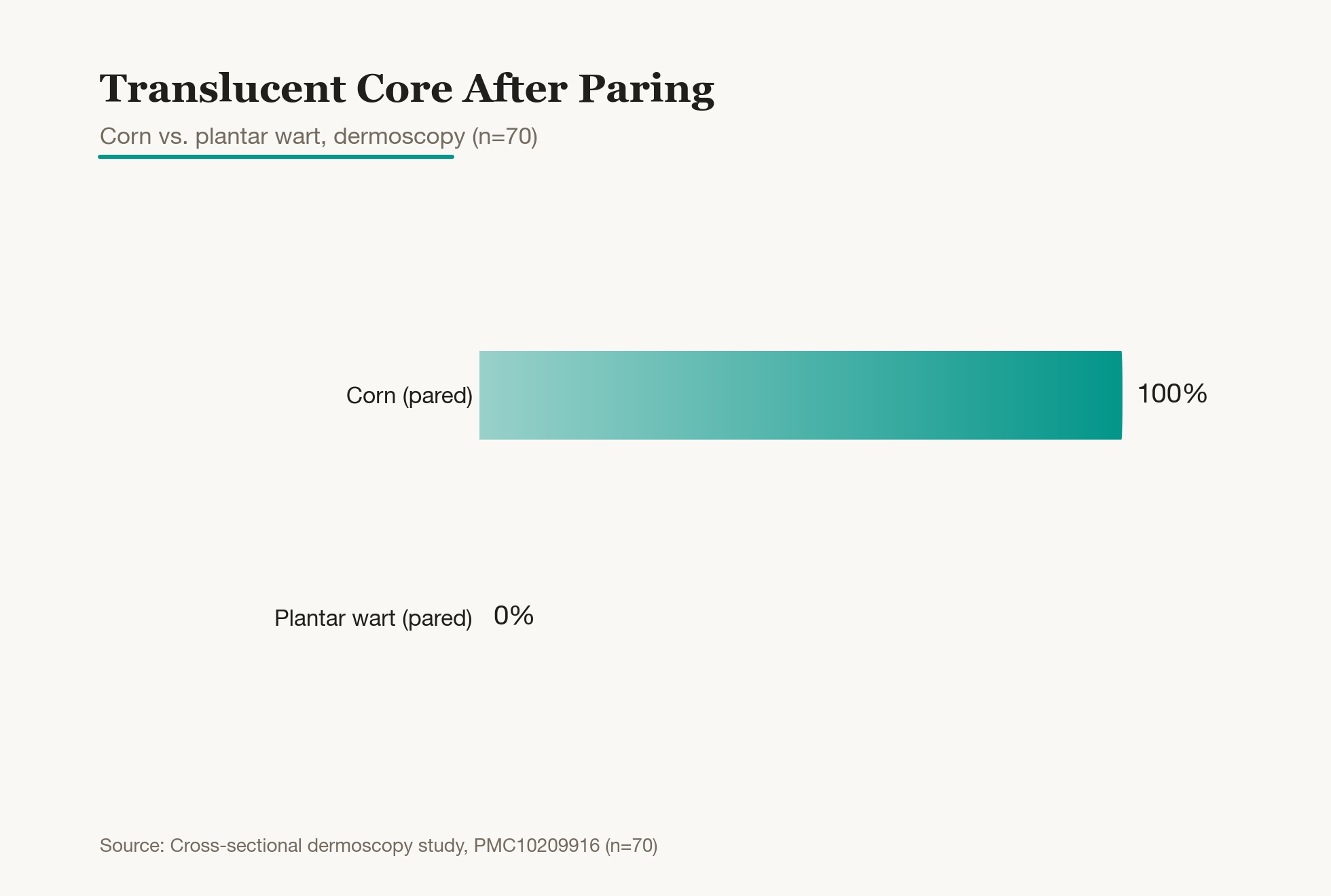
Clinics sometimes pare down the skin slightly to check. In a study of 70 lesions, paring revealed a translucent central core in corns, while warts showed dark red dots with slight bleeding. Since each finding shows up only in its own type of lesion, this is a reliable way to tell the two apart.
Do freezing and laser work too?
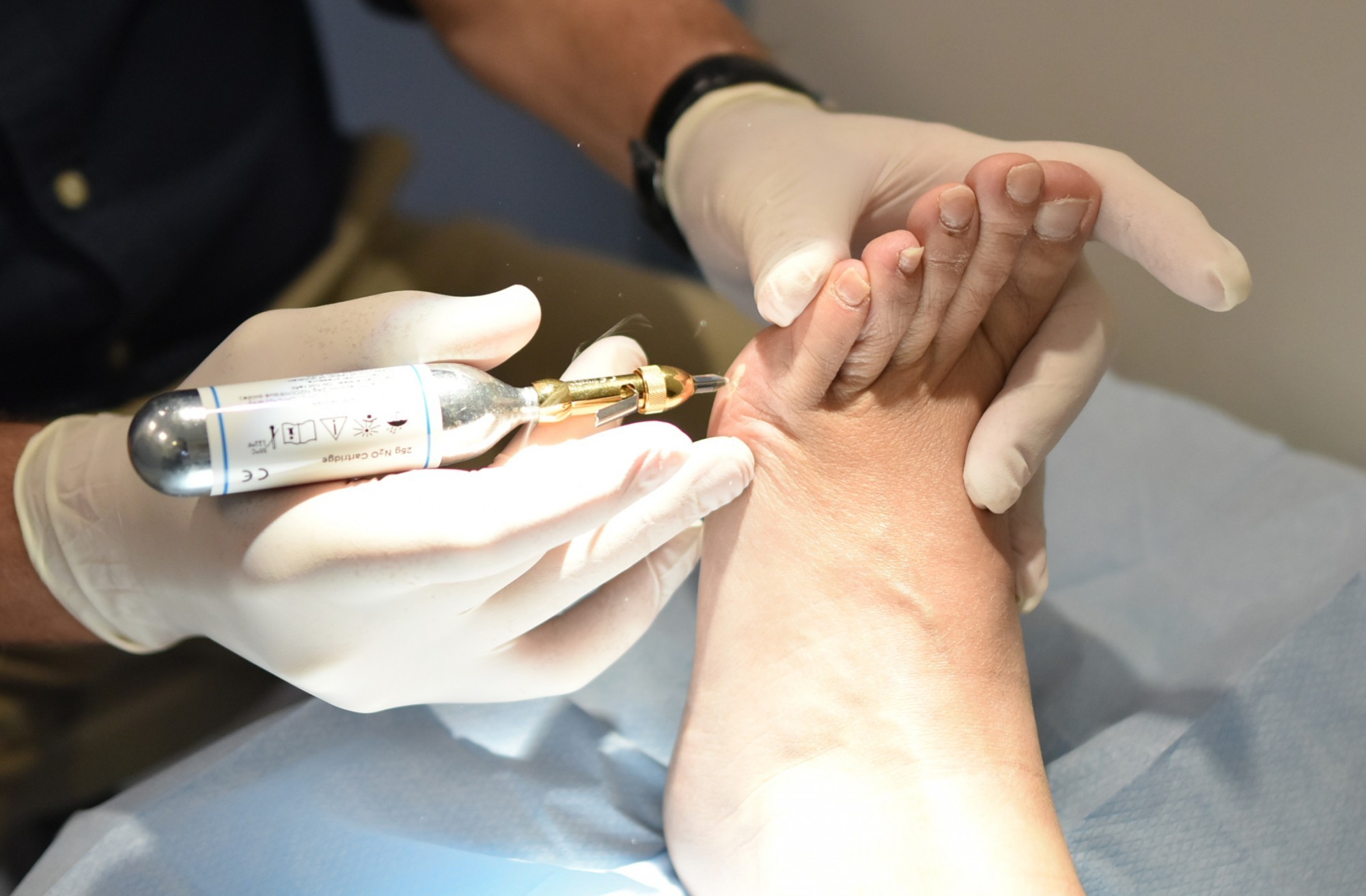
Cryotherapy, freezing off lesions with liquid nitrogen, is commonly used for warts, but the situation is different for corns. A look at the literature turns up little evidence that cryotherapy works on corns or calluses. Many sources actually recommend against it, since it can damage the surrounding normal skin as well. Because the lesion itself is thickened skin from repeated irritation, not a virus, freezing does not appear to be a good match for it.
CO2 laser vaporizes the thickened stratum corneum and is used at some clinics for this purpose. Erbium:YAG laser has also been reported to cause less thermal damage, putting less strain on surrounding tissue. Still, most of the evidence so far comes from case reports rather than large comparative studies, so it is too early to call it a standard treatment.
In the end, cryotherapy and laser are best thought of as supplementary options to consider depending on the case. Across the board, the same point is emphasized: if the underlying pressure is left unaddressed, a corn is likely to come back in the same spot no matter which method is used to remove it.
Do salicylic acid patches work on corns?
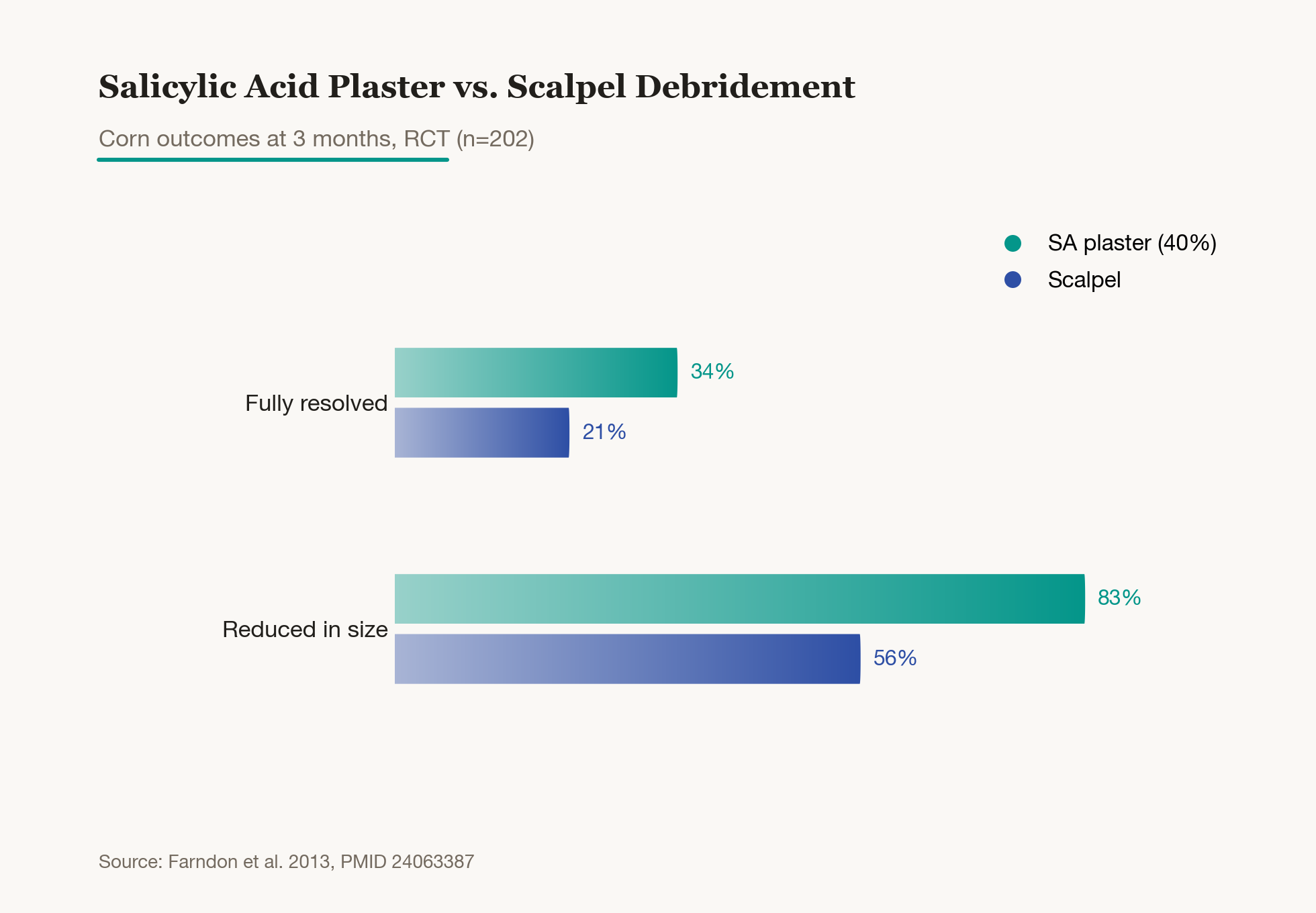
Salicylic acid is an ingredient that softens and dissolves thickened skin, and it is one of the oldest treatments used for corns. One randomized comparative study actually put this to the test. It followed 202 patients split into a group using 40% salicylic acid patches and a group treated with scalpel paring, over 3 months.
The patch group came out ahead. At the 3-month mark, corns had completely cleared in 34% of the patch group versus 21% of the paring group. The gap was even wider for size reduction, 83% for the patch group versus 56% for the paring group. Pain also dropped more in the patch group.
A follow-up analysis at 12 months found a median time to recurrence of 10 months for the patch group and 13.4 months for the paring group. The direction consistently favored the patch group, though it wasn't possible to say with statistical significance that the patches delayed recurrence over the full observation period. Even so, few at-home treatments have this much evidence behind them.
How to remove and care for calluses
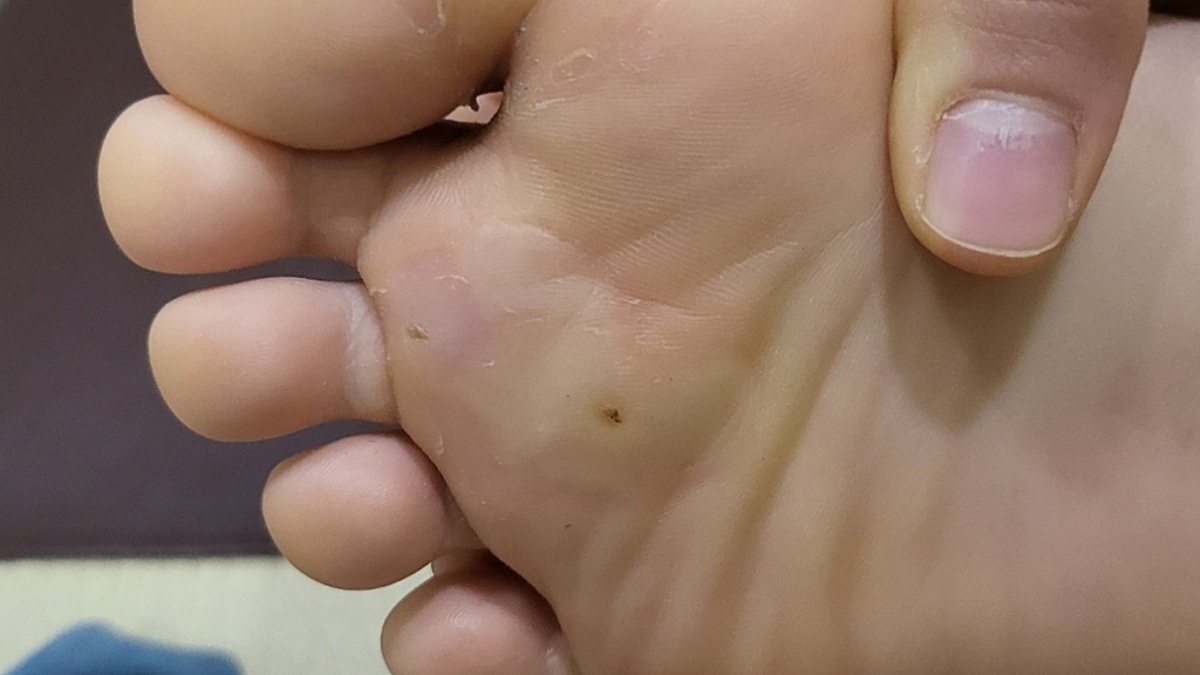
Unlike a corn, a callus has no central core, so it is relatively easy to manage. After a bath, when the skin is softened, gently working it down with a foot file or pumice stone can reduce its thickness. Filing too deep or too hard can lead to cuts or infection, so a light touch matters.
Adding a urea-based softening cream helps break down the thickened skin more effectively. Products in the 20% to 50% range are commonly used, typically applied to the thickened area at night and left to absorb. If you have a condition like diabetes that slows wound healing, it is safer to have a clinic manage it rather than filing at home.
Clinics can also pare down the thickness all at once with a scalpel. It is painless and gives an immediate result, but if the underlying cause remains, the callus often thickens again within a few weeks, so repeat visits are usually needed.
Choosing shoes and pads to prevent recurrence
For corns and calluses, prevention matters far more than treatment. If the underlying cause of concentrated pressure is left unaddressed, they will keep coming back in the same spot no matter how well they are removed. Shoes are the first thing to look at.
Shoes that are narrower than your forefoot, pointed at the toe, or have a high heel concentrate pressure on specific spots and are the most common cause of recurrence. Simply measuring your foot accurately and choosing shoes with some room across the forefoot can spread out the pressure considerably.
Adding a donut-shaped pad or a silicone offloading pad to the pressure point can spread the load carried at that spot to the surrounding area. If a prominent bone or the shape of the foot itself is the cause, custom insoles that redistribute pressure are also worth considering.
Sweaty spaces between the toes are prone to soft corns, so choosing breathable socks and shoes helps, and inserting a thin silicone spacer between the toes to reduce friction can help as well. If you spend a lot of time standing or walking, rotating between two or three pairs of shoes with different sole cushioning, rather than wearing the same pair all day, is another way to limit how long pressure builds up in one spot.
| Category | Recommended | Avoid |
|---|---|---|
| Shoe width | Roomier than your forefoot | Narrow, tight-fitting shoes |
| Heel | Low, stable heel | High heels, pointed toes |
| Padding | Pressure-distributing pads | Thin pads that just compress |
| Skin care | Regular filing and moisturizing | Neglect |
Was this helpful?
About this article
Written by a practising aesthetic physician and intended for general education — not a substitute for individual medical advice.
Read next

Tiny Facial Bumps: How to Tell Flat Warts, Milia and Skin Tags Apart, and How to Treat Them
The small bumps that show up on the face can look alike, but flat warts, milia, and skin tags have different causes and different treatments. Here is how to tell the three apart at a glance, the right CO2 and Er:YAG laser or electrocautery approach for each, how common they are, how they tend to recur, and real evidence on why removing them at home is risky.
By Dr. Lee
Warts on Hands and Feet and Corns: How to Tell Them Apart and Treat Them
Warts on the hands and feet form when HPV settles into skin cells and hijacks them to replicate. They're easy to mistake for calluses or corns, but the cause and growth pattern are different. Here's how the infection and immune response work, plus treatment options and prevention habits.
By Dr. Kim
Flat Wart Causes and Symptoms: Why They Spread When Squeezed, and Treatment
Flat warts are a viral skin condition, so picking or scratching at them doesn't clear them up, it spreads them further. Here's why that happens, how to tell them apart from moles or acne, and the logic behind removal and preventing recurrence.
By Dr. Kim