Dark Underarms: Causes, Care and Topical Ingredients
By Dr. Kim7 min read

Darker underarms are a more common concern than most people realize. The face gets all the attention and product budget, while the underarms quietly get skipped, until one day you notice the color difference the moment you take your shirt off.
This kind of pigmentation almost never comes from a single cause. It's usually friction, hair removal, chemical irritation, and individual skin tendencies all stacking up together. Once you separate out each factor, the plan for managing it gets a lot clearer too.
Why do underarms darken so easily?
The underarm moves constantly, and skin, fabric, and the inner arm are always brushing against each other there. When that pressing and rubbing repeats day after day, skin switches on a protective response to defend itself.
One of those protective responses is melanin production. Melanin's original job is shielding skin from UV, but it reacts the same way to physical irritation like friction or inflammation, ramping up production in response. That's exactly why folds and high-friction spots like the underarms, groin, and neck tend to run darker than the rest of the body.
Does heavy friction leave pigment deep in the skin?
When irritation keeps repeating, the melanocytes sitting just under the surface become more reactive. Every time they get triggered, they pump out more melanin, almost like squeezing out another dab of paint every time an alarm goes off.
The problem is that melanin doesn't always stay put in the epidermis. When irritation is strong or goes on long enough, some of that pigment leaks down into the dermis, the deeper layer of skin. Pigment sitting in the epidermis sheds naturally along with dead skin cells, but pigment that has settled into the dermis sticks around much longer. That's why older, long-standing friction damage takes noticeably more time to fade.
Do shaving and waxing affect pigmentation?
Shaving and waxing are two of the biggest contributors to underarm pigmentation. Every pass of a razor drags across the skin's surface and leaves behind tiny nicks you can't even see.
To skin, those micro-injuries register as inflammation, small but real. As the wound heals, melanin gets produced right along with it, leaving discoloration behind at that exact spot. This response is called post-inflammatory hyperpigmentation. In other words, the injury itself may be minor, but the color it leaves behind can linger long after it's healed.
Waxing works the same way. Pulling hair out from the root irritates the surrounding follicle, and when that happens repeatedly, the same mechanism kicks in and darkens the area. That's why spots that have been shaved or waxed for years tend to show the deepest pigment.
Using a dull blade or shaving on dry skin makes the irritation even worse. A blade that doesn't glide smoothly ends up dragging over the same spot multiple times instead of cutting cleanly in one pass, which multiplies the number of micro-injuries. Simply prepping with shaving foam or oil to let the razor glide can cut down on irritation significantly.
Does deodorant make it darker?
Fragrance, alcohol, and aluminum compounds found in deodorants and antiperspirants can act as irritants depending on your skin. When these ingredients trigger irritant contact dermatitis, even redness and itching too mild to notice is enough to activate melanin and let pigment build up over time.
Applying deodorant right after shaving is a common combination that leaves darker marks. Chemical ingredients land directly on freshly nicked skin, so the irritation effectively doubles up in one spot.
Thick, velvety changes in underarm color
When the underarm becomes noticeably thick, velvety, and bumpy along with the darkening, a different mechanism is usually at play. This condition, called acanthosis nigricans, frequently overlaps with insulin resistance, a state where the body can't use insulin efficiently and blood insulin levels stay elevated.
When insulin stays high over time, it starts stimulating growth-signal receptors on skin cells. That drives excess growth of both keratinocytes and melanocytes, thickening the skin and deepening its color at the same time. This is why the pattern shows up so often alongside obesity, polycystic ovary syndrome, and prediabetes.
In these cases, treating the underarm on its own has real limits. Managing weight and blood sugar together is understood to be necessary for meaningful improvement. On the flip side, when blood sugar stabilizes, both the thickness and the color have been reported to fade together, which makes this one of the clearest examples of how skin reflects what's happening in the body as a whole.

How each topical ingredient works and when results appear
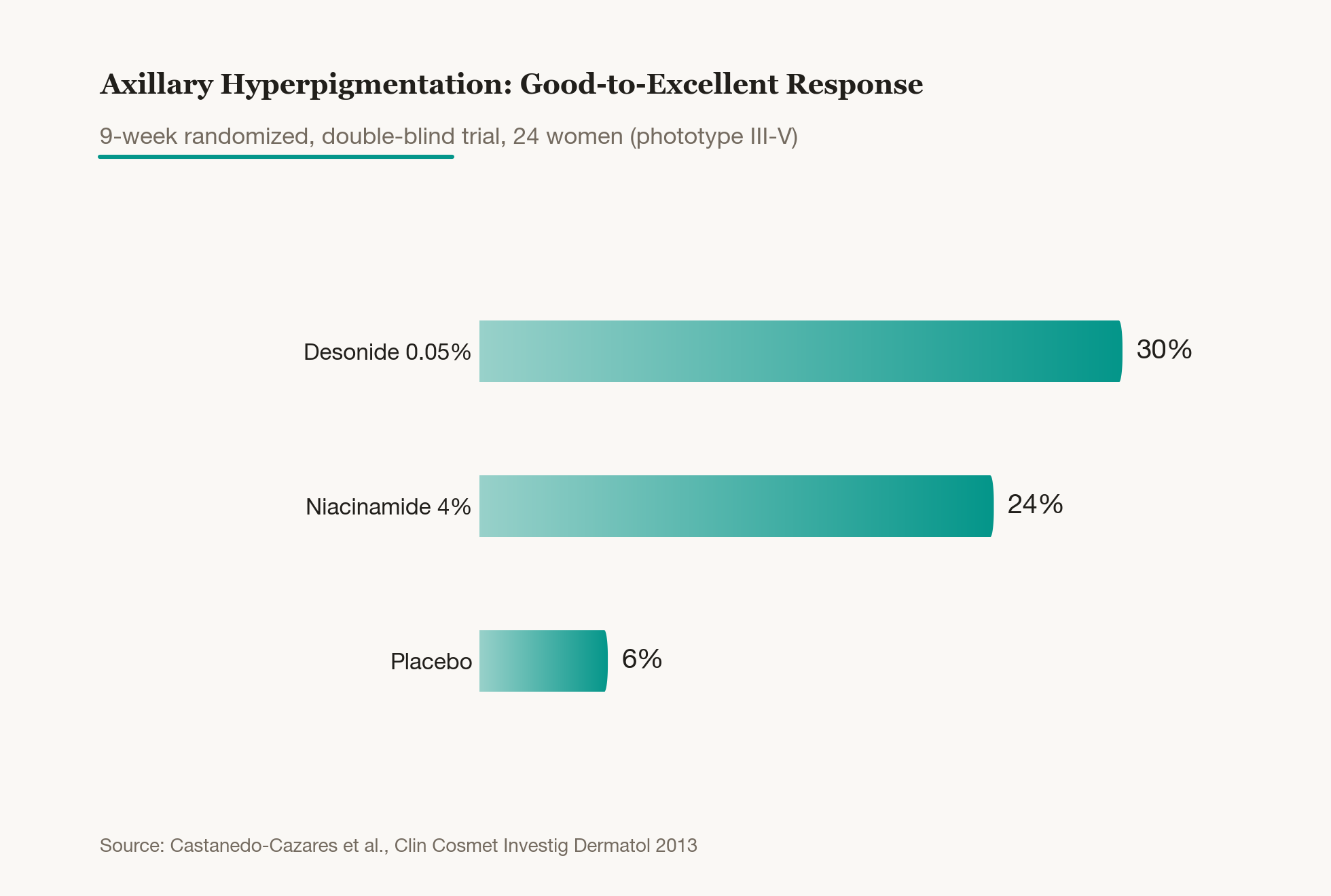
Ingredients commonly used for underarm pigmentation each work at a different point in the process. That's why people often layer them in gradually based on how their skin tolerates irritation, rather than reaching for just one.
- Retinoids (tretinoin): Speed up skin cell turnover so pigment-holding cells shed away faster. Starting at a low concentration is recommended since irritation can occur.
- Niacinamide: Blocks the pathway that transfers melanin from melanocytes into keratinocytes, slowing how fast pigment builds up on the surface. It's gentle enough to be relatively low-risk even on sensitive areas.
- Azelaic acid: Inhibits tyrosinase, the enzyme that drives melanin production, while also calming inflammation. It's considered especially useful when irritation, like post-inflammatory hyperpigmentation, is the underlying cause.
- Hydroquinone: Strongly suppresses melanin production itself. Because it can be irritating, it's typically used short-term under a doctor's supervision.
These ingredients generally take about 8 to 12 weeks of consistent use before visible change shows up. Pigment sitting in the epidermis tends to fade within that window, but older pigment that has settled into the dermis can take 6 months or longer.
Daily habits that reduce friction
Reducing the irritation itself matters just as much as applying the right ingredients. If the underlying cause keeps repeating, new pigment will keep building back up no matter how good your product routine is.
- Switching from a razor to an electric shaver or laser hair removal helps, since it cuts down on the repetitive scraping that irritates skin.
- Switching to a gentler deodorant with less fragrance and no alcohol is worth trying, since it lowers the odds of triggering contact dermatitis in the first place.
- Tight bras and tops keep recreating the same friction zone, so looser, softer fabrics are a better choice.
- Leaving a gap of time before applying deodorant after shaving, rather than applying it immediately, helps reduce irritation.
What if products don't lighten it?
If months of over-the-counter care haven't moved the needle, or if the skin has also become thicker and bumpy in texture, it's time for a dermatology visit. When acanthosis nigricans is suspected, the priority is checking for an underlying hormonal or metabolic cause alongside treating the skin itself.
In-office treatment may combine high-strength retinoids, chemical peels, or pigment-targeting lasers depending on the case. Because underarm skin is thin and sensitive, intensity is always dialed in carefully, since too much irritation can end up creating new pigmentation instead of clearing the old.
If acanthosis nigricans is suspected, it's worth seeing an endocrinologist alongside a dermatologist. Since the skin change can be a visible sign of what's happening with insulin inside the body, addressing the underlying cause rather than just treating the color on the surface tends to lead to a more stable result over the long run.
References
Korean Dermatological Association, American Academy of Dermatology (AAD), and Ministry of Food and Drug Safety (MFDS).
Was this helpful?
About this article
Written by a practising aesthetic physician and intended for general education — not a substitute for individual medical advice.
Read next
Causes of Dark Inner Thighs: Is It Only Friction?
The inner thighs take more friction and irritation than almost any other area, which is why pigmentation tends to build up faster there. Here's why this spot darkens so easily, and which skincare and treatments actually help depending on the cause.
By Dr. Lee
Red Acne Marks: Causes, How to Tell Them Apart, and Laser Treatment
The red marks left behind after acne clears up often aren't pigment at all, but dilated blood vessels showing through the skin. Since the cause and the way they fade differ from pigmentation, they call for a different care approach. Here's how to tell the two apart and how each one recovers.
By Dr. Kim

Blue Light Pigmentation and Collagen Damage: Causes and Care
Blue light is the wavelength emitted by phone and computer screens, and because it's longer than UV rays, it reaches deeper into the skin, all the way to the dermis. Here's how this light generates free radicals inside skin cells and stimulates pigment cells, leading to dark spots and collagen breakdown, along with practical ways to cut back on screen exposure and protect your skin.
By Dr. Lee