DPN (Dermatosis Papulosa Nigra): Why Doesn't Washing Remove It?
By Dr. Kim7 min read

Lean in close to a mirror and you might spot a cluster of tiny dark bumps scattered across your cheeks or temples. They look like little grains, small and slightly raised, which is why people often call them "black seeds." But they aren't clumps of dirt or dead skin. Scrubbing doesn't clear them, and in many cases the count actually grows over time.
The proper name for this change is dermatosis papulosa nigra, or DPN for short. It's a benign buildup that forms when surface skin cells cluster together on a tiny scale, closer to a pattern of skin aging than an actual disease. Below is a look at why it shows up in this particular shape, and why washing or squeezing never makes it disappear.
What kind of skin change is DPN?
DPN shows up as small, smooth bumps, typically 1 to 5 millimeters across, in shades of brown or black. The surface is glossy and firm, and pressing on one doesn't hurt.
At its core, each bump is a small patch of the epidermis, the skin's outermost layer, growing slightly thicker than the tissue around it. Think of it as a fold rather than a growth, a bit like a corner of wallpaper lifting slightly off the wall, with the cell layer bunching up into a small raised dome. The dark color comes from melanin pigment that tends to build up heavily in that same spot.
Under the microscope, DPN looks almost identical to seborrheic keratosis, the common rough patches that show up on aging skin. The difference is that DPN bumps are much smaller, appear in far greater numbers, and show up most noticeably on people with deeper skin tones.
Why does DPN cluster on the cheeks and around the eyes?
DPN has a clear tendency to gather on the face, especially around the cheekbones, the eye area, and the temples. It can spread down to the neck in some cases, but it almost never shows up on the torso or limbs.
These spots are vulnerable because they fold and compress repeatedly every time you make an expression. Every laugh or frown creases the skin along the same lines, and that repeated folding nudges the epidermal cells in that exact spot to grow just a little more than the surrounding skin. It's similar to how an old sheet of paper develops a permanent crease line if you keep folding it along the same spot.
These areas also happen to have a high density of oil glands and pores. Cell turnover around the pores, meaning how quickly new cells are made and shed, runs faster here than elsewhere, and that faster cycle is thought to create more opportunities for localized cell overgrowth.
Is DPN dirt or a hygiene problem?
Many people assume DPN is grime that built up from not washing well enough. Some even try to scrub it off with force.
But DPN is made of the epidermis itself growing outward in that spot, not debris sitting on top of the skin. It isn't flaky dead skin or dust that rinses away, because it's living tissue, part of the skin itself. Scrubbing hard doesn't remove it. It can actually irritate the area further, deepening the color or triggering inflammation.
People sometimes confuse DPN with acne, but the two work completely differently. Acne involves clogged pores and inflammatory bacteria, while DPN is purely a matter of cell growth with no bacteria or inflammation involved. That's why acne treatments like antibiotics or exfoliating ingredients have no effect on DPN.
Why does DPN increase with age?
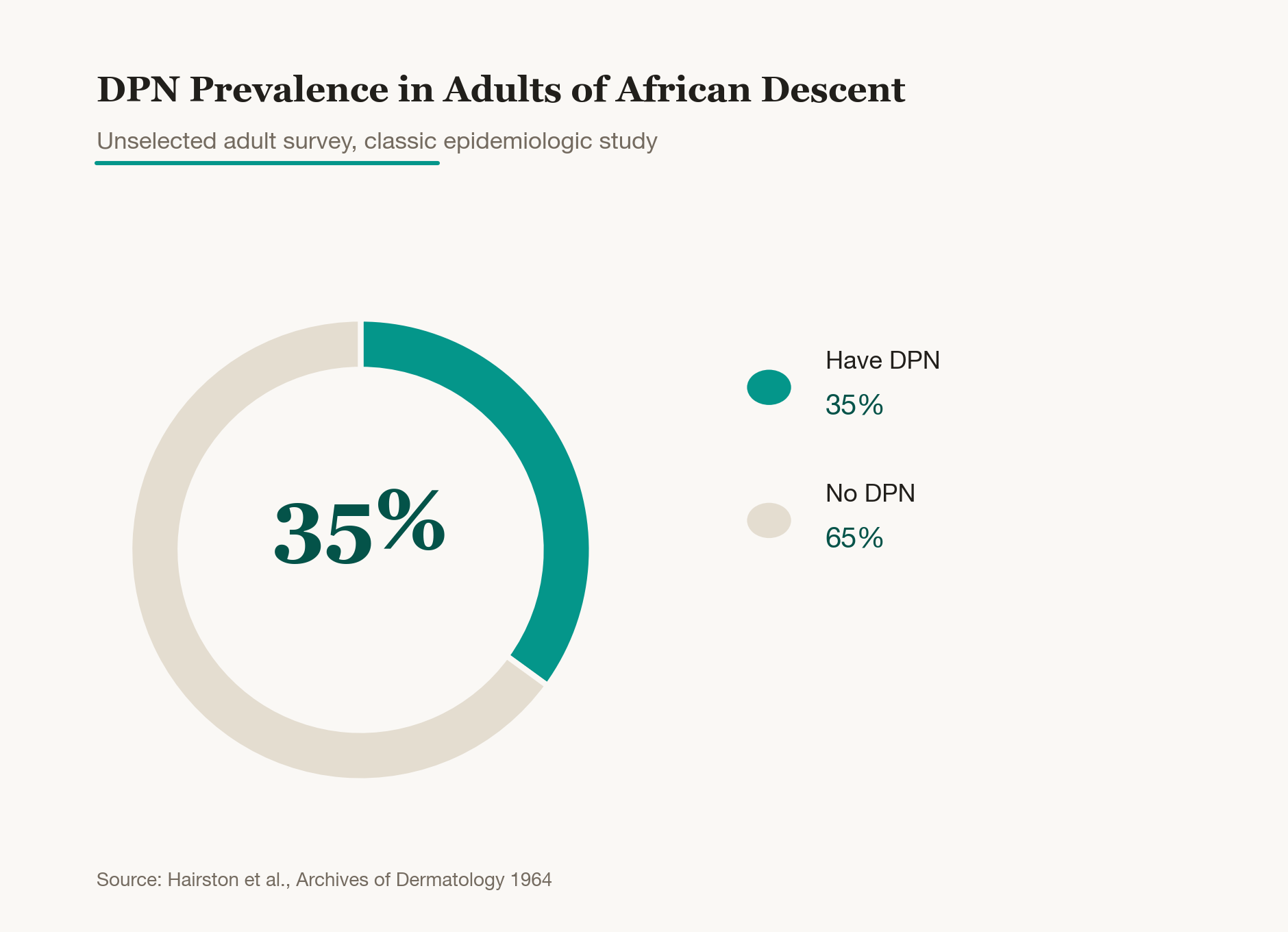
DPN typically first appears as one or two small bumps in the late teens or twenties, and both the number and size tend to grow with age.
This traces back to how the skin's natural renewal balance gradually shifts over the years. In youth, the rate at which epidermal cells form and shed stays in balance, but with age, newly made cells increasingly fail to clear away completely, leaving small pockets that build up in localized spots. It's a bit like cleaning out an old drawer that never quite empties out, with a little clutter always settling into one corner.
Family history plays a well-documented role too. If a parent or sibling has DPN, the odds of developing it yourself go up, which fits with the idea that the genetic factors controlling how fast and how skin cells grow tend to run in families.
How to tell it from moles and skin cancer
DPN often gets mixed up with moles, but the two form through entirely different mechanisms.
- Moles (melanocytic nevi): These form when pigment-producing cells themselves cluster together. The issue is the number and location of the cells that make pigment, which puts moles on a completely different starting point from DPN.
- DPN: This is epidermal tissue growing outward in a localized spot. It's a change in the structure of the epidermis itself, not an overgrowth of pigment cells.
- Cancer-related lesions: If a bump is asymmetric, unevenly colored, or growing quickly, it may not be DPN at all and needs to be checked to rule out something else. DPN, by contrast, tends to look consistent and changes extremely slowly.
If a new bump suddenly grows larger or develops an irregular shape, don't assume it's DPN. Get it checked by a dermatologist. If a spot has looked exactly the same for years, it's usually nothing to worry about, but having it formally confirmed once tends to bring more peace of mind than trying to judge it by eye alone.
Removal methods if you want them gone
DPN is harmless and doesn't need to be removed for medical reasons. Still, plenty of people find it bothersome and want it gone.
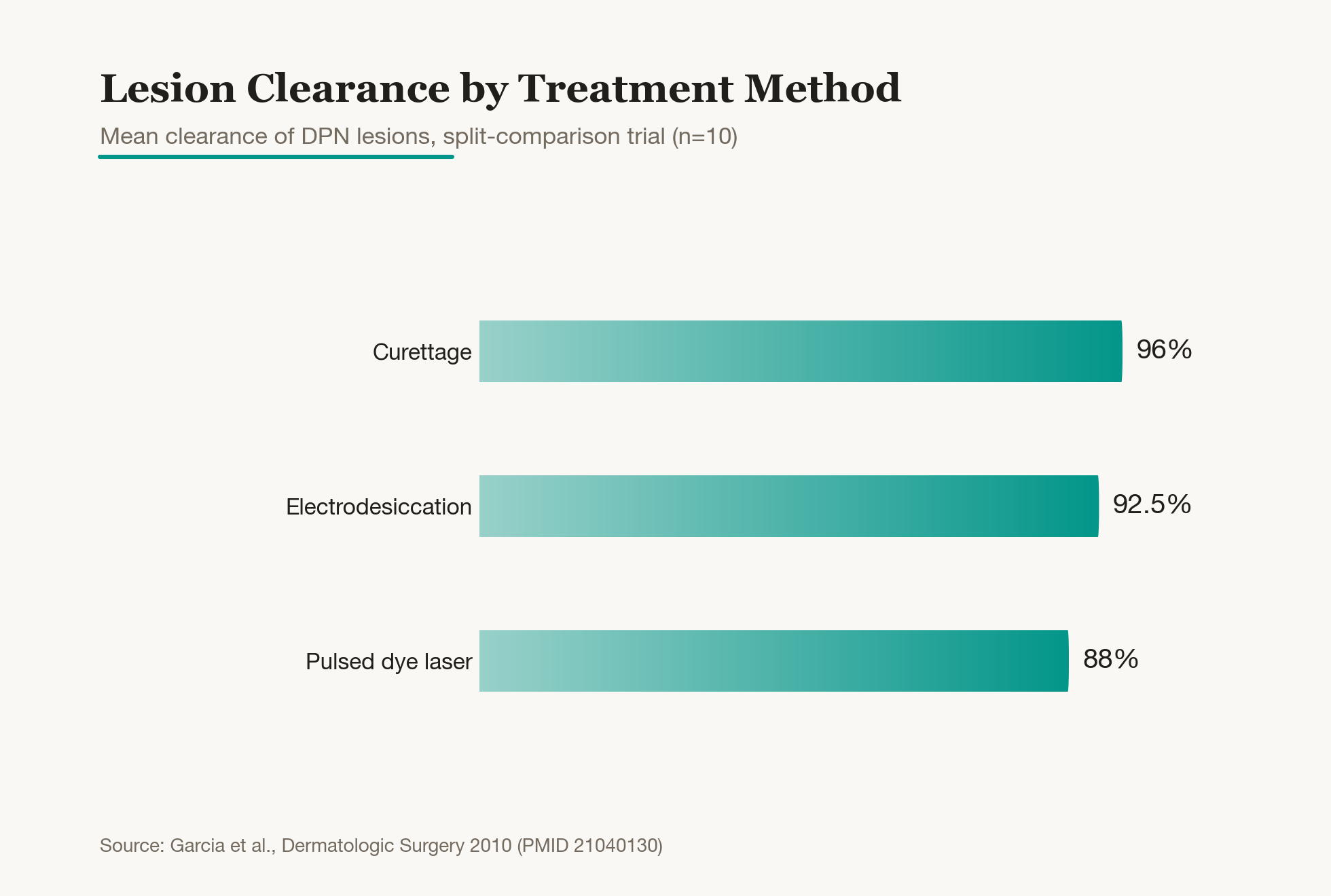
The goal of any removal method is simply to clear away that localized patch of epidermal tissue. The most common approaches are electrodesiccation (using a mild electric current to burn away the tissue), cryotherapy (freezing the tissue off with liquid nitrogen), and lasers that target the specific pigment inside the bump.
With lasers, the melanin pigment inside the bump absorbs a specific wavelength of light, converts it into heat, and that heat breaks down the tissue. Electrodesiccation and cryotherapy work differently, physically destroying the tissue so it falls away on its own. The methods differ, but the end goal is the same: clearing out that localized cluster of built-up cells.
Can color remain where they were removed?
After DPN removal, the treated spot sometimes ends up darker than before, or in other cases turns pale instead.
This happens because people with deeper skin tones tend to have pigment-producing cells that react more strongly during the healing process. When tissue is damaged, melanin production temporarily ramps up as part of the recovery response, and this reaction tends to be more pronounced the deeper the skin tone. In the opposite scenario, if the pigment cells themselves get damaged during healing, that spot can end up lighter instead.
If you're considering DPN removal, it helps to keep the following in mind.
- Adjusting treatment intensity: Trying to clear everything in one aggressive session can trigger a stronger pigment reaction during healing, so a gentler approach spread across multiple sessions is generally recommended.
- Sun protection: Sun exposure while the treated area is healing can stimulate melanin production and worsen pigment changes, so it needs real attention.
- A gradual approach for multiple bumps: Rather than clearing everything at once, spacing treatments out over several sessions gives each area enough time to fully recover, which is said to lower the risk of pigment-related side effects.
Since DPN itself isn't a dangerous change, taking things slow and pacing treatment to match your skin's recovery speed tends to produce a cleaner result in the end.
References
Korean Dermatological Association, American Academy of Dermatology (AAD), and Ministry of Food and Drug Safety (MFDS).
Was this helpful?
About this article
Written by a practising aesthetic physician and intended for general education — not a substitute for individual medical advice.
Read next
Milia Under the Eyes: Causes and Removal, and Why Squeezing Doesn't Work
Milia are the small white bumps that show up around the eyes and just won't budge no matter how you squeeze them. Here's an easy breakdown of how milia actually form, how they differ from acne, and why doctors remove them with a needle or laser instead.
By Dr. Lee

Flat Wart Causes and Symptoms: Why They Spread When Squeezed, and Treatment
Flat warts are a viral skin condition, so picking or scratching at them doesn't clear them up, it spreads them further. Here's why that happens, how to tell them apart from moles or acne, and the logic behind removal and preventing recurrence.
By Dr. Kim
Blackheads: Causes, Care and Is It Okay to Squeeze Them by Hand?
Blackheads aren't trapped dirt. They're a plug of sebum and dead skin cells inside the pore that turns dark through oxidation. Here's why extracting them often leaves marks, and which ingredients actually help, explained through the science behind it.
By Dr. Kim